
Direct Answer: A fixture isn’t just a light source — it’s the visual anchor of a room. Scale, finish, and placement determine whether a space feels intentional or just lit.
Most homeowners spend weeks choosing paint colors, countertop materials, and cabinet hardware — then pick a light fixture in about four minutes online. And that’s exactly why so many rooms feel almost right but not quite.
On the Monterey Peninsula, where homes in Carmel-by-the-Sea, Pacific Grove, and Pebble Beach carry serious design investment, the wrong fixture can undercut an otherwise beautiful room. Scale that’s off by a few inches, a finish that clashes with the hardware, or a shade that kills the warmth — these aren’t small details. They’re the things people notice without knowing why a room feels flat.
This article focuses on the two things that matter most when choosing a fixture: scale and proportion, and finish in context. Get those right, and everything else starts to fall into place.
Why Scale Is the First Decision — Not the Last
Most people choose a fixture based on style first and then hope the size works out. That’s backwards. Scale is the decision that makes or breaks a fixture in a real room.
A chandelier that’s too small above a dining table doesn’t just look wrong — it makes the whole room feel unfinished, like furniture that didn’t quite arrive. Too large, and it crowds the space and draws attention for the wrong reasons.
There are simple starting points for sizing:
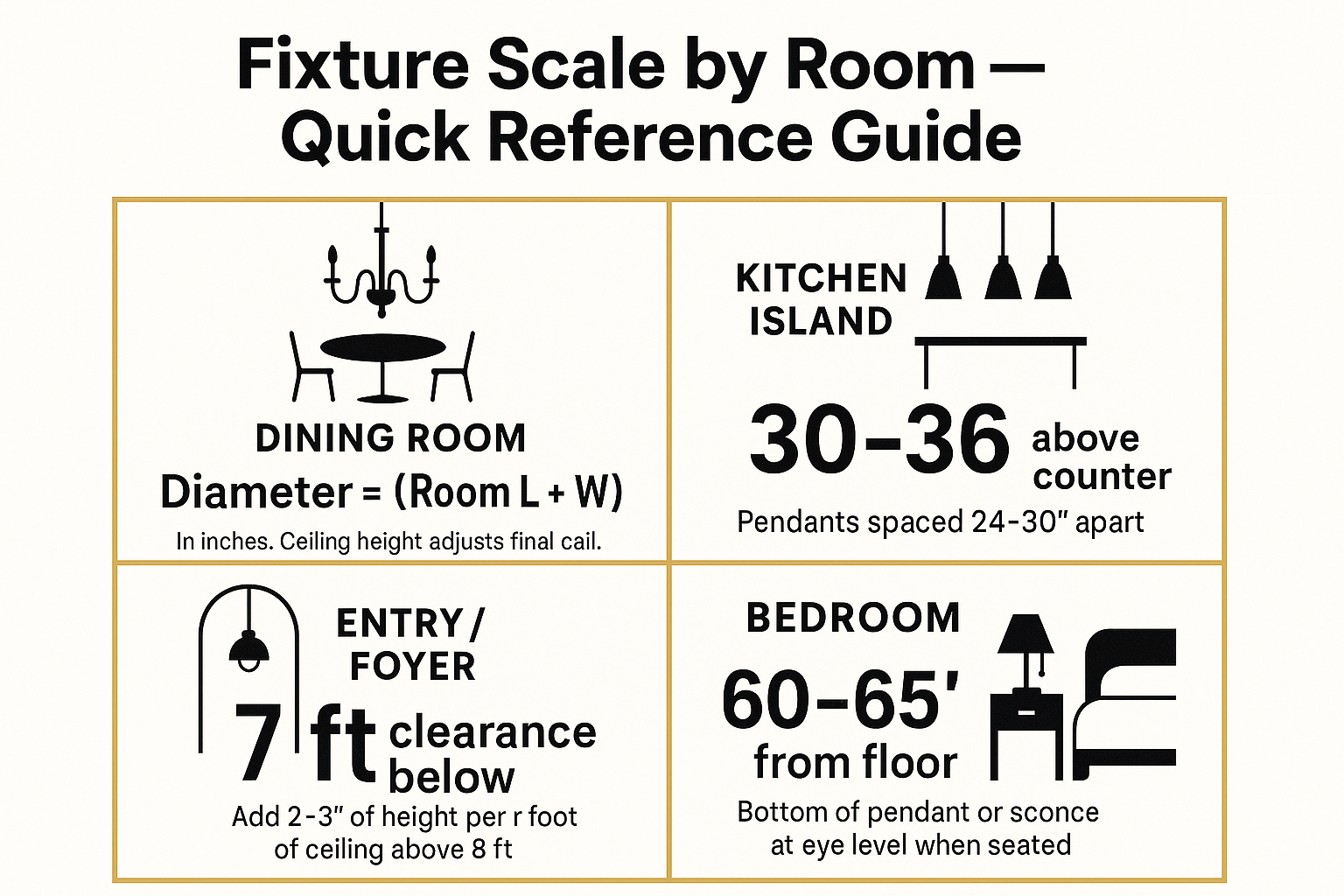
- Dining room chandeliers: The fixture diameter (in inches) should roughly equal the table length and width added together, then divided by two. A 36″ x 72″ table typically calls for a chandelier around 54″ wide — but ceiling height and room proportions matter too.
- Entryways and foyers: A fixture hung in a two-story entry should generally leave 7 feet of clearance below it for comfortable traffic flow.
- Kitchen islands: Pendants over an island should be spaced 24 to 30 inches apart and hung 30 to 36 inches above the countertop.
These are starting points, not rules. A vaulted ceiling in a Carmel Valley ranch home behaves very differently than a flat 8-foot ceiling in a Pacific Grove bungalow. How lighting actually shapes a room is a longer conversation than most online guides let on — and the proportions of the fixture are usually where it begins.
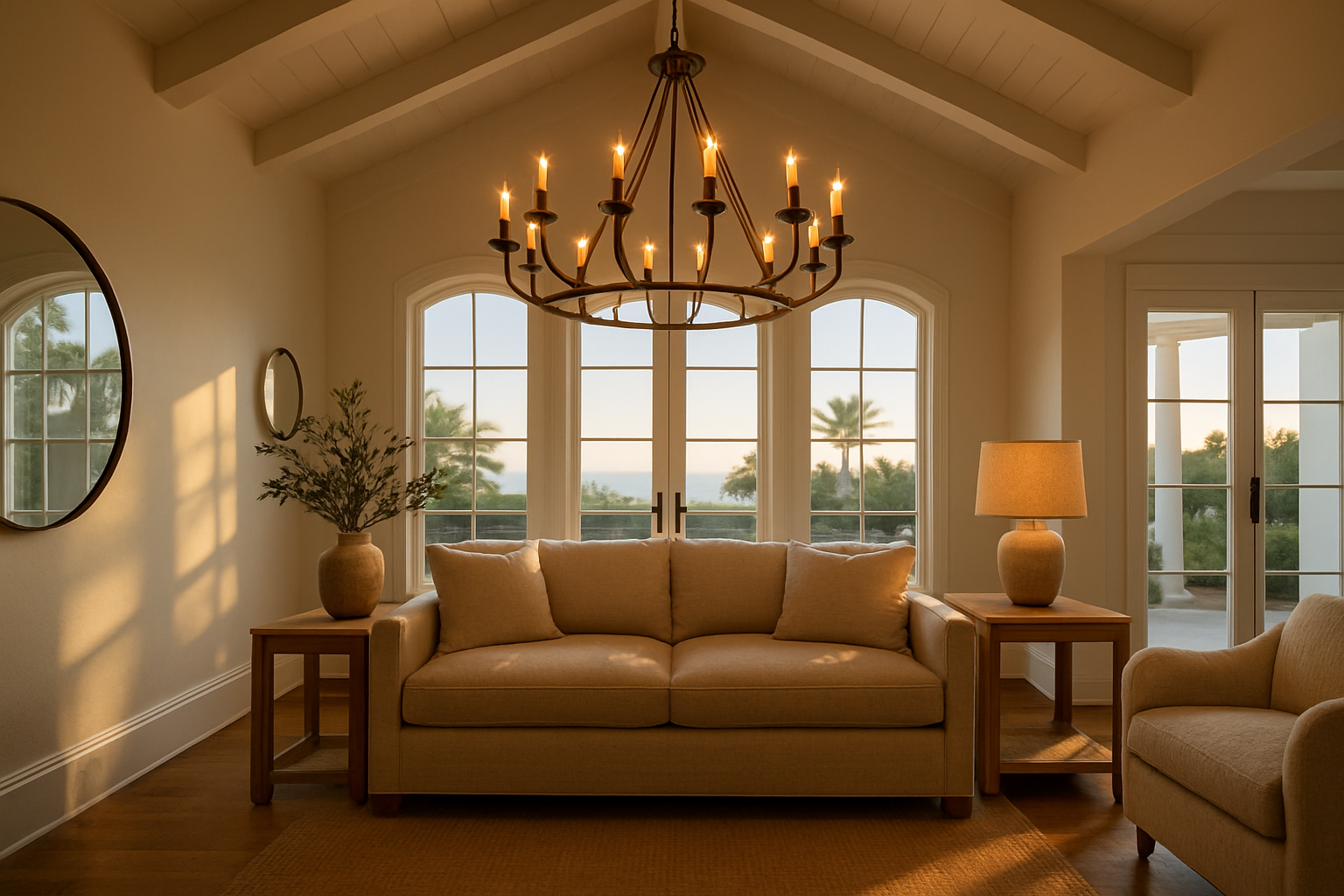
Finish: The Detail That Either Pulls a Room Together or Doesn’t
Fixture finish is where a lot of otherwise well-planned rooms fall apart. It’s not that the finish is ugly — it’s that it doesn’t belong in that room, with those other finishes.
On the Monterey Peninsula, coastal homes tend to lean toward finishes that hold up visually against natural textures — whitewashed wood, stone, linen, and aged metals. A polished chrome fixture in that context looks like it wandered in from a hotel bathroom. A brushed brass or oil-rubbed bronze fixture reads as grounded and intentional.
Here’s how to think about finish pairing:
- Brushed nickel: Works in almost any modern or transitional room; reads as neutral without being cold
- Matte black: Strong contrast finish — best in rooms with white or light walls, pairs well with open shelving and black hardware
- Antique brass or aged gold: Warm and rich; works well in spaces with warm wood tones, leather, or layered textiles
- Oil-rubbed bronze: A classic coastal finish, especially in craftsman or traditional-leaning interiors
- Polished nickel vs. polished chrome: Polished nickel has a slightly warmer tone and ages more gracefully; chrome runs cool and hard
You don’t have to match every metal in a room exactly. But the finishes should be in conversation with each other — similar undertones, complementary warmth. Brushed nickel vanity lighting is a good example of a finish that works across a wide range of bathroom styles precisely because it doesn’t try to compete with other elements in the room.
The fixture shade also plays into this. A linen drum shade warms a space differently than a clear glass globe or a metal cone — and each reads as part of the room’s overall material story. Choosing the right shade for a fixture is worth thinking through before you commit to a fixture body.
Fixture Scale at a Glance: Quick Reference by Room Type
Use this quick reference when sizing fixtures for the most common rooms in a home.
What Fixture Type Actually Does to a Room
Beyond scale and finish, the type of fixture you choose shapes how light behaves in the room — and that behavior determines how the space feels at 7pm when you’re in it.
A flush mount distributes light broadly and evenly. That’s practical for hallways and utility rooms, but it tends to flatten a space visually. There’s no shadow play, no depth — just illuminated.
A pendant or chandelier does something different. It concentrates light, creates a visual focal point, and naturally draws the eye upward. That’s why a well-chosen chandelier can make an average-height ceiling feel taller — it’s a perspective trick that works because of where the light pools and where the shadows fall.
Wall sconces work horizontally. They fill the mid-zone of a room where overhead fixtures miss and table lamps don’t reach. In a dining room or living room, sconces flanking a fireplace or artwork add dimension that makes the room feel finished rather than just lit.
This layered approach — combining ambient, task, and accent sources — is what separates rooms that feel designed from rooms that just have lights in them. Layered kitchen lighting in Carmel homes is a strong example of what this looks like in practice: pendants over the island, recessed lights for general work light, and under-cabinet strips for the counter itself.
None of those layers is optional. Each one does something the others can’t.
Fixture Type vs. What It Actually Does in a Room
Every fixture type serves a specific purpose. Choosing the wrong type for a room’s function is one of the most common mistakes homeowners make.
| Fixture Type | Where It Works Best | What It Does to the Space |
|---|---|---|
| Chandelier | Dining rooms, entries, living rooms | Creates focal point, adds vertical drama, concentrates light below |
| Pendant | Kitchen islands, reading nooks, bedside | Directs task light downward, anchors a zone within a larger room |
| Flush / Semi-Flush Mount | Hallways, closets, low-ceiling rooms | Broad ambient coverage, minimal visual presence |
| Wall Sconce | Flanking beds, fireplaces, artwork, hallways | Mid-level fill light, adds depth and dimension |
| Recessed Downlight | Kitchens, bathrooms, transitional spaces | Clean overhead coverage without visual clutter |
| Table / Floor Lamp | Living rooms, bedrooms, reading corners | Portable accent and task light, adds warmth at eye level |
The One Specification Most Homeowners Overlook
You can choose the right fixture, the right finish, and the right size — and still get the room wrong if you ignore color temperature.
Color temperature is measured in Kelvins (K). Lower numbers mean warmer, more amber light. Higher numbers mean cooler, bluer light. A 2700K bulb reads like candlelight. A 4000K bulb reads like a dentist’s office.
For most living spaces — bedrooms, dining rooms, living rooms — 2700K to 3000K is the sweet spot. Kitchens and bathrooms where you need to see clearly can go up to 3000K, but rarely higher.
This matters locally for another reason. Carmel-by-the-Sea has specific exterior lighting ordinances that cap residential exterior fixtures at 3000K and restrict lumen output. If you’re selecting fixtures for a Carmel home’s outdoor areas, color temperature isn’t just an aesthetic decision — it’s a compliance issue. Always verify current requirements with the City of Carmel or a licensed contractor before finalizing exterior fixture selections.
What color rendering index means in lighting is a related spec worth understanding, especially if you’re choosing fixtures for spaces where color accuracy matters — like a bathroom vanity where you’re applying makeup, or a kitchen where you’re judging the color of food.
Frequently Asked Questions About Choosing the Right Light Fixture
How do I know if a fixture is the right size for my room without buying it first?
The old trick is to cut craft paper or tape newspaper to the rough dimensions of the fixture and hold it in place. It feels low-tech, but it works. For a chandelier, you’re checking how it sits relative to the table below and the ceiling above — and whether the visual weight of the fixture feels proportionate to the room. For pendants over an island, hang a piece of string at the intended height and step back. Scale problems become obvious fast when you can see them in the actual space.
Do all my fixtures need to match throughout the house?
No — and trying to match everything perfectly often makes a home feel like a showroom floor rather than a lived-in space. What should be consistent is the finish family and the general design direction. You can mix a brass chandelier in the dining room with brass sconces in the hallway and a different brass pendant in the kitchen, and the rooms will feel connected without being identical. Where it tends to go wrong is when finishes have different undertones — warm brass in one room and cool chrome in the next feels disconnected.
What’s the difference between a fixture that comes with bulbs and one that doesn’t?
Fixtures sold without bulbs give you control over the light output and color temperature — which is a good thing. You choose the bulb that fits your space. Fixtures with integrated LEDs have the light source built in, which means you can’t swap it out later. Integrated LED fixtures tend to be more energy-efficient, but make sure you know the color temperature and lumen output before you buy, because you’re living with those specs for the life of the fixture.
I have 8-foot ceilings. Can I still use a chandelier?
Yes, but size and hanging height matter more in that scenario. You’ll want a fixture with a smaller vertical profile — something that doesn’t hang more than 12 to 18 inches below the ceiling in a low room. Many chandelier styles come in multiple sizes, and a smaller-scale version of a dramatic fixture can work beautifully in a tighter space. The mistake is choosing a chandelier designed for a 10-foot ceiling and forcing it into an 8-foot room.
Does fixture placement matter as much as the fixture itself?
Placement is at least as important as the fixture you choose. A chandelier hung too high over a dining table loses its connection to the surface below — it looks like it’s floating rather than anchoring the space. A pendant hung too low becomes a hazard. Recessed lights placed without a plan leave dark corners regardless of how many you install. Placement decisions — especially for whole-room or multi-fixture layouts — are worth thinking through before anything goes into a ceiling.
Ready to See What the Right Fixture Actually Looks Like in Person?
The Home Lighter at 2034 Sunset Drive in Pacific Grove has been helping homeowners across the Monterey Peninsula — from Carmel-by-the-Sea to Pebble Beach to Carmel Valley — find fixtures that fit both the room and the budget since 1969. Walk-ins are always welcome, and Greg and Tammy are on the floor to answer the kinds of questions that don’t have easy answers online. For more involved projects, appointments are available — just call (831) 655-5500 to set one up.