
Direct Answer: To replace a shade on an antique floor lamp, you need four things: top ring diameter, bottom diameter, slant height, and fitter type. The fitter matters most, since types are not interchangeable.
Some lamps are furniture. Others came from a grandmother, survived three moves, and still sit in the same corner of the living room where they always have.
One Monterey County homeowner wrote in twice in a single afternoon about a shade for an antique floor lamp passed down from her husband’s grandmother. She was worried, and she was right to be. Getting a replacement shade wrong on a lamp like that is not just a design miss.
The good news is that shade replacement is a solvable problem with a short list of specifics. This guide covers the four measurements that decide whether a shade fits, the fitter types that trip almost everyone up, and how shade shape changes the light the lamp actually gives you.
The Four Measurements That Decide Whether a Shade Fits
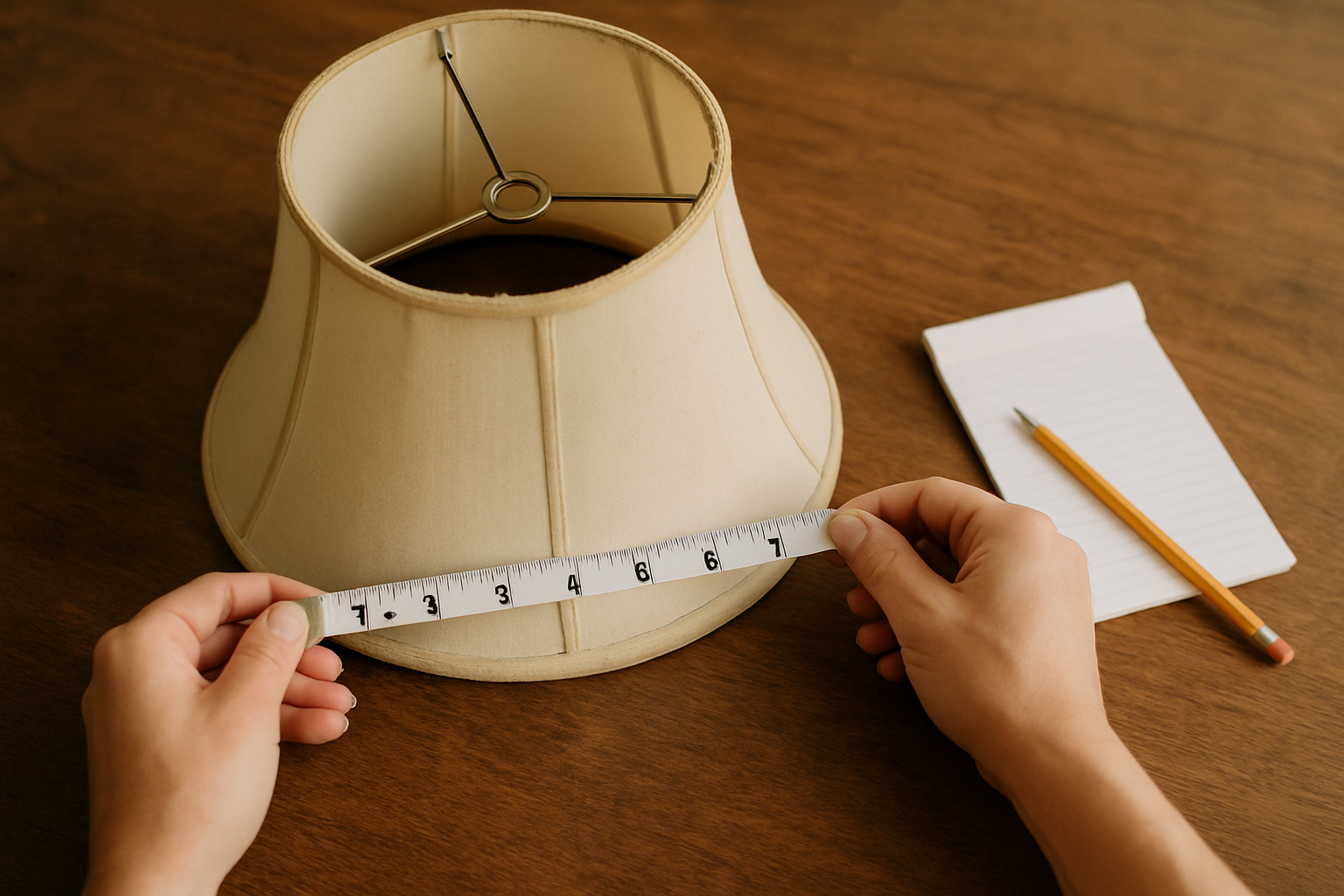
Before you shop, measure. A shade that looks perfect in a photo is useless if the numbers are off by an inch.
Here is what to write down:
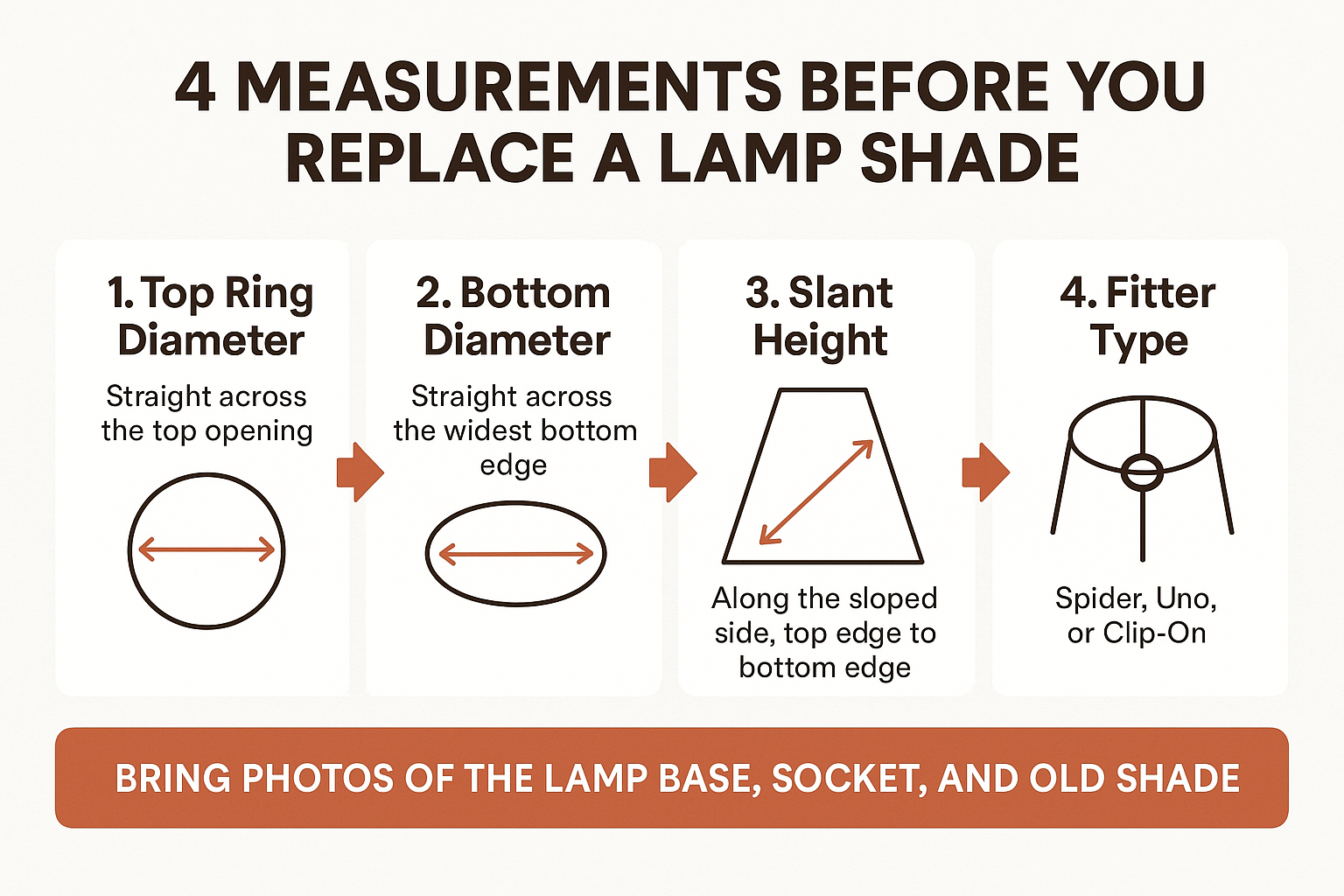
- Top ring diameter. Measure straight across the opening at the top of the shade, edge to edge.
- Bottom diameter. Same measurement across the widest point at the bottom opening.
- Slant height. Run the tape along the sloped side, from the top edge down to the bottom edge. This is not the same as the vertical height, and confusing the two is a common mistake.
- Fitter type. The hardware that connects the shade to the lamp. More on this below, because it is where most replacements fail.
Also measure the harp if your lamp has one. That is the metal loop that arches over the bulb. Harps come in standard sizes, usually stated in inches, and swapping to a taller or shorter harp is an easy way to fix a shade that sits an inch too high or too low.
Snap photos too. A picture of the lamp base, the socket area, and the old shade from the side gives anyone helping you far more to work with than measurements alone. Our guide on how to find a replacement lamp shade that actually fits walks through the same steps with more detail.
Fitters: The Part Nobody Thinks About Until It Does Not Work
The fitter is the hardware inside the shade that holds it onto the lamp. Three main types show up on floor lamps, and they are not interchangeable.
- Spider fitter. The most common. A wire frame with arms that meet in a small center ring. It rests on top of the harp and is held down by a finial screwed on above it.
- Uno fitter. A ring built into the top of the shade that either threads onto the socket or slides over it under the bulb. Uno shades need no harp at all. Older bridge-arm and downbridge floor lamps often use these.
- Clip-on fitter. A wire clip that grips the bulb itself. Sized for either standard or candelabra bulbs, and the two sizes do not swap.
A gorgeous shade with a spider fitter will not go on a lamp built for an uno. No amount of proportion, color, or fabric quality fixes that.
One more thing worth checking on an older lamp: the socket and cord. Cloth-wrapped wiring from the mid-century era gets brittle, and coastal humidity on the Peninsula does not help. Rewiring is work for a licensed electrician or a lamp repair specialist, not something to attempt because the shade is off anyway.
Fitter Types at a Glance
Use this to identify what your lamp already has before you start shopping.
| Fitter Type | How It Attaches | Commonly Found On |
|---|---|---|
| Spider | Sits on a harp, secured by a finial | Most table and floor lamps made after the 1950s |
| Uno | Threads onto or slips over the socket, no harp | Bridge-arm and downbridge floor lamps, many antiques |
| Clip-on | Clips directly onto the bulb | Small accent lamps, candelabra sconces, some vintage pieces |
Shape Changes the Light, Not Just the Look
Proportion gets all the attention. Shape decides what the lamp actually does in the room.
- Drum shades have straight sides with the same top and bottom diameter. Light goes up and down in roughly equal amounts, which suits ambient light in a living room.
- Empire shades taper, narrow at the top and wide at the bottom. They push more light downward, which is why they work well over a reading chair.
- Bell shades flare outward with a curved profile. They spread light softly and read as more traditional, which often suits an older lamp better than a modern drum.
Material matters just as much. A fully opaque shade concentrates light straight down into a tight pool. A translucent linen or silk shade lets light pass through the sides, filling the room and lifting the corners.
On a foggy Pacific Grove afternoon when the light outside goes flat and gray, that difference is not subtle. If the original shade was a translucent fabric and you replace it with an opaque one, the room will feel darker even though the bulb has not changed.
Lining changes things too. A white lining bounces cool, bright light. A gold or champagne lining warms it. Our expert guide to shades for light fixtures covers material and lining choices in more depth, and the drum shade style guide is useful if you are leaning that direction.
What to Measure Before You Shop
Gather these four numbers first. Everything else in the process depends on them.
Why Antique Floor Lamps Are Hard to Match at a Hardware Store
There is a reason people with older lamps end up calling a lighting showroom instead of driving to a big-box aisle.
Floor lamps built decades ago used sizes and fitters that are no longer standard. Wide bottom diameters, uno fitters, unusual slant heights, and silk or parchment materials that mass retailers stopped stocking years ago.
What tends to be different at a specialty showroom:
- A wider spread of sizes, including the in-between dimensions older lamps need
- All three fitter types on hand, not just spider
- Materials beyond basic polyester, including linen, silk, and paper
- Access to special-order and custom shade sourcing when nothing off the shelf fits
Cost depends almost entirely on size, material, and construction. Simple machine-made shades sit at the low end of the market, while hand-sewn silk or a custom size runs considerably higher. Prices move, so it is worth confirming current numbers directly with a showroom rather than relying on a figure from a blog post.
One last note on bulbs. Modern LED bulbs run far cooler than the incandescent bulbs an antique lamp was designed around, which is easier on delicate silk and paper shades. The U.S. Department of Energy has a plain overview of lighting choices and energy use if you want the background. For a reading lamp specifically, our notes on choosing bulbs for desk and task lamps apply to floor lamps too.
Frequently Asked Questions About Antique Lamp Shade Replacement
Can I bring my old shade in to match it?
Yes, and it is the best thing you can do. Bringing the original shade, or the whole lamp if it is manageable, removes all the guesswork about fitter type and proportion. Walk-ins are welcome, and appointments are available for more involved projects.
What if the frame is fine but the fabric is torn?
Recovering an original frame is sometimes possible and can be the right call when the shade is original to a sentimental lamp. It is a specialty service, so the first step is having someone look at the frame condition and tell you honestly whether it is worth doing.
How do I know if my shade is too big or too small for the lamp?
A common starting point for floor lamps is a shade with a bottom diameter close to the height of the lamp base body, with the shade covering the socket and harp completely when viewed from a standing position. If you can see the bulb or socket from where you normally sit, the shade is too small.
Does The Home Lighter repair or rewire old lamps?
No. The showroom handles fixture and shade selection, sourcing, and design guidance. Any wiring, socket replacement, or installation work should go to a licensed electrician or a dedicated lamp repair specialist.
How long does a special-order shade take?
It depends on the manufacturer and whether the shade is a stock size or custom. Special orders commonly run several weeks, and custom work takes longer, so it is smart to start early if the lamp is meant for a specific room in a remodel.
Have a Lamp Worth Getting Right?
Shade replacement on a piece with history deserves more than a guess and a return label. Greg and Tammy at The Home Lighter invite Monterey County homeowners to bring the lamp, the old shade, or just a few photos and measurements by the showroom at 2034 Sunset Drive in Pacific Grove. Walk-ins are welcome, appointments are available for larger projects, and questions are always fine by phone at (831) 655-5500.