
Direct Answer: Most flicker and buzz comes from a mismatch between an older dimmer built for incandescent bulbs and the electronic driver inside an LED fixture. The dimmer, driver, and fixture have to match.
You turn the dial down and the light shudders. Or the fixture hums like a wasp in a jar. Or it dims beautifully to about halfway, then drops straight to off with no warning.
This is one of the most common calls that comes in from Monterey Peninsula homeowners, and it almost never means the fixture is broken. In most cases it is a dimmer compatibility problem between the wall control and the electronics inside the LED fixture.
One homeowner in Carmel Valley reached out after her electrician pulled a dining room chandelier down from the ceiling because it needed a new transformer with a dimmer. The fixture was fine. The controls were the issue, and the whole room sat dark while she sorted it out.
Can you use any dimmer with LED bulbs and fixtures?
No. And this is the single biggest reason older homes on the Peninsula have flickering fixtures.
An old dimmer was designed for an incandescent bulb, which behaves like a simple resistor. Chop the power and the filament just glows dimmer. Nothing complains.
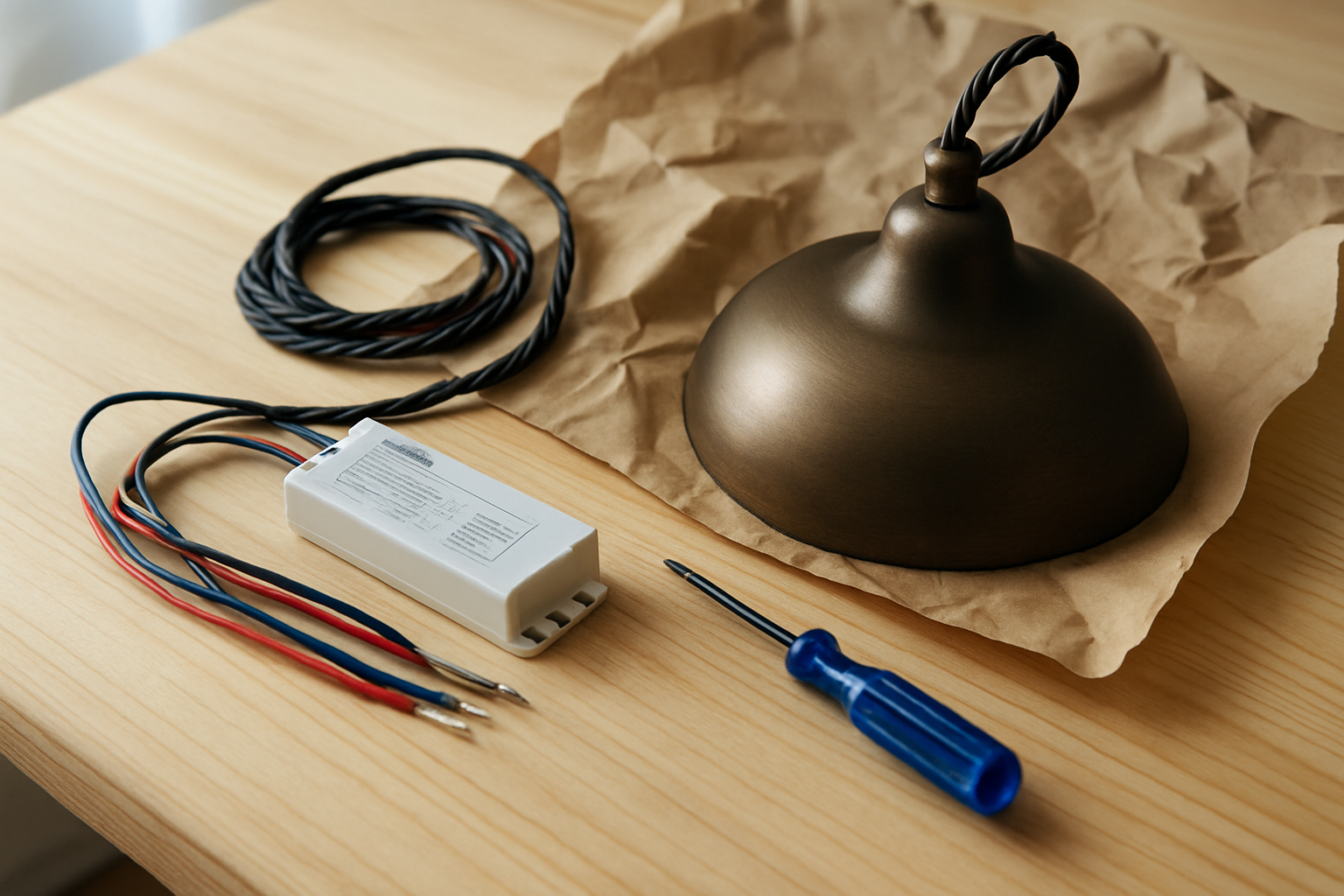
An LED fixture has a driver inside it, a small piece of electronics that converts household power into the low voltage the diodes need. When an old dimmer chops the power, the driver has to guess what to do with what is left.
The other problem is load. Many older dimmers have a minimum wattage they need to see, often somewhere in the 40 to 60 watt range depending on the model. Swap three 60 watt bulbs for three 9 watt LEDs and the dimmer is suddenly running on a fraction of the load it was designed for.
That is why so many 1920s Pacific Grove cottages and mid-century Monterey homes develop flicker the year after an LED swap. Nothing failed. The math just changed underneath the old control.
What Each Symptom Is Actually Telling You
Different symptoms point to different mismatches. Here is how to read what your fixture is doing before anyone touches a wire.
| What you see or hear | Likely cause | First thing to check |
|---|---|---|
| Flicker at low dim levels only | Dimmer is below its minimum load, or the driver cannot hold a steady output that low | Total LED wattage on the circuit versus the dimmer’s rated minimum |
| Buzzing from the fixture | Driver reacting to the chopped waveform from a leading-edge dimmer | Whether the dimmer is rated for LED and matches the driver type |
| Buzzing from the wall switch itself | Dimmer is overloaded or poorly matched to the load | Have a licensed electrician evaluate it before you keep using it |
| Only dims to about 50 percent, then cuts off | Driver does not support a full dimming range | The fixture spec sheet, not the dimmer |
| Faint glow when switched off | Leakage current through the dimmer keeping the driver partly awake | Dimmer type and whether the circuit has a neutral wire |
Why swapping the dimmer does not always fix it
Plenty of homeowners buy an LED-rated dimmer, install it, and get the same flicker. That is deflating, and it is common.
Some LED fixtures dim poorly no matter what control is on the wall, because the driver inside them was never built for a deep dimming range. A driver that bottoms out at 20 percent is going to bottom out at 20 percent with any dimmer you pair it with.
This is where the spec sheet earns its keep. When you are shopping for a fixture that will live on a dimmer, look for:
- A stated dimming range, written as something like 100 to 5 percent or 100 to 1 percent
- A named list of compatible dimmer models by manufacturer and part number
- The driver type, usually TRIAC/ELV for residential or 0-10V for commercial
- Whether the driver is integral to the fixture or remote and replaceable
- Minimum and maximum load per dimmer
When a product page has none of that, treat the silence as information. Lines like Hinkley, Visual Comfort, and Hubbardton Forge generally publish dimmer compatibility because designers and electricians ask for it.
If you want the wider picture on controls before you shop, home lighting controls explained walks through dimmers, scenes, and smart systems in plain terms.
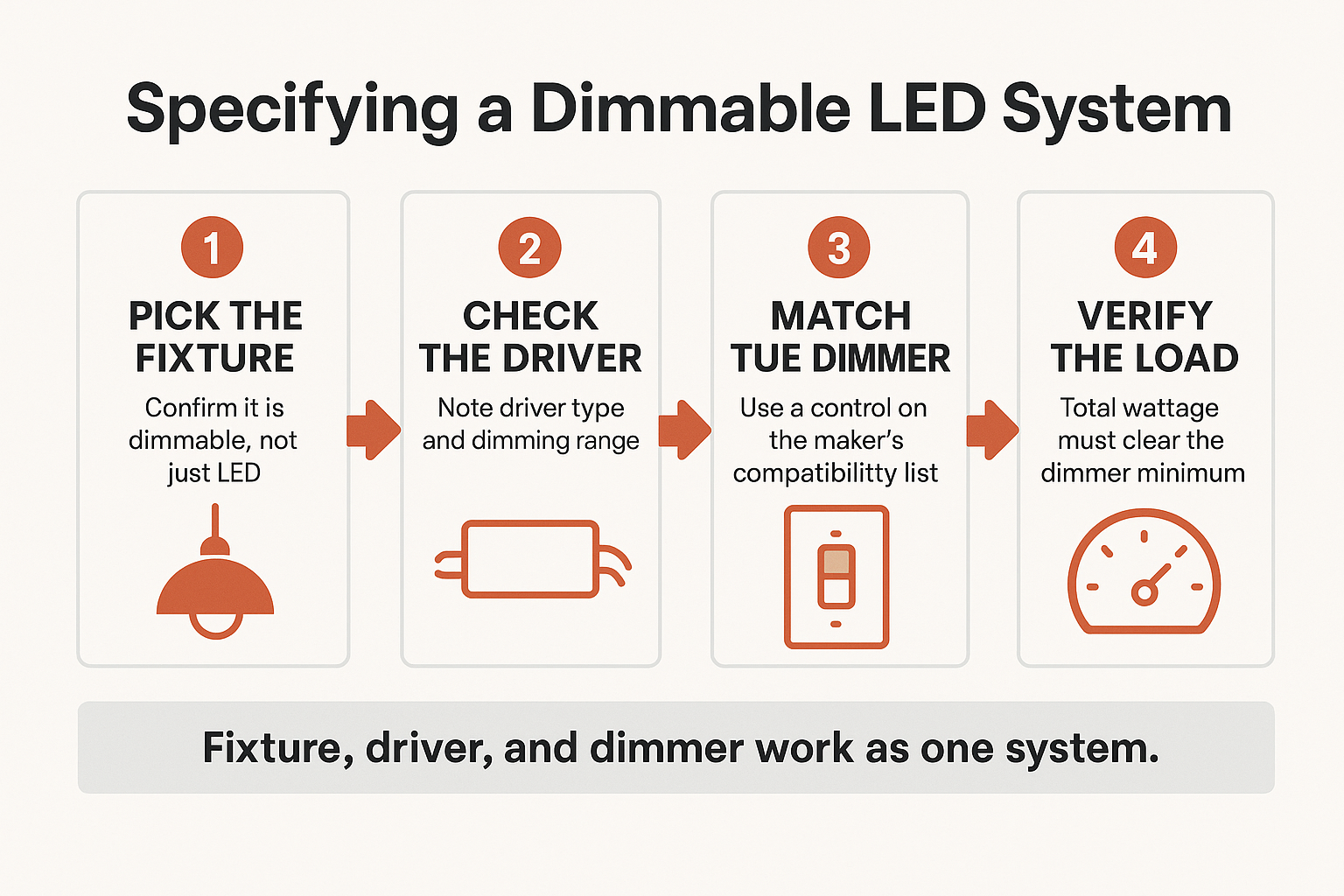
How to Spec a Dimmable LED System That Actually Works
Getting this right is a four-step sequence, and the order matters more than most people expect.
Will a smart dimmer solve the problem?
Sometimes. Not always.
A good smart dimmer helps in two real ways. Most of them let you set a low-end trim, which raises the floor so the fixture never drops into the range where it flickers. Many are also built for very low loads, which solves the minimum wattage issue outright.
What a smart dimmer cannot do is improve a driver that was never designed to dim smoothly. If the fixture is the weak link, adding a nicer control just gives you an expensive way to watch the same flicker.
One more wrinkle worth knowing before you buy: most smart dimmers need a neutral wire in the switch box. Older Monterey and Pacific Grove homes frequently do not have one at the switch, and finding out mid-project is a frustrating way to lose a weekend. A licensed electrician can confirm that in a few minutes.
What does Title 24 require for dimming in a Monterey County remodel?
California’s Title 24 energy standards, with the current update effective January 1, 2026, include dimming capability for lighting in habitable rooms on permitted new construction and major remodels.
The practical result for a homeowner in Carmel or Pebble Beach pulling permits is that dimming is not an upgrade you can skip. So the fixture, the driver, and the dimmer all need to be confirmed as a working system before selections are final, not after the drywall is up.
The good news is that the code requirement and the design goal point the same direction. A properly matched dimmable LED system passes inspection and looks better in the room. The Department of Energy’s overview of LED lighting covers the basic behavior of these systems if you want the technical background.
Exterior work adds one more layer. Carmel-by-the-Sea caps residential exterior fixture color temperature at 3000K and limits lumen output, so exterior selections need to clear that before dimming ever enters the conversation. Verify current requirements with your local building department or your contractor, since the details do change.
For more on how the state rules touch interior selections, see this guide to interior fixtures and Title 24 rules.
Frequently Asked Questions About Dimmer Compatibility and LED Fixtures
Is a buzzing dimmer a fire hazard?
It can be a warning sign, so do not ignore it. A buzz coming from the wall switch itself often means the dimmer is carrying more load than it is rated for, or that it is poorly matched to what is on the circuit. Turn the circuit off and have a licensed electrician evaluate it. A faint hum from the fixture is usually a driver and dimmer mismatch rather than a safety issue, but an electrician can tell the two apart in person.
What does 0-10V dimming mean, and does my house need it?
0-10V dimming uses a separate pair of low voltage control wires running to the driver, which tells the fixture exactly how bright to be. It is common in commercial and architectural work because it dims very smoothly and predictably. Most homes do not have it, since it requires that extra wiring run. If a fixture you like is 0-10V only, your electrician needs to know before rough-in, not after.
My electrician says my chandelier needs a new transformer with a dimmer. Can I just buy that part?
Often yes, and it happens more than you would think. Low voltage chandeliers use a transformer or driver that can fail or turn out to be non-dimming, and on many fixtures that component is replaceable without touching the fixture itself. Bring the model number, a photo of the existing component, and a photo of the dimmer on the wall. Matching the right part is usually a short conversation once someone can see what you are working with.
Can I put LED bulbs in an old chandelier that is already on a dimmer?
You can, but check two things first. Use bulbs specifically marked dimmable, since a standard LED bulb on a dimmer will flicker or fail early. Then add up the total wattage and compare it to your dimmer’s minimum load, because a chandelier that went from 300 watts to 45 watts may now be below what the old control needs to run cleanly.
What does an LED-compatible dimmer cost?
Pricing varies by brand and features, but many Monterey County homeowners find that quality LED-rated dimmers fall somewhere in the range of about $25 to $70 per switch at local suppliers, with smart dimmers running higher. Installation labor is separate and depends on your electrician. If the fixture itself needs a replacement driver or transformer, that cost depends entirely on the fixture, so it is worth confirming the exact part before budgeting.
Why does my LED fixture glow faintly even when the switch is off?
That is called ghost lighting, and it comes from a small amount of leakage current passing through the dimmer and keeping the driver partly powered. Sometimes a matched dimmer clears it. Sometimes the fix is a different fixture or a small load-correction device that an electrician can install.
Want to Sort Out a Flickering Fixture Before You Buy Anything?
Dimming questions are easier to answer with the fixture details in front of you, and a showroom visit is a straightforward way to compare how different lines behave on a dimmer. Greg and Tammy at The Home Lighter keep spec information on hand for the manufacturer lines they carry, and walk-ins are welcome at the Pacific Grove showroom on Sunset Drive, with appointments available for more involved projects. For installation or any wiring evaluation, work with your licensed electrician. The showroom can be reached at (831) 655-5500.