
Direct Answer: Restaurants layer multiple light sources at different heights, keep color temperatures between 2700K and 3000K, and use dimmers to shift the mood from bright to intimate as the evening progresses.
You sit down at a restaurant in Carmel-by-the-Sea and almost immediately feel yourself relax. The conversation flows easier. The food looks better. You stay longer than you planned. None of that is an accident.
Restaurant designers have spent decades figuring out exactly how light affects the way people feel in a space. And the techniques they use aren’t complicated — they’re just applied with real intention. Color temperature, fixture placement, and dimming control do most of the heavy lifting.
The good news is that these same principles translate directly to residential spaces. If you’ve ever wanted your dining room or living room to have that same warm, pulled-together feeling, understanding how restaurants do it is the right place to start.
The Color Temperature Trick Most People Don’t Know About
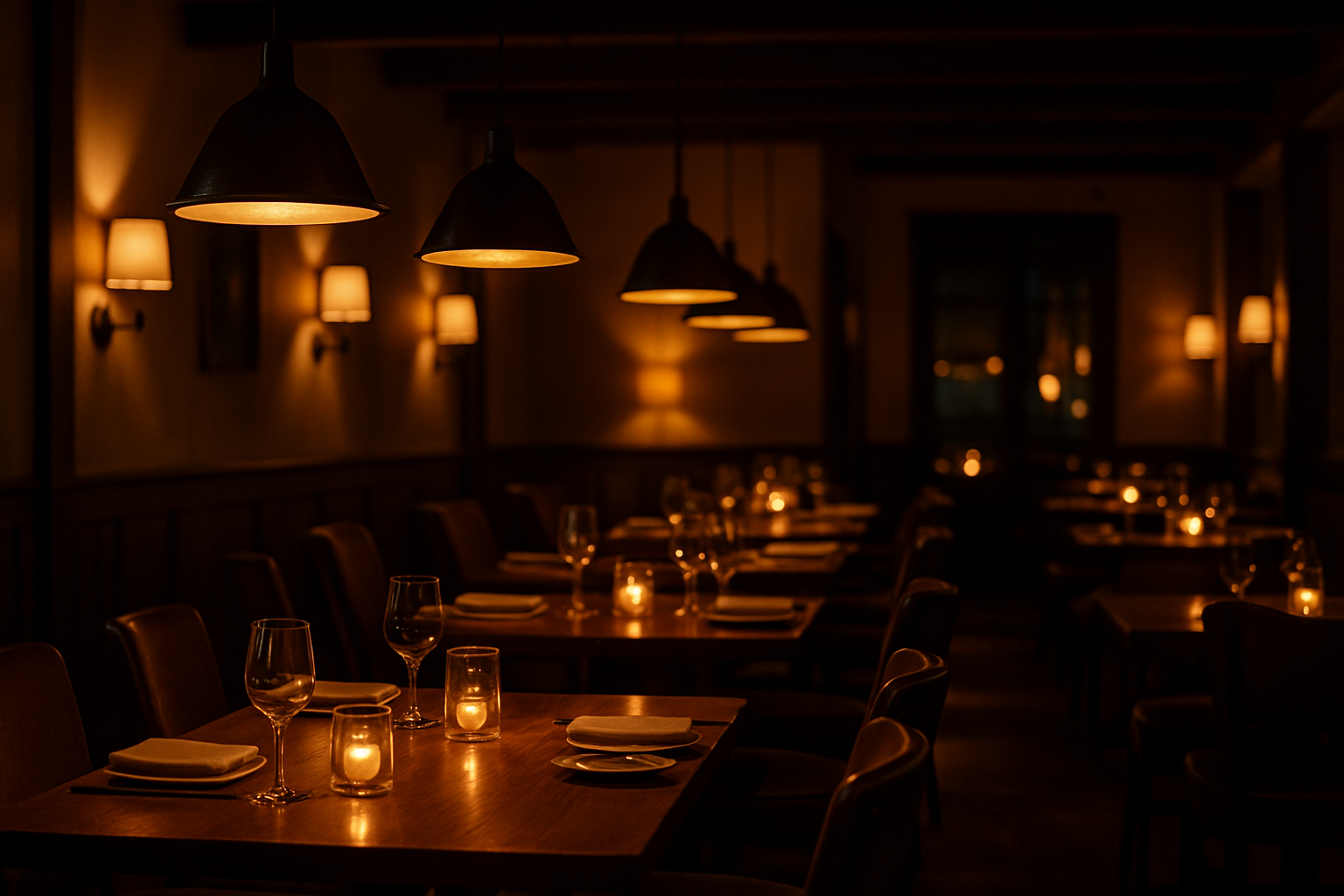
Walk into a fast food restaurant and the light feels harsh and clinical. Walk into a fine dining room and it feels warm and golden. The difference comes down almost entirely to color temperature — measured in Kelvins.
Fast food uses 4000K to 5000K light, which is cool and bluish. It keeps people alert and moving. Fine dining uses 2700K to 3000K, which is warm and amber-toned. It slows people down in the best possible way.
This isn’t a stylistic preference — it’s physiology. Warmer light triggers a more relaxed response. Cooler light does the opposite. Designers choose their color temperature before they choose a single fixture.
For homeowners, this is the single most impactful and lowest-cost change available. Swapping bulbs from 4000K to 2700K in a dining room or living area can shift the entire feeling of the space without touching a single fixture. If you want to go deeper on how this number affects what you actually see, the guide on what color rendering index means in lighting explains the connection between color temperature and how accurately your light shows color — which matters a lot at a dinner table.
Why Restaurants Never Rely on One Light Source
The fastest way to make a room feel flat and institutional is to light it entirely from the ceiling. A single overhead fixture — even a beautiful one — creates uniform illumination that erases depth and shadow. Restaurants avoid this almost universally.
Instead, they layer three types of light working together:
- Ambient light — the base layer that fills the room without creating harsh shadows
- Task light — focused light at the table level, often from pendants hung low over tables or candles
- Accent light — wall sconces, lit shelving, bar backlighting, or artwork spots that add visual texture
The key is that no single layer dominates. The ambient light is kept intentionally dim. The task light brings warmth and focus right where people are sitting. The accent light creates points of visual interest around the room so your eye has somewhere to travel.
This approach — often called layered lighting — is exactly what residential designers replicate in high-end homes. A Pebble Beach dining room with a chandelier, two wall sconces, and a buffet lamp in the corner will feel completely different from the same room lit by that chandelier alone. The fixtures can be identical. The layering changes everything.
For a closer look at how accent sources contribute to this effect, the guide on accent light fixtures breaks down placement and spacing in plain terms.
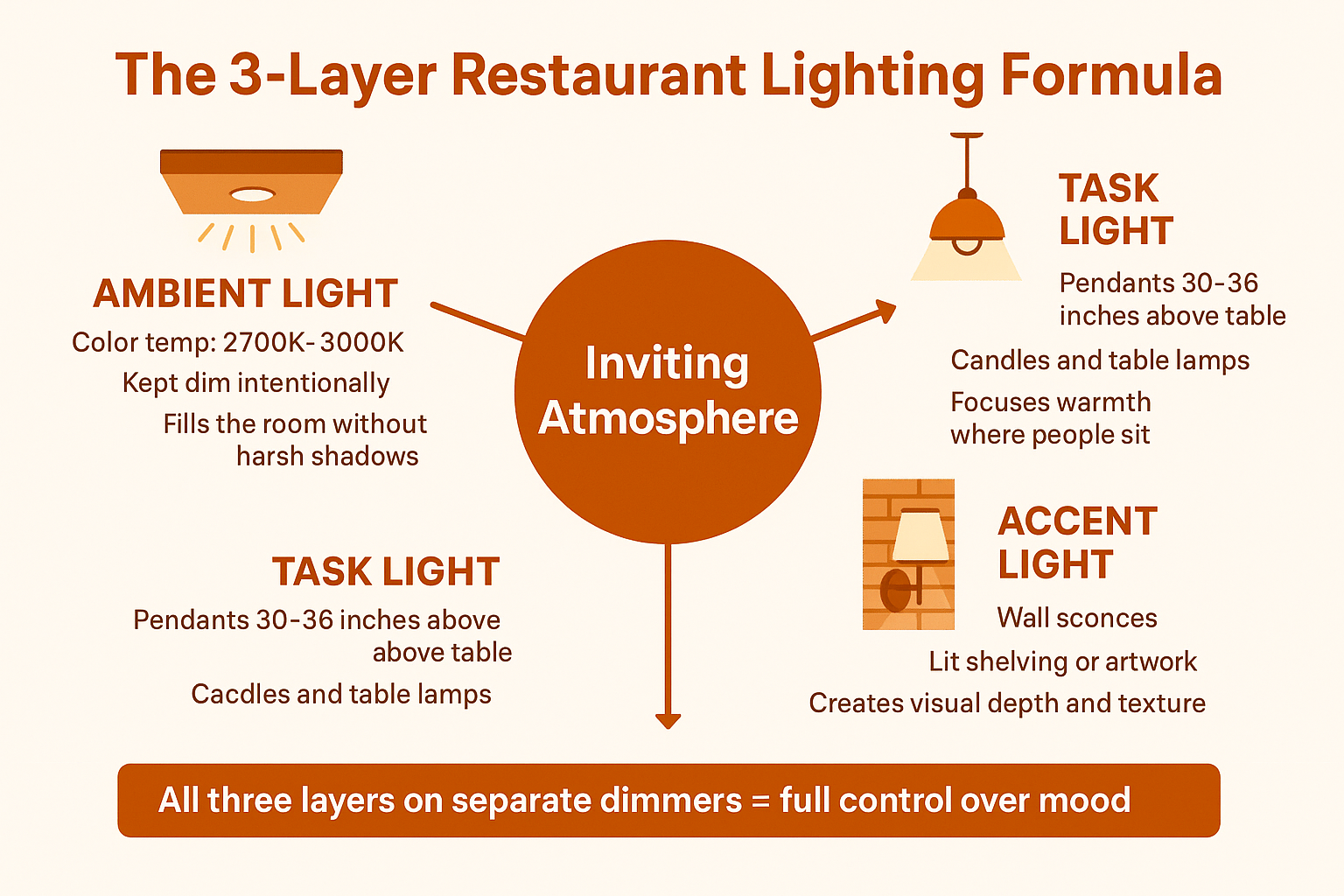
The 3-Layer Restaurant Lighting Formula
This breakdown shows how restaurants combine three distinct light layers to create warmth and depth — and how the same approach works in a residential dining room.
Dimmers Are Doing More Work Than You Think
A restaurant at 6:00 PM during happy hour looks noticeably different from the same room at 8:30 PM during peak dinner service. The fixtures didn’t change. The bulbs didn’t change. The dimmer settings did.
Dimming is what gives restaurant designers real-time control over how a space feels. It’s also the single most underused tool in residential lighting. Most homeowners install a dimmer, set it once, and forget it exists.
The way restaurants use dimmers is more deliberate. Each lighting layer — ambient, task, accent — is typically on its own dimmer circuit. That means the staff can pull the overhead ambient light down as the evening gets later while keeping the table-level sources at the same warmth. The room shifts from lively to intimate without anything obviously changing.
For this to work at home, a few things matter:
- Not all LED bulbs are dimmer-compatible — this is a common frustration, and choosing the wrong bulb causes flickering or a narrow dimming range
- Trailing-edge dimmers generally work better with LED loads than older leading-edge (TRIAC) dimmers
- Separate circuits for separate layers — if your ambient and accent fixtures are on the same switch, you lose independent control
The guide on whether incandescent bulbs are dimmable gets into the mechanics of dimming compatibility in more detail, which matters when you’re mixing fixture types in a single room.
Restaurant Lighting Techniques vs. How They Translate at Home
Here’s a side-by-side look at what restaurants do and the residential equivalent for each technique.
| Restaurant Technique | What It Does | Home Translation |
|---|---|---|
| 2700K–3000K bulbs throughout | Creates warm, amber-toned light that relaxes guests | Replace any cool-white bulbs in dining and living areas with 2700K LEDs |
| Pendants hung 30–36″ over tables | Focuses warm light right where people eat | Hang a pendant 30–36″ above your dining table surface |
| Wall sconces at mid-height | Adds visual texture and reduces flat overhead wash | Add sconces in dining room or hallway at 60″ from floor |
| Separate dimmer circuits per layer | Allows mood shifts without changing fixtures | Wire ambient, task, and accent fixtures to separate dimmers |
| No single dominant light source | Prevents harsh shadows, creates depth | Reduce overhead brightness; let lamps and sconces carry more weight |
What Pendant Height Actually Has to Do With It
One detail restaurants get right that most homeowners get wrong is pendant height over a table. When a pendant hangs too high, it becomes a general light source and loses the intimate, focused quality that makes table lighting feel special. When it hangs at the right height, the light pools directly on the table and the faces around it.
The standard recommendation for a pendant over a dining table is 30 to 36 inches between the bottom of the fixture and the tabletop. Restaurants often go even lower — closer to 28 inches — with smaller fixtures to create a more enclosed, intimate feel per table.
For homeowners, the ceiling height in the room matters here. If you have 9-foot ceilings, a pendant hung 30 inches above the table will sit at about 5 feet 6 inches from the floor — comfortable for most rooms. If you have 8-foot ceilings, you may need to adjust or choose a low-profile fixture that still delivers focused downlight.
Fixture size matters too. A pendant with a drum shade diffuses light softly downward and outward, which works well over a round or oval table. A narrow cylinder pendant throws a tighter beam — better over a small bistro table or kitchen island where you want more focused light. Getting the scale right before you buy is worth the effort, and a chandelier size calculator can help confirm proportions for larger fixtures in the same space.
Frequently Asked Questions About Restaurant-Style Lighting at Home
What color temperature should I use in my dining room to get that warm restaurant feel?
2700K is the sweet spot for most dining rooms. It’s the warmest end of the LED color spectrum without crossing into the yellow-orange territory of old incandescent bulbs. Some people go up to 3000K if they want the room to feel a little brighter while still staying warm — but avoid anything above 3000K if your goal is a relaxed, evening atmosphere.
Do I need to rewire anything to get layered lighting, or can I work with what I have?
In most cases you can add a lot of layering without rewiring. Plug-in wall sconces, buffet lamps, and table lamps can all add lower-level light sources without an electrician. Where you’ll need electrical work is if you want to add hardwired sconces or put different fixture groups on separate dimmer circuits. That’s worth it for a full dining room refresh, but it’s not required to start.
Why does the food at nice restaurants always look so much better?
Part of it is color rendering index (CRI) — a measure of how accurately a light source shows the true colors of what it’s illuminating. High-CRI bulbs (above 90 CRI) make food look richer, more vibrant, and more appetizing. Low-CRI light flattens everything. Warm color temperature helps too, since it enhances reds and oranges — exactly the tones in well-cooked food and wine.
Can I use this approach in a small dining area or open-concept space?
Absolutely. Small spaces actually benefit more from layered lighting because a single overhead fixture in a tight room feels especially oppressive. In an open-concept layout, use the different light layers to visually define the dining zone from the living area — a pendant over the table, lower ambient in the seating area nearby. It creates separation without a wall.
Is there a cost-effective way to start without buying all new fixtures?
Yes — start with the bulbs. Swapping to 2700K, high-CRI LED bulbs in whatever fixtures you already have costs $20 to $60 for most dining rooms and creates a noticeable shift immediately. Add a dimmer switch for $15 to $40 per circuit, and you’ve made a significant change for under $100 before touching a single fixture.
Want to Bring This Feeling Into Your Own Home?
The techniques behind great restaurant lighting aren’t out of reach for a Monterey Peninsula home — they just take the right fixtures, the right bulbs, and a plan for how the layers work together. Greg and Tammy at The Home Lighter have been helping homeowners and designers across Carmel, Pacific Grove, and Pebble Beach work through exactly these decisions since 1969. Stop by the showroom at 2034 Sunset Drive in Pacific Grove — walk-ins are always welcome — or call at (831) 655-5500 to talk through what you’re working on.