
Direct Answer: Outdoor lighting on the Monterey Peninsula involves local ordinances, coastal weather conditions, and design standards that make generic fixture choices a real risk. Getting it right means knowing those specifics before you buy.
Most homeowners shopping for outdoor lighting start with what looks good online. They find a fixture they like, check that it’s weather-rated, and order it. On the Monterey Peninsula, that approach can land you with a fixture your city won’t allow, a finish that won’t survive six months of coastal salt air, or light that looks completely wrong against a Carmel stone cottage or a Pebble Beach estate.
The combination of local ordinances, marine climate, and neighborhood design expectations here is genuinely different from what you’d face in Sacramento or San Jose. Those differences aren’t small print — they’re the difference between a finished project you’re proud of and one you have to redo.
This guide focuses on the two things that matter most before you choose any exterior fixture on the Peninsula: what the rules actually require and what the environment will actually do to your fixtures over time.
Carmel-by-the-Sea Has Specific Rules — and They Apply to Your Fixtures
Carmel-by-the-Sea is well known for its design ordinances, but a lot of homeowners don’t realize how specifically those rules apply to exterior lighting. The city caps residential exterior fixture color temperature at 3000K and restricts lumen output to protect the town’s visual character and reduce light pollution. That means a standard cool-white LED fixture — the kind sold by the thousands on Amazon — is likely out of compliance before it’s even mounted.
3000K is a warm white tone, similar to what you’d see from an old halogen. It looks flattering on wood, stone, and stucco. But it’s not the default setting on most off-the-shelf LED products, which often run at 4000K or higher. If you’ve ever looked at a house at night and thought the lighting felt harsh or clinical, you’ve probably seen a 4000K fixture on a home that deserved something warmer.
Beyond color temperature, lumen restrictions mean you can’t just throw a high-output floodlight on the wall and call it done. The intent is to keep Carmel’s residential streets looking like Carmel — pedestrian-scaled, warm, and not lit like a parking structure.
If your property is in Carmel, Pacific Grove, or Pebble Beach, always verify current requirements with your local planning department or a licensed contractor before purchasing. Rules do get updated, and the penalty for non-compliance on a visible exterior fixture isn’t just an aesthetics problem — it can become a permitting issue on future work.
For a deeper look at how California’s statewide rules layer on top of local requirements, the guide on interior lighting fixtures in Carmel, CA and Title 24 rules covers the compliance landscape in plain terms.
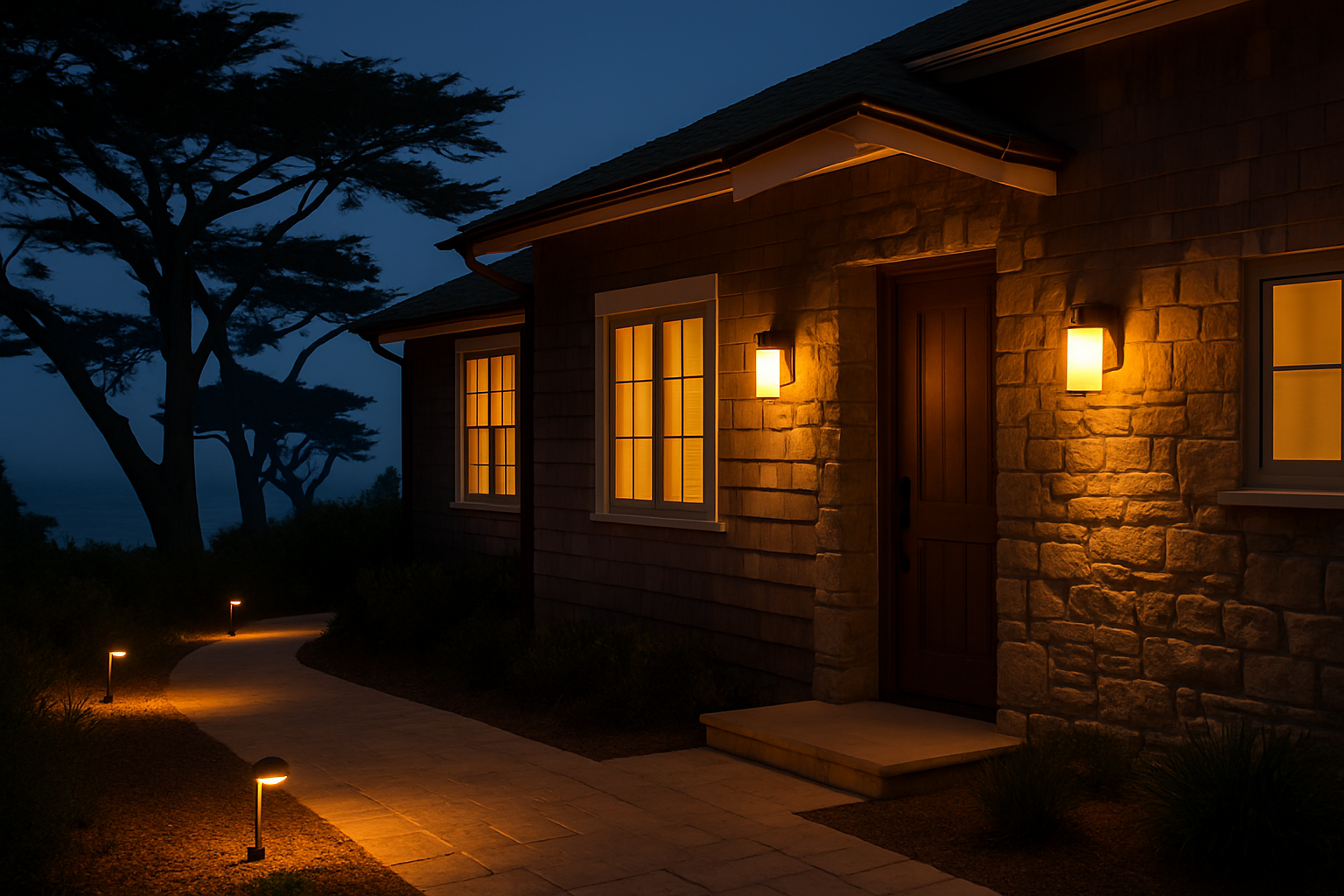
What Coastal Salt Air Does to Outdoor Fixtures (And What to Look For Instead)
The Monterey Bay is beautiful. It is also corrosive. Homes within a mile or two of the water — which covers most of Pacific Grove, Monterey, and large portions of Carmel — sit in an environment where salt-laden air accelerates oxidation on metal finishes faster than most fixture warranties account for.
A fixture rated for damp or wet locations will survive rain. But wet-rated doesn’t mean salt-air rated. Those are different things, and the distinction matters if you’re within a half-mile of the water.
Finishes that hold up well in coastal conditions:
- Marine-grade stainless steel — the gold standard for salt resistance, common in higher-end coastal fixtures
- Powder-coated aluminum — lightweight, won’t rust, and holds finish well if the coating is intact
- Solid brass or bronze — develops a patina over time rather than corroding; many homeowners in Carmel and Pebble Beach actually prefer this look
- Dark bronze or black powder coat — widely available and performs well when the coating quality is high
Finishes that tend to fail faster near the water:
- Chrome — shows pitting and corrosion within a year or two in heavy marine exposure
- Brushed nickel — better indoors than out; the lacquer coat on most nickel finishes isn’t built for sustained salt exposure
- Painted steel — rusts from any chip or scratch in the coating
For covered porches or protected eave locations with less direct exposure, your finish options widen. But for any fixture getting regular fog, mist, or sea breeze, the material choice is as important as the design.
If you’re also thinking about covered outdoor spaces with ceiling fans, the wet-rated outdoor ceiling fans guide walks through what wet-rated really means and which products are built for it.
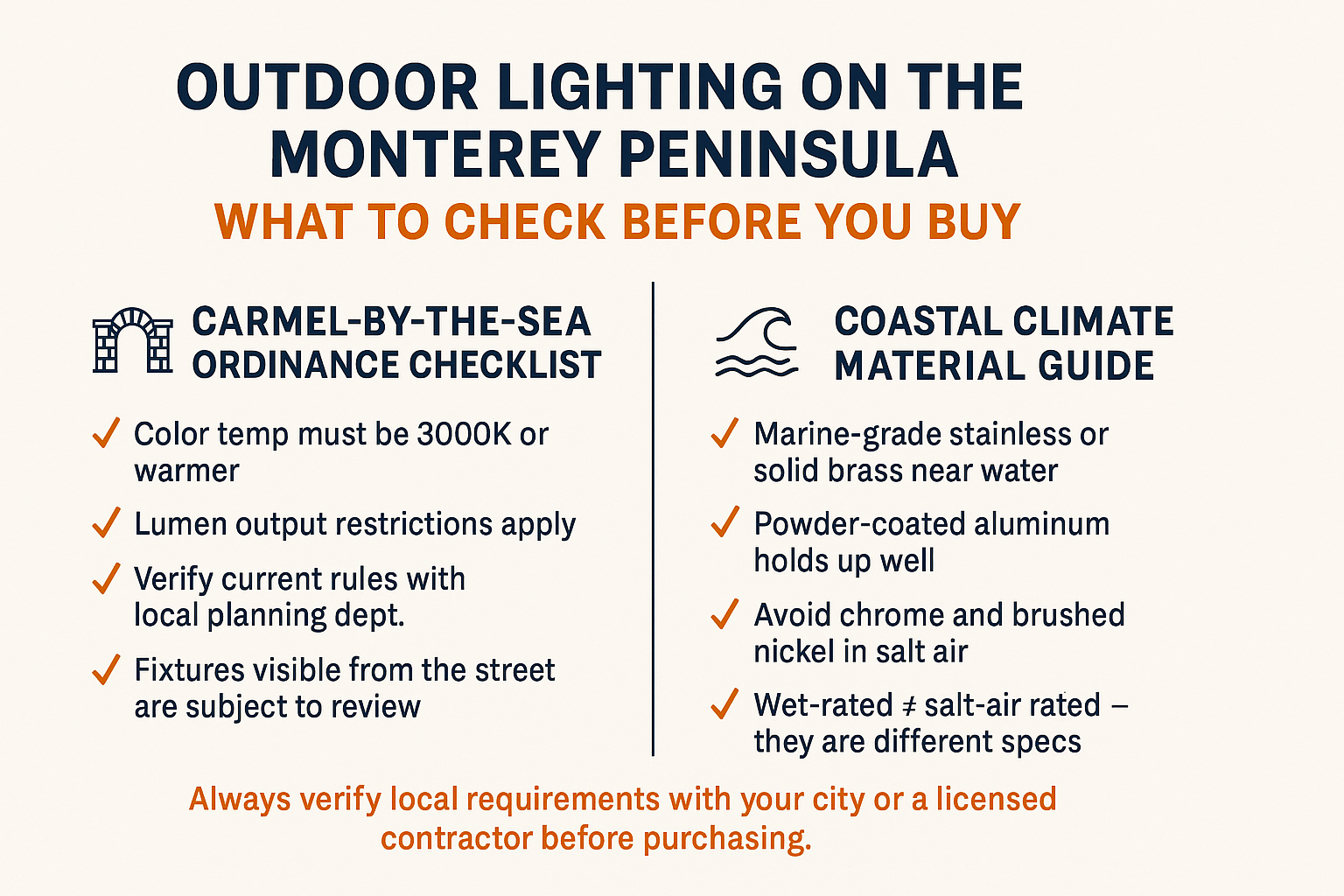
Outdoor Lighting Rules at a Glance: Monterey Peninsula Quick Reference
This reference covers the key compliance and material checkpoints for exterior lighting on the Monterey Peninsula — what to confirm before you purchase any outdoor fixture.
Fixture Finish Performance in Coastal Conditions
Not all finishes age the same way near the water. Here’s a quick comparison of common outdoor fixture materials and how they hold up in the Monterey Peninsula’s marine environment.
| Finish / Material | Salt Air Performance | Best Used For |
|---|---|---|
| Marine-grade stainless steel | Excellent — built for it | Fixtures with full water and salt exposure |
| Solid brass or bronze | Very good — patinas rather than corrodes | Traditional and coastal-style fixtures in Carmel, Pebble Beach |
| Powder-coated aluminum | Good — holds well if coating is intact | Modern fixtures, eave mounts, pathway posts |
| Dark bronze powder coat | Good — widely available at this spec level | Most mid-range outdoor sconces and pendants |
| Brushed nickel | Fair — not recommended near water | Protected interior-adjacent locations only |
| Chrome | Poor — pits and corrodes within 1-2 years | Not recommended for any coastal exterior use |
| Painted steel | Poor — rusts from any coating breach | Avoid for Peninsula exteriors near the water |
Warm Light Isn’t Just Prettier — It’s the Right Call Here
There’s a reason the most admired homes in Carmel Valley, Pebble Beach, and Pacific Grove tend to have outdoor lighting that feels settled and warm rather than bright and white. Part of it is the local ordinance. But part of it is something more straightforward: warm light just works better against the materials that define this region’s architecture.
Natural wood siding, Carmel stone, weathered shingle, and painted stucco all read beautifully under 2700K to 3000K light. The warmth in those tones pulls out the texture and depth in natural materials. A cool-white fixture at 4000K or 5000K tends to flatten the same surfaces — they look washed out or clinical rather than rich.
Pathway lighting is a good example. A 2700K brass path light on a flagstone walkway in Carmel-by-the-Sea looks like it belongs there. The same path under 4000K LEDs looks like an airport taxiway. The lumen output might be identical, but the experience is completely different.
For anyone interested in how this same warm-versus-cool tradeoff plays out in landscape settings on the Peninsula, the article on warm and elegant landscape lighting in Pebble Beach gets into the specifics of fixture placement and tone in that neighborhood’s particular aesthetic.
And if you’re curious about how color temperature connects to the broader question of how light affects a space, what color rendering index means in lighting is a useful read — it explains why the same lumen count can look completely different depending on the light source.
Frequently Asked Questions About Outdoor Lighting on the Monterey Peninsula
Do I need to get a permit to replace an outdoor light fixture in Carmel?
A straight one-for-one fixture swap in the same location generally doesn’t require a permit. But if you’re adding new fixtures, running new wiring, or doing anything that qualifies as new electrical work, a permit is likely required. Your licensed electrician will know what triggers permit requirements in your specific city. Carmel-by-the-Sea is particularly attentive to exterior changes on visible facades, so when in doubt, ask before the work starts.
What does ‘3000K’ actually mean, and how do I know if a fixture meets it?
Color temperature is measured in Kelvin (K) and describes how warm or cool a light source looks. 3000K is a warm white — similar to a halogen bulb. 4000K is a neutral white. 5000K looks daylight-blue. When shopping for fixtures, the color temperature is listed in the product specs. If a fixture uses a replaceable bulb, the fixture itself doesn’t have a color temperature — the bulb does, so you’d choose a 3000K or 2700K bulb to meet Carmel’s requirement.
My house is in Pacific Grove, not Carmel. Do the same rules apply?
Pacific Grove has its own municipal code and its own approach to exterior lighting. The Carmel 3000K cap is specific to Carmel-by-the-Sea. That said, Pacific Grove — especially near Lover’s Point and the coastal neighborhoods — has design-sensitive areas where fixture choices are noticed. Always verify requirements with the City of Pacific Grove’s planning or building department for any work that involves exterior changes.
How much should I expect to spend on quality outdoor fixtures for a coastal home?
For a single exterior wall sconce in a material that holds up to salt air — solid brass, bronze, or marine-grade aluminum — expect to spend $150 to $500+ per fixture at a quality level worth putting on a Peninsula home. Pathway lights run roughly $80 to $200 each for fixtures that will actually last. The cheapest fixtures online are often painted steel with thin finishes — they look fine in the showroom photo and corrode in under two years near the water.
Can I use smart lighting controls on my outdoor fixtures to comply with California’s Title 24 rules?
California Title 24 (with updates effective January 1, 2026) does require certain lighting controls for remodels and new construction — including outdoor lighting in some circumstances. Smart controls like motion sensors, timers, and occupancy sensors can satisfy some of those requirements. But compliance depends on the specifics of your project scope, so confirm with your electrician or contractor what’s required before you finalize fixture and control selections.
Does the showroom carry fixtures specifically rated for salt air?
The Home Lighter’s curated collection includes manufacturers who build for coastal conditions. Greg and Tammy can point you to specific lines and finishes appropriate for your home’s location and exposure level. Walk-ins are welcome at the showroom at 2034 Sunset Drive in Pacific Grove, and appointments are available for larger projects.
Ready to Choose Outdoor Fixtures That Actually Work Here?
Greg and Tammy at The Home Lighter have been helping Peninsula homeowners sort through exactly these decisions since 1969 — which fixtures hold up near the water, which color temperatures meet local rules, and which designs fit the way coastal homes actually look. Stop by the showroom at 2034 Sunset Drive in Pacific Grove any time — walk-ins are always welcome — or call at (831) 655-5500 to talk through your project before you visit.