
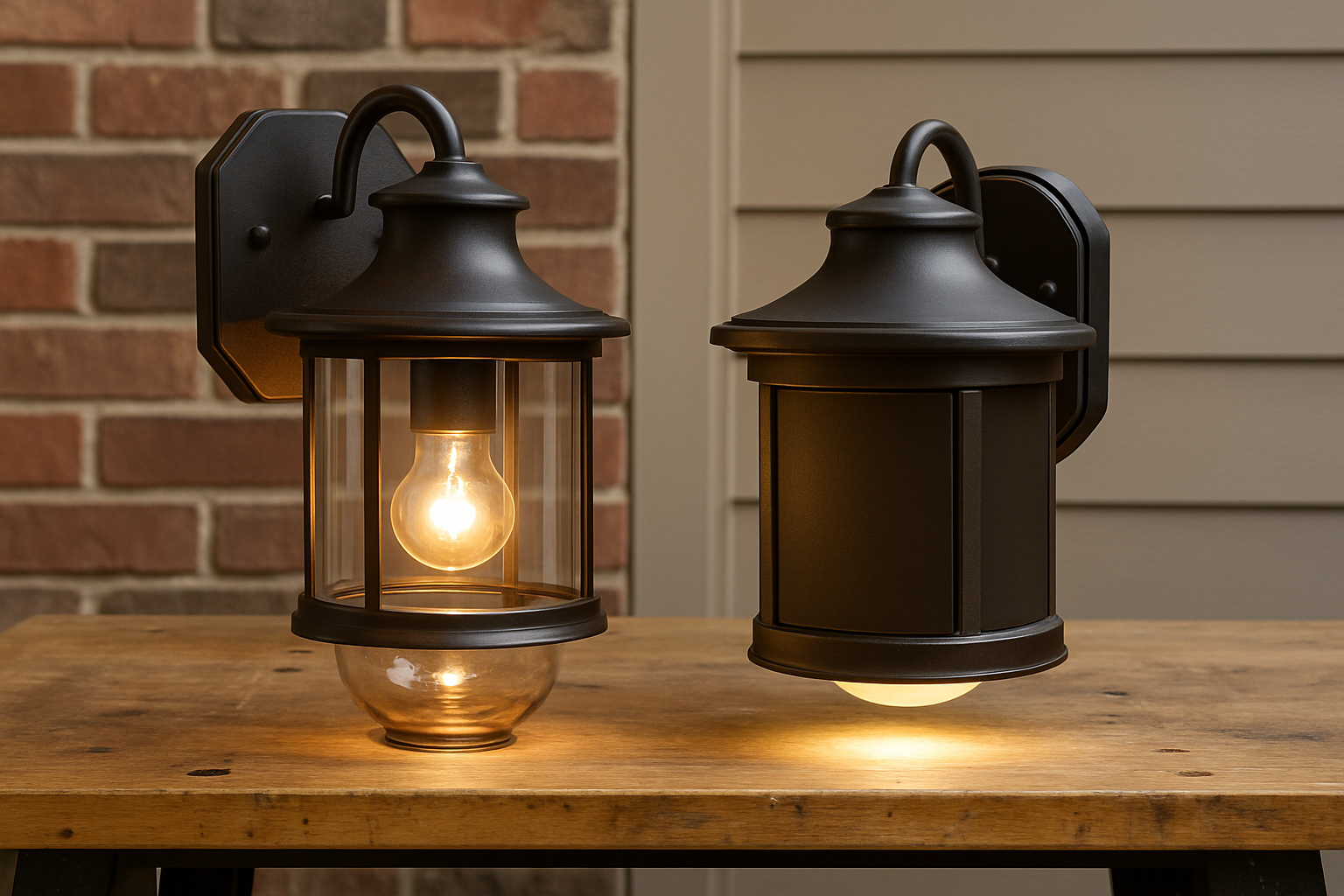
Direct Answer: Fully shielded means the fixture housing blocks light from escaping above horizontal, with any bottom glass flush to the housing. If the bulb is visible from the side, it likely will not pass.
You found a lantern you love. It looks right for the cottage, the finish matches the door hardware, and the price works. Then someone mentions that Carmel has rules about exterior lighting, and suddenly you are not sure whether the box arriving next week is going to be a problem.
This trips up a lot of people on the Peninsula, and it is not because homeowners are careless. It is because the rule is about how the fixture is built, not how bright the bulb is. Those are two different things, and product listings almost never spell out the first one.
This guide covers what fully shielded actually means in plain terms, a test you can run while scrolling a product page, and why a simple fixture swap inside Carmel city limits can involve more paperwork than a weekend project usually does.
What Fully Shielded Exterior Light Fixtures in Carmel Actually Means
Carmel-by-the-Sea Municipal Code Chapter 17.39 asks that exterior fixtures be fully shielded. In practice that means the housing itself blocks light from spilling out sideways or upward. The light goes down, and only down.
The code also addresses the bottom of the fixture. Any glass or diffuser has to sit flush to the fixture, which rules out drop lenses and globes that hang below the housing. A lens that dips below the metal lets light escape at an angle, which is exactly what the ordinance is written to prevent.
Here is the test you can run standing in an aisle or looking at a product photo:
- Can you see the bulb or the lit lens from the side, at eye level? If yes, it probably does not qualify.
- Does the glass hang below the bottom edge of the metal housing? That is a drop lens.
- Is the top of the fixture solid, or is there an open vent or decorative gap that light can pass through?
- Does the fixture description mention full cutoff, full shielding, or downlight only?
One more thing people get wrong. Mounting a fixture under a deep eave or a porch canopy does not make it fully shielded. The code’s canopy language is direct on that point, and the same logic applies to tucking a lantern under an overhang and calling it good. The shielding has to come from the fixture.
The Four Specs to Check Before You Order
Most compliance problems happen at the buying stage, not at installation. The fixture shows up at the door, someone finally reads the ordinance, and the return window becomes the real issue.
Most ecommerce listings will not tell you whether a fixture meets Carmel’s requirements. They are written for a national audience and use marketing language, not code language. So you have to go find the numbers yourself.
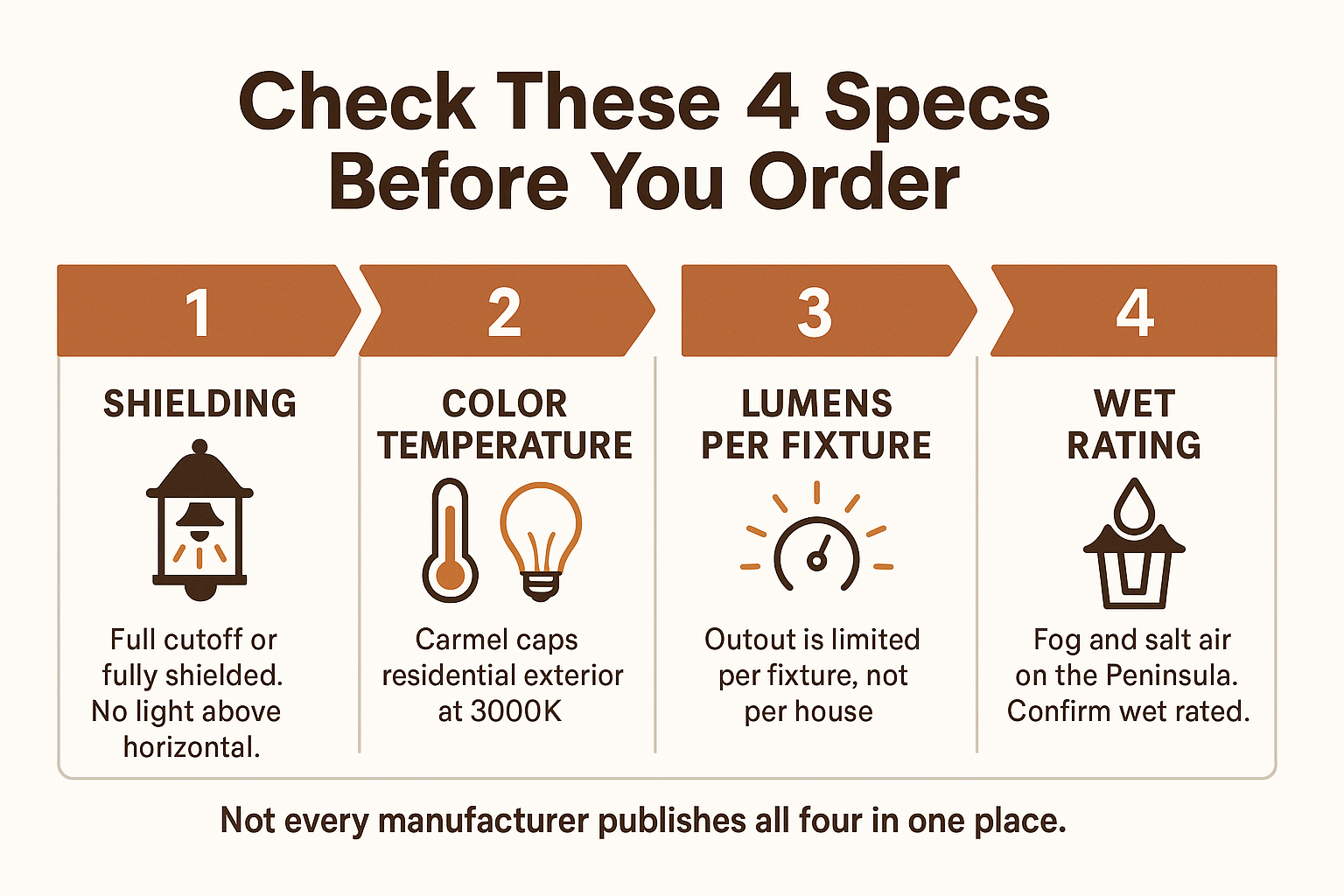
Before an order goes in, look for these four items on the manufacturer’s spec sheet or cut sheet:
- Shielding or cutoff description. Look for full cutoff, fully shielded, or a photometric drawing showing zero uplight.
- Color temperature. Carmel caps residential exterior fixtures at 3000K, so a 4000K lamp or integrated LED is out even if the housing is fine.
- Lumen output per fixture. The ordinance limits output, and that figure is per fixture, not per house.
- Wet rating. On the Peninsula this matters for durability as much as code. Wet rated and damp rated are not interchangeable, especially in a Carmel fog belt.
Be realistic about this: not every manufacturer publishes all four in one place. Some bury lumens in a lamping chart, some only give shielding details in a photometric PDF, and some list nothing at all. If three of the four are missing, that is useful information about the fixture.
If spec sheets are unfamiliar territory, this walkthrough of finish codes, ratings, and fit covers how to read one line by line.
Common Porch Light Setups and How They Tend to Land
This is a general reference, not a ruling. Carmel’s Department of Community Planning and Building is the authority on any specific fixture.
| Fixture setup | Likely to pass? | What the code language points to |
|---|---|---|
| Open-bottom lantern with clear glass panels, bulb visible from the side | No | Light escapes above horizontal and the bulb is not concealed by the housing |
| Wall sconce with a flat lens flush to the bottom of the housing | Often yes | Bottom glass or diffuser must sit flush to the fixture |
| Fixture with a drop lens or globe hanging below the metal | No | Drop lenses do not qualify as fully shielded |
| Any fixture mounted under a deep eave or porch canopy | Not on that basis alone | Canopy mounting does not by itself make a fixture fully shielded |
| Floodlight or spotlight aimed at the house or yard | Review required | Floodlights and spotlights go to the Planning Commission |
The Four-Spec Check, in Order
Run these four checks on the spec sheet before the order goes in, not after the box arrives.
A Fixture Swap Can Involve More Paperwork Than You Expect
Here is the part that catches people planning a quick Saturday change. Replacement is one of the moments the City uses to bring older exterior lighting up to current standards.
Chapter 17.39 directs that a lighting plan be submitted to the Department of Community Planning and Building along with the associated permit application. Existing noncompliant fixtures are treated as a nonconforming use that may be maintained and replaced in kind, but when fixtures are being replaced or substantial exterior modifications are happening, the code calls for exterior lighting to be brought into compliance through the building permit process. You can read the ordinance language yourself in the City of Carmel-by-the-Sea Chapter 17.39 document.
The order of operations that saves the most grief:
- Settle on the fixtures first and collect the cut sheets for each one.
- Hand those cut sheets to your licensed electrician or contractor before anything is filed.
- Let them confirm with the City what is required for your specific project, since scope changes the answer.
- Only then place the order.
Doing it in that order means you are not holding a filed permit application hostage to a fixture that is still three weeks out. Lead times are their own planning problem on Peninsula projects.
Shielded Lighting Usually Works Better in a Carmel Winter Anyway
The ordinance exists to protect the dark, forested character of the village, and it limits exterior lighting to specific purposes such as lighting a building entrance. Plenty of homeowners read that as a compromise. In practice it is often the better-performing choice.
Think about December here. Daylight saving time ends November 1, 2026, sunset falls around 4:51 pm on December 1, and the month typically brings roughly 2.4 inches of rain across about 9.9 rain days. Guests are walking up a wet path in the dark.
A fixture that throws light sideways puts glare in their eyes and makes the ground harder to read. A shielded fixture pointed down lights the surface they are actually walking on.
So the practical approach is simple:
- Light the walkway and the door, not the sky and not the neighbor’s bedroom.
- Aim everything down.
- Use more low-output fixtures rather than one bright one.
Fixture scale matters here too, since most front door lanterns people buy are too small for the entry they are serving. And in a salt air zone like Carmel Point or Pebble Beach, material choice decides how long that fixture lasts.
State Energy Code Is a Separate Set of Rules
Two different rulebooks apply, and they do not cover the same ground.
California’s 2025 Building Energy Efficiency Standards, Title 24 Part 6, took effect January 1, 2026 and govern lighting controls and efficiency on permitted remodels and new construction statewide. Carmel’s ordinance is local and applies inside city limits whether you are doing a full remodel or swapping one porch light.
The short version: local rules shape which fixture you can choose, and state code shapes how it gets switched and controlled. Carmel’s code also requires residential outdoor lighting to be controlled per the California Energy Code, so the two meet at the switch.
Controls, dimmers, photocells, and wiring are work for your own licensed electrician. Requirements change, so verify both with the City of Carmel-by-the-Sea and your contractor rather than relying on a blog post, including this one. The 2026 code changes are covered in more depth here.
Frequently Asked Questions About Fully Shielded Exterior Lighting in Carmel
If I just put a dimmer on my existing lantern, does that make it compliant?
No. Dimming reduces output, but shielding is about fixture construction, not brightness. A lantern with an exposed bulb still throws light sideways at any dim level.
My porch light is under a deep overhang. Isn’t that already shielded?
That is the single most common assumption, and the ordinance addresses it directly. Mounting under a canopy does not by itself make a fixture fully shielded. The shielding has to be part of the fixture.
What does a compliant exterior fixture typically cost?
Costs vary a lot by material, finish, and manufacturer, and tariffs have moved pricing around recently. Many Monterey Peninsula homeowners find that a well-built shielded exterior lantern lands anywhere from a couple hundred dollars to well over a thousand for a solid brass or hand-forged piece. The honest answer is that it depends on the fixture, so get a real quote on the specific model.
Can I keep the old fixtures that don’t meet the current rules?
The code treats existing noncompliant exterior fixtures as a nonconforming use that may be maintained and replaced in kind. But once you are replacing fixtures or doing substantial exterior work under a permit, the code directs that exterior lighting be brought into compliance. Your contractor can confirm where your project falls.
Do these rules apply in Pacific Grove, Monterey, or Carmel Valley?
Chapter 17.39 applies inside Carmel-by-the-Sea city limits. Other Peninsula jurisdictions have their own standards, and unincorporated Carmel Valley falls under Monterey County. Check with the jurisdiction that issues your permit.
Checking a Fixture Before the Order Goes In
If you have spent an evening scrolling and come away unsure whether a lantern will pass in Carmel, spec sheets are easier to read side by side than guessed at from a product photo. Greg and Tammy at The Home Lighter can pull shielding, color temperature, and wet rating details across lines from more than 60 manufacturers and talk through how a fixture lines up with local requirements before money changes hands. Walk-ins are welcome at 2034 Sunset Drive in Pacific Grove, appointments are available for more involved projects, and installation is always handled by your own licensed electrician. The showroom number is (831) 655-5500.
