
Direct Answer: As of January 1, 2026, any permitted residential remodel in California must meet the 2025 Energy Code, requiring high-efficacy fixtures, vacancy sensors in certain rooms, and dimming capability in habitable spaces.
If you have a permitted remodel underway right now, a bathroom in Monterey, a new build in Pacific Grove, a living room lighting upgrade in Carmel, the 2025 California Energy Code (Title 24, Part 6) already applies to your project. It took effect January 1, 2026, and any permit application filed on or after that date falls under the new rules.
Most homeowners don’t find out about these requirements until they’re mid-project. That’s when the questions start: Do I have to use LED? Will my dimmer still work? Does this apply if I’m just swapping out a fixture? Those are real questions, asked by real people planning real projects on the Monterey Peninsula.
This article walks through what the code actually requires for residential lighting, where it gets confusing, and why fixture selection decisions made early in a project are far easier to get right than ones made after the walls close.
Does the 2026 Lighting Code Apply to My Project?
The short answer: if you’re pulling a permit, yes. The California Energy Commission confirms the 2025 Building Energy Efficiency Standards apply to any permit application filed on or after January 1, 2026, including additions, alterations, and new construction.
That covers a wide range of projects:
- A bathroom remodel where you’re moving or replacing fixtures
- New construction, including a custom home in Pacific Grove
- A kitchen renovation with new cabinet lighting or recessed cans
- Any project that adds or relocates lighting circuits
Projects that don’t pull a permit, like a straight fixture swap on an existing junction box, with no new wiring, may fall outside the code’s direct reach. But that’s a determination your licensed electrician or local building department makes, not something to assume. When in doubt, ask before you order fixtures.
What Are the Three Main Lighting Requirements?
Title 24 residential lighting rules come down to three things for most homeowners. They’re not complicated once you see them plainly.
1. High-efficacy light sources
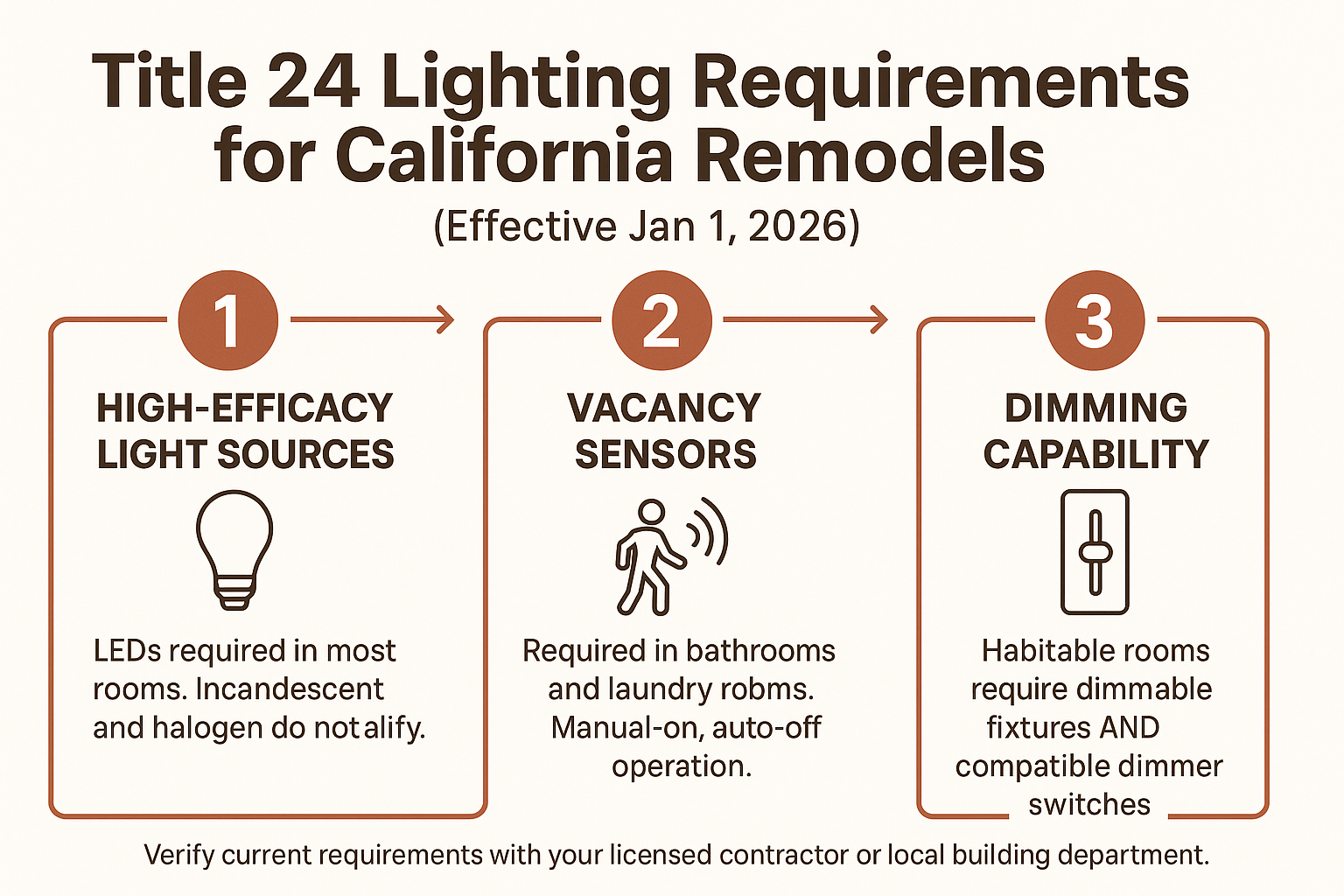
In practice, this means LEDs. The code requires high-efficacy fixtures in most areas of a home, kitchens, bathrooms, living rooms, bedrooms, and more. A fixture that uses incandescent or halogen bulbs won’t meet the standard. If you’re shopping for fixtures without checking efficacy ratings, you could end up with something that looks right but fails inspection.
2. Vacancy sensors in certain rooms
Bathrooms and laundry rooms require vacancy sensors, controls that turn lights off automatically when no one is in the room. These are similar to occupancy sensors but require a manual-on switch rather than triggering automatically when motion is detected. For a Monterey homeowner doing a bathroom renovation, this is a detail worth knowing before the electrician rough-in is complete.
3. Dimming capability in habitable rooms
Kitchens, living rooms, dining rooms, and similar spaces need fixtures and controls that support dimming. That means the fixture itself must be dimmable, and the dimmer switch must be compatible. Home lighting controls vary significantly, not every dimmer works with every LED driver, and mismatches cause flickering, buzzing, or reduced dimming range.
Title 20 vs. Title 24: What’s the Difference and Why Does It Matter?
This is where a lot of homeowners get tripped up, especially those who ordered fixtures online before talking to anyone local.
Title 20 is a product standard. It governs whether a lamp or fixture can be sold in California at all. A fixture that passes Title 20 is legal to purchase and stock on a shelf here.
Title 24 is a building design code. It governs how lighting systems are designed, installed, and controlled in a permitted project. A fixture can pass Title 20 and still result in a code failure if the control system isn’t set up to match, wrong dimmer, missing sensor, wrong room designation.
One homeowner reaching out about a bathroom remodel had already ordered vanity fixtures before talking to a contractor. The fixtures were LED and Title 20 compliant. But the project plan didn’t include a vacancy sensor, and the dimmer they’d chosen wasn’t compatible with the fixture’s LED driver. The fixtures were fine. The system wasn’t.
This is why fixture selection and control design go together. Choosing a fixture without knowing what dimmer it requires, or whether your electrician is planning for a sensor, is a gap that shows up at inspection, not at the showroom.
Title 24 Residential Lighting: Three Requirements at a Glance
This infographic summarizes the three core Title 24 lighting requirements for California residential remodels permitted on or after January 1, 2026.
If You’re in Carmel, There’s a Second Layer to Think About
Title 24 applies statewide. But if your project is within Carmel-by-the-Sea city limits, there’s a local ordinance on top of it that governs exterior lighting separately.
Carmel’s exterior lighting rules cap residential fixture color temperature at 3000K and restrict lumen output per fixture. These are local zoning requirements, not state energy code, and they apply whether or not a building permit is involved. That’s an important distinction: you could do a simple fixture swap on an exterior wall in Carmel with no permit and still need to meet the city’s ordinance.
For a homeowner doing both interior work (Title 24) and exterior work (Carmel ordinance) on the same property, the challenge is finding fixtures that satisfy both sets of requirements at the same time, the right color temperature, the right output, and the right efficacy rating. That’s not impossible, but it requires knowing both targets before you start shopping.
For more detail on Carmel’s outdoor requirements, this breakdown on landscape lighting compliance covers the ordinance specifics. Always verify current ordinance details directly with the City of Carmel, since rules can be updated.
Title 24 vs. Carmel Exterior Ordinance: Side by Side
These two sets of rules overlap for any Carmel homeowner doing both interior and exterior work. Here’s how they compare at a glance.
| Title 24 (State Energy Code) | Carmel Exterior Ordinance (Local) | |
|---|---|---|
| What it governs | Lighting system design in permitted projects | Exterior fixture specs on Carmel properties |
| When it applies | Any permit filed on or after Jan 1, 2026 | Applies to exterior lighting regardless of permit status |
| Key requirements | High-efficacy sources, vacancy sensors, dimming | 3000K max color temperature, restricted lumens per fixture |
| Enforced by | Building inspector at permit sign-off | City of Carmel zoning / code enforcement |
| Who sets the rules | California Energy Commission (statewide) | City of Carmel-by-the-Sea (local ordinance) |
Why Fixture Decisions Made Early Are Easier to Get Right
Several homeowners reaching out to local lighting resources have the same story: they picked fixtures they loved online, placed the order, and then found out at the electrician walk-through that the dimmer wasn’t compatible or the bathroom plan didn’t include a sensor.
Those course corrections are manageable before drywall is closed. After the rough-in is done, changing control locations or rewiring for a sensor adds real cost and delays.
The practical move is to bring your floor plan to a showroom before the permit is submitted, or at minimum before the electrician rough-in. A review of your fixture choices against the three Title 24 requirements (efficacy, sensors, dimming compatibility) is straightforward with the right information in front of you. For anyone doing a bathroom vanity lighting upgrade or a full kitchen lighting renovation, this kind of pre-purchase review can save a significant amount of rework.
Code requirements aren’t an obstacle to a well-designed space. They’re a specification layer. The fixtures that meet Title 24 include beautiful, well-crafted options from manufacturers like Visual Comfort, Hinkley, and Arroyo Craftsman, brands where design and performance aren’t in conflict.
Frequently Asked Questions About Title 24 Lighting Requirements in California
Do I have to use LED fixtures to meet the 2026 California lighting code?
In practice, yes. The code requires high-efficacy light sources, and LEDs are the only common residential option that meets that standard. Incandescent and halogen fixtures won’t qualify. That said, ‘LED’ covers a wide range of fixture styles, from understated vanity bars to statement pendants, so meeting the code doesn’t mean limiting your design choices.
Will my existing dimmers still work with the new LED fixtures?
Not necessarily, and this is one of the more common surprises during a remodel. Many older dimmers were designed for incandescent loads and don’t communicate well with LED drivers. The result can be flickering, buzzing, or a dimming range that barely changes. Your electrician should confirm dimmer compatibility before installation, and it’s worth checking compatibility at the fixture selection stage, not after. For a deeper look at how dimmers and LED fixtures work together, this guide on home lighting controls breaks it down.
Does the code apply if I’m just swapping out one fixture?
A direct fixture swap on an existing junction box with no new wiring typically doesn’t trigger a permit requirement, and if there’s no permit, Title 24 enforcement doesn’t apply in the same way. But this depends on your specific project and local jurisdiction. Your licensed electrician or the Monterey County building department can tell you definitively whether your scope of work requires a permit.
What’s a vacancy sensor and how is it different from an occupancy sensor?
Both respond to motion, but they work differently. An occupancy sensor turns lights on automatically when it detects someone in the room. A vacancy sensor requires you to turn the light on manually, but turns it off automatically when the room is empty. Title 24 requires vacancy sensors in bathrooms and laundry rooms for exactly this reason, they reduce energy waste without removing control from the homeowner.
I’m doing work on a Carmel property. Do I have to follow both Title 24 and the local ordinance?
Yes, if your project includes exterior lighting. Title 24 governs the interior lighting system in your permitted project. Carmel’s exterior ordinance caps color temperature at 3000K and restricts lumen output, and it applies to exterior fixtures regardless of whether a permit is involved. For a project that touches both, you need fixtures that satisfy both standards at once. Verifying current Carmel ordinance specifics directly with the City is the right step, the rules can be updated, and the city’s planning department is the authoritative source.
Can I get help reviewing my fixture choices against the code before I order?
A local lighting showroom with expertise in residential projects can review whether your planned fixtures are high-efficacy, dimmable, and compatible with the control layout your electrician is planning. That’s a practical conversation to have before you commit to an order, not after. Bring a rough floor plan and a list of the rooms involved, and the review becomes much more specific and useful.
Ready to Review Your Fixture Choices Before the Permit Is Submitted?
Greg and Tammy at The Home Lighter have been helping Monterey Peninsula homeowners work through exactly these kinds of project decisions since 1969. Walk-ins are welcome at the showroom at 2034 Sunset Drive in Pacific Grove, and appointments are available for more involved projects. You can also reach the showroom directly at (831) 655-5500 to talk through your project before you place a fixture order.