
Direct Answer: For bathroom vanity lighting, side sconces should be centered at 60–65 inches from the floor. An overhead bar should be no wider than the mirror, or a few inches wider at most.
A lot of homeowners on the Monterey Peninsula reach out to a lighting showroom with a specific fixture model in mind — they’ve done the online research, they’ve found something they like, and they want to know if it’s available. What they don’t always have is a clear picture of where the fixture goes, how high it should sit, or whether the size actually works with their mirror. Those two things — placement and proportion — are where most vanity lighting goes wrong.
The fixture choice matters. But the decisions that actually determine whether your bathroom looks finished or awkward are mostly dimensional. Height, width, and mirror size are what drive the result, and they’re specific enough that it’s worth understanding before you commit to anything.
This article walks through the placement and sizing questions that come up most consistently in bathrooms across Pacific Grove, Carmel, and Monterey — including the practical rules for sconce height, when a bar fixture works and when it doesn’t, and what California’s energy code means for permitted bathroom remodels.
Why Sconce Height Is Where Vanity Lighting Usually Goes Wrong
The single most common mistake in bathroom vanity lighting isn’t the fixture — it’s where the fixture ends up on the wall. Mount a sconce too high and the light shines down onto the top of your head. That creates shadows under your eyes, nose, and chin, which is exactly the opposite of what a bathroom needs.
The standard recommendation is to center a side-mounted sconce at 60 to 65 inches from the finished floor. That puts the light roughly at eye level for most adults, which means it illuminates the face evenly rather than casting it in shadow. Mounted too low — below 58 inches — and the sconce fails to light the upper face adequately.
A few things affect where that sweet spot lands in your specific bathroom:
- Ceiling height — taller ceilings don’t change the ideal sconce height, but they do affect how the fixture reads visually in the space
- Mirror height — the sconce should be centered on the mirror’s vertical midpoint, not above it
- User height — households with significant height variation may want to split the difference rather than optimizing for one person
- Existing rough-in location — if an electrician already roughed in boxes at a different height during a remodel, that’s a real constraint worth knowing before you select a fixture
For homeowners in active Monterey County bathroom renovations, talking through the rough-in location with your licensed electrician before finalizing fixture selections can save a lot of frustration.
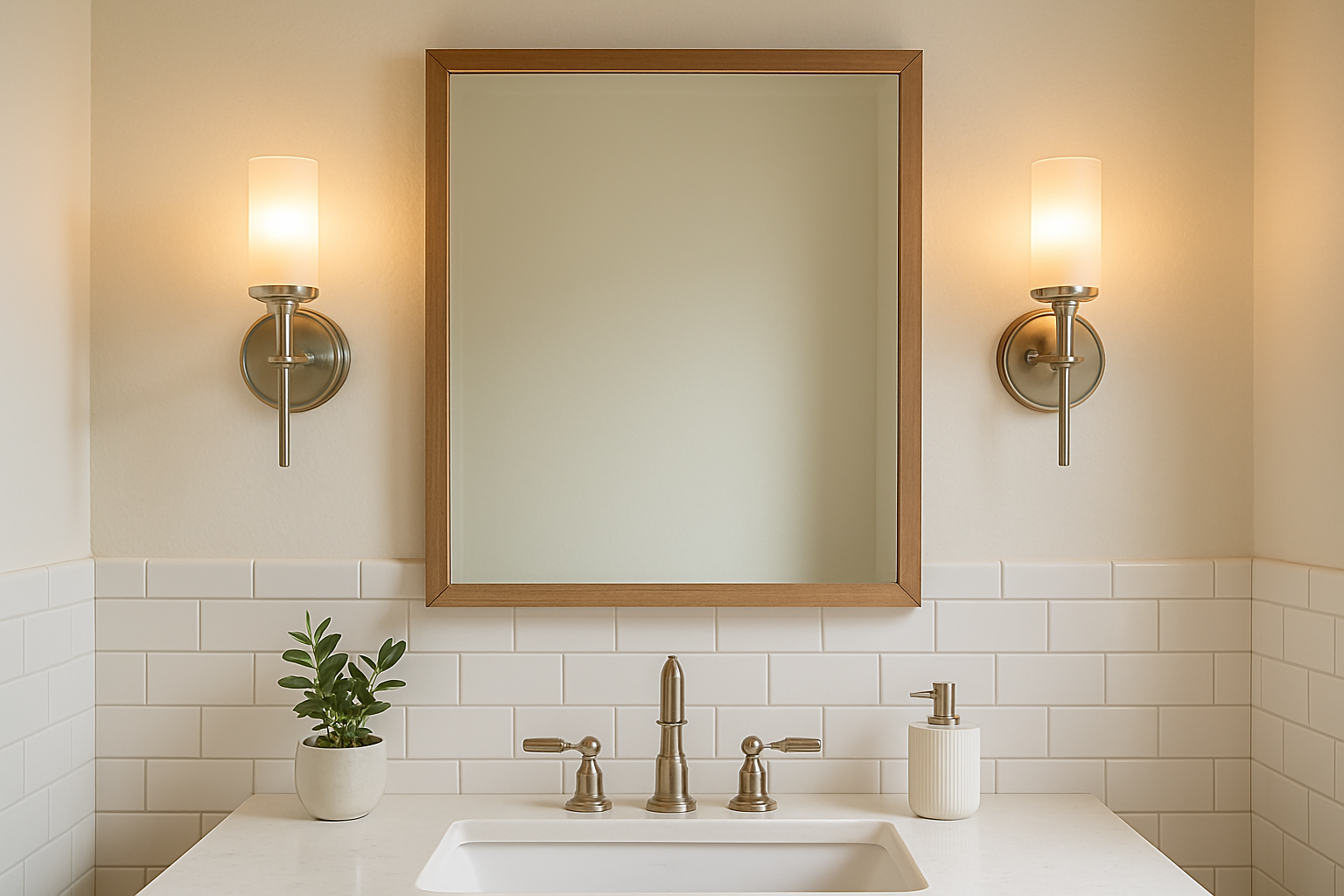
Bar Fixture or Flanking Sconces — What Your Mirror Size Actually Tells You
The choice between a single bar mounted above the mirror and two sconces flanking it isn’t just a style preference. It’s a functional decision that depends heavily on your mirror’s dimensions.
A single overhead bar throws light downward from one source. That’s fine for general illumination, but it casts shadows on both sides of the face — which makes shaving, applying makeup, or getting a good look at yourself harder than it needs to be. Side-mounted sconces at eye level illuminate the face from both directions, which eliminates most of that shadow problem.
But sconces aren’t always the right answer either. In a smaller bathroom with a narrow mirror, sconces can project too far into the space and feel crowded. And in a very compact bathroom, an overhead bar may be the only practical option.
Here’s how mirror width generally guides the decision:
- Mirror narrower than 36 inches — an overhead bar typically works well; sconces may be too tight
- Mirror 36 to 48 inches — either approach can work; the bathroom’s overall size often breaks the tie
- Mirror wider than 48 inches — side sconces are usually the stronger choice; a single bar rarely provides even coverage across that span
- Double vanity with a wide mirror — two sconces (one per sink bay) or a long multi-light bar are both reasonable, depending on the mirror configuration
For a deeper look at how fixture type affects a room’s function, the fixture-by-fixture breakdown there is worth reading alongside this one.
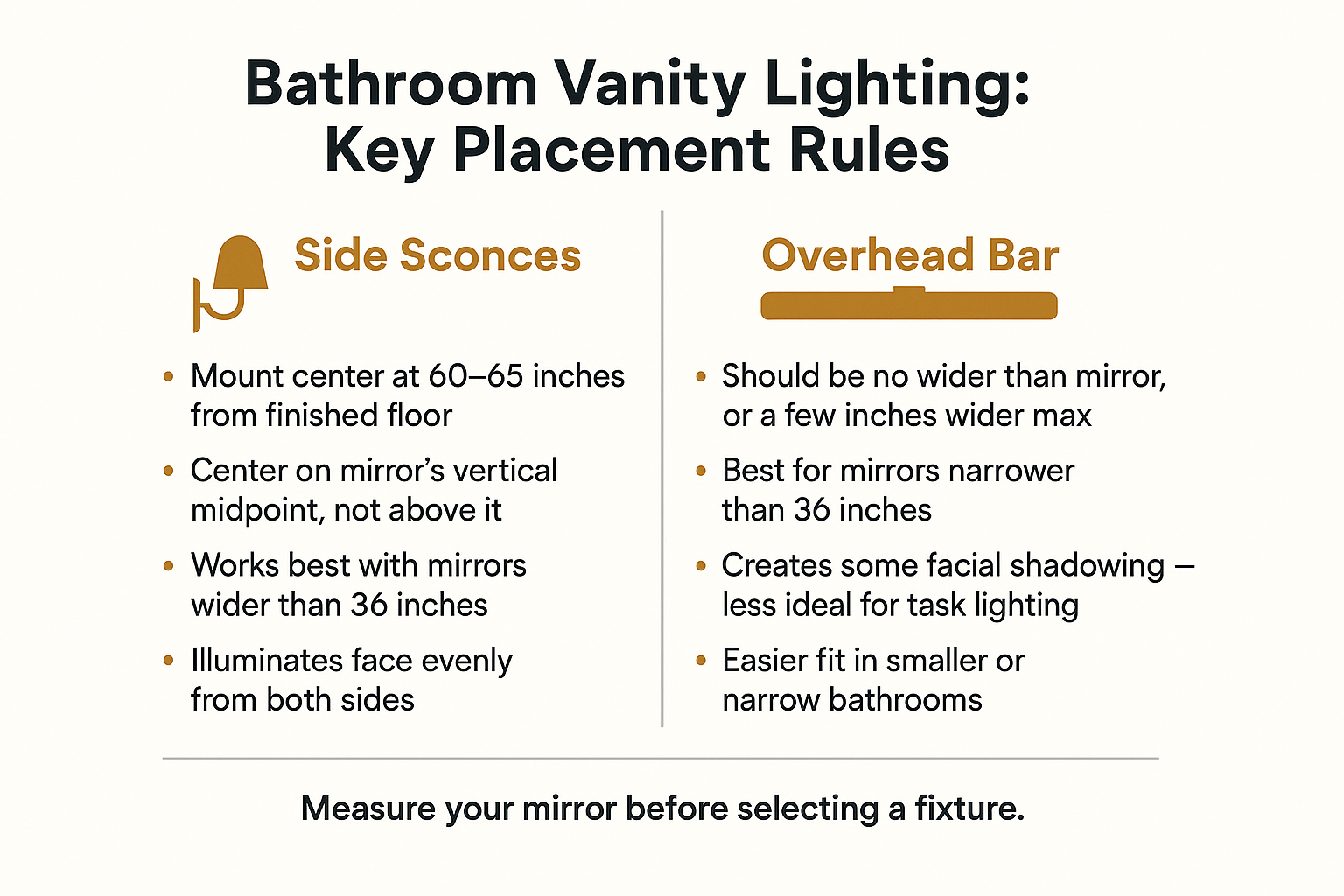
Vanity Lighting Placement at a Glance
These are the core dimensions that determine whether bathroom vanity lighting works — use them as a starting reference before your fixture selection.
Can a Vanity Light Overhang the Mirror — and How Much Is Too Much?
This question comes up more often than you might expect. The short answer is yes, a vanity bar can overhang the mirror slightly — but there are real limits.
An overhead bar that extends more than a few inches beyond the mirror’s edges on each side starts to look unbalanced. It also begins putting light at an angle that doesn’t serve the face the way a well-positioned fixture should. The fixture and the mirror are meant to work together visually and functionally, so a bar that dramatically overpowers the mirror in width undercuts both.
A practical guideline: the bar should be no wider than the mirror itself, or at most two to three inches wider on each side. That small amount of overhang is often intentional and can look clean. Anything beyond that is worth reconsidering — either by sizing down the fixture or sizing up the mirror.
For side sconces, the overhang question is different. Sconces flanking a mirror should be positioned so their center aligns with the mirror’s vertical midpoint — not above it. Mounting sconces above the mirror’s top edge pushes the light source higher than ideal and recreates the same shadowing problem you’d get from a too-high overhead bar.
If you’re working with a brushed nickel vanity light or a similar horizontal bar fixture, checking the fixture’s listed width against your mirror measurement before ordering is a simple step that prevents a lot of frustration.
Vanity Lighting Placement Quick Reference
Use this as a starting checklist when measuring your bathroom before selecting a fixture.
| Measurement | Standard Guideline | Notes |
|---|---|---|
| Sconce center height | 60–65 inches from finished floor | Adjust slightly for household height range |
| Bar fixture width | Equal to mirror width, or up to ~3 inches wider per side | Wider than that looks unbalanced |
| Sconce vertical position | Centered on mirror’s vertical midpoint | Not above the mirror’s top edge |
| Mirror width threshold for sconces | 36 inches or wider | Narrower mirrors often suit a bar better |
| Clearance from mirror edge (sconces) | 2–4 inches from mirror’s side edge to sconce center | Gives visual breathing room without losing even coverage |
Permitted Bathroom Remodels and California’s Energy Code
If your bathroom project is pulling a permit — which most significant remodels in Monterey County will — California’s energy code enters the picture. California Title 24, with updated requirements taking effect January 1, 2026, governs lighting controls and efficiency standards for residential remodels and new construction statewide.
In practical terms, a permitted bathroom renovation may need to address:
- Fixture wattage and LED compliance — most code-compliant fixtures today are already LED, but the spec matters during permit review
- Dimming controls — Title 24 often requires dimmable fixtures in certain residential spaces; the specifics depend on the scope of the remodel
- Occupancy or vacancy sensing — some permitted bathroom projects trigger sensor requirements depending on the extent of the work
The California Energy Commission publishes the current Building Energy Efficiency Standards, which is the authoritative source for what’s required. But for most homeowners, the clearest path is to confirm applicable requirements with your licensed contractor or electrician before finalizing fixture selections — not after.
For anyone doing a more involved project, the article on home lighting controls including dimmers and smart systems explains how these controls work in plain language, which can be helpful context when your contractor starts asking about dimmer compatibility.
What to Measure Before You Walk Into a Showroom
One pattern that comes up consistently with bathroom lighting inquiries is that customers arrive with a specific fixture model in mind but haven’t measured their mirror or confirmed their rough-in location. That’s not a criticism — it’s just the natural way people shop. But it often means the fixture they’ve picked won’t work in the space, which leads to delays or a second trip.
Before selecting any vanity fixture, it helps to know:
- Mirror width — the single most important dimension for deciding between a bar and sconces
- Mirror height — needed to find the vertical midpoint for sconce placement
- Distance from finished floor to existing electrical rough-in — this tells you whether your ideal sconce height is achievable without moving boxes
- Mirror-to-ceiling clearance — matters when sizing an overhead bar, particularly in bathrooms with lower ceilings
- Bathroom width — in narrow bathrooms, sconce projection depth becomes a real consideration
These are not complicated measurements. Most of them take five minutes with a tape measure. But having them in hand before you start selecting fixtures is what separates a confident decision from an expensive guess.
The broader principles behind how different fixture types serve different spaces can also help frame the decision before you get into the specifics of a particular model or finish.
Frequently Asked Questions About Bathroom Vanity Lighting
How high should bathroom sconces be mounted next to a mirror?
The center of a side-mounted sconce should sit at 60 to 65 inches from the finished floor — roughly eye level for most adults. Mounted higher, the light shines down onto the top of the head and creates unflattering shadows under the eyes and nose. Mounted lower than that range, it doesn’t illuminate the face evenly.
Can a vanity light be wider than the mirror?
Yes, but within reason. An overhead bar that extends two to three inches beyond the mirror’s edges on each side is generally fine and can look intentional. A bar that dramatically overhangs the mirror looks unbalanced and starts putting light at angles that don’t serve the face well. When in doubt, match the bar width to the mirror width or go slightly narrower.
Is a bar fixture or side sconces better for vanity lighting?
It depends on your mirror. For mirrors narrower than 36 inches, an overhead bar usually works well. For mirrors wider than 36 to 48 inches, side sconces at eye level tend to be the stronger functional choice — they illuminate the face from both sides and eliminate the shadow problem that a single overhead source creates. The bathroom’s overall size also plays a role: in a very small bathroom, sconces can project too far into the space.
Do I need to worry about California’s energy code for a bathroom remodel?
If your project is pulling a permit, yes. California Title 24 — with updated requirements effective January 1, 2026 — covers lighting controls and efficiency standards for residential remodels statewide. Depending on the scope of your project, you may need to address dimming controls, occupancy sensing, or specific fixture wattage. Confirm what applies to your project with your licensed contractor before finalizing any fixture selections.
Where should sconces be positioned relative to the mirror — centered on it, or above it?
Centered on the mirror’s vertical midpoint — not above the mirror’s top edge. Mounting sconces above the mirror pushes the light source too high and recreates the same downward-shadowing problem you’d get from an overhead fixture placed too high.
What should I bring with me when shopping for vanity lighting?
At minimum: your mirror’s width and height, the distance from the finished floor to your existing electrical rough-in boxes, and the mirror-to-ceiling clearance. These measurements are what determine which fixture types and sizes actually work in your space. Having them in hand makes the selection process much faster and prevents choosing a fixture that looks right online but doesn’t fit the wall.
Ready to Get Vanity Lighting Right the First Time?
Greg and Tammy at The Home Lighter work with homeowners across Monterey County — from Pacific Grove to Carmel Valley — who are in the middle of bathroom remodels and want guidance they can actually trust. Walk-ins are always welcome at the showroom at 2034 Sunset Drive in Pacific Grove, and appointments are available for more involved projects. You can also reach the showroom by phone at (831) 655-5500 if you want to talk through your measurements before making the trip.