
Direct Answer: The main types of residential light fixtures are chandeliers, pendants, flush mounts, semi-flush mounts, wall sconces, recessed downlights, and track heads — each one solves a different ceiling height, room size, or layering problem.
If you’ve ever typed ‘ceiling lights’ into a search bar and ended up more confused than when you started, you’re not alone. The terminology alone — semi-flush, torchiere, sconce, semi-pendant — can stop a shopping trip cold before you’ve even looked at a single fixture.
Most people don’t realize how many distinct fixture categories exist until they’re standing in the middle of a remodel trying to figure out what actually belongs on their ceiling. One homeowner who reached out about a hallway pendant quickly discovered she first needed to know her ceiling height, her junction box location, and whether she even wanted a pendant at all.
This guide walks through the most common residential fixture types in plain language — what each one looks like, what problem it solves, and where it breaks down. On the Monterey Peninsula, where homes range from low-ceiling cottages in Pacific Grove to vaulted-beam spaces in Carmel Valley, fixture type is rarely a one-size-fits-all decision.
The Core Fixture Types — What They Are and Where They Work
Let’s start with the categories you’ll encounter most often in a residential space.
Chandeliers are hanging fixtures that branch into multiple arms, shades, or light sources. They’re meant to be seen — the fixture itself is part of the room’s design. A chandelier over a dining table or in an entryway isn’t just providing light; it’s anchoring the whole space visually. If you want to know whether your ceiling can handle one at all, Is Your Ceiling Ready for a Chandelier? Here’s How to Tell covers exactly that.
Pendants also hang from the ceiling, but they’re typically a single light source on a single cord, rod, or chain. Think of a pendant over a kitchen island or a bedside pendant in place of a table lamp. The line between a pendant and a chandelier gets blurry with cluster pendants or linear multi-light bar fixtures — those borrow from both categories, and the label matters less than whether the scale and drop work for your room.
Flush mounts sit directly against the ceiling with no gap. They’re the right call when ceiling height is 8 feet or under — low enough that a hanging fixture would feel like it’s coming down at you. A tight bedroom, a low hallway, a small bathroom: flush mount territory.
Semi-flush mounts drop a few inches below the ceiling on a short stem. That small gap creates visual interest and a little more light spread than a flat flush mount, without the drama of a full chandelier drop. They work well in rooms where you want something that reads as a fixture rather than a utility light — but the ceiling isn’t tall enough to support a real hang.
Wall sconces are mounted directly to the wall and do something the ceiling fixtures can’t: they layer light at eye level. They’re useful in hallways, on either side of a bathroom mirror, flanking a bed, or framing a fireplace. Because they don’t require floor or table space, they’re a practical choice in tighter rooms where every square foot counts. More Than Just Something on the Ceiling: How Lighting Actually Shapes a Room gets into how wall-level light changes the feel of a space.
Recessed downlights (sometimes called can lights) sit flush inside the ceiling, casting light straight down or at an adjustable angle. They disappear into the ceiling plane, which is why so many homeowners over-rely on them — they feel like a safe, neutral choice. But a room lit only by recessed downlights tends to feel flat and shadowless. They work best as part of a layered plan alongside other fixture types.
Track heads are adjustable fixtures mounted on a single electrified track, letting you aim multiple light sources from one junction box. They’re common in kitchens, galleries, and anywhere you need directed light that can be repositioned without rewiring.
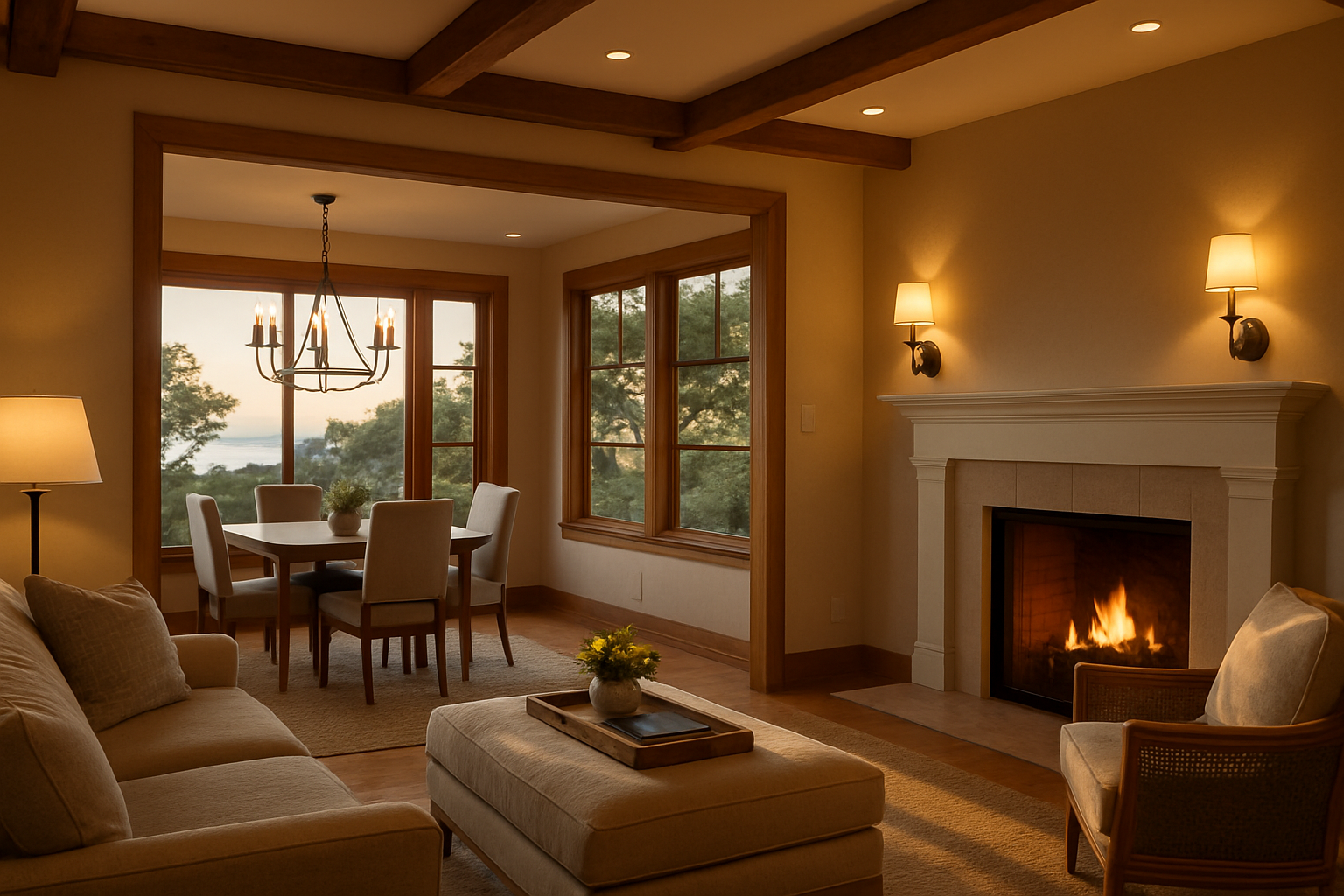
Why Ceiling Height Changes Everything
Fixture type and ceiling height interact in ways most people don’t think about until the fixture arrives and something feels off.
A chandelier that looks proportionate in a showroom photo — or a product image shot in a studio — may hang too low in a room with 8-foot ceilings. The general rule of thumb is to leave at least 7 feet of clearance between the floor and the bottom of a hanging fixture in any walk-through space. In a dining room where people are seated, you can go a little lower — but not much.
On the flip side, a flush mount that reads as subtle and modern in a smaller room can practically disappear in a space with 12- or 14-foot ceilings. Vaulted ceilings, open beams, and tall entryways are extremely common in Carmel Valley ranch homes and Pacific Grove Victorians alike — and those spaces call for fixtures with real visual weight and enough drop to feel present in the room.
Before you start shopping by style, know these numbers:
- Ceiling height — measure at the peak for vaulted or cathedral ceilings
- Junction box location — centered, off-center, or near the wall changes what fixture type is even practical
- Room dimensions — a larger room needs a larger or more numerous fixture to avoid looking underwhelming
- Clearance from furniture — over an island or dining table, 30 to 36 inches from the fixture bottom to the surface is the typical target range
For help sizing a chandelier specifically, the Chandelier Size Calculator: A Pro’s Guide to Perfect Sizing is worth a look before you commit to anything.
Quick Reference: Which Fixture Type Goes Where
This reference shows the most common fixture types, their ideal ceiling conditions, and where they’re typically used in a home.
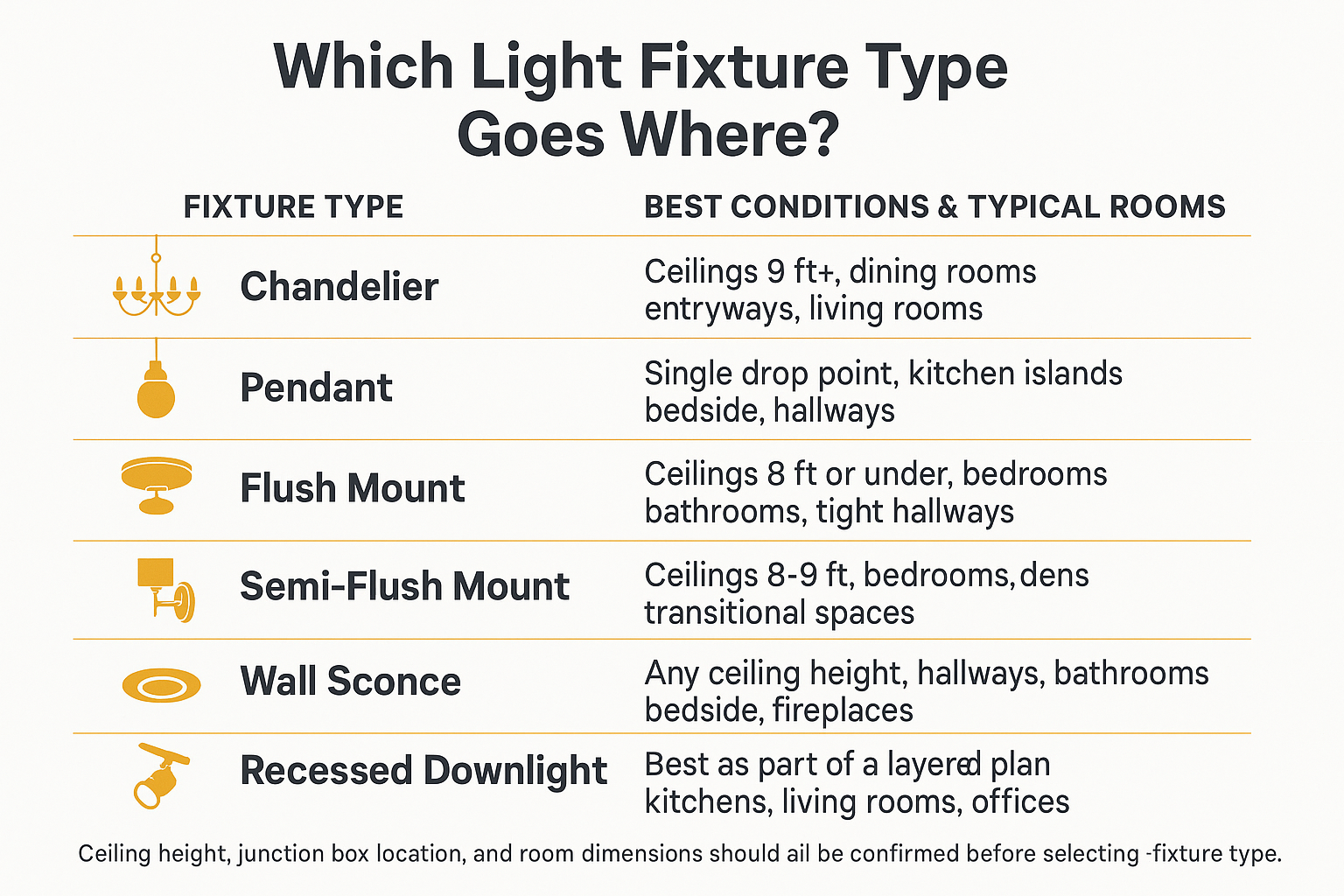
Fixture Types at a Glance
A quick summary of each fixture category, the ceiling condition it suits best, and the rooms where it most commonly shows up.
| Fixture Type | Ceiling Height Sweet Spot | Common Rooms |
|---|---|---|
| Chandelier | 9 ft and above | Dining room, entryway, living room |
| Pendant | 8 ft and above (adjust drop) | Kitchen island, hallway, bedside |
| Flush Mount | Under 8 ft | Bedroom, bathroom, low hallway |
| Semi-Flush Mount | 8–9 ft | Bedroom, den, transitional spaces |
| Wall Sconce | Any height | Hallway, bathroom vanity, bedside, fireplace |
| Recessed Downlight | Any height (best layered) | Kitchen, living room, office |
| Track Head | Any height | Kitchen, studio, gallery, accent zones |
The Pendant vs. Chandelier Question — and Why It Gets Murky
This is probably the most common point of confusion for homeowners shopping ceiling fixtures, and it’s worth addressing directly.
Both pendants and chandeliers hang from the ceiling. The clearest distinction is that a pendant is one light source suspended on one cord, rod, or chain — while a chandelier branches into multiple arms, shades, or sockets. A single globe hanging over a kitchen island is a pendant. A branching fixture with six candle arms over a dining table is a chandelier.
But modern fixture design blurs those lines constantly. A cluster pendant groups multiple single-cord bulbs from one canopy — it hangs like a pendant but spreads light like a chandelier. A linear suspension fixture (long and horizontal, popular over rectangular dining tables) borrows from both categories depending on how many light sources it holds. And a multi-light pendant might use three shades on separate cords from a single canopy — pendant or chandelier? Genuinely depends on who you ask.
The practical takeaway: don’t get too attached to the label. What matters is the scale, the drop length, and whether the fixture reads as a statement or a utility. For rooms where a chandelier might actually be the right answer, The Rooms Where a Chandelier Actually Makes Sense breaks that down by room type.
Fixture Type Is the First Decision, Not the Last
A lot of homeowners start shopping by style — they search ‘modern chandelier’ or ‘farmhouse pendant’ and spend an hour scrolling before realizing they haven’t answered any of the foundational questions yet.
Fixture type should come first. Once you know whether your space calls for a flush mount, a semi-flush, or a hanging fixture with real drop, you’ve narrowed the field considerably. Then style, finish, and bulb type all follow from there.
The sequence matters because returns are common when the order gets reversed. Someone falls in love with a chandelier online, orders it, and discovers it hangs 6 inches too low for their 8-foot ceiling. Or they buy a flush mount that looked substantial in photos and find it reads as a night light in their vaulted living room.
There are also layering decisions to think through — most well-lit rooms use at least two fixture types working together. A kitchen might combine recessed downlights with pendants over the island and a sconce or two near the sink. A bedroom might use a semi-flush mount as the primary fixture and wall sconces for reading. Understanding what each type contributes to the room’s overall light makes those combinations easier to plan. Ambient Lighting for Home: The Monterey Guide covers how those layers actually work together.
And once you’ve settled on fixture type, bulb type becomes the next real variable — color temperature and dimming compatibility both depend on what fixture you’re running. The Difference Between Dim and Warm (And Why It Matters) is a useful next read once you’re at that stage.
Frequently Asked Questions About Types of Light Fixtures
What’s the difference between a flush mount and a semi-flush mount?
A flush mount sits flat against the ceiling with no visible gap. A semi-flush mount has a short stem that drops a few inches below the ceiling, giving the fixture a little more visual presence. If your ceiling is under 8 feet, flush mount. If it’s around 8 to 9 feet and you want something that reads as a real fixture without a full hanging drop, semi-flush is usually the better call.
Can I use a chandelier in a room with 8-foot ceilings?
It depends on the chandelier’s dimensions and how much drop you can afford. The general clearance target for a walk-through space is at least 7 feet from floor to the bottom of the fixture — which leaves very little room in an 8-foot ceiling once you account for the canopy and any drop rod. Short, compact chandeliers or flusher-profile designs can sometimes work, but many standard chandeliers simply hang too low to be safe or comfortable. Measuring before you buy is worth the extra ten minutes.
Are recessed lights a replacement for other fixture types?
Not really. Recessed downlights are great for general illumination and task lighting, but a room lit only by recessed lights tends to feel flat — no shadows, no warmth variation, no visual focal point. They work best as one layer in a plan that also includes a statement fixture or wall sconces. Many homeowners in Monterey County end up adding sconces or pendants specifically because their remodel relied entirely on can lights and the room never felt quite right.
What fixture type works best in a hallway?
Hallways are usually best served by flush mounts (for low ceilings), semi-flush mounts (for standard ceilings), or wall sconces — especially in longer hallways where a series of sconces can create a clean, rhythmic look. Pendants can work in a wide entry hallway or foyer, but in a narrow corridor the drop can feel intrusive.
Do I need to know my junction box location before picking a fixture?
Yes — and it matters more than most people realize. The junction box position determines where the fixture hangs in relation to the room. A centered box is ideal for a chandelier or pendant. An off-center box may mean a track system, a surface-mounted option, or repositioning the box (which requires an electrician). Your licensed electrician should confirm box location and weight rating before any fixture is installed.
I have vaulted ceilings — does that change which fixture types make sense?
Vaulted and cathedral ceilings are common in Carmel Valley and Pacific Grove homes, and yes, they change the equation significantly. High ceilings need fixtures with enough visual weight and drop to feel present in the space — a small flush mount on a 14-foot vaulted ceiling will look lost. Chandeliers, large pendants, and semi-flush mounts with real scale are usually the right direction. You’ll also want to confirm that any hanging fixture comes with an adjustable-length drop rod or chain to set the hanging height correctly.
Not Sure Which Fixture Type Fits Your Space?
Greg and Tammy at The Home Lighter have been helping Monterey Peninsula homeowners sort through exactly these questions since 1969 — from low-ceiling Pacific Grove bungalows to open-beam Carmel Valley great rooms. Walk-ins are always welcome at the showroom at 2034 Sunset Drive in Pacific Grove, and appointments are available for more involved projects like whole-home fixture planning or new construction. Give them a call at (831) 655-5500 to talk through what your space actually needs before you start shopping.