
Direct Answer: Most ceilings can support a chandelier, but you need to verify ceiling height, junction box weight rating, and fixture size before you buy anything.
You’ve found a chandelier you love. Maybe it’s a statement piece for your dining room in Carmel Valley, or a layered entry fixture for a home in Pebble Beach. And then the question hits: can my ceiling actually handle this?
It’s a fair question, and not enough people ask it before they buy. The wrong fixture for the wrong ceiling creates real problems — a chandelier that’s too heavy for the box, hung too low for the room, or wildly out of proportion for the space.
The good news is that most ceilings can support a chandelier with the right preparation. What you need to know before you shop comes down to three things: ceiling height, junction box capacity, and fixture sizing. Get those right, and everything else falls into place.
Ceiling Height: The Number That Changes Everything
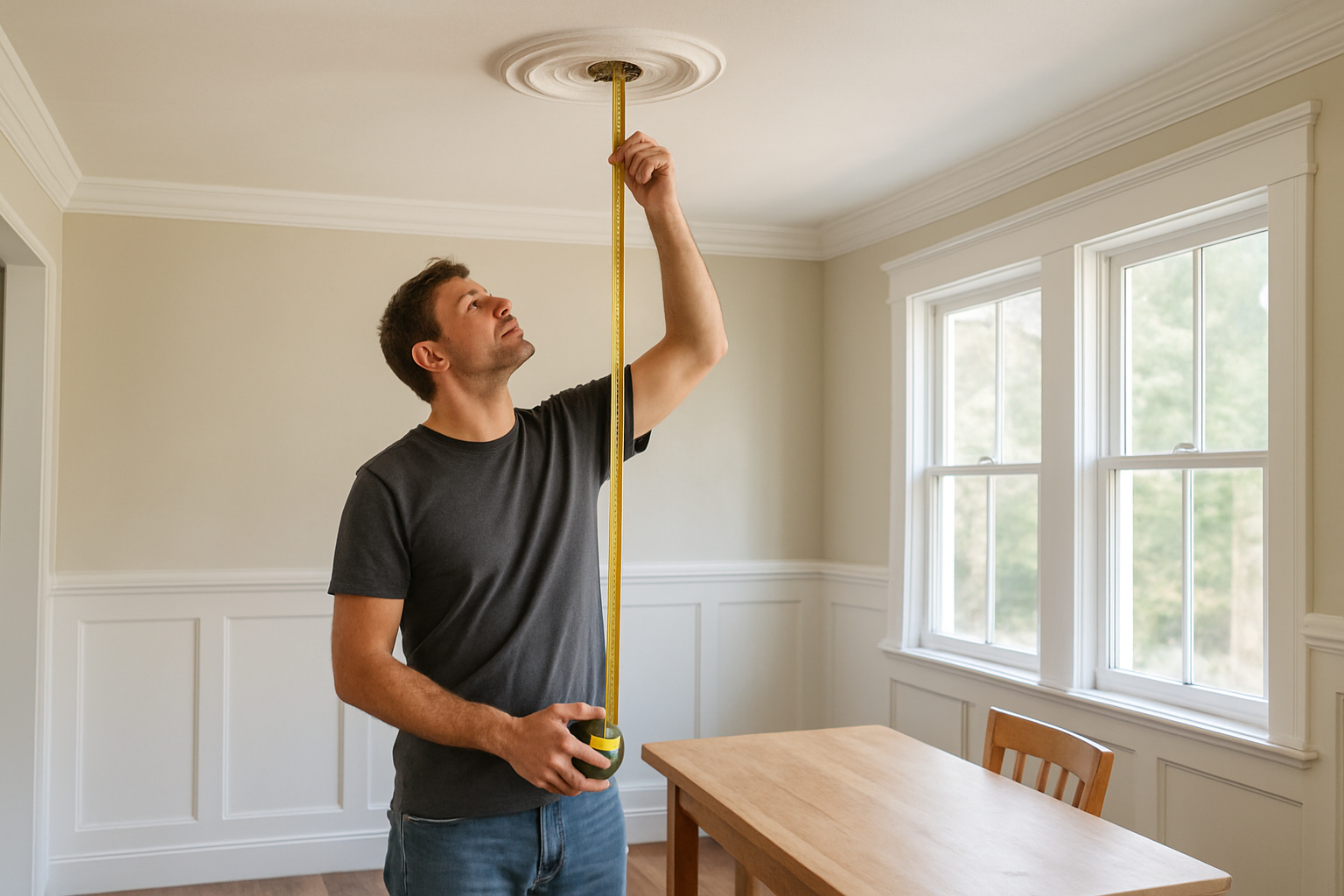
Standard ceiling height in most homes is 8 feet. That’s workable for a chandelier, but it leaves very little margin for error — especially in a dining room, where the fixture needs to hang low enough to feel intimate but high enough that nobody bumps their head.
The general rule most lighting designers follow:
- Over a dining table: hang the bottom of the fixture 30 to 36 inches above the tabletop
- In an entry or foyer: the bottom of the chandelier should clear the floor by at least 7 feet
- In a living room or bedroom: same 7-foot clearance from the floor applies
If your ceiling is 8 feet, you can still do it — but a low-profile or semi-flush chandelier is often the smarter choice. Once you hit 9 or 10 feet, you have real room to work with, and that’s where a traditional drop chandelier starts to look truly at home.
Many Monterey Peninsula homes — particularly older Craftsman and Victorian-era homes in Pacific Grove — have 8-foot ceilings on the main floor and taller ceilings in entry halls. That entry hall is often the best place to make a chandelier statement when the rest of the home is more constrained.
For help thinking through the rooms where a chandelier actually makes sense, that guide walks through room-by-room logic in plain terms.
The Junction Box Question — and Why It Matters More Than Most People Think
This is the part that surprises people the most. The junction box in your ceiling — that round electrical box the fixture connects to — has a weight rating stamped right on it. Standard boxes are rated for 35 to 50 pounds. Fan-rated boxes are typically rated for 150 pounds with movement factored in.
Many chandeliers, especially larger or more ornate ones, weigh 40 to 80 pounds or more. A box that’s not rated for the load can pull out of the ceiling — and that’s a serious safety issue, not just a cosmetic one.
Before anything else, have your licensed electrician check what’s in your ceiling. If the existing box can’t handle the fixture you want, they can install a fan-rated brace bar kit — a steel brace that anchors between two ceiling joists — which can typically support 150 pounds or more. This is a common fix and not an expensive one; most electricians in Monterey County charge somewhere in the range of $75 to $150 for the swap, depending on accessibility.
What you should verify before you buy:
- Current junction box weight rating (look for a stamp or label inside the box)
- Whether the box is mounted to a joist or floating between them
- Whether the box is older than 20 years — older boxes may not meet current load ratings
For homes in Carmel-by-the-Sea going through permitted remodels, California Title 24 may also affect what controls and components are required in the ceiling cavity. This guide on interior lighting fixtures in Carmel and Title 24 rules explains what’s currently in play for residential projects.
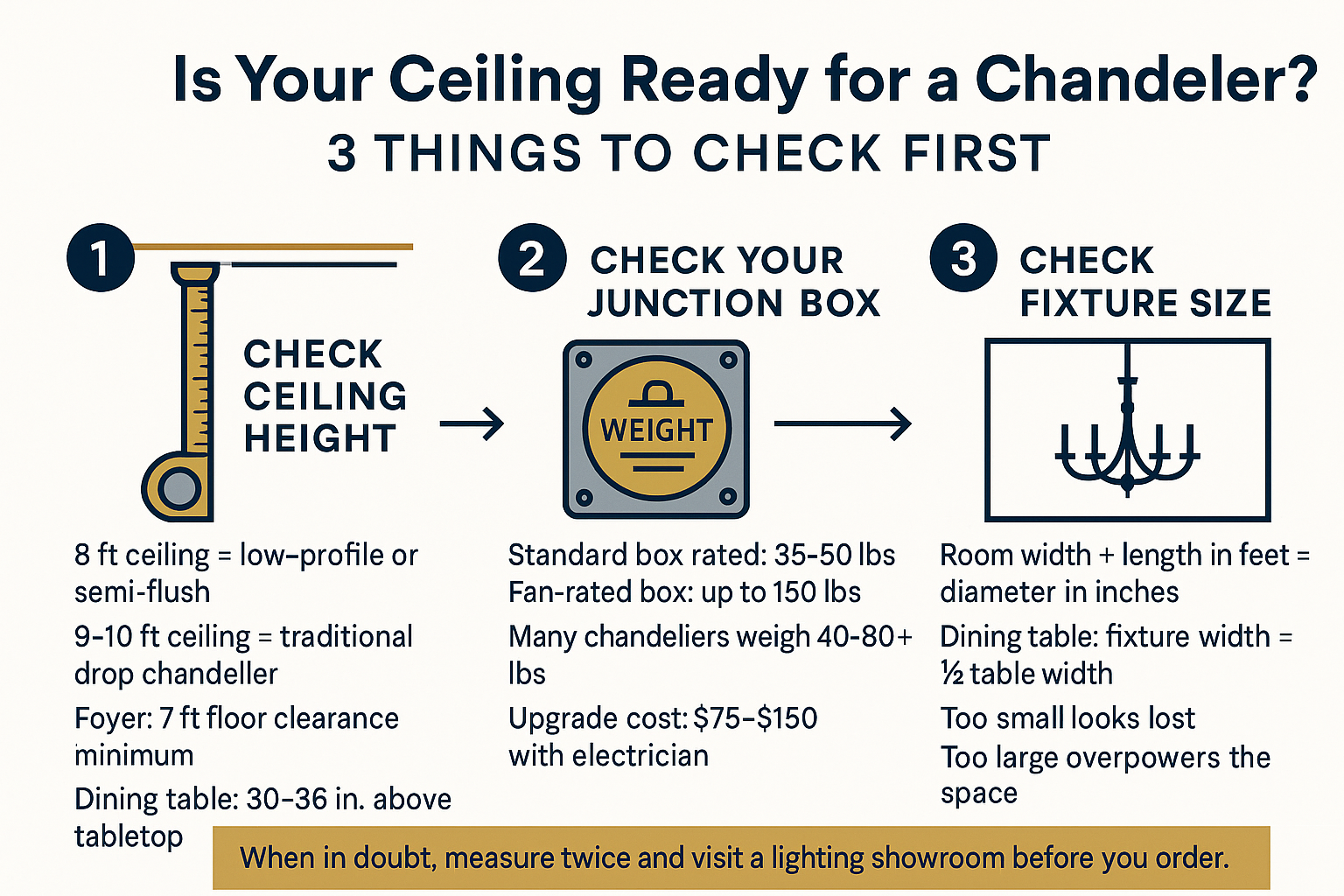
Chandelier Ceiling Readiness: A Quick-Check Guide
Use this reference before you visit a showroom or order anything. It covers the three factors that determine whether your ceiling and room are ready for a chandelier.
Fixture Sizing: The Formula Most Homeowners Skip
A chandelier that’s too small looks lost. One that’s too large makes the room feel crowded. Sizing is one of those things that seems subjective but actually has a straightforward starting point.
For general rooms, add the room’s length and width in feet. That number in inches gives you a reasonable chandelier diameter. A 12 x 14 foot living room (26 feet total) points you toward a fixture roughly 24 to 28 inches in diameter.
For dining rooms, the fixture width should be roughly half the width of the table. A 48-inch wide table works well with a chandelier between 22 and 26 inches across. Go wider than half the table and it starts to feel top-heavy; go narrower and it looks like an afterthought.
This is where seeing a fixture in person — rather than on a screen — makes a genuine difference. A 24-inch chandelier looks very different hanging in a showroom at the right height than it does photographed against a white backdrop on a website. Why buying lighting locally still makes a difference covers exactly that problem and why it’s especially true with larger statement pieces.
For a more detailed breakdown of the math, the chandelier size calculator guide walks through different room types and table configurations with real numbers.
Chandelier Readiness: What to Check Before You Shop
Run through these three checks before you walk into a showroom or make any decisions. Knowing these numbers will make the selection process faster and more accurate.
| What to Check | What You’re Looking For | What Happens If You Skip It |
|---|---|---|
| Ceiling height | 8 ft minimum; 9–10 ft for full drop fixtures | Fixture hangs too low; safety and proportion issues |
| Junction box rating | 35–50 lbs standard; 150 lbs fan-rated | Fixture can pull from ceiling under its own weight |
| Fixture diameter | Room L+W in feet = diameter in inches | Fixture looks lost or overwhelms the space |
| Canopy and chain length | Adjustable chain standard; some fixtures fixed | Wrong drop length for your ceiling height |
| Ceiling slope or angle | Sloped ceiling needs an angled canopy adapter | Standard canopy won’t sit flush; fixture hangs crooked |
One More Thing: Sloped and Vaulted Ceilings
A lot of homes on the Monterey Peninsula — particularly newer builds in Carmel Valley and custom homes in Pebble Beach — have vaulted or sloped ceilings in the main living areas. These look beautiful, but they create a specific challenge for chandelier installation.
Most standard canopies sit flat against a horizontal ceiling. On a sloped ceiling, you need an angled canopy adapter — sometimes called a swivel canopy — that allows the chandelier to hang plumb even when the ceiling above it is at an angle. Not every fixture comes with one, and not every fixture is compatible with one.
This is worth checking with your electrician before you select a fixture. The adapter itself is usually $15 to $40, but if the fixture you love doesn’t support it, you’ll need to choose something that does.
The other consideration with vaulted ceilings is ceiling height at the peak versus the sides. The peak might be 14 feet, but if the chandelier hangs in the center of a living room where the ceiling slopes down to 9 feet at the walls, the actual hang point may be higher than you expect — which affects how the fixture reads from eye level. Measure at the hang point, not the peak.
Frequently Asked Questions About Chandelier-Ready Ceilings
Do I need an electrician before I buy a chandelier?
Not before you buy, but you’ll definitely need one before installation. What’s worth doing ahead of time is asking your electrician to check the junction box rating in the room where you’re planning to hang the fixture. That tells you whether the existing box can handle the weight, or whether it needs to be upgraded. Knowing that before you shop helps you avoid falling in love with a 70-pound iron chandelier when your box is only rated for 35.
My ceiling is only 8 feet. Can I still have a chandelier?
Yes, but you need to be selective about the fixture. Look for chandeliers with a shorter drop or a semi-flush design that mounts closer to the ceiling. Many manufacturers make 8-foot-ceiling-friendly versions of their most popular styles. The key number in a dining room is 30 to 36 inches above the tabletop — work backward from there to figure out how much vertical space you have to work with.
How heavy is too heavy for a standard junction box?
A standard box is rated for 35 to 50 pounds. Anything heavier than that needs either a fan-rated box or a brace bar upgrade. Many decorative chandeliers — especially larger wrought iron, crystal, or multi-arm fixtures — exceed that range. Always check the fixture’s listed weight before assuming your existing box is sufficient.
What if I want a chandelier in a room that doesn’t have a ceiling light at all?
That’s a bigger electrical project, but it’s done regularly. Your electrician will need to run a circuit to the location and install a properly rated junction box. Cost varies depending on whether there’s attic access above the room and how far the new circuit needs to run. In Monterey County, expect somewhere in the range of $300 to $700 for a straightforward new ceiling circuit — more if the ceiling is difficult to access or the panel needs work.
Does the finish or style of the chandelier affect which ceiling it works in?
Structurally, no — finish doesn’t affect weight or installation. But visually, it matters a lot. A dark iron chandelier in a room with white 8-foot ceilings can feel heavy. A lighter brass or chrome fixture in the same space reads as more open. This is one of those decisions that’s much easier to make when you can see the fixture in context rather than on a product page.
I have a ceiling fan now. Can I replace it with a chandelier in the same spot?
Often yes — and this is actually a good situation to be in. Ceiling fans require a fan-rated junction box, which is typically rated for 150 pounds. That means the box that’s already there can likely handle most chandeliers without any upgrade. Have your electrician confirm the rating, and you’re probably ready to go.
Ready to Find the Right Chandelier for Your Ceiling?
Greg and Tammy at The Home Lighter have been helping Monterey Peninsula homeowners work through exactly these questions since 1969 — ceiling height, box ratings, fixture sizing, and everything in between. Stop by the showroom at 2034 Sunset Drive in Pacific Grove any time — walk-ins are always welcome, and appointments are available if you’re working through a larger remodel. You can also call at (831) 655-5500 to talk through your space before you make the trip.