
Direct Answer: Buying lighting locally means seeing true finish colors, getting layout advice before you buy, and avoiding the costly returns that come from ordering fixtures that look nothing like the photos online.
Most homeowners start their lighting search online. It feels efficient — thousands of fixtures, fast shipping, easy price comparison. Then the box shows up, and the brass looks nothing like the photos, the scale is completely off, and suddenly there’s a $400 return sitting in the garage.
That story plays out constantly on the Monterey Peninsula, where homes in Carmel-by-the-Sea, Pacific Grove, and Pebble Beach tend to have specific architectural personalities — coastal cottages, mid-century ranches, Mediterranean estates — that demand fixtures with some design intention behind them. A generic online catalog isn’t built for that.
This article isn’t about dismissing online shopping entirely. It’s about understanding what you actually get when you buy from a local lighting showroom, and where that matters most when you’re making decisions that will live in your home for the next ten to twenty years.
The Problem with Ordering Lighting You’ve Never Seen in Person
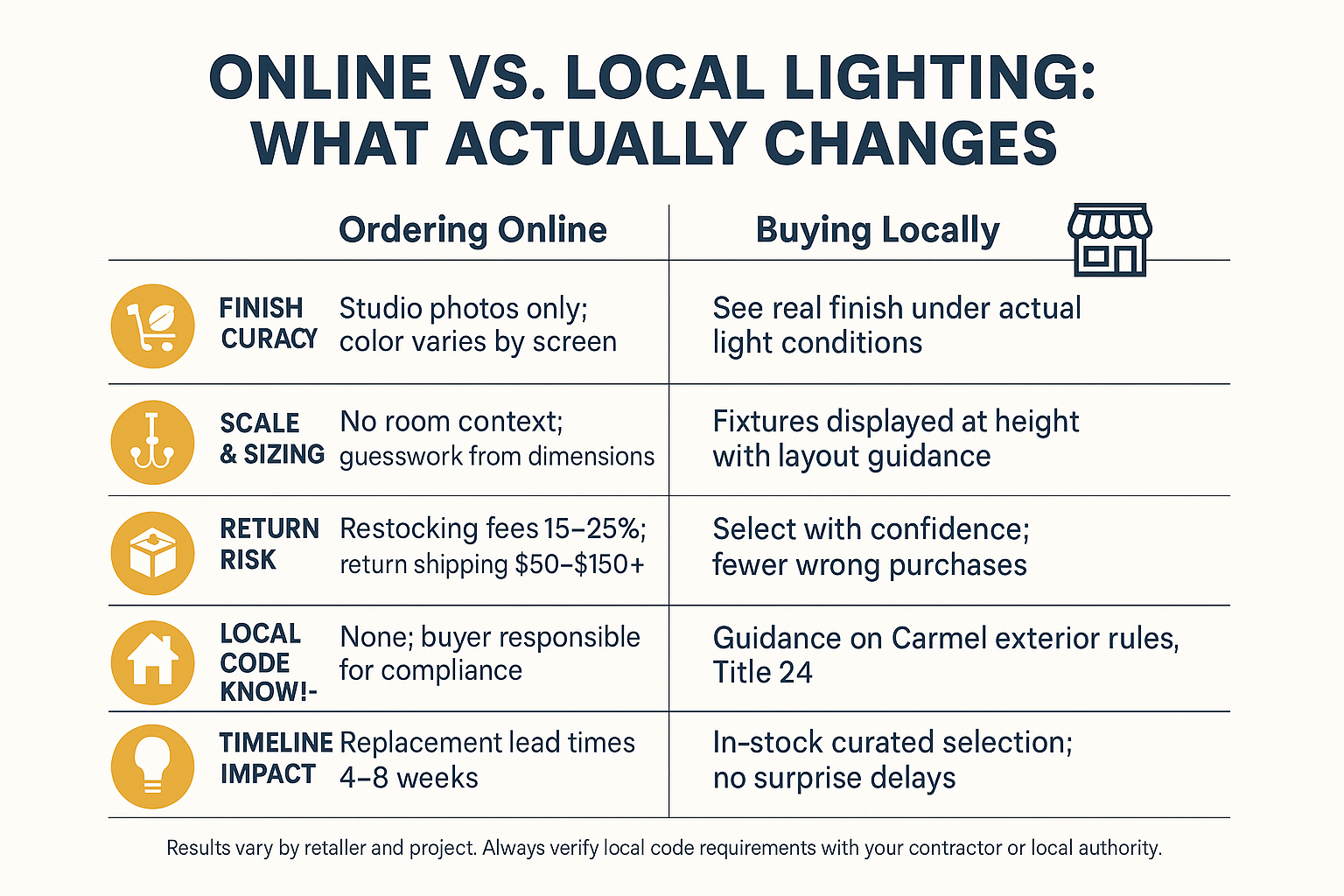
Fixture photography is one of the most misleading categories in all of retail. Manufacturers shoot against white backgrounds with studio lighting designed to make every finish look its best. A “warm brass” online can arrive looking closer to gold — or flat yellow — depending on the light in your actual home.
Finish perception is only part of the problem. Scale is the other. Online listings typically show fixtures isolated, with no surrounding context. A pendant that reads as mid-sized in a product photo might be comically small over a kitchen island in a 9-foot-ceiling home in Carmel Valley. Knowing how to size fixtures before you buy isn’t guesswork — it’s a skill, and it requires knowing the room, not just the listing. The Chandelier Size Calculator guide covers the math, but even the math depends on having accurate room measurements and ceiling height in hand before you choose.
The return process for online lighting is also more painful than most people expect:
– Most vendors charge restocking fees of 15–25%
– Shipping a damaged or oversized fixture back can cost $50–$150 or more
– Lead times on replacements can run 4–8 weeks for anything not in stock
If you’re on a remodel timeline — which most Peninsula homeowners are — that delay can push back your electrician’s rough-in schedule and everything that follows it.
What You Actually Get from a Local Lighting Showroom
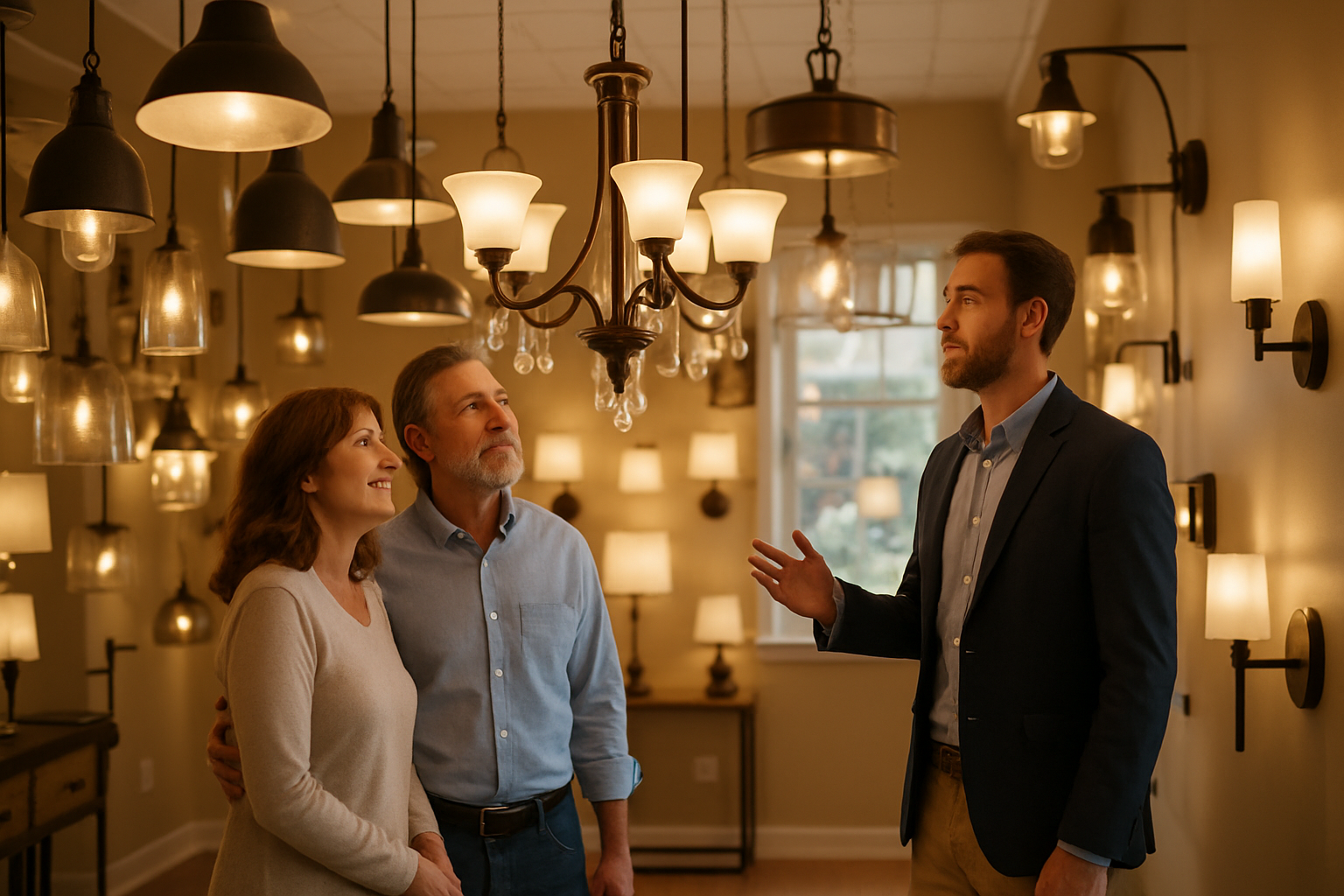
Walking into a good local showroom is a different experience than most people expect — and not just because the fixtures are lit and displayed. The real value is the conversation that happens before you point at anything.
A knowledgeable showroom consultant will ask about your ceiling height, your existing finishes, your natural light conditions, and what the room needs to do — reading, cooking, entertaining, sleeping. How the right fixture changes everything in a room isn’t just a design principle; it’s a practical reality that only surfaces when someone helps you think through the whole picture.
Here’s what that in-person process gives you that online shopping doesn’t:
- Finish accuracy — you see the actual color under warm and cool light, not a studio photo
- Scale reference — fixtures are displayed at real heights in real room simulations
- Layering advice — guidance on combining ambient, task, and accent sources so nothing looks flat
- Local code awareness — particularly relevant for outdoor fixtures in Carmel, where exterior lighting rules cap color temperature at 3000K and restrict lumen output
- Spec support for contractors and designers — trade customers can work through layout and fixture specs before the job starts, not after
None of that shows up in a product listing. And none of it costs extra — it’s part of what a good local showroom offers because they’re invested in you leaving with the right fixture, not just a fixture.
Online vs. Local: What Changes When You Buy in Person
This comparison breaks down the key differences between ordering lighting online and buying from a local showroom — across the factors that matter most when a fixture is going to live in your home for years.
<h2 id="where-local-expertise-pays-for-itself-remodels-and-whole-home-projects“>Where Local Expertise Pays for Itself: Remodels and Whole-Home Projects
Single fixture purchases are one thing. But the local advantage gets dramatically more valuable when you’re doing a kitchen remodel, bathroom renovation, or whole-home fixture refresh — the kinds of projects that are common in Carmel Valley and Pebble Beach, where homes frequently trade hands and get updated before or after sale.
On a kitchen remodel, you’re typically coordinating three to five fixture types in one room: recessed cans, pendants over an island, under-cabinet task lighting, and sometimes a statement piece over a dining area nearby. Getting those to work together — in finish, in scale, in color temperature — is a design problem, not a shopping problem. Lighting a coastal kitchen involves thinking about how morning fog light and afternoon sun change the way finishes read throughout the day.
For bathroom vanity work specifically, the placement of fixtures relative to the mirror, the color temperature of the bulbs, and the CRI (color rendering index) all affect how people actually look and feel in that space. A CRI of 90 or above is generally recommended for vanity lighting — and that’s not information most online product pages lead with. Understanding what CRI means in real terms can be the difference between a bathroom that flatters and one that makes everyone look slightly unwell.
A local showroom handles that coordination across rooms and fixtures in a way that a browser tab cannot.
Common Lighting Mistakes and What They Actually Cost
These are the errors that come up most often when homeowners skip the in-person selection process — and what fixing them typically runs on the Central Coast.
| Mistake | What Goes Wrong | Typical Cost to Fix |
|---|---|---|
| Wrong fixture scale | Pendant too small over island; chandelier overwhelms entry | $200–$600 replacement + restocking fee |
| Mismatched finish | Brass fixture reads gold next to satin nickel hardware | $150–$500 replacement + shipping both ways |
| Wrong color temperature outdoors | Carmel exterior fixture exceeds 3000K ordinance limit | Fixture replacement required; potential compliance issue |
| No layered lighting plan | Single overhead source leaves room flat and dim | $300–$1,200+ to add sconces or undercabinet lighting later |
| Low CRI bulbs in vanity | Skin tones look off; makeup application unreliable | $50–$200 in bulb replacement; sometimes fixture swap needed |
Frequently Asked Questions About Buying Lighting Locally
Is local lighting actually more expensive than buying online?
Sometimes the sticker price is higher — but that comparison rarely accounts for return shipping, restocking fees, or the cost of ordering twice when the first fixture is wrong. On the Monterey Peninsula, where remodels carry contractor day-rates of $100–$250 per hour, a wrong fixture that delays your electrician is a far bigger expense than any showroom price difference.
Can a showroom help me if I already know what I want?
Yes, and often they can source it or find something comparable. If you’ve seen a specific fixture online, a good local showroom can tell you whether it’s the right scale for your space, whether the finish will work with your existing hardware, and sometimes whether there’s a better option at a similar price point. Bringing photos and room measurements with you makes that conversation faster.
What should I bring to a lighting showroom appointment?
At minimum: ceiling height, room dimensions, photos of your existing finishes (hardware, cabinetry, flooring), and a rough sense of your fixture budget. If you’re doing a remodel, a floor plan or contractor drawing is even better. The more context you bring, the more specific the guidance can be.
Do I need an appointment, or can I just walk in?
Walk-ins are welcome at The Home Lighter’s showroom at 2034 Sunset Drive in Pacific Grove. If your project is more involved — a whole-home refresh or a new construction spec — calling ahead at (831) 655-5500 means Greg or Tammy can set aside time to go deeper with you.
What about Carmel’s outdoor lighting rules — how does a local showroom help with that?
Carmel-by-the-Sea caps exterior residential fixture color temperature at 3000K and restricts lumen output for landscape and architectural lighting. A local showroom that knows the Peninsula can steer you toward compliant fixtures from the start, rather than leaving you to discover a problem after installation. Always confirm current requirements with your contractor or the City of Carmel directly, but starting with fixtures already in the right range saves a lot of headache. Why outdoor lighting on the Monterey Peninsula needs a different approach covers this in more detail.
Does The Home Lighter install the fixtures they sell?
No — installation is not something the showroom provides. You’ll work with your licensed electrician or contractor for that part of the project. What the showroom does is make sure you arrive at that installation day with fixtures that are right for the space, compliant with local requirements, and coordinated across the whole project.
Ready to Choose Fixtures You’ll Actually Be Happy With?
Greg and Tammy at The Home Lighter have been helping Monterey Peninsula homeowners make confident lighting decisions since 1969 — from single fixture replacements to whole-home remodel specs. The showroom at 2034 Sunset Drive in Pacific Grove is open to walk-ins, and the team is available by phone at (831) 655-5500 for questions before you make the trip.