
Direct Answer: Good entryway lighting design pairs a properly scaled overhead fixture with sconces or a lamp, so the space feels layered instead of lit by one dim ceiling light.
Most people shop for entry lighting the same way they shop for a replacement filter. It ends up on a list with a bathroom vanity fixture and a kitchen pendant, and it gets whatever attention is left over.
But the entry is the one space every single visitor experiences before they see any other room. Whatever it says about your house, they believe it, because they have nothing else to compare it to yet.
This guide covers the three decisions that actually change how an entry feels: getting the scale right, deciding whether the fixture is background or statement, and coordinating the porch light with the foyer light. It also covers what Carmel-by-the-Sea’s exterior lighting rules mean for that last one.
Why Entryway Lighting Design Works Differently Than Other Rooms
A living room gets help. It has windows, lamps on end tables, maybe a floor lamp in the corner and light spilling in from the kitchen.
An entry usually has none of that. Many Peninsula foyers have no window at all, or one narrow sidelight next to the door. Whatever the fixture puts out is the entire lighting picture, day and night.
That changes what matters in the fixture you pick:
- Total output has to carry the space alone, not supplement daylight
- Light distribution matters because one hot spot in the middle leaves the corners dark
- Color quality shows up immediately on faces, floors, and finishes
- Scale reads instantly, since there is no furniture to distract from it
Entries also work hard. People set bags down, check the mirror, look for keys, and greet each other. A single dim ceiling light handles none of those well.
If you want a framework for sizing up a space before you shop, how to read a room before you pick a light fixture walks through the same thinking applied to any room in the house.
The Scale Problem: Almost Every Entry Fixture Is Too Small
This is the most common mistake, and it is easy to make. A fixture that looked substantial hanging in a showroom looks tentative once it is up in a foyer with a 10-foot ceiling.
Newer construction through Carmel Valley and in the hills above Monterey often has entry ceilings at 10 feet, and plenty of two-story foyers run higher. A 12-inch flush mount sized for a bedroom disappears up there.
A rule of thumb designers use: add the length and width of the entry in feet, then use that number in inches as your fixture diameter. A 6 by 8 foot entry points toward a fixture around 14 inches wide. Treat it as a starting point, not a law.
For hanging height, the standard guidance is:
- Keep the bottom of the fixture at least 7 feet above the floor in a walk-through path
- In a two-story foyer, center the fixture in the window when viewed from outside
- Allow roughly 2.5 to 3 inches of fixture height per foot of ceiling height
One more thing worth checking before you fall in love with something large: the ceiling has to support it. Is your ceiling ready for a chandelier covers box ratings and weight, and your licensed electrician should confirm the mounting before anything is ordered.
One Fixture Is Not a Lighting Plan
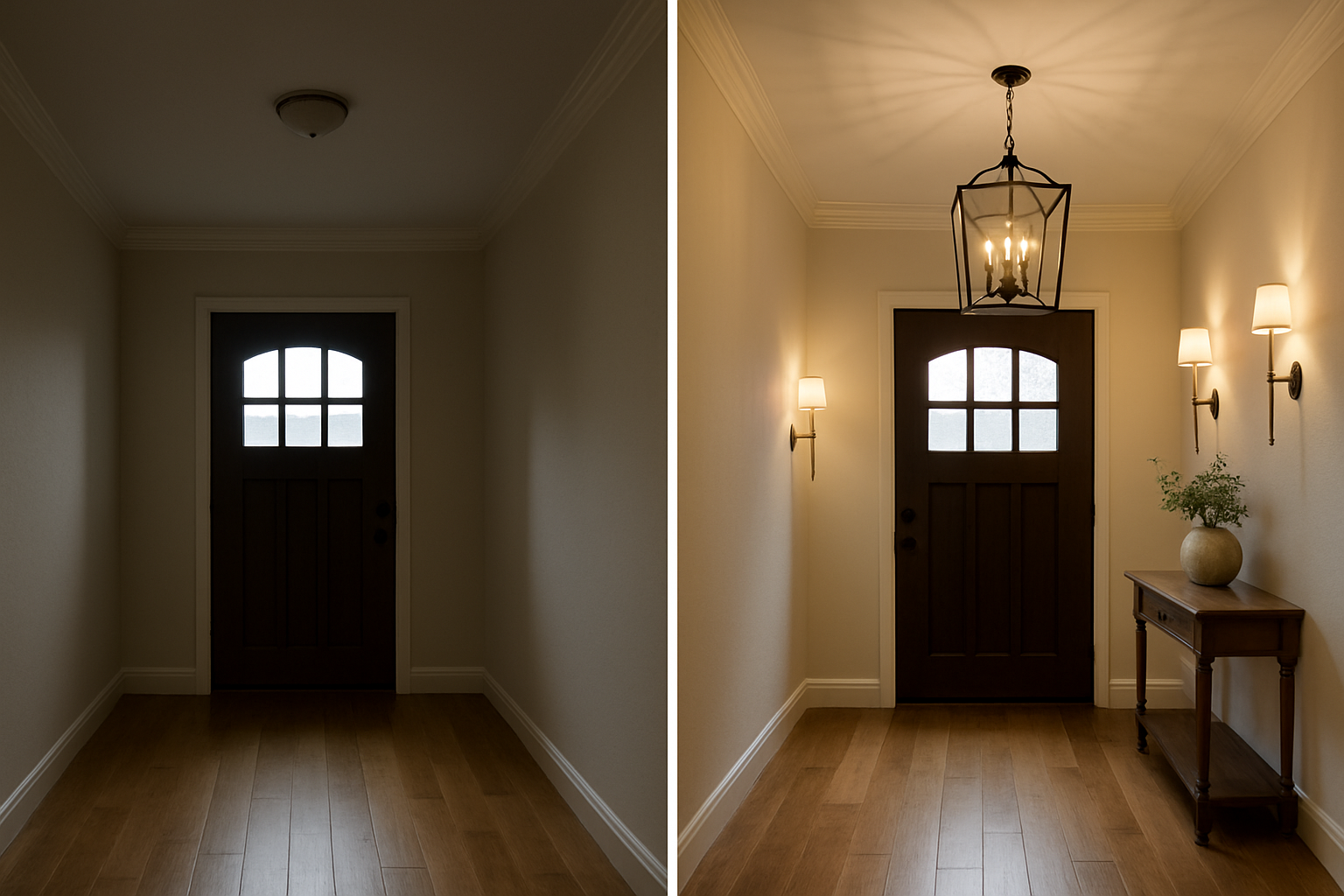
Even a correctly sized overhead fixture only lights the top half of a room. It pushes light down from the ceiling, and the lower walls, the console table, and anyone standing there stay in shadow.
Adding a sconce or a pair of sconces fills in that lower zone. It is the single change that makes an entry feel designed rather than just illuminated.
Where the second layer can go:
- Flanking sconces on either side of a mirror or console, mounted around 60 to 66 inches to center
- A single sconce on the wall opposite the door in a narrow entry
- A table lamp on a console, which needs an outlet but no electrical work
- A picture light over art, if the entry is where you hang something you care about
Put both layers on dimmers. An entry at 10 a.m. and an entry at 10 p.m. want very different light levels from the same fixtures.
Height is where sconce placement usually goes sideways. Where wall sconces belong gets into mounting heights and spacing in more detail.
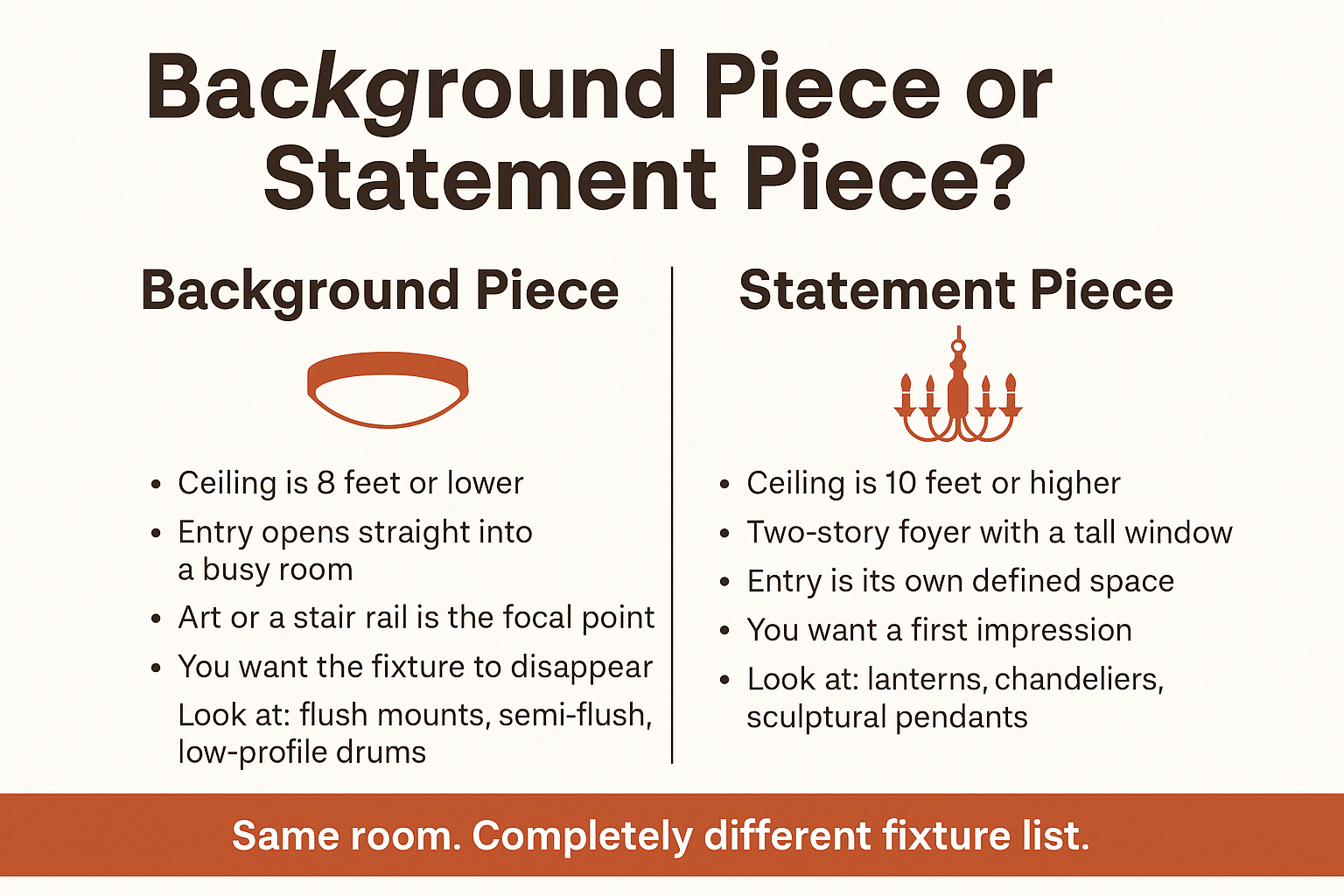
Background Piece or Statement Piece? Ask These Questions
Before comparing fixtures, decide what job the fixture is supposed to do. The answer changes the entire shortlist.
Your Porch Light and Your Foyer Light Are One Decision
Homeowners in Monterey County often shop these separately, sometimes weeks apart. It shows.
A visitor sees the exterior fixture as they walk up, then the interior fixture as the door opens. Those two moments happen about four seconds apart, so the fixtures need to speak the same language.
They do not have to match. They do need to agree on:
- Finish family, so warm brass outside is not fighting matte black inside
- Shape logic, meaning a lantern outside pairs better with a lantern or a clean drum than with something ornate
- Color temperature, so the light itself does not shift as the door swings open
In Carmel-by-the-Sea, that coordination also has a compliance layer. The city caps residential exterior fixture color temperature at 3000K and limits lumen output, so your exterior choice narrows before style even enters the conversation.
Statewide, California Title 24 governs lighting controls and efficiency for remodels and new construction, with updated requirements effective January 1, 2026. You can review the current standards through the California Energy Commission, and always confirm details with your local building department or licensed contractor before ordering.
For exterior planning on larger properties, planning outdoor lighting for a Pebble Beach or Carmel property covers how those rules play out in practice.
Color Rendering: The Spec Most People Skip
Color Rendering Index, or CRI, measures how accurately a light source shows color compared to daylight. It runs on a 100 point scale.
In a room with big windows, a mediocre bulb gets covered by daylight most of the day. An entry has no such cover.
A fixture running a source below 80 CRI makes skin tones look flat and washes the life out of wood, stone, and textiles. In a foyer with a limestone floor or a walnut console, that is the first thing a guest sees.
Sources at 90 CRI and above let those materials look the way they do outside at midday. Given how many Peninsula homes lean on natural stone and wood in the entry, it is worth asking about before you buy. What color rendering index actually means breaks the number down further.
Matching Entry Fixture Type to Ceiling Height
Ceiling height narrows the field faster than style does. Use this as a starting point, then confirm clearances for your specific entry.
| Ceiling Height | Fixture Types That Work | What to Watch |
|---|---|---|
| 8 feet or under | Flush mount, low-profile semi-flush | Keep the bottom above head height in the door swing path |
| 9 to 10 feet | Semi-flush, small lantern, single pendant | Scale up the diameter; small fixtures read as an afterthought |
| 10 to 12 feet | Lantern, chandelier, tiered pendant | Bottom of fixture roughly 7 feet off the floor minimum |
| Two-story foyer | Multi-tier chandelier, linear or cascading pendant | Center in the window from outside; confirm relamping access |
| Vaulted or sloped | Sloped-ceiling adapter fixtures, long-stem pendants | Verify the canopy supports the slope angle before ordering |
Frequently Asked Questions About Entryway Lighting Design
How much should I expect to spend on an entry fixture?
Costs vary widely by size, materials, and brand. Many Monterey Peninsula homeowners see entry fixtures land anywhere from a couple hundred dollars for a well-made flush mount to several thousand for a large tiered chandelier in a two-story foyer. Metal quality, hand finishing, glass work, and fixture diameter drive most of that spread. A showroom can give you an exact quote once they know the ceiling height and the look you are after.
Can I just replace the fixture in the spot that is already wired?
Usually yes, and plenty of people do. Just check the weight rating on the existing box and the ceiling height before you commit, and have a licensed electrician handle the swap. If the pre-wired spot is off center for the entry, that is worth solving now rather than living with it.
What color temperature should entry lighting be?
Most interior entries look best in the 2700K to 3000K range, which reads warm without going orange. If your entry is in Carmel-by-the-Sea, remember the exterior fixture is capped at 3000K under city rules, so matching the interior to that keeps the transition smooth. Verify current requirements with the city before finalizing exterior selections.
Do I really need sconces if the overhead fixture is big enough?
You do not need them. But an overhead fixture alone lights the upper half of the room, and the lower half is where people actually stand. Even one lamp on a console changes how the space reads at night.
How do I keep the entry from clashing with the rooms it opens into?
Pick a finish family and stay in it as you move through the sightline. If the entry opens directly into a dining room with a visible chandelier, the two fixtures will be seen together, so they should relate. They do not have to be from the same collection, just the same conversation.
Thinking Through Your Entry Before You Buy
Entry fixtures are easier to get right when you can see the scale in person and hold the finish next to the one going on your front porch. Greg and Tammy at The Home Lighter keep a curated collection at the Pacific Grove showroom at 2034 Sunset Drive, and walk-ins are welcome, with appointments available for more involved Monterey County projects. The showroom can be reached at (831) 655-5500.