
Direct Answer: Choosing a flush mount ceiling light comes down to ceiling height, room size, and how much other light the space already has, not just what fits the junction box.
One homeowner shopping for a fixture put it plainly: she needed something low-profile, not fussy for a small office, roughly 8 by 8 feet, with recessed cans already handling task light over the desk. She wanted the ceiling fixture to disappear. That framing, the fixture as a background player, is how most people approach flush mounts.
But a poorly chosen background fixture still registers. You may not be able to name why a room feels slightly off, but a fixture that is too small, the wrong finish, or the wrong shape for the ceiling height contributes to that feeling. The flush mount is the lighting category most often decided with the least thought, and it shows.
For homeowners on the Monterey Peninsula, where rooms in older Pacific Grove cottages and Carmel bungalows regularly have 8-foot ceilings and limited natural light, the flush mount decision comes up constantly. Getting it right is simpler than most people expect, once you understand the three things that actually drive the choice.
Ceiling Height Matters More Than Room Size
Most people size a flush mount based on how big the room is. Ceiling height is actually the more important variable.
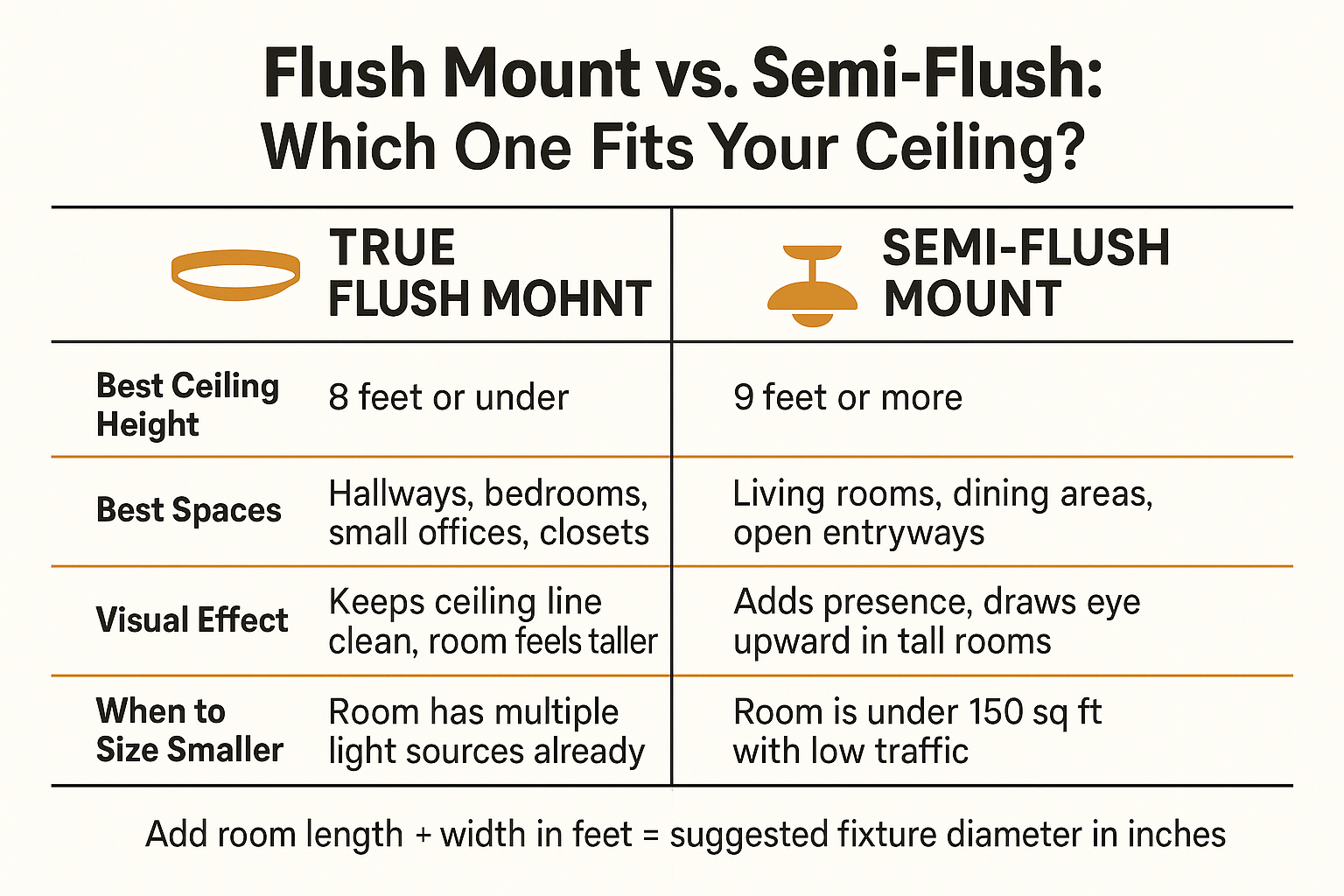
In a room with a standard 8-foot ceiling, a semi-flush that drops even 6 to 8 inches can feel like it’s crowding the space, especially in a hallway, bedroom, or small office where you’re moving through or standing under it regularly. A true flush mount, which sits tight against the ceiling with little or no drop, is usually the right answer in those spaces.
Semi-flush mounts make more sense when you have 9 feet of clearance or more. That extra volume gives the fixture room to hang into the space without feeling like it’s in your way. If you’re choosing between the two and you’re not sure about your ceiling height, measure before you decide, the difference between 8 and 9 feet changes the right call entirely.
This also connects to how the fixture reads visually. A semi-flush in a low-ceiling room doesn’t just feel cramped physically, it draws the eye down in a way that makes the ceiling feel lower than it is. A flush mount in that same room keeps the ceiling line clean. For more on how fixture type affects the whole character of a room, what makes each fixture type the right one for a room is worth a read.
How to Size a Flush Mount Without Guessing
A commonly used starting point: add the room’s length and width in feet, and that number, converted to inches, gives you a reasonable fixture diameter. A 10 by 10 room suggests roughly a 20-inch fixture as a baseline.
But that starting point gets adjusted by several factors:
- How many light sources are already in the room. A flush mount in a room with recessed cans and under-cabinet lighting plays a very different role than the only fixture in the space. If it’s the sole source of ambient light, size up. If it’s filling a gap in a layered scheme, a smaller, more refined fixture may read better.
- Finish complexity. A busy, multi-element fixture in a small space competes with the room. A simpler profile, clean lines, tinted glass, a single material, often works better in tight rooms.
- Ceiling height. Lower ceilings tend to favor smaller-diameter fixtures, even if the square footage math suggests going bigger.
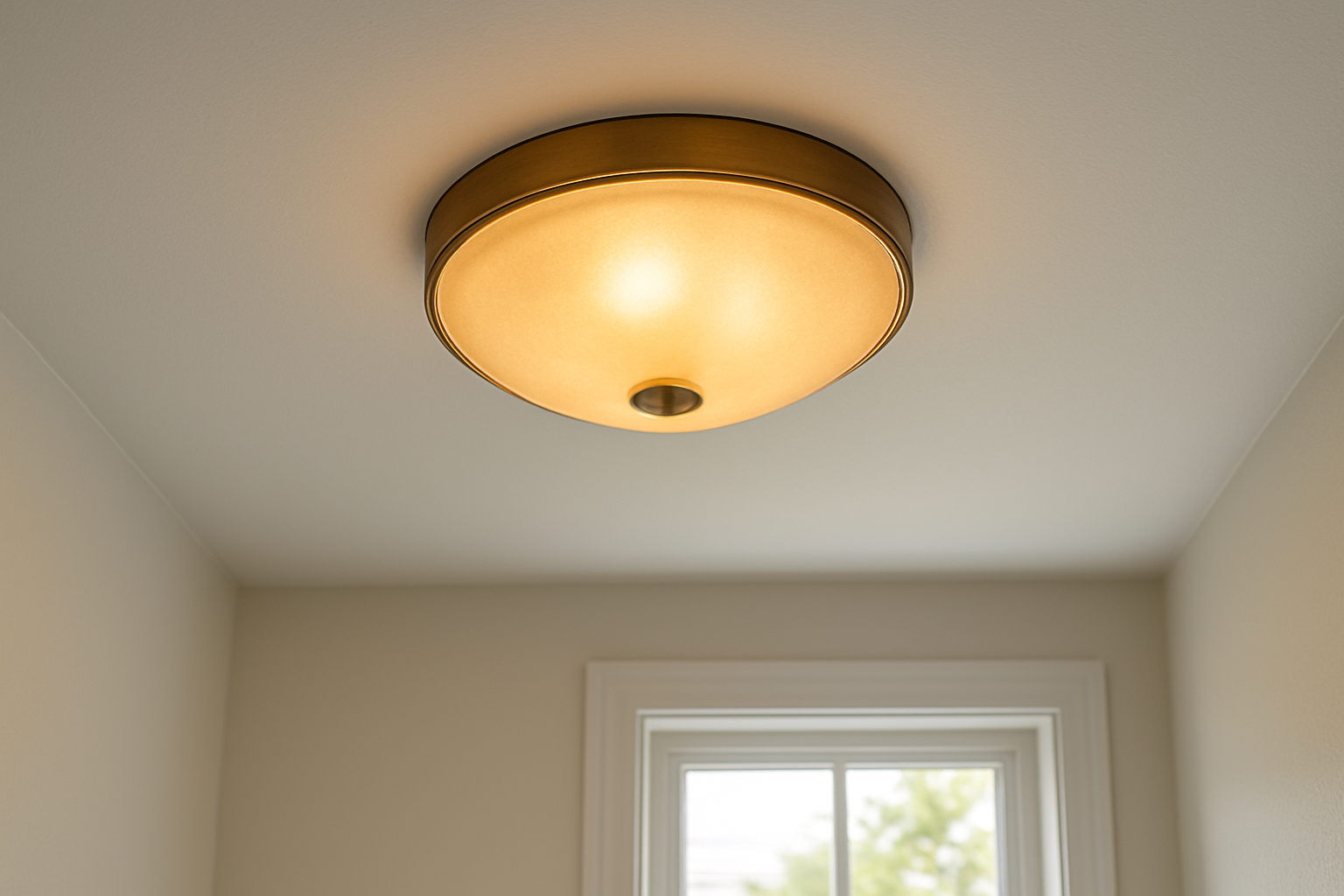
For the 8 by 8 office mentioned earlier, with brass trim already present on other fixtures in the space, a 14 to 16-inch flush mount with a warm brass ring and frosted or tinted glass would read as intentional without competing with the task lighting already doing the work. The fixture doesn’t need to perform; it needs to belong.
The Lighting Facts label from the U.S. Department of Energy is also a useful resource when comparing lumen output across flush mount options, particularly if the fixture will be the primary light source in the space.
Flush Mount vs. Semi-Flush: A Quick Decision Guide
Use this reference when the ceiling height is the deciding factor between fixture types.
Room Size, Ceiling Height, and Starting Fixture Diameter
These are starting points, not rules. Adjust based on how many other light sources are in the room and how much visual weight the fixture needs to carry.
| Room Size | Ceiling Height | Starting Fixture Diameter |
|---|---|---|
| 8 x 8 ft (64 sq ft) | 8 ft | 14-16 inches |
| 10 x 10 ft (100 sq ft) | 8 ft | 18-20 inches |
| 10 x 12 ft (120 sq ft) | 8-9 ft | 20-22 inches |
| 12 x 14 ft (168 sq ft) | 9 ft | 24-26 inches (or consider semi-flush) |
| Hallway (narrow) | 8 ft | 10-14 inches, elongated or round |
Shape and Finish Are Not Decorative Decisions
Flush mounts in 2026 are being chosen with the same attention as pendants. The category has moved well past the basic dome-over-a-bulb fixture. Tinted glass, deliberate geometric shapes, and thoughtfully selected finishes are now common, not because the fixture needs to be a feature, but because a flat white plastic dome in a room with brass hardware and warm wood tones creates a small visual conflict that the eye catches even when the brain doesn’t register why.
The choice is usually one of two directions:
- Blend in, match the fixture’s finish to the ceiling color or to the hardware already present in the room. A brushed brass ring on a white or cream fixture reads as intentional against a white ceiling without standing out.
- Quiet statement, choose a fixture with a defined shape and material that acknowledges the room without competing with it. Smoked or amber-tinted glass is popular right now because it adds warmth to the light output, not just the look.
For rooms where the flush mount sits alongside other fixture types, finish coordination matters. A pendant in the hallway and a flush mount in the adjacent bedroom should feel like they came from the same conversation, not necessarily matching, but consistent. Picking a pendant for a room that isn’t your kitchen covers finish coordination in detail and applies directly here.
And if you’re working through a full room refresh, how to read a room before you pick a light fixture is a useful place to start before the flush mount conversation even begins.
Frequently Asked Questions About Flush Mount Ceiling Lights
What is the actual difference between a flush mount and a semi-flush mount?
A flush mount sits directly against the ceiling with no gap or drop. A semi-flush has a short stem or canopy that holds the fixture 6 to 12 inches below the ceiling. The practical difference is ceiling clearance, flush mounts are for 8-foot ceilings, semi-flush mounts work better where you have 9 feet or more.
Can a flush mount be the only light source in a room?
Yes, but it changes what you need from it. If it’s the only ambient source, size up from the standard formula and make sure the fixture’s lumen output matches the room’s size. A small, low-output fixture in a room with no other light will leave corners dim and the space feeling flat.
Does flush mount finish need to match other fixtures in the room?
It doesn’t need to match exactly, but it should feel consistent with the room’s other hardware. If the room has brushed nickel door handles and a chrome vanity fixture nearby, a warm brass flush mount will create a small visual conflict. Staying within one finish family, or deliberately mixing warm and cool metals in a way that’s intentional throughout the room, is the goal.
How do I know if a flush mount fixture will be bright enough?
Check the lumen output, not just the wattage. A general guide: rooms used for reading or detail work need roughly 50 lumens per square foot. A room used mainly for relaxing or passing through can get by with 20-30 lumens per square foot. If the fixture is supplementing recessed cans or other sources, the bar is lower.
What about California Title 24, does it apply to a flush mount replacement?
It can, depending on whether the project involves a permit or qualifies as a remodel under the code. California’s updated Title 24 requirements (effective January 1, 2026) cover lighting controls and efficiency in remodels and new construction. If you’re swapping a fixture on an existing circuit without a permit, it’s a simpler situation, but if you’re part of a larger remodel, it’s worth confirming with your contractor. What California’s 2026 lighting code means for your remodel breaks this down clearly.
Ready to Find the Right Flush Mount for Your Space?
Greg and Tammy at The Home Lighter have worked through this decision with homeowners across the Monterey Peninsula, from Pacific Grove cottages with tight 8-foot ceilings to Carmel Valley rooms that finally have the clearance for a semi-flush. Walk-ins are welcome at the showroom at 2034 Sunset Drive in Pacific Grove, and appointments are available for more involved projects. Give them a call at (831) 655-5500 if you want to talk through your space before you come in.