
Direct Answer: Governor Newsom signed SB 868 on September 30, 2026. Starting January 1, 2027, California homes may use UL certified plug-in solar devices totaling up to 1,200 watts AC with no utility interconnection agreement.
Electricity on the Monterey Peninsula is not cheap. Many households here see rates somewhere in the neighborhood of 35 cents per kWh, and that number shows up every time a hallway light stays on or a kitchen gets relit for a remodel.
So when a new state law makes it legal to plug a small solar setup straight into a wall outlet, people start asking what it actually covers. The short version: Governor Newsom signed SB 868, the Plug and Play Solar Act, on September 30, 2026, and it takes effect January 1, 2027.
This article walks through what the law allows, what 1,200 watts realistically offsets in a Pacific Grove or Carmel home, and why fixture and circuit planning still matters even when the utility is out of the approval loop.
What the California Plug In Solar Law SB 868 Actually Says
SB 868 was authored by Sen. Scott Wiener and cleared both houses of the Legislature in August, including a 73-0 vote in the Assembly. With the governor’s signature, California becomes the 10th state to legalize plug-in solar, as reported by pv magazine USA, Solar.com, and Energy Digital.
The law defines portable solar generation devices as photovoltaic devices designed to connect to a building’s wiring through a receptacle and offset onsite electricity consumption. Here is what that means in practice:
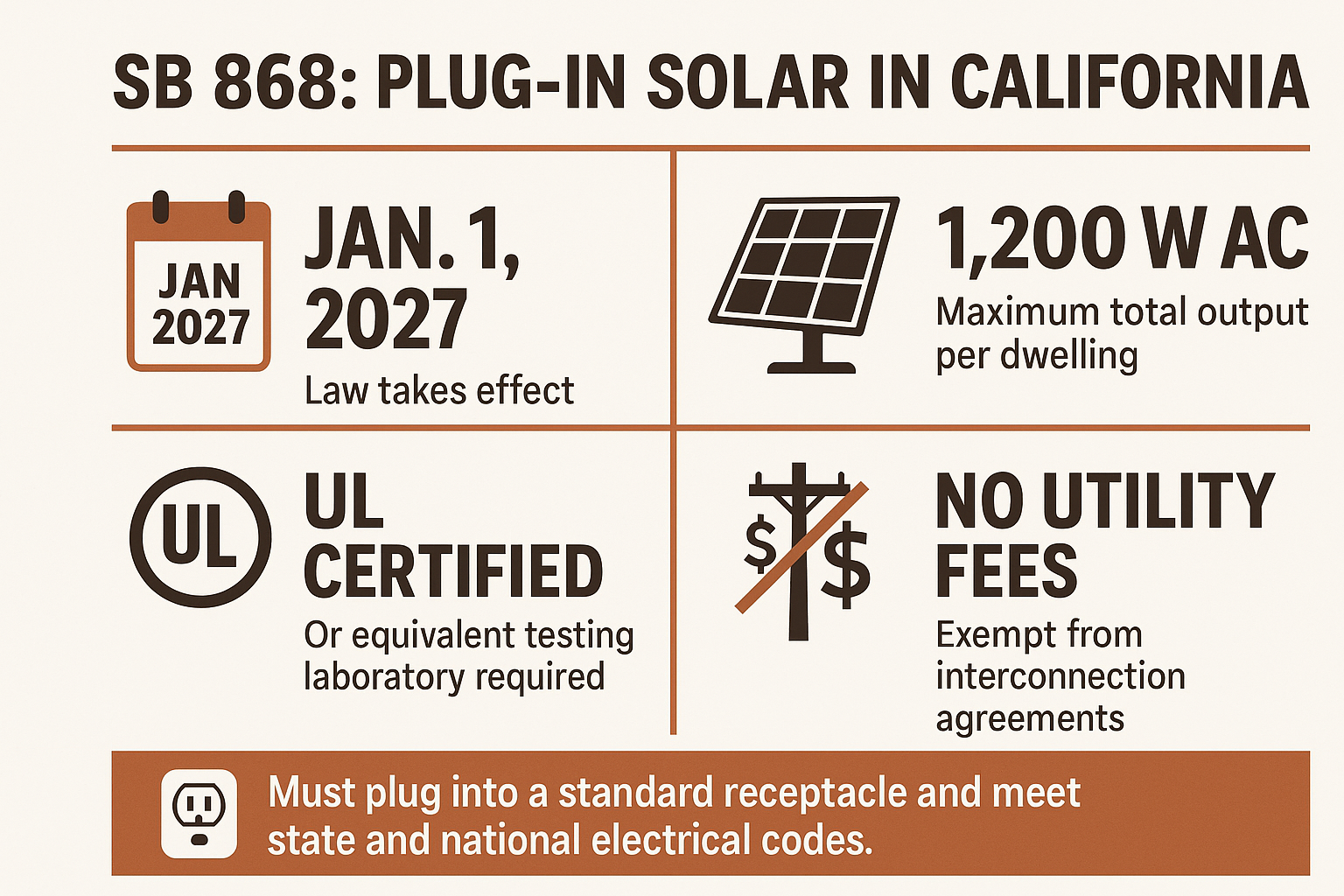
- A single dwelling can have devices with total AC output of no more than 1,200 watts
- The devices must plug into a standard outlet
- They must be certified by UL or an equivalent testing laboratory
- They must meet state and national electrical codes
- Qualifying systems are exempt from utility interconnection agreements
- Utilities are barred from charging fees on them
That last pair is the real shift. Rooftop solar in California normally means an application, an agreement, and a wait. Under SB 868, a qualifying plug-in device skips that process entirely.
One thing the law does not do is widen the rules. The cap is per dwelling, not per panel, and the certification requirement is not optional. An uncertified kit ordered from an overseas seller does not qualify just because it fits in a box.
What 1,200 Watts Actually Covers in a Peninsula Home
This is where lighting enters the conversation. A 1,200 watt ceiling is a real limit, and the honest answer is that it covers plug load and lighting far better than it covers heating, cooking, or EV charging.
If a home has already moved to LED, the lighting load is probably smaller than people assume. A whole first floor of LED fixtures might draw a few hundred watts with everything on at once. A single room is usually well under a hundred.
That cuts two ways. It means a plug-in setup can meaningfully cover lighting during daylight hours. But it also means the savings are modest if the fixtures are already efficient.
The homes that stand to gain most are the ones still running older loads:
- Halogen pendants and track heads, which can pull 50 watts or more each
- Recessed cans with old incandescent trims in kitchens and hallways
- Fluorescent fixtures in garages, laundry rooms, and older kitchens, now that California stopped selling the replacement tubes
- Oversized bulbs installed to compensate for poor layout, which is a common issue covered in this guide to how many lumens a room actually needs
There is also a local wrinkle worth saying out loud. Output depends on sun, and Pacific Grove in May and June is not Carmel Valley in September. A panel that performs well inland may sit under marine layer for weeks on this side of the hill, so run the numbers against your own bill and your own exposure before assuming a fixed return.
Rough Lighting Loads Against a 1,200 Watt Ceiling
These are general ballpark figures to show scale, not spec sheet values. Actual draw varies by fixture, bulb, and dimmer setting.
| Lighting Load | Approximate Draw | Notes |
|---|---|---|
| 6-light LED dining chandelier | Roughly 35-55 watts | Modern LED bulbs at 6-9 watts each |
| Eight LED recessed cans in a kitchen | Roughly 70-100 watts | Depends on trim and lumen output |
| Three-light LED vanity bar | Roughly 20-30 watts | Often the most used fixture in a bathroom |
| Three halogen pendants over an island | Roughly 150-180 watts | A common upgrade candidate |
| Older 4-foot fluorescent shop fixture | Roughly 80-110 watts | Tubes no longer sold new in California |
| Eight low-voltage LED path lights | Roughly 25-40 watts | Runs at night, so solar offsets it indirectly |
SB 868 at a Glance
The four numbers that decide whether a plug-in solar device qualifies under the new law.
Code Compliance Did Not Go Away
Skipping the utility application is not the same as skipping the electrical code. SB 868 specifically requires these devices to meet state and national electrical codes, which means the circuit they plug into still matters.
A standard 15 or 20 amp branch circuit was designed to deliver power to loads, not to receive it from a backfeeding device. Whether a particular outlet is a sensible place to plug one of these in is a question for a licensed electrician, not a product listing.
Meanwhile, the lighting side of the code keeps moving on its own track. The current California Title 24 cycle took effect January 1, 2026 and governs lighting controls and efficiency for remodels and new construction. You can read the current building energy efficiency standards from the California Energy Commission directly, though a permit-pulling contractor will usually be the one applying them.
And if the project touches exterior lighting in Carmel-by-the-Sea, local rules are stricter than state rules. The city caps residential exterior fixture color temperature at 3000K and limits lumen output, which is why fully shielded porch fixtures come up so often in Carmel projects. Verify current requirements with your local building department or your contractor before ordering anything.
The Home Lighter does not install fixtures or solar devices. Installation work belongs with your licensed electrician or contractor, every time.
What to Do Between Now and January 2027
If a kitchen or bath remodel is already on the calendar, this law is not a reason to change the plan. It is a reason to be deliberate about which fixtures go in.
A few practical moves:
- Pull one month of your own bill and find your actual rate per kWh rather than using a statewide average
- Count what is still halogen or fluorescent in the house, since those are the loads worth replacing first
- Ask about serviceability before buying, because a fixture with an integrated LED array instead of a replaceable bulb is a different long-term proposition
- Talk to your electrician early about which circuits in the house would even be candidates
- Order fixtures on a realistic schedule, since lead times on specialty lighting can stretch well past what people expect
Homeowners call the showroom in Pacific Grove with versions of this question all the time, usually framed as some mix of “we are remodeling” and “we want the bill to go down.” Greg can walk through fixture efficiency, dimming, and layout so the lighting plan holds up whether or not a plug-in panel ever shows up on the patio.
Frequently Asked Questions About California’s Plug-In Solar Law
Can I buy a plug-in solar kit right now and use it?
The law takes effect January 1, 2027. Before that date, the exemptions in SB 868 do not apply, so anything you set up now is still subject to the existing rules your utility enforces.
Does the 1,200 watt cap apply per panel or per house?
Per dwelling. The law says a single dwelling can have devices with total AC output of no more than 1,200 watts, so adding a second kit counts against the same ceiling.
Will this cover my whole house?
No. At 1,200 watts, a plug-in setup is sized for lighting and plug loads during daylight hours. Heating, cooking, laundry, and EV charging are well beyond what it can carry, and coastal fog means real-world output on the Peninsula swings a lot by season.
Do I still need a permit or an electrician?
The law removes the utility interconnection agreement and bars utility fees. It does not remove the requirement that the device meet state and national electrical codes. Check with your local building department, and have a licensed electrician look at the circuit before anything gets plugged in.
Should I hold off on buying light fixtures until 2027?
There is no reason to wait. Fixture selection, dimming, and layout drive how a room feels and how much it draws regardless of where the electricity comes from. If anything, picking efficient fixtures now shrinks the load a plug-in device would need to cover later.
Thinking Through Lighting and Energy Use on the Peninsula?
Homeowners across Monterey County are weighing what the 2027 change means alongside remodels already in motion. The showroom at 2034 Sunset Drive in Pacific Grove keeps a curated collection on display, and walk-ins are welcome, with appointments available for more involved projects. Greg at The Home Lighter can be reached at (831) 655-5500 for questions about fixture efficiency, layered lighting, or energy-efficient options.
