
Direct Answer: A replaceable bulb fixture takes a new lamp from any hardware store. An integrated LED fixture only lasts as long as its driver and board, unless the maker sells those parts.
A homeowner picks a slim LED fixture for the hallway. It looks great, it dims smoothly, and nobody thinks about it again for six years. Then it starts flickering, and the electrician says there is nothing inside to swap out.
The housing is fine. The glass is fine. The finish still looks new. But one small part quit, and the whole fixture goes in the truck.
That is the question worth asking on the showroom floor, not in year eight: can this thing be opened and repaired later? Here is how to read a fixture for that before you pay for it.
Integrated LED vs Replaceable Bulb Light Fixtures: What You Are Actually Choosing
Almost every fixture sold today falls into one of two camps.
A replaceable bulb fixture has a standard socket. The lamp screws in or pins in, and when it burns out you buy a new one at any hardware store in Monterey County, CA. The fixture itself outlives dozens of bulbs.
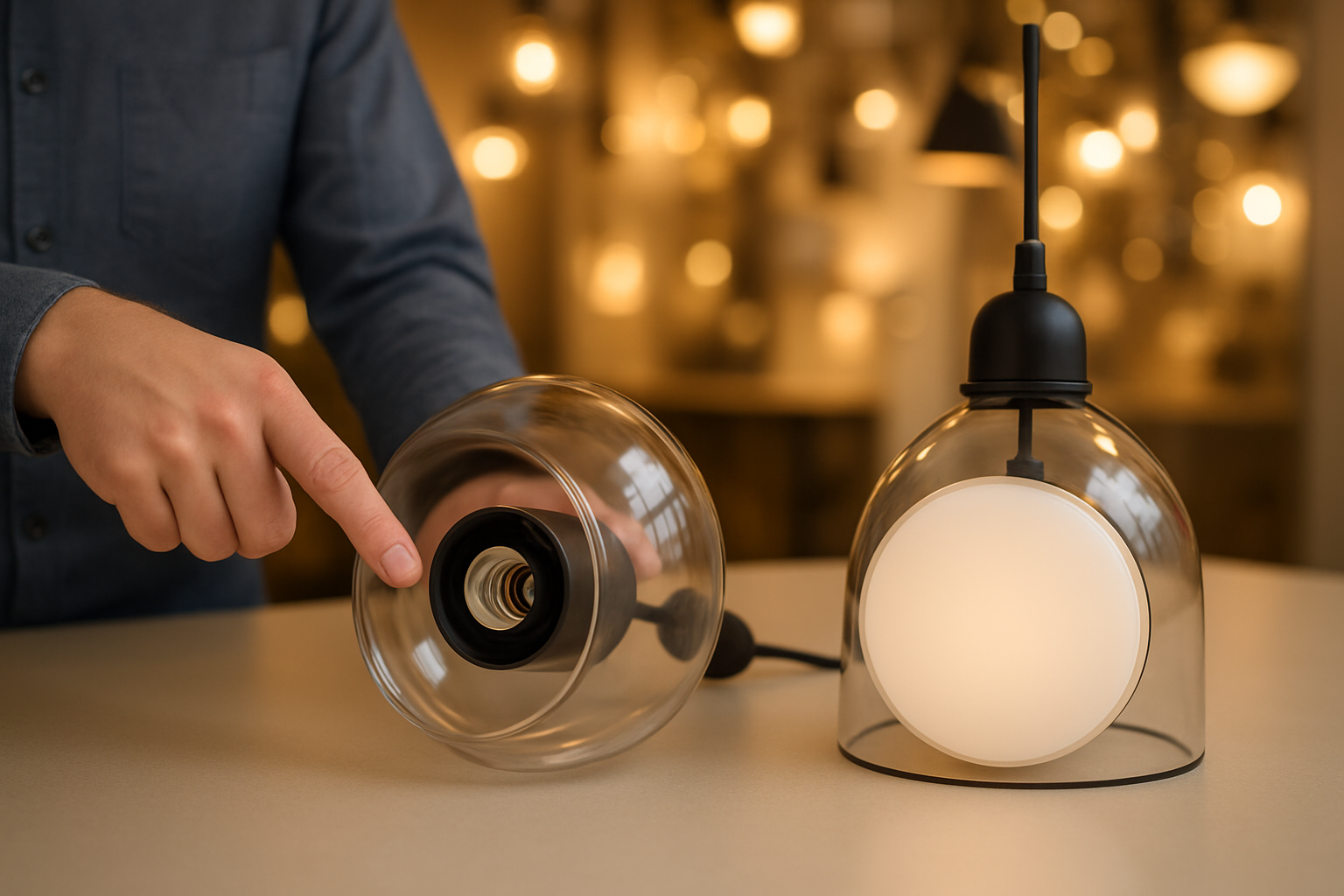
An integrated LED fixture has the diodes built onto a board inside the housing. There is no socket and no bulb. The light source and the fixture are one product.
That second setup is not a cost-cutting trick. Integrated LED is the reason a pendant can be a quarter inch thick, or a sconce can glow from a seam instead of a shade.
The trade-off is dependence. When something inside quits, you need the manufacturer to sell you a part.
And two integrated fixtures that look nearly identical online can be built completely differently:
- One opens with four screws, and the LED board carries its own replacement part number.
- One is riveted and sealed, with the board bonded to the housing.
- One puts the driver in the canopy, where an electrician can reach it without taking the fixture down.
A product listing rarely tells you which is which. Reading the actual spec sheet usually does.
The Driver Fails Long Before the LEDs Do
Most people assume an LED fixture dies when the LEDs burn out. That is usually not what happens.
The part that fails first is the driver, a small power supply tucked inside the fixture or up in the canopy. It converts household voltage into the low-voltage current the LEDs need. It runs warm, it holds capacitors, and it wears out on its own schedule.
The industry has finally put numbers on this. In February 2026, the Global Lighting Association published guidelines on the repairability of light fixtures, pointing out a gap that installers have seen for years.
Fixtures were sold on 50,000-hour lifespan promises. In real buildings, non-replaceable drivers and LED boards are giving out somewhere around year 5 to year 9, according to industry coverage of those guidelines.
When that happens inside a sealed fixture, a perfectly good housing, lens, and finish get thrown out along with the one component that quit.
There is a middle step worth knowing about too. Not every flicker means a dead driver. Sometimes it is a mismatch between the fixture and the wall control, which is a dimmer compatibility problem rather than a failure. An electrician can sort that out in a few minutes.
What to Check Before You Pay
None of this requires technical knowledge. It requires asking six questions while the fixture is still on the shelf.
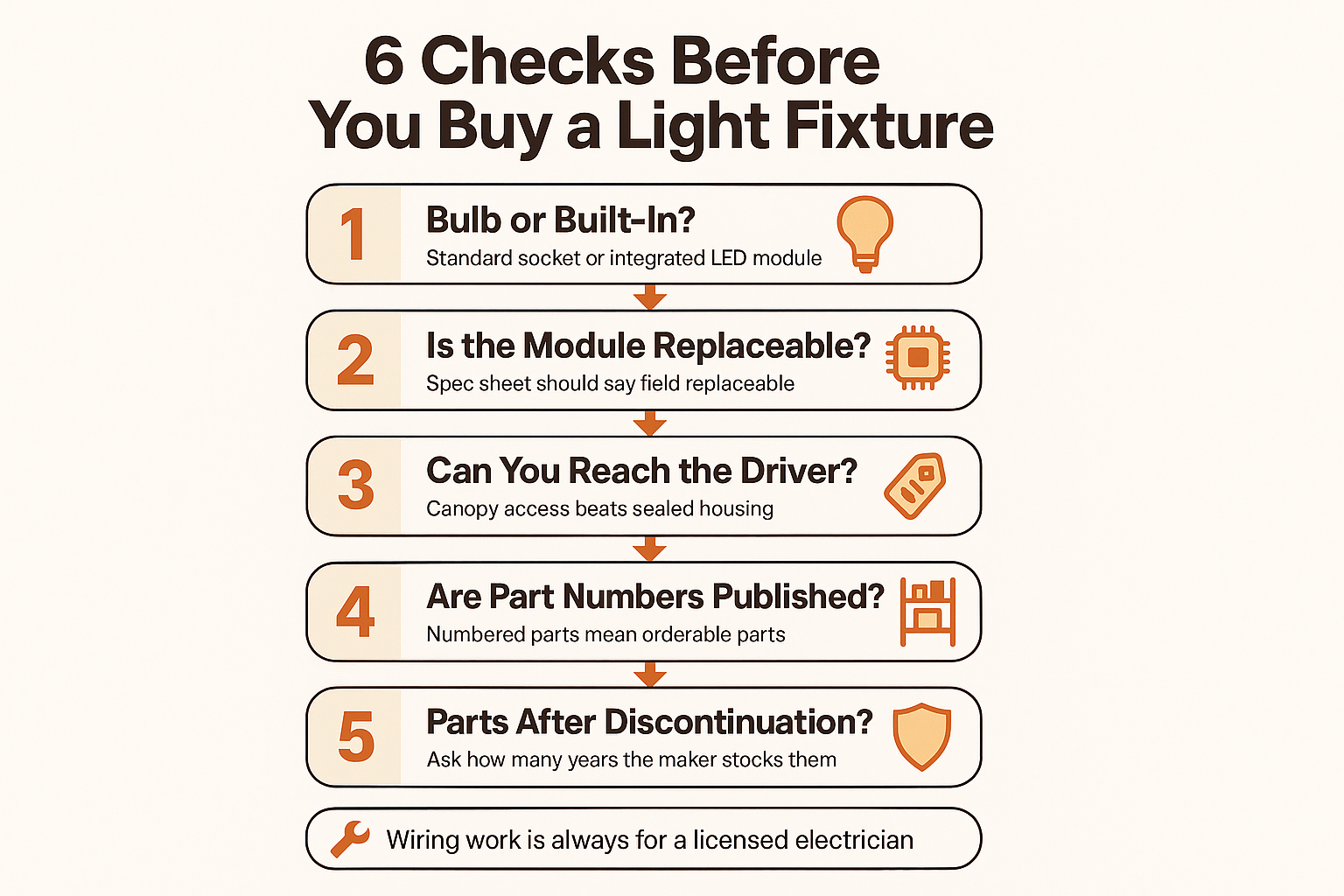
- Is the light source a standard socket lamp or an integrated module? If it takes a common bulb base, most of this worry goes away.
- If it is integrated, is the module listed as field replaceable? Good spec sheets say so in plain words.
- Can the driver be reached without pulling the fixture off the ceiling? A canopy-mounted or remote driver is a much easier repair.
- Does the manufacturer publish replacement part numbers? If parts have numbers, somebody is expected to order them someday.
- Does the maker stock parts for discontinued lines, and for how long? This is the question that separates brands.
- What does the warranty actually cover? Some cover the driver and board. Some cover only the finish against corrosion, which matters on the coast but does nothing for you when the light goes dark.
One plain safety note: anything involving wiring is work for your own licensed electrician, not a DIY afternoon. A good electrician will thank you for buying a fixture with an accessible driver, because the alternative is an hour on hold with a manufacturer that stopped making the part in 2029.
Six Checks That Tell You If a Fixture Is Fixable
This is the short version to keep on your phone while you shop.
How Three Common Fixture Setups Compare
Same shape, same finish, very different second decade. Here is what each build gives you.
| Fixture build | What can be replaced later | What to ask before you buy |
|---|---|---|
| Standard socket, takes a bulb | Bulb, and often the socket, shade, and glass | Is the base a common size, and does it dim well with the bulb you plan to use |
| Integrated LED, built to be serviced | LED module, driver, lenses, trims | Are part numbers published, and how long are parts stocked after the line ends |
| Integrated LED, sealed housing | Usually nothing | Warranty length and coverage, since the warranty is the only repair path you have |
| Integrated LED with remote driver | Driver, without removing the fixture | Where the driver sits, and whether an electrician can reach it from the canopy |
Why This Lands Differently on the Monterey Peninsula
Pacific Grove’s median age sits above 50, and the median home value runs somewhere around 1.1 million dollars. That describes people who have owned the same house for a long time and intend to stay in it.
Harvard’s Joint Center for Housing Studies projects improvement and repair spending growth slowing to roughly half a percent by mid-2027. On the Peninsula, that shows up as homeowners replacing one tired fixture at a time instead of doing a whole-house refresh.
When a single fixture is the entire project, how long it lasts carries a lot more weight than it would in a gut remodel. You are not going to be back in a showroom next spring.
Our fixtures also work harder in the dark half of the year. December here averages under ten hours of daylight, with sunset before five o’clock.
A kitchen island pendant or a hallway flush mount racks up most of its annual run time between November and February. That is real wear on a driver, year after year, in a house where the fog rolls in by mid-afternoon.
Integrated LED Is Not the Villain
It would be easy to read all of this as “only buy fixtures that take bulbs.” That would cost you some of the best lighting on the market.
Slim profiles, even glow with no visible hot spots, and warm dimming behavior that mimics a candle as it lowers all exist because the light source is engineered into the fixture. You cannot get that from a socket and a bulb.
The honest question was never integrated versus bulb. It is whether the maker built the thing to be opened, and whether that company will still sell you a board in 2036.
American manufacturers with long production runs tend to do better here than fast-moving import lines, because they are still building the same collection a decade later. A marketplace listing cannot tell you which is which. A person standing next to the fixture, who has ordered parts for that brand before, usually can.
Why the Original Order Matters Ten Years Later
A real share of the questions that come into a local showroom are not new purchases at all. They are repairs.
A Carmel Valley homeowner had her electrician pull a dining room chandelier down and report that it needed a new transformer with a dimmer. She wanted to know whether that part was available so the fixture could go back up.
Another customer wrote in two and a half years after buying a ceiling fan and light, saying the remote was lost and she could not recall the fan’s name. Someone else needed replacement snoots for LED track heads. Another needed a receipt on a fixture bought back in 2019.
Every one of those is solvable when the original order is on file. Sourcing one part instead of a whole new light is a large part of what a showroom relationship is actually worth, and it is one of the reasons buying lighting locally still makes a difference years after the box is recycled.
The Home Lighter has been on the Peninsula since 1969 and carries lines from more than 60 manufacturers, including American makers such as Hubbardton Forge and Arroyo Craftsman that have a track record of supporting parts well down the road.
Frequently Asked Questions About Fixture Serviceability
Can an electrician just replace the driver in an integrated LED fixture?
Often yes, if the driver is a separate module and the manufacturer still sells it. The work itself is straightforward for a licensed electrician. The hard part is sourcing the right part number, which is why it helps to know the brand and model before anything comes down from the ceiling.
Is replacing a driver cheaper than replacing the whole fixture?
Usually, though it depends heavily on the brand and the fixture. Costs vary, but a replacement driver or LED module is generally a fraction of what a comparable new fixture runs, and you skip re-selecting a design you already like. An exact figure depends on the manufacturer and the part, so it is worth asking a showroom to price the component before you assume the fixture is done.
Are bulb fixtures always the safer long-term bet?
For pure repairability, yes. A socket is the most universal interface in lighting. But you give up some of the thinnest profiles and the smoothest warm dimming, so it depends on what the room needs more.
What does a 50,000-hour rating actually promise?
It describes the LED chips, not the fixture as a whole. It typically means the diodes should still produce about 70 percent of their original brightness at that point. It says nothing about the driver, which is the part most likely to quit first.
I bought a fixture years ago and lost all the paperwork. Can it still be identified?
Frequently, yes. A clear photo of the fixture and of any label inside the canopy is often enough for a showroom to match it to a manufacturer line and pull the part number, especially if the original order was placed locally and is still on file.
Thinking about the second decade of a fixture, not just the first week?
Homeowners across Monterey County, CA are welcome to bring a photo, a model number, or just a question about whether a fixture they are considering can be serviced later. Greg and Tammy can walk through how a given manufacturer handles parts and warranties. The showroom sits at 2034 Sunset Drive in Pacific Grove, walk-ins are welcome, and appointments are available for more involved projects at (831) 655-5500.
