
Direct Answer: Many older fixtures fail because of one part, not the whole light. A socket, transformer, gasket, or fan receiver can often be sourced by model number, then installed by a licensed electrician.
A light stops working, and the first thought is almost always the same: time to buy a new fixture. But a good number of these failures trace back to one component, not the whole light.
One Carmel Valley homeowner described the situation perfectly. Her electrician pulled a dining room chandelier down from the ceiling, told her it needed a new transformer with a dimmer, and she wanted to know if that part could be picked up locally that same week so the fixture could go safely back up.
That is the shape of most parts questions on the Monterey Peninsula. Identify the part, source the part, then let a licensed electrician put the fixture back. This guide walks through the questions homeowners here actually ask.
Can an older fixture really be fixed with one replacement part?
Often, yes. Quality fixtures are built from separate pieces, and when one piece gives out the rest of the fixture is usually fine.
The parts that fail most often on residential fixtures are small and specific:
- Sockets that have corroded or lost tension
- Low-voltage transformers and integrated dimmer modules
- Ceiling fan receivers and paired remotes
- Glass shades, diffusers, and lens gaskets
- Canopies, crossbars, and mounting straps on older hanging fixtures
- Cords, harps, and finials on lamps
One thing stays constant through all of it. Sourcing a part and installing a part are two different jobs, and the physical work belongs to a licensed electrician or contractor. Anything involving line voltage, a junction box, or a ceiling connection is their call, not a weekend project.
The practical order looks like this: figure out exactly what the fixture is, confirm the part is still available through that manufacturer line, then hand it to the electrician who is already on the job. Homeowners who work that sequence usually keep a fixture they like instead of starting a fixture search from scratch.
Where is the model number on a light fixture, and why does it matter so much?
The model number is the hinge point for every parts question. Inquiries that get answered fastest are the ones that arrive with a catalog number attached.
One local customer needed a pair of snoots for specific LED track luminaires and simply listed the fixture code. Another was tracking down details on a Hubbardton Forge fixture purchased in 2019. Both questions had a clear starting point.
Check these places before calling anyone:
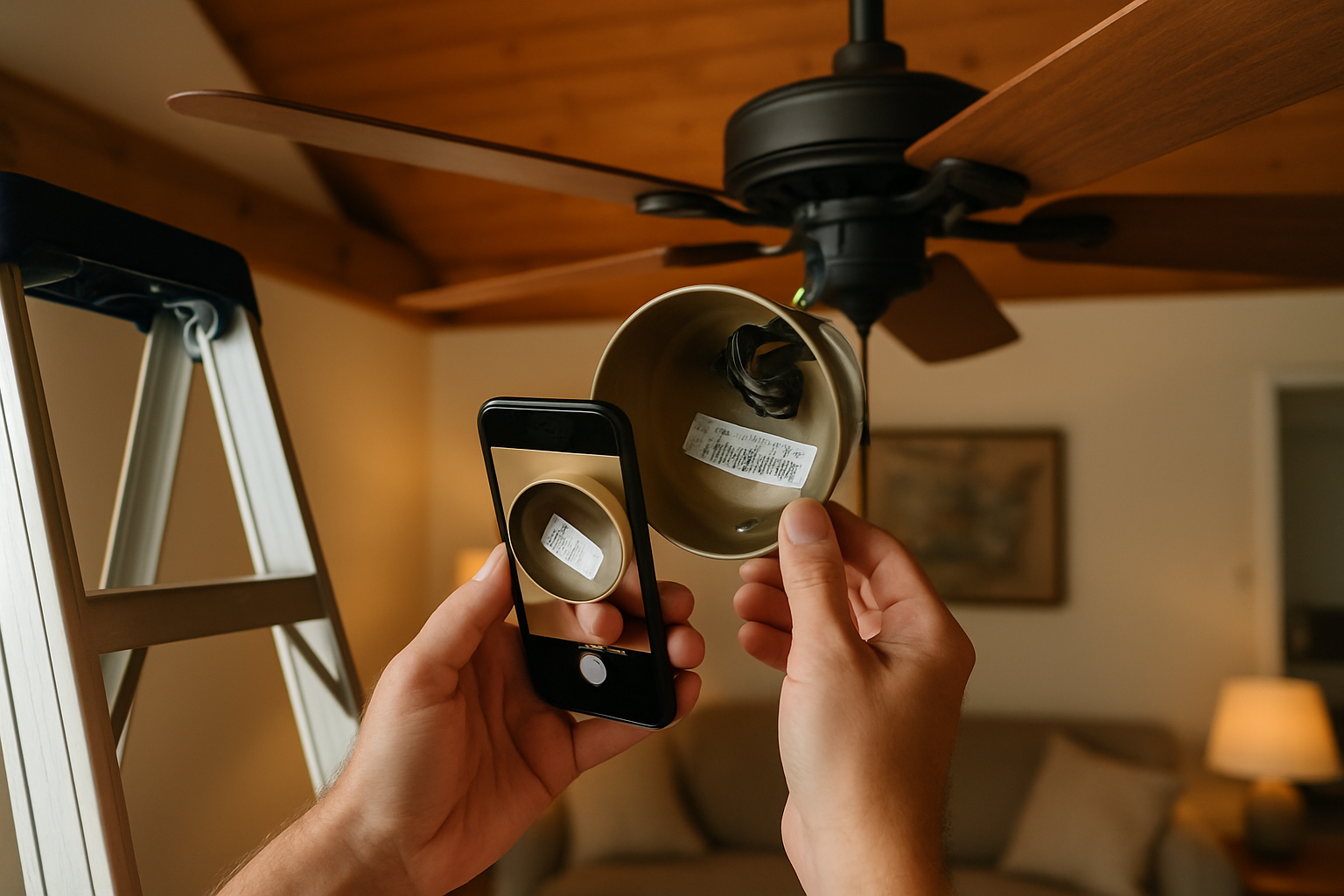
- Inside the canopy, the cover that sits flat against the ceiling
- The socket cup or socket housing on a pendant or chandelier arm
- The transformer housing on a low-voltage fixture
- The motor housing on a ceiling fan
- The original invoice, whether paper or in an old email folder
If nothing is legible, photos do a lot of work. Shoot the fixture from a few angles, including the mounting hardware and any visible label.
And for fixtures nobody remembers buying, purchase records help more than people expect. A showroom that has been selling on the Peninsula since 1969 often has a record that names the fixture, which turns a guessing game into a part number.
I lost my ceiling fan remote. Can I just buy another one?
This is one of the most common parts requests, and the honest answer is that it depends on the fan.
One homeowner explained she had bought a fan and light fixture a couple of years earlier, could not remember the brand, and wanted the remote replaced before winter so the fan could push warm air down from the fireplace. Reasonable request, but it starts with identifying the fan.
Most fan remotes are paired to a specific receiver tucked inside the fan canopy. The handset talks to that receiver on a set frequency or code, so a remote that looks identical from another brand usually will not run the fan. Brand and model matter more than the shape of the handset.
Three outcomes are typical:
- The manufacturer still sells a matching handset, and it pairs to the existing receiver
- The handset is discontinued, so the fix becomes a matched remote and receiver set
- A universal kit works, but only if the receiver is replaced too, which means opening the canopy
That last one is electrician territory. The model number is usually printed on a label inside the canopy or on the motor housing, so that is the first place to look. For more on how these fans are put together, see Ceiling Fan and Light Combos: What to Know Before You Buy.
Common Fixture Failures and the Part Usually Behind Them
A quick reference for matching a symptom to the component worth checking first. An electrician confirms the diagnosis before anything gets ordered.
| What the fixture is doing | Part often behind it | What to bring or note |
|---|---|---|
| Chandelier dead after years of normal use | Low-voltage transformer or integrated dimmer module | Photo of the transformer and its label |
| Bulb flickers or buzzes on a dimmer | Incompatible dimmer or driver, not the bulb | Dimmer brand plus bulb type |
| Fan runs but the light will not respond | Paired remote or canopy receiver | Fan model number from the canopy |
| Bulb loose or intermittent in the socket | Worn socket or socket cup | The old socket if it has been removed |
| Outdoor fixture full of moisture | Lens gasket or corroded socket | Photos of the seal and finish |
| Vintage pendant with no way to hang it | Canopy, crossbar, or mounting strap | Measurements and a full fixture photo |
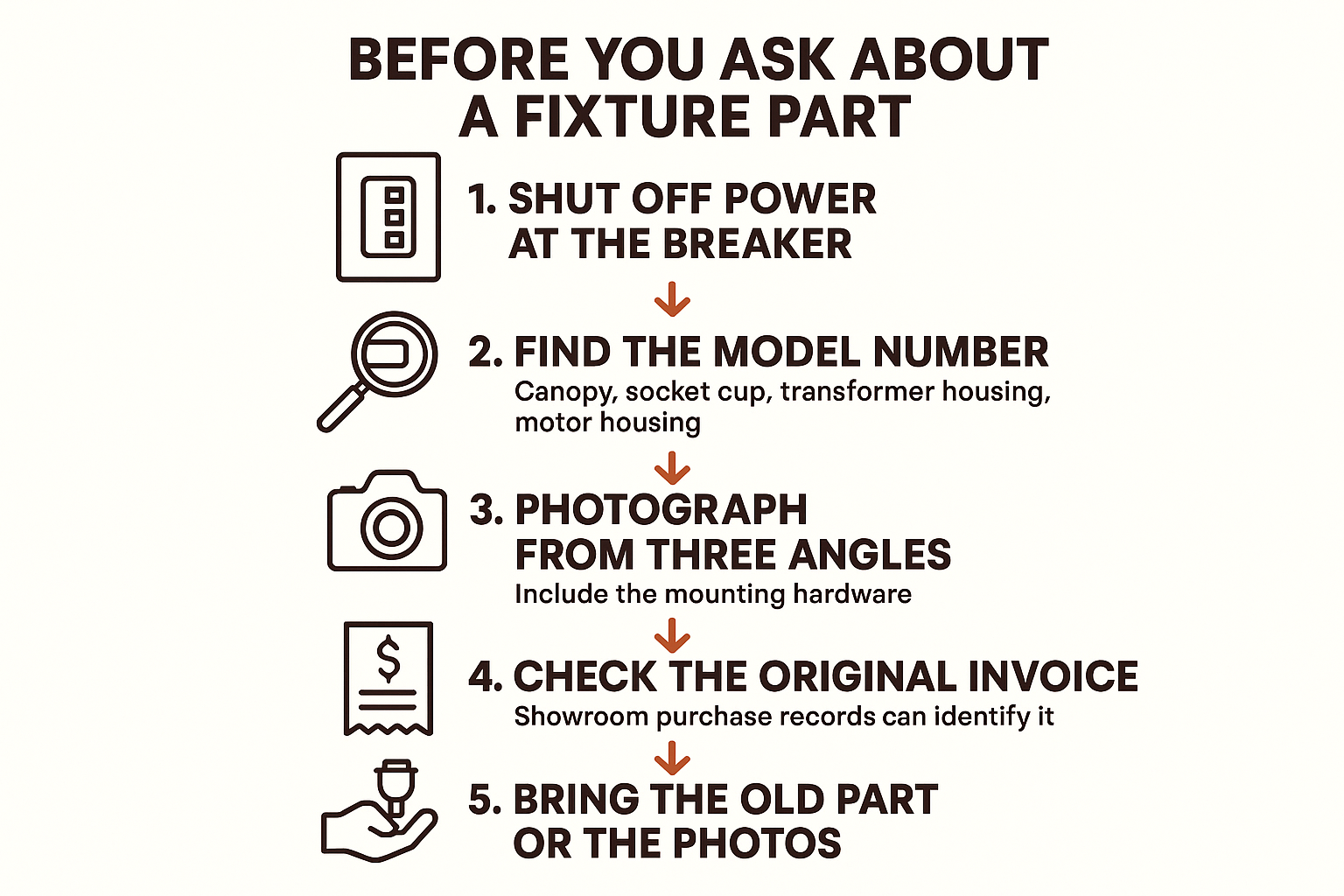
What to Do Before You Ask About a Part
Five steps that turn a vague parts question into one that can actually be answered the same week.
What can actually be replaced on an inherited or vintage fixture?
Monterey Peninsula homes are full of these. One homeowner had three pendants from the 1960s and needed canopies and crossbars before they could hang over a kitchen island. Another asked about an antique floor lamp handed down from her grandmother in law.
On most older fixtures, the replaceable list is longer than people assume:
- Sockets and socket cups
- Cords and plugs
- Harps and finials
- Canopies, crossbars, and mounting straps
- Glass shades and diffusers
- Shades on floor and table lamps
Where it gets less promising is the guts. Brittle cloth-insulated wiring, a cracked or heavily corroded housing, or a body that cannot safely carry a modern socket can make saving a fixture a poor bet, even when the finish still looks beautiful.
Sentiment counts for something, though. A lamp that means something to the family is usually best routed to a dedicated lamp repair specialist who rewires as their trade. For the shade side of that project, Replacing a Lamp Shade on a Lamp You Actually Care About covers how to get proportion and fit right.
Why can’t I find the same bulb my fixture has always used?
Bulbs are the quiet reason older fixtures suddenly seem broken. Nothing failed, the bulb just stopped being made.
Federal general service lamp standards set a floor of 45 lumens per watt for the everyday bulbs used in most household fixtures. That pushed standard incandescent and halogen versions out of production, so the replacement for a decades-old fixture is now almost always an LED.
Matching it correctly comes down to four things:
- Same base type, such as a medium screw base or a candelabra base
- Same bulb shape, so it still fits behind the glass or inside the shade
- Brightness compared in lumens, not watts
- Color temperature around 2700K if the goal is for the fixture to look the way it always has
One caution before buying a case of bulbs. Some older fixtures with integrated transformers or magnetic dimmers will not accept an LED without a controls change, which shows up as flicker, buzz, or a bulb that will not dim past halfway. Why Your LED Fixtures Flicker or Buzz on a Dimmer explains what usually causes it.
Why do outdoor fixtures fail so fast in Pacific Grove and Pebble Beach?
Salt air. It goes after sockets, gaskets, and finishes far faster along the coastline than it does a few miles inland.
An outdoor fixture that quit near the water usually needs something other than a bulb. The usual suspects are a corroded socket, a failed lens gasket letting moisture in, or a housing that has rusted past the point of repair.
There is a compliance wrinkle here too. Carmel-by-the-Sea limits residential exterior fixtures to a maximum 3000K color temperature and caps lumen output per fixture, so dropping in a brighter or cooler bulb during a repair can quietly put a property out of compliance.
California Title 24 also governs lighting controls and efficiency on remodels and new construction, with updated requirements effective January 1, 2026. Rules change, so confirm current requirements with the city or a licensed contractor before changing anything outdoors. Why Outdoor Lighting on the Monterey Peninsula Needs a Different Approach goes deeper on coastal exposure.
Do lighting showrooms do lamp repairs?
One homeowner’s message was four words long: “Do you do lamp repairs?” It comes in often enough to deserve a straight answer.
A lighting showroom is generally a fixture and design resource, not a repair bench. The Home Lighter is no exception, so bench rewiring and lamp restoration belong with a repair specialist or an electrician.
Where a showroom earns its keep on the parts side is identification and sourcing. With 60-plus manufacturer lines carried over the years, including Hubbardton Forge, Quoizel, Feiss, Hinkley, Minka, and Visual Comfort, Greg can often name a fixture from a photo and trace whether the part is still available through that line.
That saves the step most homeowners get stuck on, which is figuring out what they own before anyone can order anything for it.
Frequently Asked Questions About Replacement Parts for Light Fixtures
Can an older fixture really be fixed with one replacement part?
Often it can. Sockets, transformers, gaskets, glass, canopies, and fan receivers are separate components, and replacing one usually costs less than a new fixture. A licensed electrician handles the installation, since anything tied to a junction box or line voltage is their work.
Where do I find the model number on a light fixture?
Check inside the canopy, on the socket cup, on the transformer housing, and on the motor housing if it is a fan. If none of those are readable, the original invoice is the next best source, and photos from several angles help fill the gap.
I lost my ceiling fan remote. Can I buy a generic one?
Sometimes, but not usually as a simple swap. Most handsets are paired to a receiver inside the fan canopy, so brand and model matter more than how the remote looks. A universal kit often means replacing the receiver too, which is a job for an electrician.
Why can’t I find the same bulb my old fixture used?
Federal efficiency rules set a 45 lumens per watt floor for general service lamps, which ended production of most standard incandescent and halogen household bulbs. Match the new LED by base type, bulb shape, lumens rather than watts, and choose around 2700K to keep the original look.
Why do coastal outdoor fixtures fail faster than indoor ones?
Salt air corrodes sockets, degrades lens gaskets, and eats finishes, so outdoor failures near Pacific Grove and Pebble Beach are often hardware, not bulbs. Keep in mind that Carmel-by-the-Sea caps residential exterior fixtures at 3000K with lumen limits, so verify requirements with the city before changing a bulb or fixture outside.
Does a lighting showroom repair lamps?
Generally no. A showroom’s value on the parts side is identifying the fixture and tracing whether the part is still available through the manufacturer. Rewiring and bench repair go to a repair specialist or electrician.
Still trying to identify what your fixture needs?
The showroom at 2034 Sunset Drive in Pacific Grove is open to homeowners across Monterey County who are working through a parts question. Walk-ins are welcome, and appointments are available for more involved projects. Bringing the fixture, the old part, or a clear photo makes the conversation much shorter, and the phone line is (831) 655-5500.
