
Direct Answer: The right ceiling fan with light depends on room size, blade span, motor quality, finish durability, and dimmer compatibility, all of which matter more in a coastal home than a spec sheet suggests.
A ceiling fan with a built-in light sounds simple enough, one fixture, two functions, done. But once you start sorting through blade spans, motor ratings, finish options, and dimmer compatibility, the decision gets complicated fast.
For homeowners on the Monterey Peninsula, there are a few extra layers to think about. Coastal conditions around Pacific Grove, Carmel, and Pebble Beach are genuinely hard on metal finishes and wood materials, and most product descriptions won’t tell you that upfront. Getting the wrong fan for a coastal bedroom or a small Monterey bathroom can mean replacing it in a few years instead of enjoying it for a decade.
This article focuses on the three things that matter most before you buy: sizing the fan correctly for the room, choosing a finish that holds up on the coast, and understanding the controls before your electrician wires the circuit. Get those three right, and everything else tends to fall into place.
Blade Span and Room Size: Measure Before You Shop
The most common mistake people make when buying a ceiling fan is choosing one that looks right without measuring the room first. Blade span is directly tied to square footage, and the wrong size either leaves the room under-ventilated or looks completely out of scale.
A general guide that holds up well in practice:
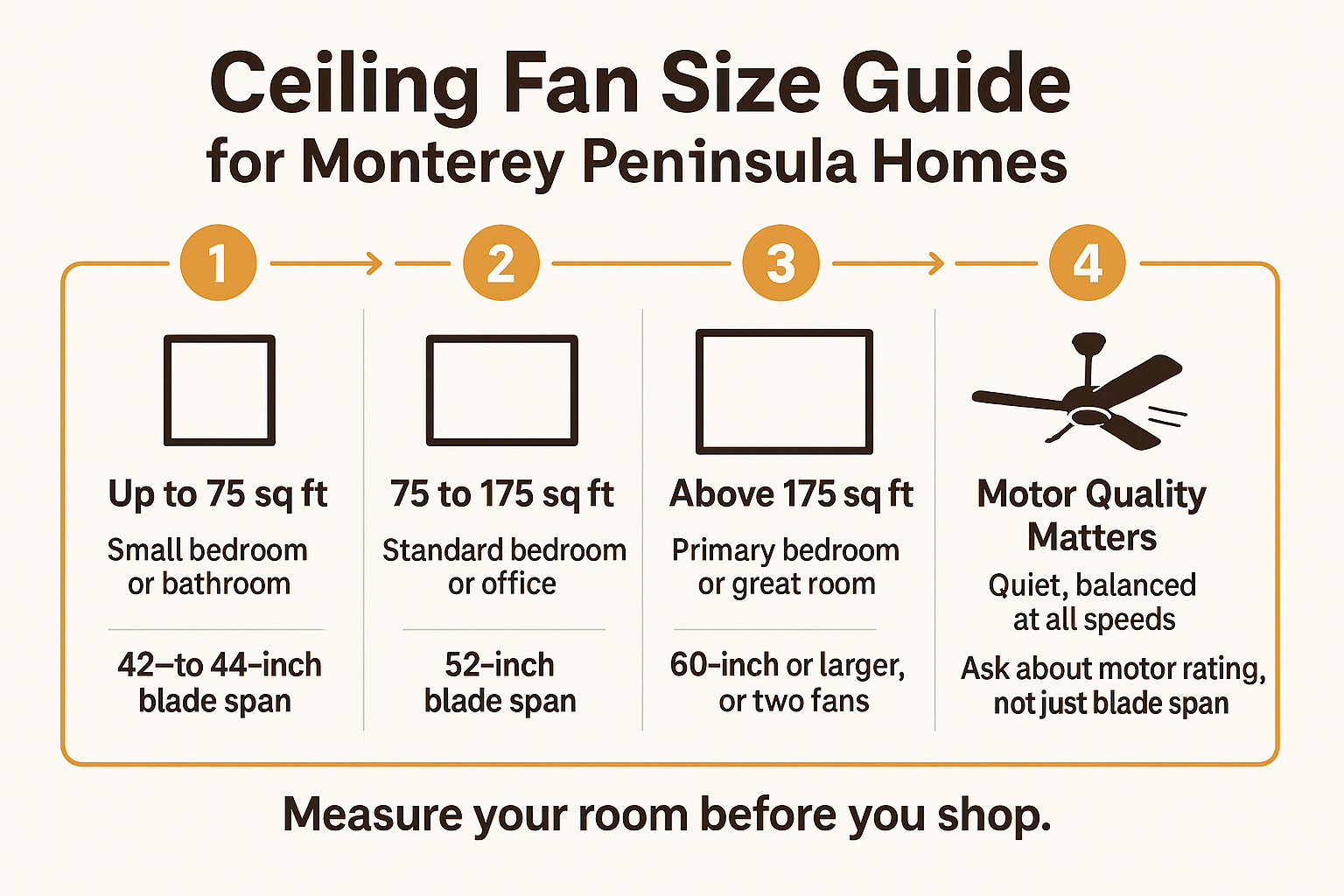
- Up to 75 sq ft (a small bathroom or compact bedroom): a 42- to 44-inch blade span
- 75 to 175 sq ft (a standard bedroom or home office): a 52-inch blade span is the standard choice
- Above 175 sq ft (a generous primary bedroom, a great room, or the open-plan spaces common in Pebble Beach and Carmel Valley homes): 60 inches or larger, or in some cases two fans
Motor size matters just as much as blade span. An underpowered motor that runs loudly or wobbles at higher speeds is a real problem in a bedroom, not a minor annoyance you get used to. Higher-quality motors run quieter and maintain balance across all speed settings, which is worth asking about specifically before you buy.
For context on how fixture scale relates to a room overall, how to read a room before you pick a light fixture is a good read before you go into any showroom conversation.
Coastal Finishes: What Holds Up and What Doesn’t
This is the part that catches a lot of Monterey Peninsula homeowners off guard. A fan that looks beautiful in a showroom or an online photo can show surface corrosion within a couple of years if it isn’t rated for the humidity and salt air that homes near the water deal with daily.
Standard painted or chrome finishes are not designed for coastal exposure. Properties in Pacific Grove, Carmel, and Pebble Beach, especially within a mile or so of the water, see accelerated corrosion on metal surfaces. And wood blades, while they look warm and natural, can swell or warp if the wood isn’t properly sealed for high-humidity environments.
What to look for instead:
- Fixtures rated for damp or wet locations (not just “indoor use”), this rating means the finish and materials have been tested for moisture exposure
- Powder-coated or marine-grade finishes that resist oxidation better than standard painted metals
- Sealed composite or ABS blade materials in place of raw or lightly finished wood if the room gets significant humidity
The Energy Star ceiling fan program from the U.S. EPA also provides efficiency ratings that are worth checking, particularly for fans running several hours a day in living spaces.
Asking a knowledgeable showroom consultant about location-specific durability is genuinely useful here. A general product description rarely distinguishes between a home in Salinas and one two blocks from Lover’s Point in Pacific Grove, but the difference in conditions is real.
Ceiling Fan Size Guide for Monterey Peninsula Rooms
Use this quick reference to match blade span to room size before you start shopping.
The Direction Switch and Why It’s Not Just a Gimmick
Most ceiling fans have a small direction switch on the motor housing, or a button on the remote, that reverses blade rotation. A lot of people never touch it after installation, which means they’re leaving real comfort and efficiency on the table.
In summer, counterclockwise blade rotation pushes air straight down. This creates a wind-chill effect that makes the room feel several degrees cooler without actually changing the temperature. On a warm September afternoon in Carmel Valley, that’s meaningful.
In winter, switching to clockwise rotation at low speed pulls air upward and pushes the warm air that collects near the ceiling back down along the walls. This is especially valuable in rooms with vaulted or cathedral ceilings, where heat can pool eight to ten feet above where anyone is sitting. One homeowner who came in for a replacement remote specifically mentioned needing to “push the warm air down from the fireplace” in winter, that’s exactly what the clockwise setting is designed to do.
The practical takeaway: if your fan has a remote or wall control, find the direction function and actually use it twice a year. If you’re buying a new fan, confirm that the direction function is accessible from the remote rather than requiring a step ladder to reach the motor switch.
Ceiling Fan Direction by Season
A quick reference for when to switch blade direction and what to expect from each setting.
| Season | Blade Direction | Effect | Best For |
|---|---|---|---|
| Summer | Counterclockwise (default) | Pushes air downward, wind-chill effect | Bedrooms, living rooms, covered patios |
| Winter | Clockwise at low speed | Pulls air up, pushes warm air down along walls | Vaulted ceilings, rooms with fireplaces |
| Year-round | Confirm via remote or wall control | Avoids climbing a step ladder mid-season | Any fan with an integrated remote system |
Dimmer Compatibility and the Controls You Need to Sort Out Early
Integrated LED light kits have improved a lot in the past several years, but one issue keeps coming up even with quality fans: dimmer compatibility.
Many ceiling fans with built-in LEDs require a fan-specific dimmer, not a standard dimmer switch from a hardware store. Pairing the wrong dimmer can cause flickering, humming, or loss of fan speed control. This isn’t a wiring problem; it’s a compatibility problem, and it can happen even when the installation is done correctly.
For the dimmer question and others related to controls, home lighting controls explained covers the range of options in plain terms.
The situation gets more complicated with specialty applications. A homeowner remodeling a small Monterey bathroom asked about a fan with a hydrostat, a humidity sensor that activates the fan automatically when moisture builds up. That’s a genuinely useful feature in a bathroom, but a hydrostat-activated fan typically runs on its own control sequence. The light component often needs to be handled separately, or the homeowner needs to understand how the controls interact before the electrician wires anything.
The important thing to know: sort out the control requirements before the circuit is wired. Changing dimmer compatibility or control wiring after the fact is an extra service call that’s easy to avoid if you confirm the specs upfront with whoever is handling your fixture selection.
For a broader look at what the 2026 California code changes mean for controls and efficiency in a remodel, what California’s 2026 lighting code means for your remodel is worth reading before any permitted work starts.
Frequently Asked Questions About Ceiling Fans with Lights
Can I use any dimmer switch with a ceiling fan that has an integrated LED light?
No, most ceiling fans with built-in LEDs require a fan-rated dimmer, not a standard one. Using the wrong dimmer can cause flickering, humming, or interference with the fan speed settings. Before your electrician wires the circuit, confirm the specific dimmer the manufacturer recommends for that fan.
What finish should I choose for a home near the water in Pacific Grove or Carmel?
Look for fixtures rated for damp or wet locations rather than indoor use only. Powder-coated finishes hold up better than standard chrome or painted metals in salt air. If the fan has wood blades, ask whether they’re sealed for high-humidity environments, unsealed wood can warp over time close to the coast.
My ceiling fan has a remote but I lost the original, can I replace it?
Sometimes, but it depends on the brand and model. Some manufacturers sell universal replacement remotes; others require a model-specific unit. This is one reason it’s worth keeping the original documentation for any fan you buy. A local showroom that carries the brand you purchased can often help track down the right replacement.
Do I need a ceiling fan rated for outdoor or damp use on a covered patio?
Yes. A covered patio is considered a damp location, which means a standard indoor-rated fan isn’t appropriate. An uncovered outdoor space is a wet location and requires a higher-rated fixture. The product rating should be clearly listed on the specification sheet before you buy.
Is a ceiling fan with a hydrostat worth it for a bathroom?
For a small bathroom that tends to hold humidity, a hydrostat can be genuinely useful, it runs the fan automatically when moisture builds up, which helps with both comfort and long-term protection against mildew. The tradeoff is that the control setup is more involved. The lighting component typically needs to be handled separately from the fan’s auto-trigger, so plan for that conversation with your electrician before installation.
Ready to Find the Right Fan for Your Space?
Greg and Tammy at The Home Lighter have been helping Monterey Peninsula homeowners work through exactly these kinds of questions since 1969, including finish choices for coastal homes, dimmer compatibility, and controls that actually make sense for how the room gets used. The showroom is located at 2034 Sunset Drive in Pacific Grove, walk-ins are welcome, and appointments are available for more involved projects. Give them a call at (831) 655-5500 if you want to talk through your space before you come in.