
Direct Answer: Find the model number on the motor housing or the sticker under the canopy first. A universal remote only works if it matches the receiver already inside your fan.
The fan works fine. The blades spin, the light still comes on when the wall switch is flipped, and nothing is broken. The remote is gone, and nobody in the house remembers what brand the fan is.
That is a real message a Monterey Peninsula homeowner sent a few years after buying a fan: “The remote for the ceiling fan is lost and I cannot recall the name of the fan.” It is one of the most common dead ends in home lighting, and it almost never means the fan needs to be replaced.
This guide covers the part most people skip. How to identify a fan you bought years ago, when a ceiling fan remote replacement from the hardware store will actually pair, and where the job stops being yours and starts being your electrician’s.
Your Fan Knows What It Is, Even If You Do Not
Before shopping for any remote, the fan has to be identified. Guessing by looks does not work, because a dozen brands sell a 52-inch bronze five-blade fan that all look roughly the same from the floor.
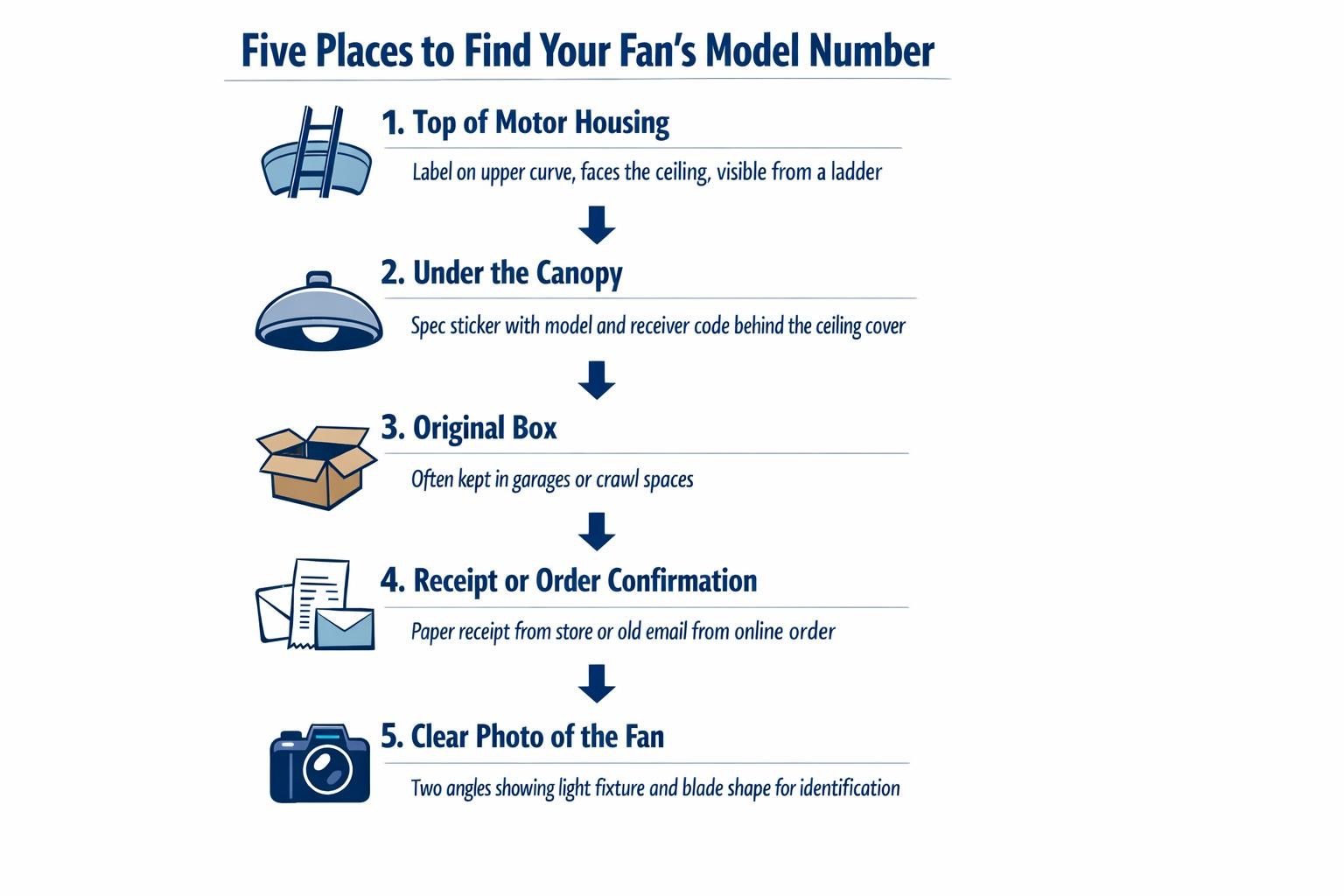
There are five places the answer usually hides:
- The top of the motor housing. Most manufacturers put a label on the upper curve of the housing, facing the ceiling. It is invisible from a couch and obvious from a ladder.
- Under the canopy. The canopy is the shallow cover where the downrod meets the ceiling. A spec sticker with the model and the receiver code often lives right behind it.
- The original box. People keep fan boxes in garages and crawl spaces more often than they expect.
- The receipt or order confirmation. A paper receipt from a local store, or an old email from an online order.
- A clear photo of the fan itself. Shoot it from two angles, with the light fixture and blade shape visible. Someone who sees fans every day can often name the line from the housing shape alone.
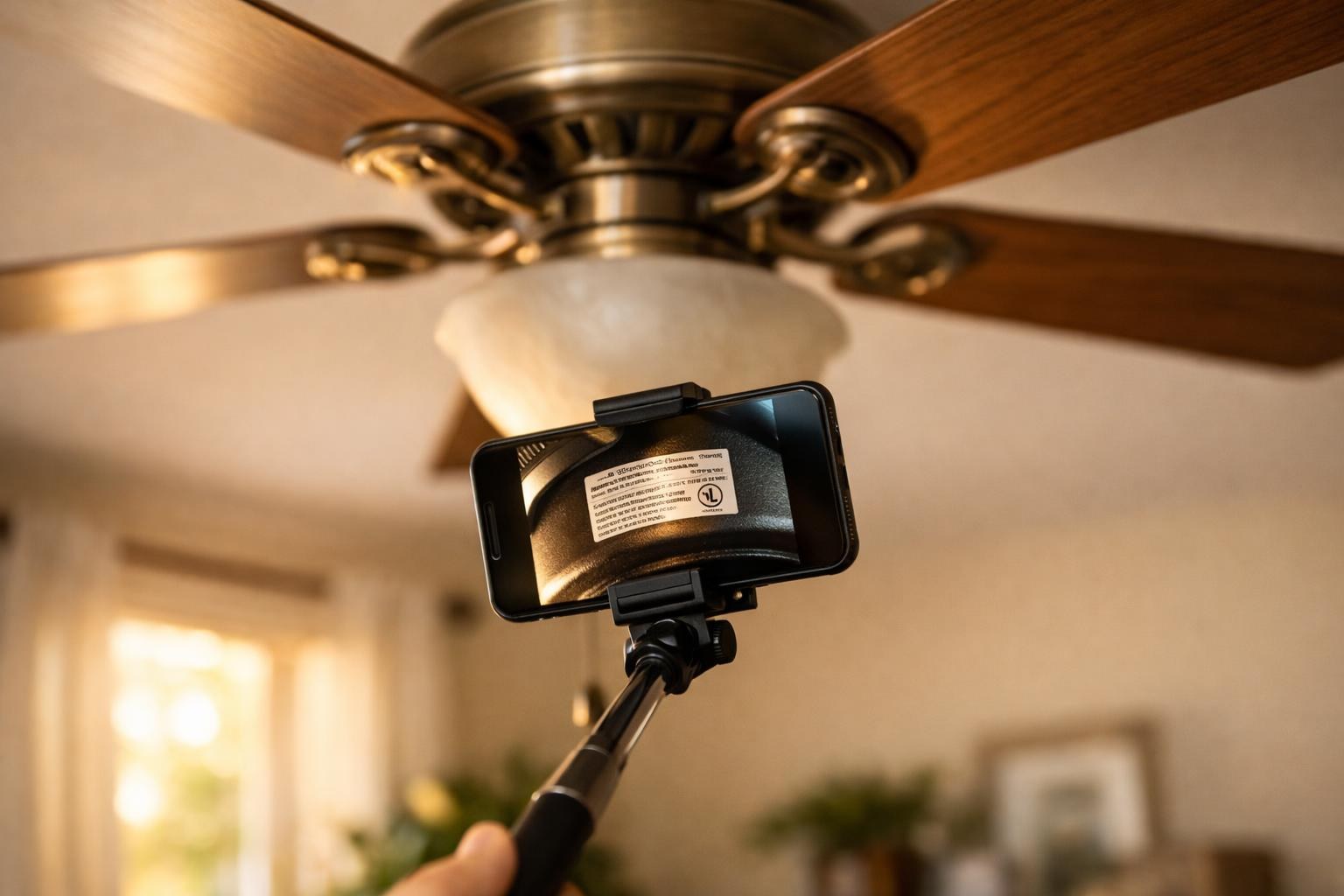
A phone on a selfie stick held up toward the housing gets the label photo without climbing anything. Anything that requires loosening the canopy belongs to a licensed electrician, since that is live wiring territory.
Why the Twenty Dollar Universal Remote Sometimes Fails
The handset is only half the system. Inside the canopy sits a small receiver, and that receiver is what actually talks to the motor and the light.
A universal remote kit replaces both pieces, handset and receiver. That is why the kit price looks cheap and the install does not. Costs vary, but these kits commonly sit in the $20 to $50 range at general retailers, while a matched factory handset for a premium fan can run several times that.
Here is where universal kits usually work and usually do not:
- Older AC-motor fans with a dip-switch receiver. These often accept a universal kit cleanly. Set the switches, pair, done.
- DC-motor fans. Generally no. The handset and receiver are matched to that specific motor controller, and a generic kit will not drive the speed steps.
- Fans with an integrated LED light module. A generic remote almost always costs you the dimming. The light goes to on and off only.
- Fans running on a smart or proprietary wall control. These need the manufacturer’s own parts to keep full function.
Before buying anything, try the free fixes. Fresh batteries, a hard re-pair by cutting power at the breaker for 30 seconds and holding the pairing button, and a check that the wall switch is fully on. Those three steps solve a surprising share of “dead” remotes.
Will a Universal Remote Work With Your Fan?
Use this as a quick sort before spending money. The fan’s motor type and light style decide most of it.
| Fan setup | Universal kit likely to work? | Better path |
|---|---|---|
| Older AC motor, pull chains still present | Usually yes | Standard universal kit, set dip switches to match |
| AC motor, no pull chains, separate bulbs | Often yes | Universal kit, confirm light circuit is supported |
| DC motor fan | Rarely | Manufacturer handset or receiver for that model |
| Integrated dimmable LED light module | Partial at best | Factory remote, or accept losing the dimming |
| Paired wall control or smart app fan | No | Manufacturer replacement part only |
Five Places to Find Your Fan’s Model Number
A visual checklist for tracking down the information a replacement remote search depends on.
Where Your Job Ends and the Electrician’s Begins
This is a clean split, and it is a handoff rather than a hurdle. Peninsula homeowners already work with their own trades, and most just want to show up to that appointment holding the right part.
Yours to try first:
- New batteries in the handset
- Re-pairing the remote after a breaker reset
- Confirming the wall switch and any dimmer are set correctly
- Finding the model number and sourcing the correct part
Your electrician’s work:
- Dropping the canopy to read the receiver label
- Swapping a receiver module
- Any rewiring, including converting a fan to a wall control
- Checking mounting hardware while the canopy is open
That last point matters more than people think. Fan hardware does fail, and there have been national recalls tied to blades separating from the motor, so an hour with a licensed electrician is a reasonable time to have the mount looked at too.
Electrician rates move around, but many Monterey County homeowners report somewhere in the range of $125 to $200 per hour with a one-hour minimum. Having the part in hand keeps that to one visit instead of two.
Late October Is a Better Time to Fix This Than Late December
A missing remote usually gets discovered the week someone wants the fan running the other direction. The homeowner quoted earlier needed it “for winter to push the warm air down from the fireplace.”
That is the real reason this gets urgent on the Peninsula. December is the darkest and wettest stretch of the year here, with sunset at 4:51 pm on December 1 and roughly 2.4 inches of rain across about ten rain days. Older Pacific Grove and Carmel homes with tall or open ceilings lean hard on reverse mode from November through March.
On many current fans, there are no pull chains at all. The reverse switch, the speed settings, and the light dimming all live in the handset. Lose it and you lose three functions at once.
Reversing a fan in winter pushes warm air trapped at the ceiling back down into the room, which is why the U.S. Department of Energy recommends running fans clockwise at low speed in cold months. Sorting out a replacement in October means it is handled before the first cold snap. Part lead times on a discontinued fan can run two to six weeks, which is a long wait in late December.
Buying Where Someone Keeps Records Pays Off Years Later
An online order from 2019 is usually a dead link and a closed support ticket. A local purchase is usually a phone call.
That shows up constantly in real customer messages. One Monterey County homeowner asked for a copy of a receipt for a fixture bought back in 2019. Another wrote in about a fan purchased roughly two and a half years earlier, asking whether the purchase could still be traced. Plenty of inquiries come from people circling back five, ten, even fifteen years later looking for a part, a shade, or a matching piece.
The lesson applies no matter where a fan came from:
- Photograph the model label the day it goes up
- Save the photo and the receipt in the same place as appliance manuals
- Note the install date and the room
It takes two minutes and saves a ladder trip a decade later. The same principle applies when an older fixture needs one part instead of a whole new light, which is far more common than most homeowners assume.
Frequently Asked Questions About Ceiling Fan Remote Replacement
Can I find my fan’s model number without getting on a ladder?
Sometimes. Hold your phone up toward the top of the motor housing and take a photo, or use a selfie stick. If the label is not there, it is likely under the canopy, and that one requires a licensed electrician because it means working near live wiring.
My fan has an LED light. Will a universal remote still dim it?
Usually not. Integrated LED modules are controlled by the fan’s own receiver, and a generic kit typically drops you down to on and off. If the dimming matters to you, the manufacturer’s handset or receiver is the right part.
The fan is 15 years old. Are parts even available?
More often than people expect. Some manufacturers support discontinued lines for a long time, and others have a current receiver that is backward compatible. It depends entirely on the brand, which is why identifying the fan comes first.
Is it cheaper to just replace the whole fan?
Rarely, if the fan is good. A quality fan plus an electrician’s install time costs far more than a handset or receiver. It is worth understanding why two fans that look alike do not cost the same before writing off a fan that still runs well.
Can I convert the fan to a wall control instead of a remote?
Often yes, but it depends on the wiring already in the wall and the fan’s motor type. This is electrician work in every case, and the fan may need a different receiver. Worth asking about if remotes keep disappearing in your house.
Still Not Sure What Fan You Have?
Greg at The Home Lighter can often identify a fan from a photo and a model label, then check what the manufacturer still supports for handsets, receivers, and other parts. That showroom has worked with Monterey County homeowners from 2034 Sunset Drive in Pacific Grove since 1969, across more than 60 manufacturer lines. Walk-ins are welcome, appointments are available for more involved projects, and the phone is (831) 655-5500.
