
When you're weighing CFL vs incandescent bulbs, it comes down to a classic trade-off: long-term savings versus upfront cost and light quality. Incandescent bulbs are cheaper to buy and give off that familiar, warm glow. However, their design is inefficient, with only 10% of electricity turning into light.
Compact Fluorescent Lamps (CFLs), on the other hand, use about 75% less energy and can last up to ten times longer. This means significant savings on your energy bills and fewer trips to the store for replacements.
The Final Verdict on CFL vs Incandescent Bulbs
Choosing the right light bulb is a small decision with a big impact on your home's atmosphere, monthly energy costs, and overall convenience. For years, the main choice for homeowners was between the classic incandescent bulb and its more efficient successor, the CFL. Even with LEDs now dominating the market, understanding the CFL vs incandescent matchup is still important, especially for older fixtures.
An incandescent bulb's technology is simple: electricity flows through a tiny wire filament, heating it until it glows. While this creates a warm, inviting light, it's also a miniature space heater, wasting a huge amount of energy. This inefficiency means higher electricity bills and a much shorter lifespan.
CFLs work on a completely different principle. An electric current excites gas and a tiny amount of mercury vapor inside the tube, causing a phosphor coating to glow brightly. This method is far more efficient, though early CFLs were known for harsh light and slow warm-up times. Modern versions offer a variety of color temperatures to suit any room.
At a Glance: CFL vs Incandescent Key Distinctions
The image below shows the stark difference between the cool white light of a CFL and the warm yellow glow of an incandescent bulb. It's a great visual for understanding the distinct atmosphere each one creates.
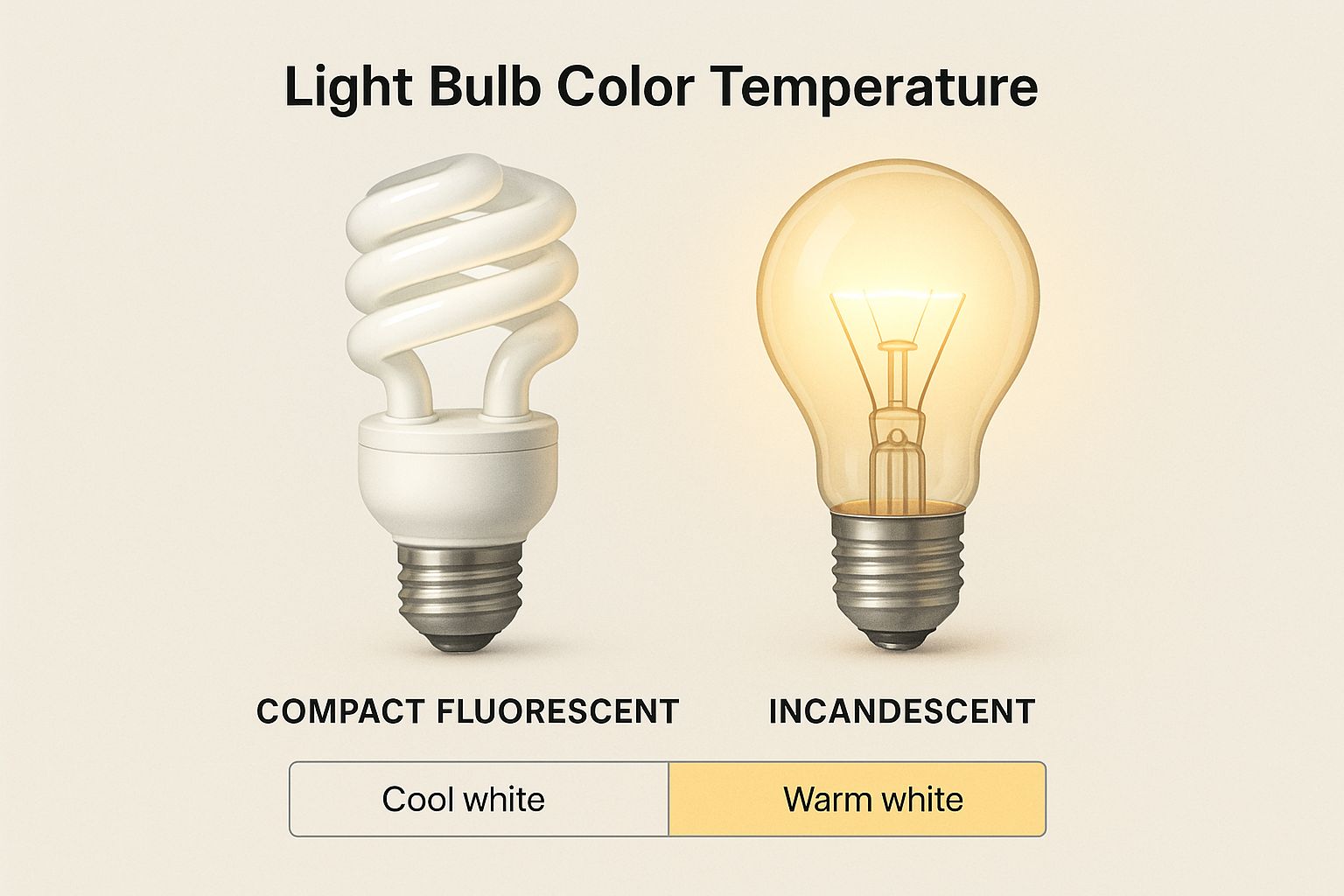
For homeowners on the Monterey Peninsula aiming for a specific look, this visual difference is critical. To help you weigh the practical trade-offs, here’s a table breaking down the key distinctions.
| Attribute | CFL (Compact Fluorescent Lamp) | Incandescent Bulb |
|---|---|---|
| Average Lifespan | 8,000–15,000 hours | 750–2,000 hours |
| Energy Efficiency | High (uses ~75% less energy) | Very Low (wastes 90% as heat) |
| Upfront Cost | Higher | Lower |
| Heat Emission | Low | High (can impact cooling costs) |
| Light Quality | Varies (from warm to cool white) | Consistently warm, yellow-white light |
| Environmental Impact | Contains a small amount of mercury | No hazardous materials, but high energy use |
Key Takeaway: The primary trade-off is clear. Incandescent bulbs offer a low initial cost and familiar warm light, while CFLs provide dramatic long-term savings on energy and replacement costs, making them a smarter financial choice for most applications.
How Light Bulbs Actually Create Light
To really get to the bottom of the CFL vs incandescent debate, you have to look at how each bulb makes light. The science behind them is worlds apart, and this core difference explains the huge gaps in their efficiency, heat output, and lifespan.
Incandescent bulbs work on a principle that is both simple and wildly inefficient. When you flip the switch, electricity heats a tiny tungsten filament inside the glass bulb to over 4,000°F, causing it to glow through a process called incandescence.
This process is incredibly wasteful. An incandescent bulb is essentially a tiny space heater that happens to give off some light, with a staggering 90% of its energy lost as heat. This is why they get hot to the touch and run up your energy bills.
The Fluorescent Method Unpacked
Compact Fluorescent Lamps (CFLs) rely on a much more sophisticated—and efficient—process. Inside the spiral tube is a mix of argon gas and a tiny amount of mercury. An electrical current flows through this mixture, exciting the mercury.
This causes the mercury to produce invisible ultraviolet (UV) light. The inside of the glass tube is coated with a phosphor material. When the UV light hits the phosphor coating, it glows, or fluoresces, creating the visible light we see.
Key Insight: The fundamental difference is this: incandescents create light by heating a solid material until it glows, a process that inherently wastes energy as heat. CFLs create light by exciting a gas to produce UV light, which then activates a coating to glow—a much cooler and more controlled method.
This efficiency is why CFLs became the first major energy-saving alternative. While today's lighting has moved on, especially with the rise of energy-efficient LED lights, understanding how these technologies work is still crucial.
The True Cost of Lighting Your Home
When comparing CFL and incandescent bulbs, the price tag is just the tip of the iceberg. The real cost unfolds over years on your electricity bills and in bulb replacements. You must look beyond the shelf price to the total cost of ownership.
An incandescent bulb looks like a steal, often costing less than a dollar. A CFL might set you back a few dollars more. But that initial savings gets vaporized by the incandescent's shocking inefficiency.
Calculating Lifetime Operating Costs
Let's use some real-world numbers. Imagine a single light fixture used for about four hours a day, which is roughly 1,500 hours of use per year.
- A standard 60-watt incandescent bulb will burn through 90 kilowatt-hours (kWh) of electricity in that year.
- A comparable 14-watt CFL, giving off the same amount of light, uses only 21 kWh.
That's an energy reduction of over 75%. The U.S. Department of Energy confirms that a typical 60-watt incandescent produces about 800 lumens, while a CFL achieves the same brightness using just 13-15 watts.
This chart shows the leap forward fluorescent technology represented, paving the way for today's even more efficient lights.
Now, let's talk replacements. An incandescent bulb might burn out in under a year. The CFL, however, can last for six to eight years. Over a CFL's 8,000-hour lifespan, you'd buy at least eight incandescents while paying four times more for electricity.
The Financial Bottom Line: When you factor in both electricity and replacement costs, a single CFL can save you $40 or more over its lifetime compared to its incandescent counterpart. Multiply that by the dozens of light bulbs in a typical home, and the savings add up fast.
The Hidden Cost of Waste Heat
There’s another cost, especially for us in warmer climates like the Monterey Peninsula. Incandescent bulbs convert 90% of their energy into heat. This is like running dozens of tiny space heaters throughout your house.
During our beautiful Central Coast summers, that extra heat makes your air conditioning work harder to keep your home comfortable. This drives up cooling bills, adding another financial hit.
CFLs, by contrast, run much cooler. Understanding these secondary costs is a big part of appreciating how home lighting affects everyday life and your budget.
How Light Quality and Daily Performance Stack Up
Beyond saving money, the bulb you choose dramatically impacts the look and feel of your home. We're talking about atmosphere, color accuracy, and overall comfort. This is where the debate shifts from your wallet to your experience.
For a long time, incandescents were the clear winner here, giving off a classic warm, steady glow. Early CFLs got a bad rap for slow start times and sterile light. Thankfully, modern CFLs have come a long way.
Understanding Color Temperature and CRI
Two key factors determine light quality: the Color Rendering Index (CRI) and color temperature, measured in Kelvin (K). CRI is a score from 0 to 100 indicating how well a light source shows true colors. Incandescent bulbs have a perfect CRI of 100.
Color temperature describes the look of the light itself, from warm to cool.
- Warm White (2700K – 3000K): The cozy, yellowish light of traditional incandescents, perfect for living rooms and bedrooms.
- Cool White (3500K – 4100K): A brighter, more neutral white, great for kitchens, bathrooms, and garages.
- Daylight (5000K – 6500K): An intense, blue-tinged white light that mimics natural daylight, often used for reading or hobbies.
While incandescents are stuck around 2700K, CFLs offer incredible versatility. You can find them across the entire Kelvin spectrum, letting you choose the perfect light for each room.
Addressing Old Performance Complaints
Remember waiting for a CFL to reach full brightness? While older models had a noticeable warm-up lag, most modern CFLs are "instant-on," eliminating that delay.
Expert Insight: Flickering was another huge complaint, often caused by using a standard CFL with a dimmer switch. You must use bulbs labeled "dimmable CFL" with a compatible dimmer to avoid flickering and damage.
Incandescents still have an edge here, as they dim smoothly with any standard dimmer. Achieving the same smooth dimming from a CFL requires careful product selection.
Practical Choices for Your Home
The ability to choose your color temperature with CFLs is a game-changer for home design. For a coastal-style home in Monterey, you might pick warm white (2700K) CFLs to get that cozy, inviting feel in the living room.
In a functional space like a kitchen, a cooler CFL (around 4000K) can make tasks safer and easier. Our guide on selecting your kitchen lighting dives deeper into how to layer light for a space that is both beautiful and functional.
Durability, Lifespan, and Environmental Impact
Beyond cost and efficiency, durability and environmental footprint are crucial in the CFL vs. incandescent debate. A bulb's lifespan directly affects convenience and long-term maintenance. This is where the two technologies truly part ways.
An old-school incandescent bulb has a short life, typically burning out after just 750 to 2,000 hours. In a busy area like a kitchen, that means changing bulbs every few months.
In stark contrast, a CFL is built to last, with an average lifespan between 8,000 and 15,000 hours. A single CFL can easily outlive ten or more incandescent bulbs, which is a major advantage for hard-to-reach fixtures.
The Environmental Trade-Off
The environmental story here is complex. Incandescent bulbs seem harmless, made of glass and metal with no toxic materials. Disposal is easy.
But their real environmental cost lies in their inefficiency. They drive up demand at power plants, contributing to higher carbon emissions. Their short lifespan also means more resources are used for manufacturing and shipping replacements.
CFLs have a different set of pros and cons. Their energy efficiency dramatically cuts greenhouse gas emissions. The catch? They contain a tiny but crucial amount of mercury.
Key Consideration: The shift away from incandescents forced a new conversation about responsible product life cycles. CFLs contain about 5 milligrams of mercury, a toxic heavy metal that is essential for them to produce light. Their disposal requires more care than just tossing them in the trash.
Safe Disposal and Handling of CFLs
Because of the mercury, you can't throw a CFL bulb into your regular garbage. Responsible disposal is critical. Fortunately, for residents here on the Central Coast, most local hardware stores and waste facilities have free recycling programs.
If a CFL accidentally breaks, don't panic. The amount of mercury is extremely small.
- Ventilate the Room: Open a window and let the room air out for 10–15 minutes.
- Avoid a Vacuum: Never use a vacuum cleaner, as it can spread mercury powder and vapor.
- Scoop Up Fragments: Use stiff paper or cardboard to scoop up larger glass fragments. Use sticky tape for smaller bits.
- Seal and Dispose: Place all pieces and tape into a sealable container, like a glass jar. Check with your local waste authority for disposal instructions.
As you weigh these long-term factors, remember that your choice of bulb is only one part of the equation. The many types of light fixtures you choose also play a massive role in your home's lighting design.
Choosing the Right Bulb for Every Room
The best light bulb is the one that fits the job you need it to do. While CFLs usually win on efficiency, room-by-room decisions tell a more nuanced story. The room's function and desired atmosphere are key.
Think of this as your personal lighting consultation. A homeowner in Monterey might need bright, consistent light for hours in a kitchen but only an instant glow in a seldom-used hallway. Each scenario calls for a different solution.
When An Incandescent Bulb Still Makes Sense
It might sound counterintuitive, but there are situations where a classic incandescent bulb is a better choice. Their strength is in places where lights are turned on frequently for very short periods.
Situational Insight: A CFL's lifespan is dramatically shortened by being switched on and off constantly. The initial jolt of electricity puts stress on its internal components.
This makes incandescent bulbs a practical fit for areas like:
- Walk-in Closets: You pop in, grab what you need, and shut the light off in under a minute.
- Pantries and Storage Rooms: These are quick trips where you just need instant, warm light.
- Certain Hallways or Entryways: If a light is only flipped on for a moment, the wear on a CFL isn't worth it.
In these cases, a cheap, reliable incandescent gets the job done without any fuss. The minimal energy savings of a CFL would be canceled out by its shortened lifespan.
Ideal Applications for CFL Bulbs
On the flip side, CFLs shine in rooms where lights stay on for long stretches. This is where their energy efficiency and long lifespan pay off. If a light is on for three or more hours at a time, a CFL is almost always the smarter move.
Look at these common high-usage areas:
- Kitchens: Lights are often on for hours during meal prep, cooking, and cleanup.
- Home Offices: Lights are on for eight hours or more during a full workday.
- Living Rooms and Family Rooms: Lights stay on all evening for reading, watching TV, or spending time together.
For these applications, the higher upfront cost of a CFL pays for itself many times over. Getting the lighting right is especially key for entertaining, as explored in our guide to custom home lighting ideas for entertaining during the holidays. While this debate is a great starting point, exploring top lighting ideas for home renovation can also be very helpful.
Frequently Asked Questions (FAQs)
Homeowners often have practical questions about how these bulbs perform day-to-day. Getting straight answers is the final step to choosing with confidence. Here are some of the most common questions we hear from our Monterey Peninsula clients.
1. Are CFL bulbs safe if one breaks in my home?
Yes, as long as you take simple precautions. A single CFL has a very small amount of mercury (about 4-5 milligrams). If a bulb shatters, open a window to air out the room for 10-15 minutes. Carefully scoop the fragments into a sealed container and never use a vacuum cleaner.
2. Why do my CFLs take a moment to get bright?
This "warm-up" period was a known issue with older CFLs as the internal gases needed time to reach full operating temperature. Most modern CFLs are "instant-on," eliminating this delay so you get full brightness right away.
3. Can I use a CFL bulb with my dimmer switch?
Only if you buy the right one. A standard CFL will flicker or burn out on a dimmer. You must purchase a bulb specifically labeled "dimmable CFL" and ensure it's compatible with your dimmer model. Incandescents, by contrast, dim beautifully with any standard dimmer.
4. How can I get the same warm glow of an incandescent from a CFL?
Yes, absolutely. The trick is to check the packaging for its color temperature, measured in Kelvin (K). To get that classic, cozy light, choose a CFL labeled "warm white" or one with a color temperature around 2700K.
5. Where can I dispose of old CFL bulbs on the Central Coast?
For homeowners on the Central Coast, getting rid of old CFLs is simple. Most local waste management facilities and hardware stores in the Monterey, Salinas, and Santa Cruz areas have free and convenient CFL recycling programs to ensure they are disposed of responsibly.
At The Home Lighter, Inc., we help you sort through these choices to find the perfect lighting for every single room. Learn more about our design consultations at https://homelighterinc.com.