
Direct Answer: Ambient lighting done right means soft, even light that fills a room without harsh shadows or glare — achieved through the right fixture type, placement, and color temperature working together.
Most homeowners don’t set out to get their lighting wrong. They pick a fixture they like, screw in a bulb, and move on. Then six months later they’re sitting in a room that looks perfectly fine in photos but feels somehow off — too bright in one corner, flat in the middle, and a little cold around the edges.
That gap between dim and done right almost always comes down to ambient lighting. It’s the base layer that every other light in your home builds on. Get it wrong, and no amount of decorative pendants or accent fixtures will save you.
This guide focuses on the two things that matter most: how ambient light actually behaves in a room, and what decisions you need to make before you buy anything. If you’re planning a remodel anywhere on the Monterey Peninsula — Carmel, Pacific Grove, Pebble Beach, or anywhere in between — these are the fundamentals worth understanding first.
What Ambient Lighting Actually Does (and Doesn’t Do)
Ambient light is the general illumination that lets you move through a space safely and comfortably. It’s not the light you read by. It’s not the light that highlights your art. It’s the foundation — the background glow that sets the overall tone of a room.
The mistake most people make is treating ambient lighting like it should do everything. A single overhead fixture cranked up to 800 lumens in the center of a living room doesn’t create ambient light — it creates a spotlight with dark edges. That’s the clinical, institutional feeling people complain about in rooms that are technically well-lit but somehow exhausting to sit in.
Good ambient lighting does three things:
- Spreads light evenly across the room without obvious hot spots
- Maintains a consistent color temperature that matches how the space is used
- Keeps glare low enough that you can look around without squinting
The reason restaurants feel so inviting isn’t magic — it’s layered, low-glare ambient light combined with intentional accents. The same logic applies at home. You’re not trying to light a parking lot. You’re trying to light a room where real people spend real time.
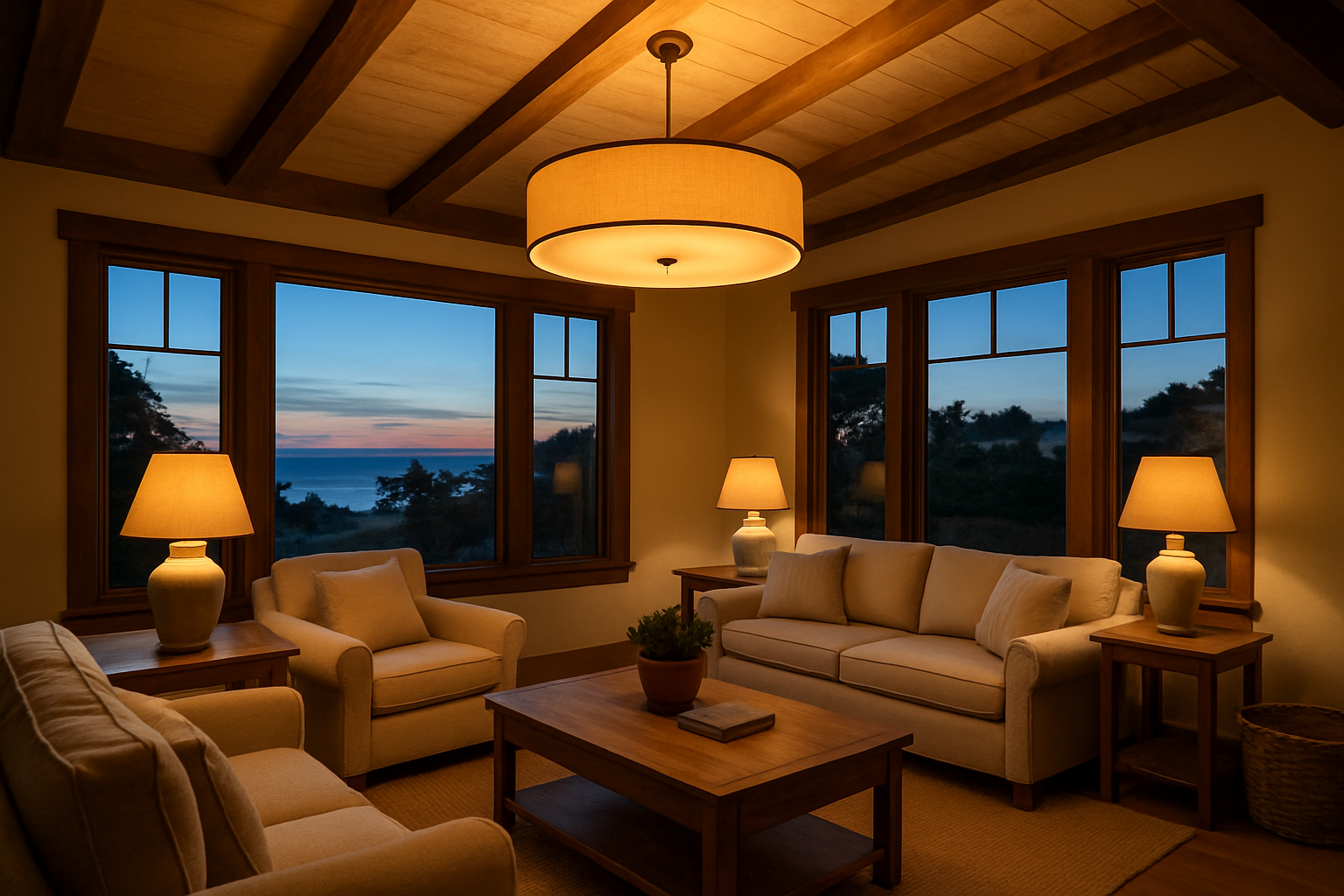
Color Temperature: The Single Biggest Variable Most Homeowners Overlook
If you’ve ever bought a bulb that looked warm in the packaging but made your kitchen feel like a hospital break room, you’ve experienced a color temperature mismatch. This is measured in Kelvins, and it matters more than most people realize.
Here’s the basic range and where each zone works:
- 2700K–3000K — Warm white. Best for living rooms, bedrooms, dining rooms, and anywhere you want a relaxed, residential feel. Most coastal homes on the Peninsula look their best in this range.
- 3000K–3500K — Neutral white. Works well in kitchens and bathrooms where you want slightly more clarity without tipping into harsh territory.
- 4000K and above — Cool white. Appropriate for garages and utility spaces, but usually wrong for living areas.
For anyone in Carmel-by-the-Sea specifically, this isn’t just a design preference — it’s a compliance issue. Carmel has exterior lighting ordinances that cap residential fixture color temperature at 3000K and restrict lumen output. If you’re doing any outdoor work, that 3000K ceiling applies, and it’s worth checking with local authorities or your licensed contractor before you spec anything. More on navigating Carmel’s interior and exterior lighting rules is available if you need to go deeper on that topic.
For interior ambient lighting, 2700K is the most forgiving starting point for Monterey Peninsula homes. Coastal light coming through the windows tends to be cool and gray for much of the year, and warmer interior lighting creates a comfortable contrast instead of competing with it.
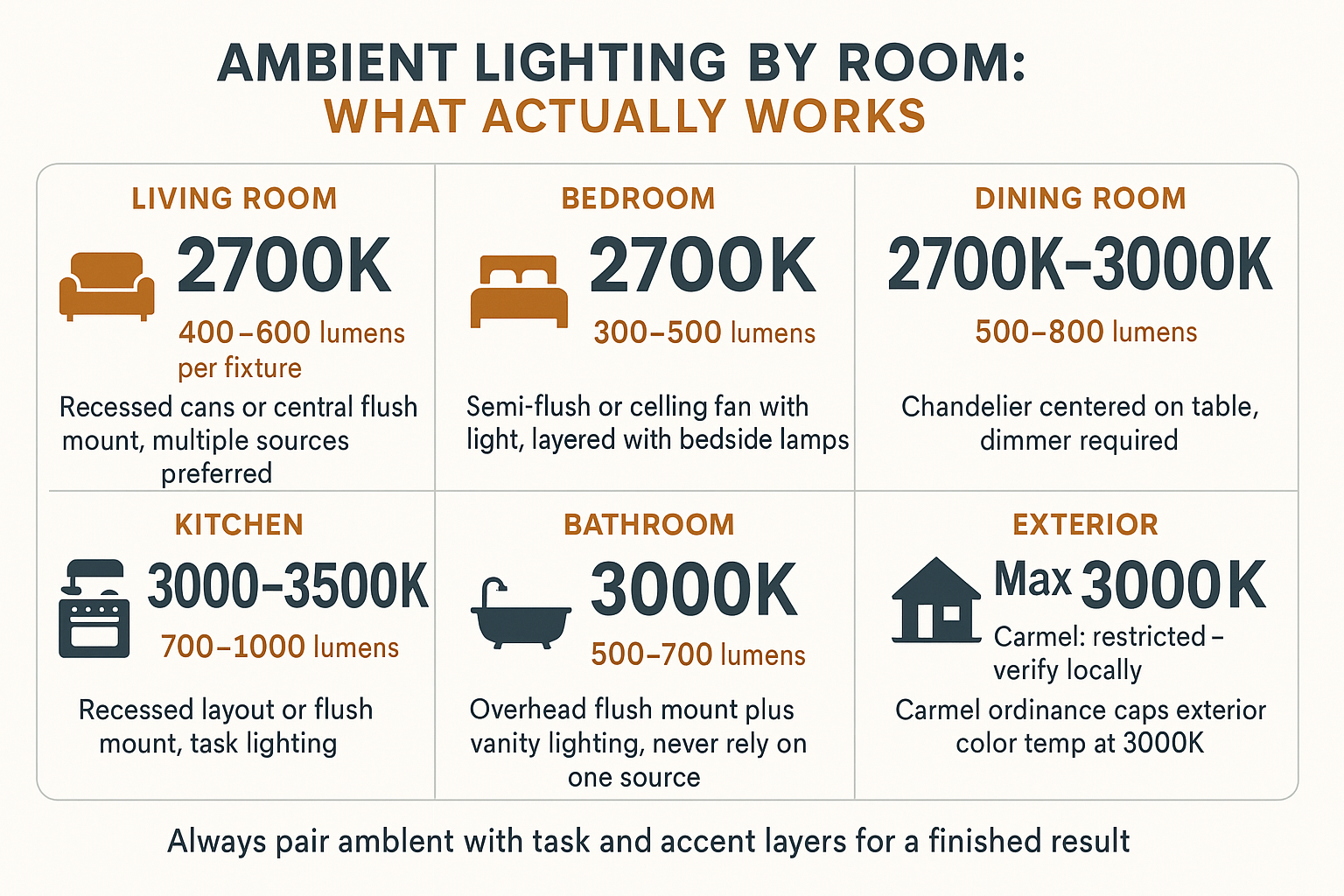
Ambient Lighting by Room: A Quick Reference
This infographic breaks down the recommended color temperature, approximate lumen range, and fixture type for the most common rooms in a Monterey Peninsula home.
How Many Fixtures You Actually Need — and Where to Put Them
This is where most homeowners undershoot. A single center fixture in a 14×16 foot room will leave every wall dim and every corner dark. That’s not ambient lighting — that’s a reading lamp for the middle of the room.
A practical rule of thumb: one recessed can or flush mount fixture for every 25–30 square feet of ceiling space, spaced evenly. In a 400 square foot great room, that’s roughly 13–16 fixtures if you’re going all-recessed. Most people are surprised by that number — but it’s why lighting plans done on paper before installation almost always look different from what homeowners would have guessed.
For rooms with lower ceilings — common in Pacific Grove bungalows and older Carmel cottages — flush mounts and semi-flush mounts do the heavy lifting. They keep light off the ceiling plane and distribute it at a height where it actually reaches the floor and furniture.
If your home has higher ceilings or an open floor plan, layered lighting across kitchen and living zones becomes especially important. One layer of ambient light in an open-plan space isn’t enough to prevent that flat, uninspired feeling.
A few placement decisions that make or break ambient lighting:
- Keep recessed cans at least 2 feet from walls to avoid scalloping (the half-moon shadow pattern on walls)
- Space fixtures evenly across the ceiling rather than clustering them in the center
- Always put ambient fixtures on a dimmer — a room at 100% feels very different at 70%, and that flexibility is what makes a space livable at different times of day
California Title 24 (updated effective January 1, 2026) requires dimmer controls on most interior lighting in new construction and major remodels statewide, so this isn’t optional for anyone doing permitted work. Your licensed electrician or contractor can confirm what applies to your specific project.
Ambient Lighting Fixture Types: What Works Where
Different fixture types create different light distribution patterns. This table helps you match the right option to the room and ceiling height you’re working with.
| Fixture Type | Best Ceiling Height | Light Distribution | Best Rooms |
|---|---|---|---|
| Recessed Downlights | 8 ft and above | Directed downward, requires multiple fixtures | Kitchen, hallways, open-plan living |
| Flush Mount | 7–9 ft | Wide, diffused, even spread | Bedrooms, bathrooms, cottages |
| Semi-Flush Mount | 8–10 ft | Upward and downward, good spread | Living rooms, entryways, dining rooms |
| Chandelier | 9 ft and above | Diffused with decorative spread | Dining rooms, foyers, primary bedrooms |
| Ceiling Fan with Light | 8–10 ft | Diffused downward, covers large area | Bedrooms, covered patios, sunrooms |
| Pendant (grouped) | 9 ft and above | Directed downward, accent-heavy | Kitchen islands, dining tables — supplement only |
What Dimmers Do That Most People Don’t Expect
A lot of homeowners buy a dimmer and then wonder why their lights flicker, hum, or won’t go below 30% before dropping off completely. That’s almost always a compatibility issue between the dimmer switch and the bulb or driver inside the fixture.
Not all LED bulbs are dimmable, and among those that are, performance varies significantly. An LED rated for dimming but paired with an incompatible switch can buzz audibly — which is noticeable in a quiet Carmel living room at 9pm. The fix is usually straightforward, but it requires knowing which dimmers work with which LED drivers before you buy.
The guide to dimmable bulb compatibility covers this in more detail if you want the technical side. The short version: specify your bulb and your dimmer together, not separately.
For ambient lighting specifically, dimmers change the entire feel of a room across different times of day:
- Morning — 80–100% for getting ready or making coffee
- Daytime — 60–70% when natural light supplements overhead fixtures
- Evening — 40–60% for relaxed conversation or cooking
- Night — 20–30% as a soft background when the TV or fireplace carries the room
That range is what separates a room that feels designed from one that just has lights in the ceiling.
Frequently Asked Questions About Ambient Lighting at Home
How is ambient lighting different from general lighting?
They’re often used interchangeably, but ambient lighting specifically refers to light that fills a space softly and evenly — without strong directional shadows. General lighting is a broader term that can include bright, task-oriented overhead light. Ambient lighting prioritizes comfort and atmosphere, not just visibility.
Can I use recessed lights as my only ambient source in a living room?
Yes, but only if you have enough of them and they’re spaced correctly. A common mistake is installing four recessed cans in a large living room and wondering why it still feels dim. You typically need one fixture per 25–30 square feet, and they need to be on a dimmer to give you any range of mood. A few well-placed floor or table lamps working alongside recessed lights will almost always look better than recessed alone.
What color temperature should I use in a bedroom?
2700K is the right starting point for almost every bedroom. It’s warm enough to feel restful without making the room look orange. Anything above 3000K in a bedroom tends to feel activating rather than calming — the opposite of what you want at the end of the day.
Do I need to worry about California Title 24 for a small bathroom remodel?
Possibly. California Title 24 energy requirements apply to permitted remodels, which can include bathroom work depending on scope. The updated rules effective January 1, 2026 require dimmer controls on most interior lighting in permitted projects. Your licensed electrician or contractor can tell you exactly what applies to your specific job — and it’s worth asking before you pick fixtures, not after.
I want warmer light but my electrician says LED options are limited. Is that true?
Not really. 2700K LED fixtures and bulbs are widely available and perform well. The bigger issue is usually that the fixtures being specified are limited — not the technology. A showroom with a curated LED selection, like The Home Lighter on Sunset Drive in Pacific Grove, can show you warm LED options across multiple fixture styles so you can see the actual light quality before you commit.
How much should I expect to spend on ambient lighting for a living room?
Fixture costs alone can range from $150 to $800+ per fixture depending on quality and style. A living room with four to six quality fixtures, a compatible dimmer switch, and appropriate bulbs might run $600–$2,500 in product costs before installation. On the Monterey Peninsula, where home values support longer-term investment, most design-conscious homeowners err toward the middle to upper end of that range — fixtures that will still look right in a decade.
Ready to See What Done Right Actually Looks Like?
Greg and Tammy at The Home Lighter have been helping Monterey Peninsula homeowners get their ambient lighting right since 1969 — and that kind of hands-on, in-person guidance is hard to replicate on a screen. Stop by the showroom at 2034 Sunset Drive in Pacific Grove to see fixtures lit and working, ask questions, and leave with a plan you actually feel confident about. Walk-ins are welcome, and if your project is larger, appointments are available. You can also call at (831) 655-5500 to talk through what you’re working on before you visit.