
Making the switch to LED lighting is one of the easiest ways to see an immediate, substantial drop in your energy bills. It's not a small tweak; it's a fundamental change in how your home uses electricity.
Because LEDs turn nearly all their energy into light instead of wasted heat, they are dramatically more efficient than older lighting technologies. You get the same, if not better, quality of light while using just a fraction of the power.
Why LED Lighting Is Your Smartest Energy Upgrade
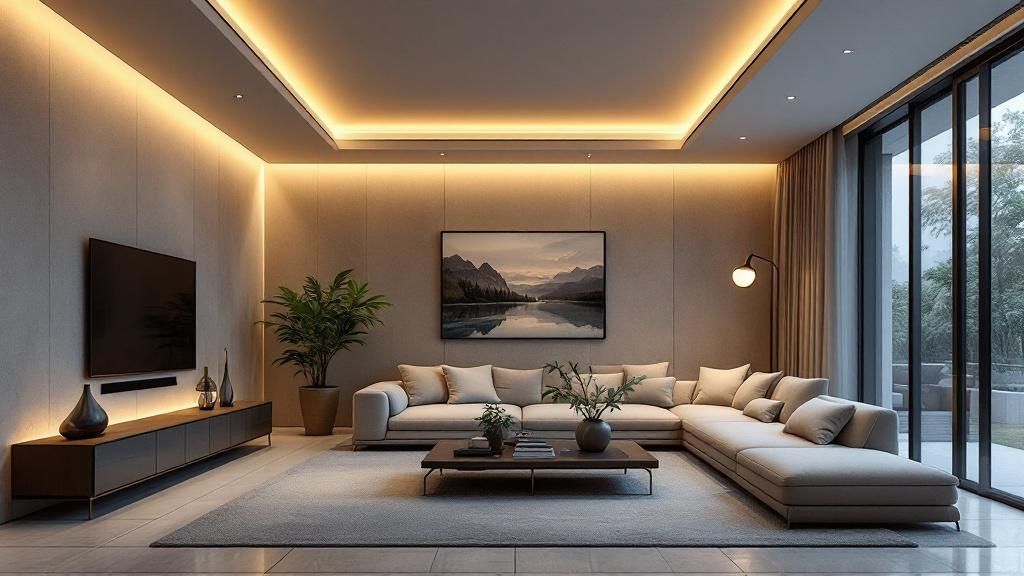
When you're thinking about home upgrades, consider LED lighting the low-hanging fruit for major efficiency gains. The difference is night and day.
Think of an old incandescent bulb like a drafty, window-unit air conditioner from decades ago—it leaks energy constantly. An LED is the modern, high-efficiency central HVAC system that uses power intelligently to get the job done.
Those old incandescent bulbs were notorious energy hogs. Their entire method of making light was primitive: heat a tiny wire until it glows. It worked, but it released about 90% of its energy as heat and only a measly 10% as actual light. You could literally feel the waste, which is why those bulbs were always scorching hot to the touch.
LEDs (Light Emitting Diodes) operate on a completely different, far more elegant principle. They generate light through a semiconductor process that releases photons with very little heat as a byproduct. This core difference is what unlocks their remarkable efficiency.
The Clear Advantage in Numbers
The numbers are staggering. According to the U.S. Department of Energy, modern LEDs consume up to 90% less energy than incandescent bulbs to produce the exact same amount of brightness. They also easily beat out their more recent predecessors, CFLs, using about 50-60% less energy.
To see just how much of a leap forward LEDs are, take a look at this quick comparison. It highlights the massive gap in efficiency and lifespan between the old and the new.
LED vs. Traditional Bulbs Quick Savings Snapshot
| Lighting Technology | Energy Use (vs. Incandescent for same brightness) | Average Lifespan (Hours) | Primary Energy Waste |
|---|---|---|---|
| LED | 90% Less | 25,000+ | Minimal Heat |
| CFL | 75% Less | 8,000 | Some Heat |
| Incandescent | Baseline | 1,200 | Extreme Heat |
As you can see, there's really no contest. LEDs not only sip energy but also last exponentially longer, compounding your savings over time by eliminating constant replacement costs.
Benefits for Central Coast Homeowners
This dramatic reduction in energy use brings two key benefits for homeowners here on the Central Coast:
- Financial Savings: It's simple math. Using that much less electricity leads directly to lower monthly utility bills. Over the incredibly long life of an LED, these savings add up to a serious return on your initial investment.
- Environmental Impact: Lower energy consumption eases the strain on our local power grid. This helps shrink our collective carbon footprint, supporting the environmentally conscious lifestyle we value in communities from Monterey to Santa Cruz.
At its heart, the value of an LED upgrade is simple: You are paying for light, not for wasted heat. Every dollar you save on energy is a dollar that can be reinvested into your home, your family, or your lifestyle.
More Than Just a Bulb Swap
An upgrade is about more than a simple one-for-one replacement; it's a chance to completely reimagine your home's lighting. Today’s market is filled with a variety of stylish and functional LED lighting fixtures that can transform any space.
From sleek recessed lighting to stunning, statement-making pendants, you can finally achieve your design vision while maximizing every dollar. Thanks to the technological leap that LEDs represent, you no longer have to choose between beautiful design and responsible energy use.
How LEDs Turn Smart Tech Into Lower Bills
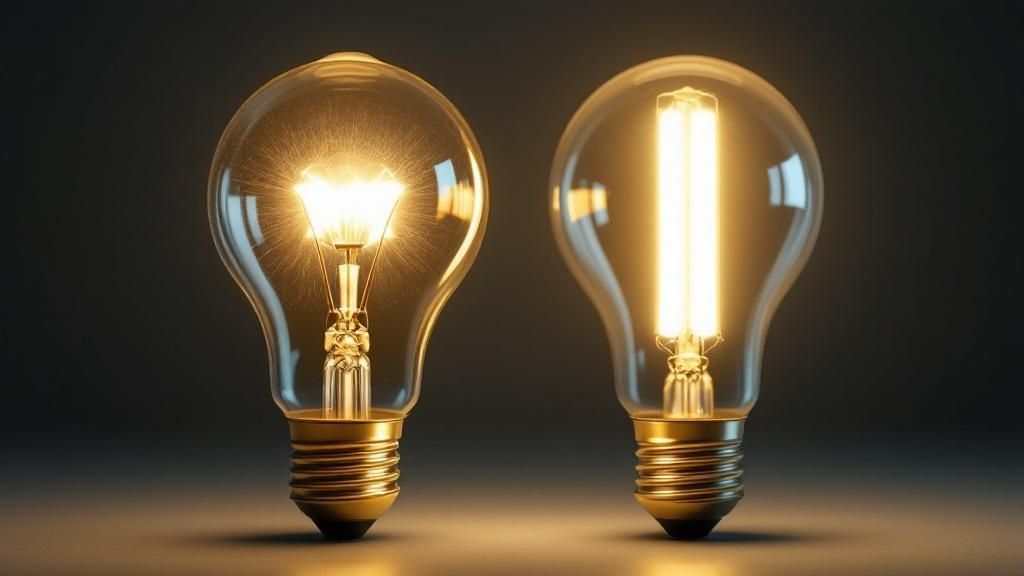
How does an LED bulb translate its technology into money back in your pocket? It’s all about a massive improvement in how a bulb uses electricity to do its one and only job: make light.
The magic is in a concept called luminous efficacy. Think of it like the miles-per-gallon rating for your car. It measures how much visible light (lumens) a bulb creates for every unit of power (watt) it pulls from the wall.
Old-school incandescent bulbs were the gas-guzzlers of the lighting world, barely managing 15 lumens per watt. In stark contrast, today’s LEDs easily hit 75 to 110 lumens per watt. This is why an 8-watt LED can produce the same bright light as a 60-watt incandescent, instantly cutting energy use by over 85%.
More Light, Less Waste
Beyond being more efficient, the very nature of an LED gives it another edge. An old incandescent or even a CFL bulb is omnidirectional—it throws light everywhere, including up into the fixture where it does you no good.
LEDs, on the other hand, are naturally directional. They are designed to emit light in a focused direction, usually a 180-degree arc. This means almost all the light they produce goes exactly where you want it: down onto your kitchen counter, on your book, or across the living room.
This targeted approach prevents waste and leads to much smarter lighting designs. You’re ensuring the energy you pay for becomes useful light, not just lost heat trapped in a fixture.
It’s a one-two punch for savings. With LEDs, you're not just using less energy to create light—you’re also using the light that is created far more effectively.
The Hidden Savings of Running Cool
Ever tried to unscrew an incandescent bulb right after you turned it off? That searing heat is pure, wasted energy. Incandescents convert up to 90% of the electricity they consume straight into heat, not light.
This waste heat doesn't just inflate your lighting bill; it actively works against your air conditioner. Here on the Central Coast, every light bulb pumping out heat forces your AC to run longer to keep your home comfortable during our warm Monterey Peninsula summers.
LEDs run remarkably cool because they convert electricity directly into light far more efficiently. This gives you two distinct types of savings: direct savings on lighting and indirect savings on air conditioning. This powerful synergy makes upgrading to energy-efficient LED lights one of the smartest investments you can make for your home.
Calculating Your Personal LED Savings And ROI
Let's get down to what really matters: how much money you can actually save by switching to LEDs. The return on investment (ROI) from an LED upgrade is often much faster than people realize.
Think of the upfront cost of LEDs as an investment, not just another purchase. Their incredible lifespan and tiny energy needs create savings that compound over time.
The Simple Formula For Annual Savings
You can estimate your potential savings for each bulb you replace with a pretty simple calculation. This formula helps turn abstract terms like "watts" into real dollars.
Here’s the basic formula:
(Wattage Difference x Daily Hours of Use x 365) / 1000 x Your kWh Rate = Annual Savings Per Bulb
Let's break down what that means:
- Wattage Difference: The wattage of your old bulb minus the wattage of your new, efficient LED.
- Daily Hours of Use: A good guess of how many hours a day that particular light is on.
- Your kWh Rate: The price you pay per kilowatt-hour. You can find this right on your PG&E bill.
A Local Monterey Peninsula Example
To make this crystal clear, let's run the numbers for a typical home right here on the Central Coast. We’ll imagine replacing just one heavily used 60-watt incandescent bulb with a 10-watt LED equivalent.
Here are the details for our example:
- Wattage Difference: 60W (Incandescent) – 10W (LED) = 50 watts saved.
- Daily Hours of Use: We'll assume the light is on for an average of 4 hours per day.
- Your kWh Rate: Electricity rates on the Monterey Peninsula can be higher. We'll use a conservative estimate of $0.35 per kWh.
Now, we just plug these numbers into our formula:
(50 watts saved x 4 hours/day x 365 days/year) / 1000 x $0.35/kWh = $25.55 in annual savings for a single bulb.
That's a significant saving from just one light!
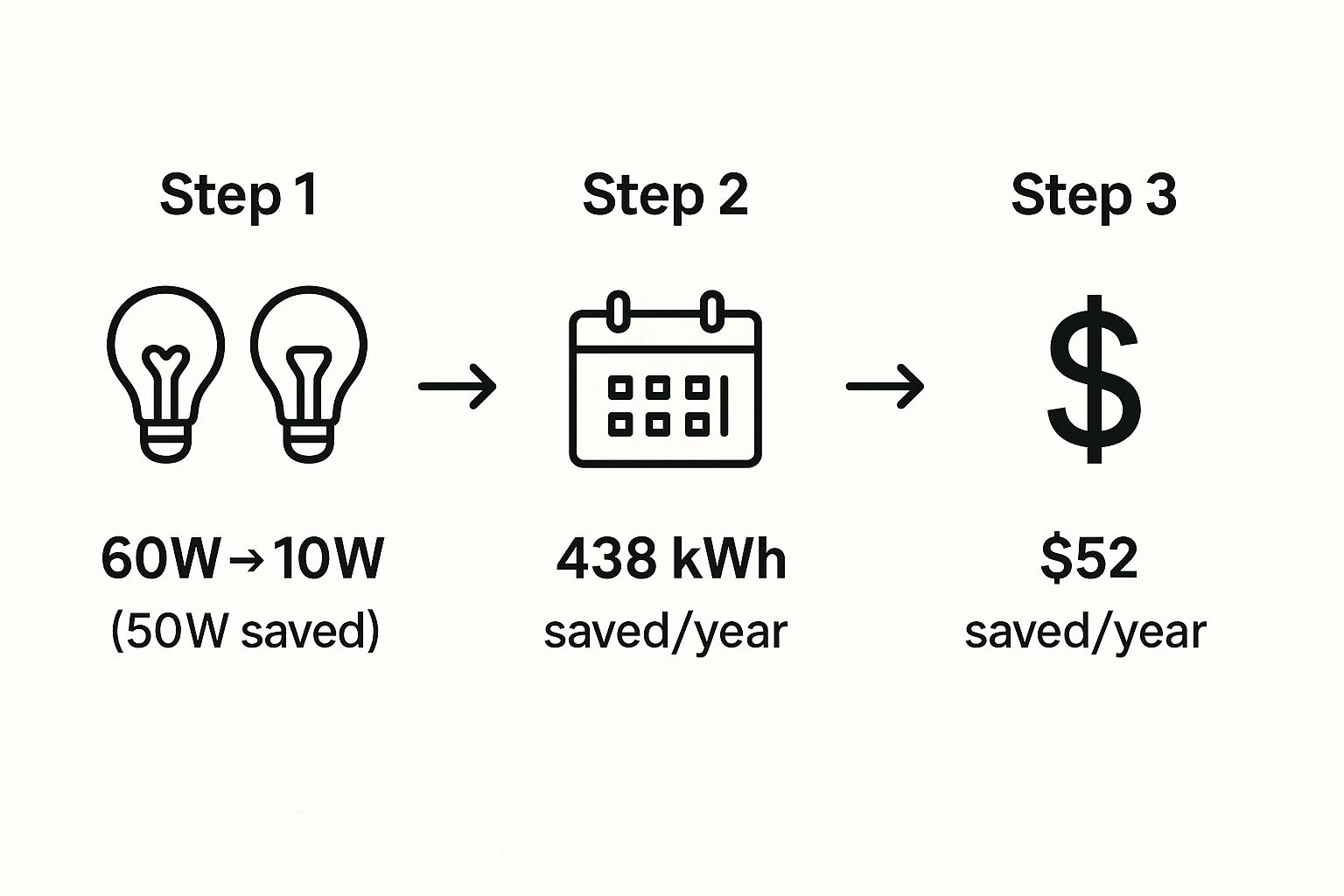
This simple infographic helps visualize how reducing wattage turns directly into real money saved each year. To see how this works in a more detailed, side-by-side comparison, check out this table.
Sample Annual Savings Calculation per Bulb
| Metric | Incandescent Bulb (60W) | LED Bulb (10W) | Savings |
|---|---|---|---|
| Daily Energy Use | 240 Watt-hours | 40 Watt-hours | 200 Watt-hours |
| Annual Energy Use | 87.6 kWh | 14.6 kWh | 73 kWh |
| Annual Energy Cost | $30.66 | $5.11 | $25.55 |
The table really drives it home. Now, multiply that $25.55 by the 20, 30, or even 50 bulbs in an average home. You can see how led lighting energy savings quickly add up to hundreds of dollars per year.
For businesses ready to amplify these benefits, exploring large-scale commercial LED lighting upgrades can lead to even more substantial operational savings.
Beyond The Electric Bill: The ROI of Longevity
The true return on your investment isn't just about the electricity you save. A key factor many people overlook is the incredible difference in lifespan.
- An old incandescent bulb might last for about 1,200 hours. In our example, that's less than a year of use.
- A quality LED bulb is rated to last 25,000 hours or more. That's over 17 years of use under the same conditions!
This means for every single LED you install, you avoid buying and replacing roughly 20 incandescent bulbs. This long-term reliability turns a simple purchase into a lasting home improvement.
Amplifying Savings With Smart LED Controls

Swapping out old bulbs for new LEDs is a fantastic first step, but it’s really just the beginning. To unlock the full potential of your lighting, the secret is in the controls. Integrating LEDs with dimmers, sensors, and timers can dramatically boost your led lighting energy savings.
This is the point where your lighting system goes from being simply "on" or "off" to being genuinely intelligent. Smart controls make sure you’re only using the exact amount of light you need, precisely when and where you need it.
The Power of Proportional Dimming
One of the simplest yet most effective ways to deepen your savings is with dimmers. Unlike old-school bulbs, which got horribly inefficient when dimmed, LEDs have a clean, linear relationship between their brightness and power draw.
When you dim a compatible LED bulb to 50% of its brightness, it uses very close to 50% of the energy. You get to create the perfect mood for any occasion while actively cutting your electricity bill.
This feature is a game-changer for rooms that serve multiple purposes. To do this, it's vital to know how to choose LED lighting fixtures that are built for smooth, flicker-free dimming.
Automating Efficiency With Sensors and Timers
Beyond what you can do by hand, automation is your best friend for maximizing savings. Adding sensors and timers takes human error—like forgetting to turn off the lights—completely out of the equation.
Here are a few scenarios that work beautifully in homes across the Monterey Peninsula:
- Motion Sensors: Perfect for hallways, laundry rooms, and garages. Lights pop on when you enter and switch off after a preset time.
- Occupancy Sensors: Ideal for bathrooms or a home office, where you might be sitting still. They keep lights on as long as they sense a person.
- Timers and Schedules: Program your outdoor lighting to turn on at sunset and off at sunrise, boosting curb appeal and security.
- Daylight Harvesting: For rooms with big windows, photosensors can measure natural light and automatically dim your artificial lights to save power.
By layering these controls, you’re not just saving money—you’re building a responsive lighting system that brings a new level of convenience and sophistication to your daily life.
How The Home Lighter Can Help
Jumping into the world of LEDs can feel like learning a new language with terms like color temperature, lumens, and dimmer compatibility. This is exactly where expert guidance makes all the difference, turning a confusing project into a seamless success.
Here at The Home Lighter, we’re proud to be the Monterey Peninsula community's local, hands-on partner. We are your project collaborators, here to help homeowners, designers, and builders find lighting that just works.
From Confusion To Clarity
Choosing the right LED is about more than grabbing a bulb off the shelf. We help you think through all the little details that matter.
- Aesthetic Goals: We’ll help you match fixture styles to your home’s unique character, whether it's a classic Carmel cottage or a modern Santa Cruz build.
- Functional Needs: From focused task lighting in the kitchen to a soft, ambient glow in the living room, we ensure every space is perfectly illuminated.
- Technical Compatibility: We take the guesswork out of the technical side, guaranteeing your new LEDs work flawlessly with your existing systems.
Our consultative process is built around understanding your project inside and out. This hands-on approach eliminates frustrating trial-and-error and ensures the final result is even better than you imagined.
We believe a successful LED upgrade is one where you don’t have to compromise. You get stunning aesthetics, ideal functionality, and maximum energy efficiency, all working together in perfect harmony.
Let us handle the complexities so you can focus on the best part: enjoying your beautifully lit space.
FAQs About LED Lighting Energy Savings
Making a smart decision is all about having the right information. Here, we tackle the most common questions we hear from homeowners and designers on the Monterey Peninsula to help you move forward with confidence.
Do LEDs really save that much electricity?
Yes, they absolutely do. An LED bulb uses up to 90% less energy than a classic incandescent bulb while producing the exact same amount of light. This is a fundamental shift in efficiency that you'll see on your monthly electricity bill.
Are LED lights worth the higher initial cost?
Without a doubt. While a single LED bulb costs more upfront, the return on investment is fantastic. You make your money back through immediate energy savings and an incredible lifespan—a quality LED can last up to 25 times longer than an old-fashioned bulb.
Can I use new LED bulbs in my old fixtures?
In most cases, yes. LEDs are designed with standard bases to fit most existing lamps and fixtures. However, fully enclosed fixtures and older dimmer switches may require special, compatible LEDs to ensure longevity and prevent flickering.
Does dimming my LED lights actually save energy?
Yes, and it's a fantastic way to save even more. With a compatible dimmer, dimming an LED to 50% brightness uses very close to 50% of the energy. This lets you set the perfect mood while actively trimming your energy costs.
What is the environmental impact of switching to LEDs?
The environmental benefits are significant. Because LEDs use far less electricity, they reduce the demand on power plants, which in turn lowers greenhouse gas emissions. For those of us who cherish the natural beauty of the Central Coast, this is a powerful way to reduce our collective carbon footprint.
Ready to see how a professional lighting plan can maximize your LED lighting energy savings and transform your home? The experts at The Home Lighter, Inc. are here to help you navigate every step. Visit us online to start your journey toward a more beautiful and efficient home.