
Direct Answer: A flat living room is almost always caused by a single overhead light source. Accent lights add contrast, depth, and visual interest by directing light at specific objects or surfaces rather than spreading it evenly everywhere.
You’ve walked into a hotel lobby or a restaurant on Cannery Row and thought, ‘this feels really good in here.’ Then you go home, flip on your living room light, and something is just… off. The furniture is fine. The paint color is fine. But the room feels flat, almost clinical, and you can’t quite put your finger on why.
The answer is almost always the same: one light source doing all the work. A single ceiling fixture spreads light evenly across every surface. And that evenness, counterintuitively, is exactly what kills the feeling of a room.
This is where accent lights come in. Not as a decorating trick, but as the tool that gives a room actual dimension. This article walks through why the problem happens, what accent lighting actually does to fix it, and where to start, whether you’re ready to remodel or just want a change you can make this weekend.
Why Even Lighting Feels Empty
The eye perceives depth through contrast. When a room is lit evenly from a single overhead source, there are no lighter areas and no darker areas, everything reads at the same visual weight. Shadows disappear, texture flattens, and the brain registers the space as two-dimensional.
Think about what a textured plaster wall looks like in flat midday light versus late afternoon sun hitting it at an angle. The texture only appears when light rakes across it, creating small pockets of shadow. The same principle applies to a fireplace surround, a gallery wall, or a linen sofa. Without contrast, those surfaces just sit there.
This is the core problem with a single recessed light or a flush-mount fixture pointed straight down. It gives you visibility, but it doesn’t give you dimension. A homeowner in Carmel who came in looking to “add some warmth” to a renovated living room recently described it well: the room was perfectly lit for finding things, but it never felt like a room you wanted to stay in. That’s the gap accent lighting closes.
For a deeper look at how different fixture types create different effects, What Makes Each Fixture Type the Right One for a Room is worth reading before you start shopping.
Where Accent Lights Actually Go in a Living Room
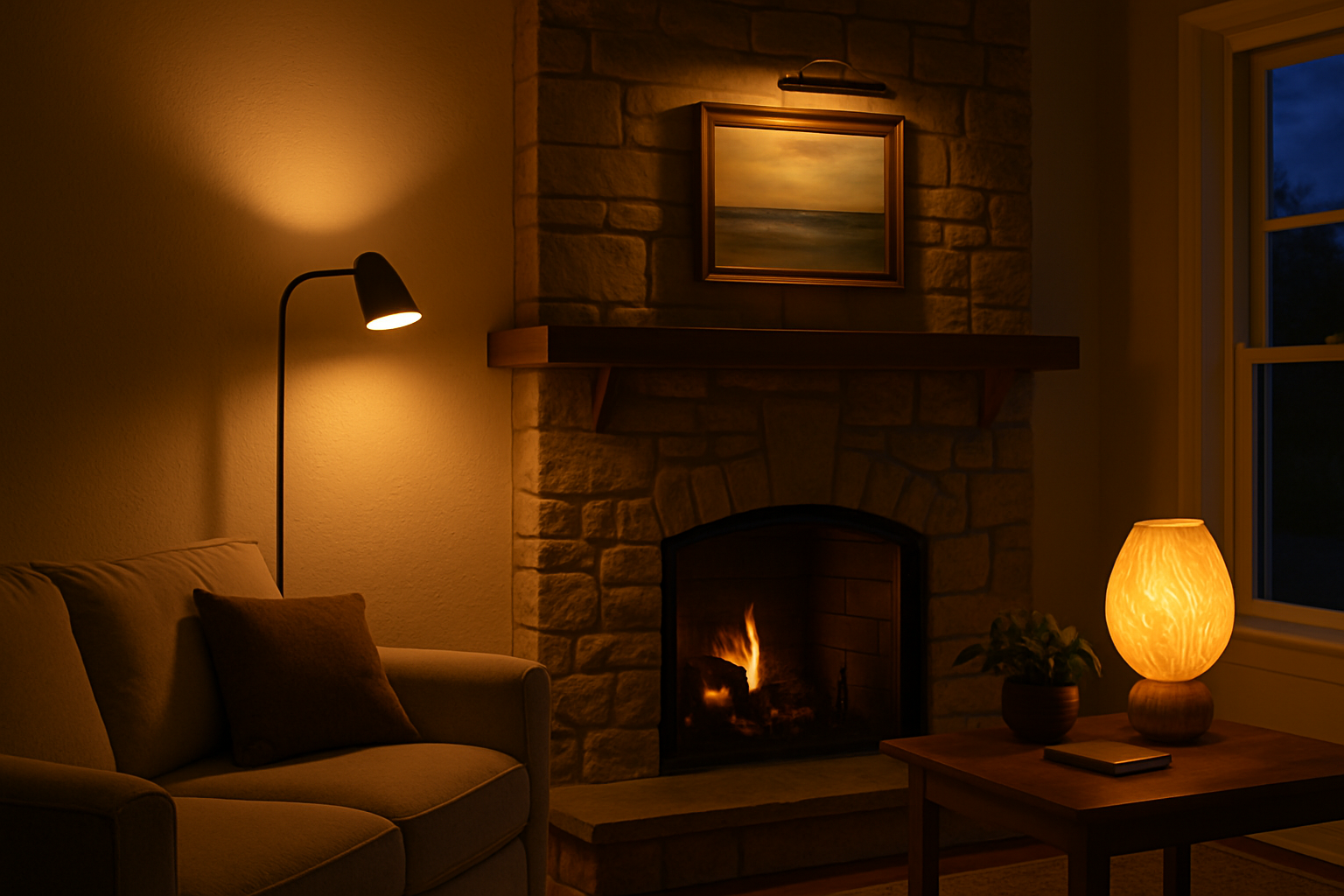
Before browsing fixtures, walk your living room slowly and identify the two or three spots where your eye naturally wants to land. Most living rooms have an obvious anchor, a fireplace, a view window, a gallery wall, or a piece of furniture that anchors the space. Those are your targets.
Asking ‘what kind of light would make this moment work better’ is a more useful starting point than browsing fixture categories without a plan. Here’s how that plays out in practice:
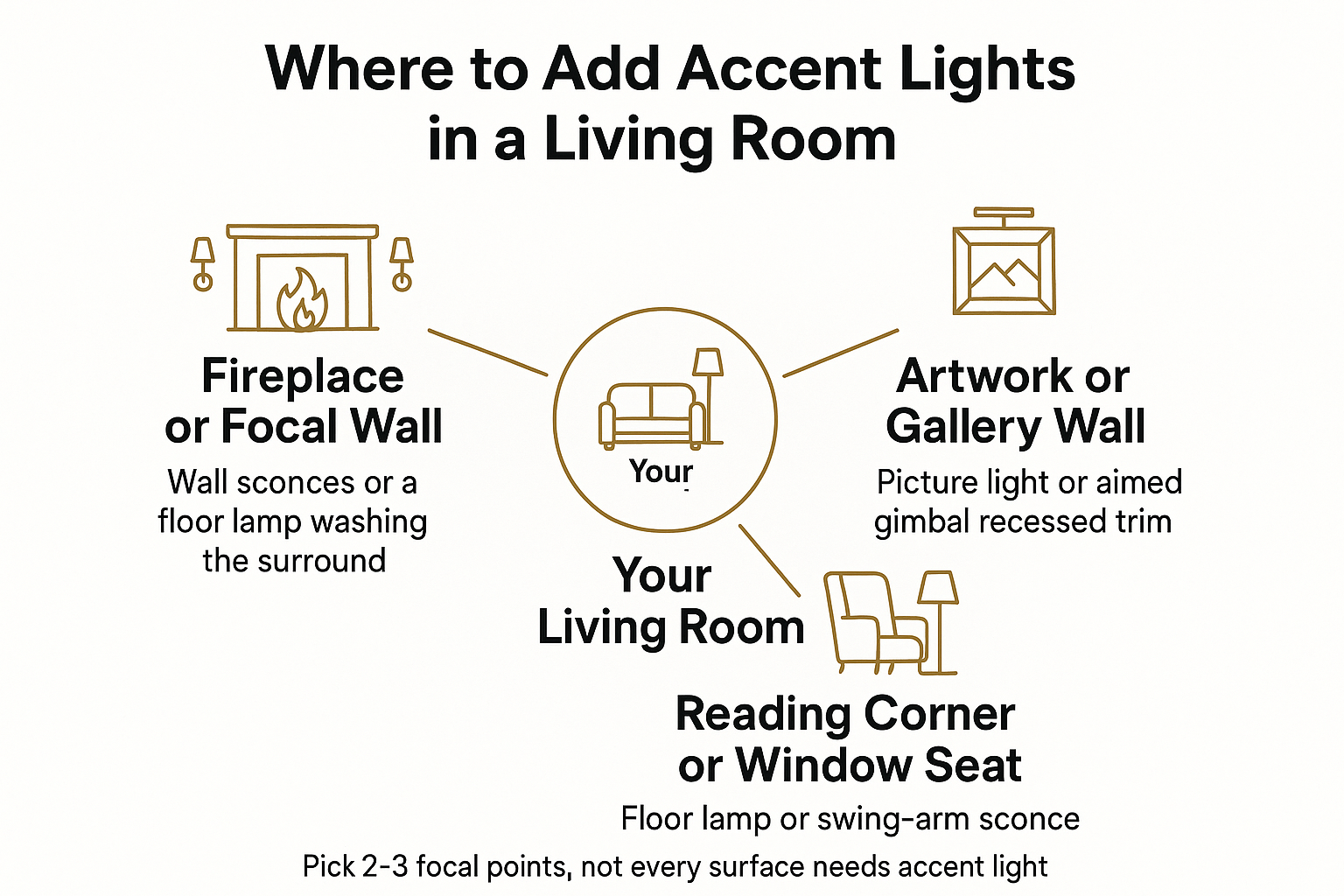
- Fireplace or focal wall: A pair of wall sconces flanking a fireplace, or a floor lamp positioned to wash the surrounding wall, draws the eye exactly where you want it. The fireplace becomes a destination rather than just a piece of architecture.
- Artwork or a gallery wall: A picture light mounted above a single large piece, or adjustable recessed trims aimed at a row of frames, separates the art from the wall and gives it presence even when the rest of the room is dim.
- A reading corner or window seat: A well-placed floor lamp or swing-arm sconce creates a pocket of light that feels intentional. It tells the eye ‘this is a place to be,’ which is exactly the feeling flat overhead lighting eliminates.
- Bookshelves or display niches: Small LED strip lights or a directed table lamp can turn a shelf from storage into a visual element.
The living room in a coastal home often has to function across a wide range of uses, daytime reading, evening entertaining, a quiet night in. One overhead fixture genuinely cannot satisfy all of those modes. Layering two or three accent sources lets you dial the room up or down depending on the moment.
For a broader view of how layered lighting works across different rooms, that article goes deeper on the ambient-accent-task breakdown.
The Three Spots That Change a Living Room
Most living rooms only need accent lights in two or three places to feel completely different. This infographic shows where those spots typically are and what fixture approach works best for each.
How to Start Without Rewiring Anything
One of the most common hesitations homeowners have is assuming accent lighting requires new electrical work. For many living rooms, it doesn’t.
The most accessible entry points require no permits and no electrician:
- Plug-in picture lights mount above artwork and plug directly into a nearby outlet. A good one runs on a cord concealed behind the frame and can change the feel of a wall in an afternoon.
- A repositioned table lamp moved to wash a corner or graze a wall, rather than just sit on a table, can add surprising depth. The fixture doesn’t need to change, just its placement.
- An adjustable floor lamp pointed at a corner or upward toward a ceiling creates reflected ambient light that softens the whole room rather than spotlighting one area.
For homeowners who are remodeling, or who already have recessed lights in place, there’s another option worth knowing: switching standard fixed trims to adjustable gimbal trims. The housing in the ceiling stays exactly the same. But instead of a bulb pointing straight down, a gimbal trim lets you aim the beam at a wall, a piece of art, or a corner. No new wiring. Just a trim swap. Many Monterey Peninsula homeowners doing kitchen or living room updates are surprised to learn their existing recessed cans can do far more than they currently are. A licensed electrician can handle the swap in less than an hour per fixture.
If you’re unsure whether your current setup supports dimming on those accent sources, Home Lighting Controls Explained: Dimmers, Scenes, and Smart Systems covers what to ask before you buy fixtures or switches.
Accent Light Options by Situation
Different living room situations call for different approaches. This table shows the most common scenarios and what type of accent lighting tends to work best for each.
| Situation | Best Accent Option | Requires Electrician? |
|---|---|---|
| Existing recessed lights | Swap fixed trims for adjustable gimbal trims | Yes, trim swap, minimal work |
| No overhead lighting changes | Plug-in picture lights, repositioned table lamps, floor lamps | No |
| Remodel or new construction | Dedicated accent recessed or wall sconce circuits with dimming | Yes, part of the remodel scope |
| Fireplace or focal wall | Wall sconces flanking the feature, or a washing floor lamp | Depends on sconce type (hardwired vs. plug-in) |
| Gallery wall or single large artwork | Picture light or aimed recessed trim | No for picture light; may need electrician for trim aim |
When the Fixture Itself Is the Accent
One shift that’s become more visible in 2026 is how designers are treating the fixture as part of the accent layer, not just a delivery mechanism for light.
A hand-blown glass pendant, an alabaster wall sconce, or a brass torchiere contributes visual weight to a room whether it’s turned on or not. The fixture becomes a sculptural object in its own right, something that holds the eye and anchors a corner the same way a piece of art does. When it’s on, the light it adds may be secondary to its presence in the room.
This matters for homeowners who are choosing between a functional fixture and a statement one. In a well-layered room, you don’t need every fixture to be a workhorse. A decorative sconce that provides a soft wash of light while also acting as a visual element is doing double duty, and that’s exactly the kind of decision that makes a room feel designed rather than assembled.
The Energy Star certification database is a useful reference if you’re also trying to confirm that a decorative fixture meets California’s energy efficiency expectations, particularly relevant as California Title 24 requirements continue to tighten for remodels and new construction. A fixture that’s visually striking and Title 24 compliant is always the better choice for a Peninsula home.
For context on how fixture type affects the overall feel of a space, Beyond the Bulb: How the Right Fixture Changes Everything in a Room covers the decisions most homeowners don’t think about until after they’ve bought something they regret.
Frequently Asked Questions About Accent Lights
How many accent lights does a living room actually need?
Most rooms feel dramatically different with just two or three targeted sources. You don’t need to light every corner. Pick the two or three spots your eye wants to go, usually a focal wall, an artwork or fireplace, and a reading area, and work from there. Adding more beyond that can start to feel busy rather than layered.
Can I add accent lighting without hiring an electrician?
Yes, for many situations. Plug-in picture lights, repositioned floor lamps, and table lamps require no electrical work at all. The limitation is that plug-in fixtures restrict where your cord can run, so if the placement you want is far from an outlet, a hardwired option will look cleaner. A licensed electrician is needed for anything hardwired or for swapping recessed trims.
What color temperature should accent lights be in a living room?
For most living rooms on the Monterey Peninsula, 2700K to 3000K is the right range. That’s the warm-white territory that reads as inviting rather than clinical. Going above 3000K in a living space tends to make the room feel like an office. Going below 2700K can look too yellow depending on your wall color and finishes. If you’re also adding outdoor fixtures, note that Carmel-by-the-Sea has a 3000K cap on exterior fixtures, worth knowing if your living room opens to a patio or deck that you’re also lighting.
My recessed lights are already in place. Can I turn them into accent lights?
Often yes. If your existing recessed housings accept adjustable gimbal trims, you can swap the straight-down trim for one that aims, usually at an angle up to 35 degrees off-center. This lets you redirect existing recessed lights at a wall, a piece of art, or a corner without touching the wiring. Check what housing brand and size you have, and ask a lighting specialist whether a compatible gimbal trim is available before assuming it’ll work.
Is there a difference between accent lighting and task lighting?
Yes, and the distinction matters for planning. Task lighting is directed at a surface you’re working on, a reading chair, a desk, a kitchen counter. Accent lighting is directed at a surface or object for visual effect, artwork, a textured wall, a fireplace. A good floor lamp next to a chair can do both at once, but they’re not the same thing. What Accent Lighting Actually Does (And Where It Goes Wrong) explains the distinction in more detail.
How much should I expect to spend on accent lighting for a living room?
It depends heavily on whether you’re going plug-in or hardwired, and what fixture quality you’re looking for. A plug-in picture light or a quality floor lamp can start a meaningful change at a modest cost, while a pair of hardwired wall sconces with professional installation involves fixture cost plus electrician labor. Many Monterey County homeowners doing a full living room refresh spend somewhere in a mid-range to premium budget for fixtures alone, but the range is wide. The best way to get a real number is to bring your room dimensions and a rough sense of what you’re trying to accomplish to a showroom where someone can help you narrow it down.
Ready to See What Accent Lighting Can Do for Your Room?
Greg and Tammy at The Home Lighter have been helping Monterey Peninsula homeowners work through exactly this kind of question since 1969, what’s causing the flatness, which fixtures will fix it, and what order to tackle things in. Walk-ins are welcome at the showroom at 2034 Sunset Drive in Pacific Grove, or call at (831) 655-5500 if you’d like to talk through your room before you stop by.