
Direct Answer: Accent lighting draws the eye to a specific surface or object by creating contrast. Without it, rooms feel flat and undefined even when the overall light level is fine.
A lot of homeowners finish a remodel, get the new fixtures installed, and still feel like something is off. The room is bright enough. The fixtures are attractive. But it reads as flat, almost like a hotel conference room instead of a home.
In most cases, the missing piece is accent lighting — or more precisely, the absence of it. Homes on the Monterey Peninsula are full of details worth illuminating: original artwork, stone fireplaces, handmade tile, built-in shelving. When none of those surfaces get their own light source, they disappear into the background.
This article breaks down what accent lighting is actually doing, why beam angle and color rendering matter far more than most people expect, and where the typical mistakes happen — before a homeowner has already paid an electrician to move fixtures.
What Accent Lighting Is Actually Doing
The job of accent lighting is contrast. It pulls a specific object or surface forward visually by making it brighter than its surroundings.
This is different from ambient light, which aims to fill a room evenly, or task light, which focuses on a work surface. Ambient lighting and accent lighting are meant to work together — one provides the base, the other creates the moments.
The most common uses for accent lighting include:
- Artwork or photography on a wall
- Fireplace surrounds and mantels
- Built-in shelving or cabinetry
- Textured surfaces like shiplap, exposed stone, or brick
- Architectural details like coffered ceilings or arched doorways
- Landscape features outdoors — trees, garden walls, stone facades
Without any accent lighting, a room tends to read as flat even when the ambient light level is technically adequate. This is one of the most common complaints homeowners describe when they walk into a space that just feels “off” — they can’t name what’s missing, but this is usually it.
For a deeper look at how the different fixture types work together, every type of light fixture explained is a good starting point.
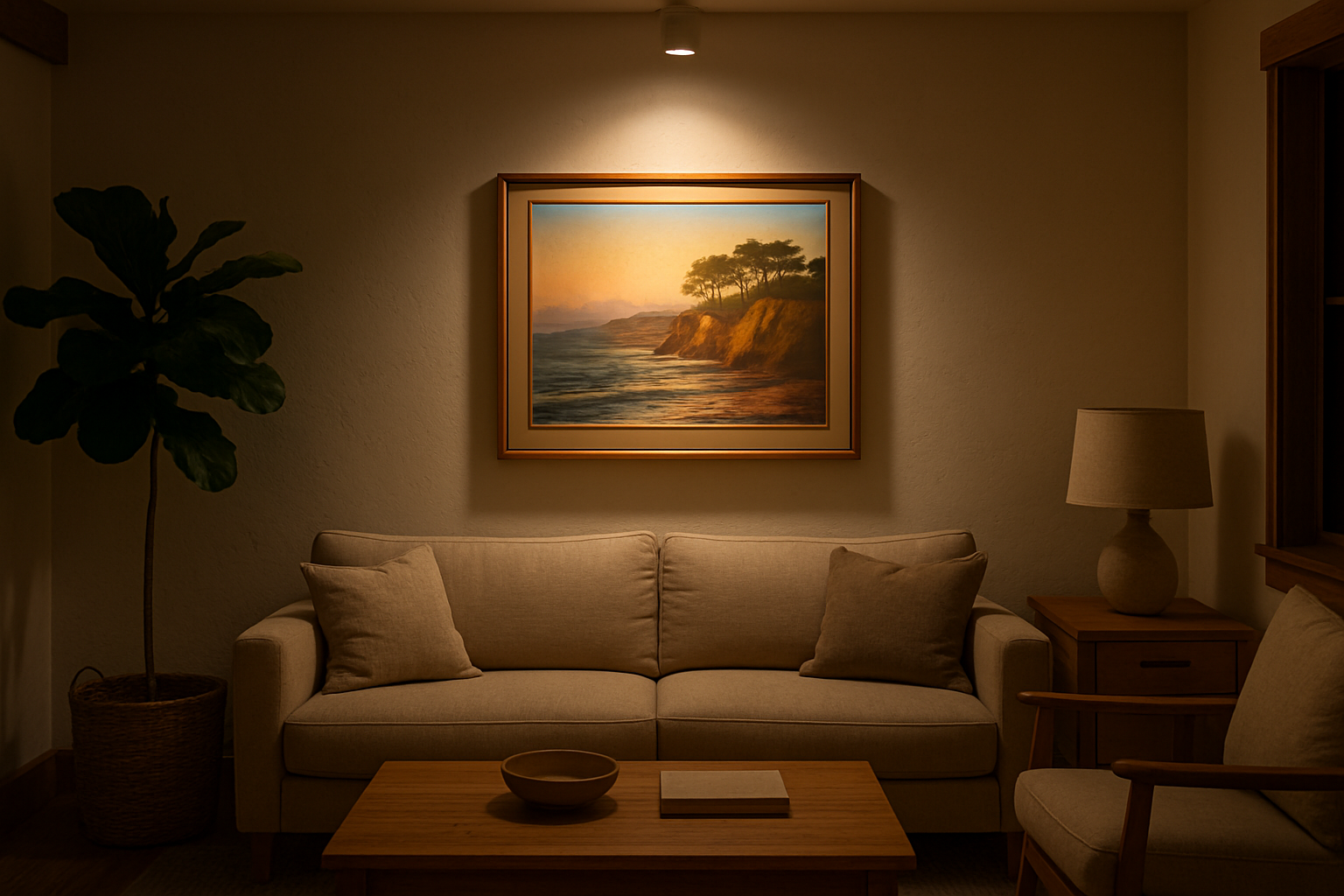
Beam Angle: The Detail That Separates Good Accent Lighting From Wasted Money
Most people shopping for accent lighting focus on the fixture style. The detail that actually determines whether the light works is beam angle — the spread of light coming out of the fixture.
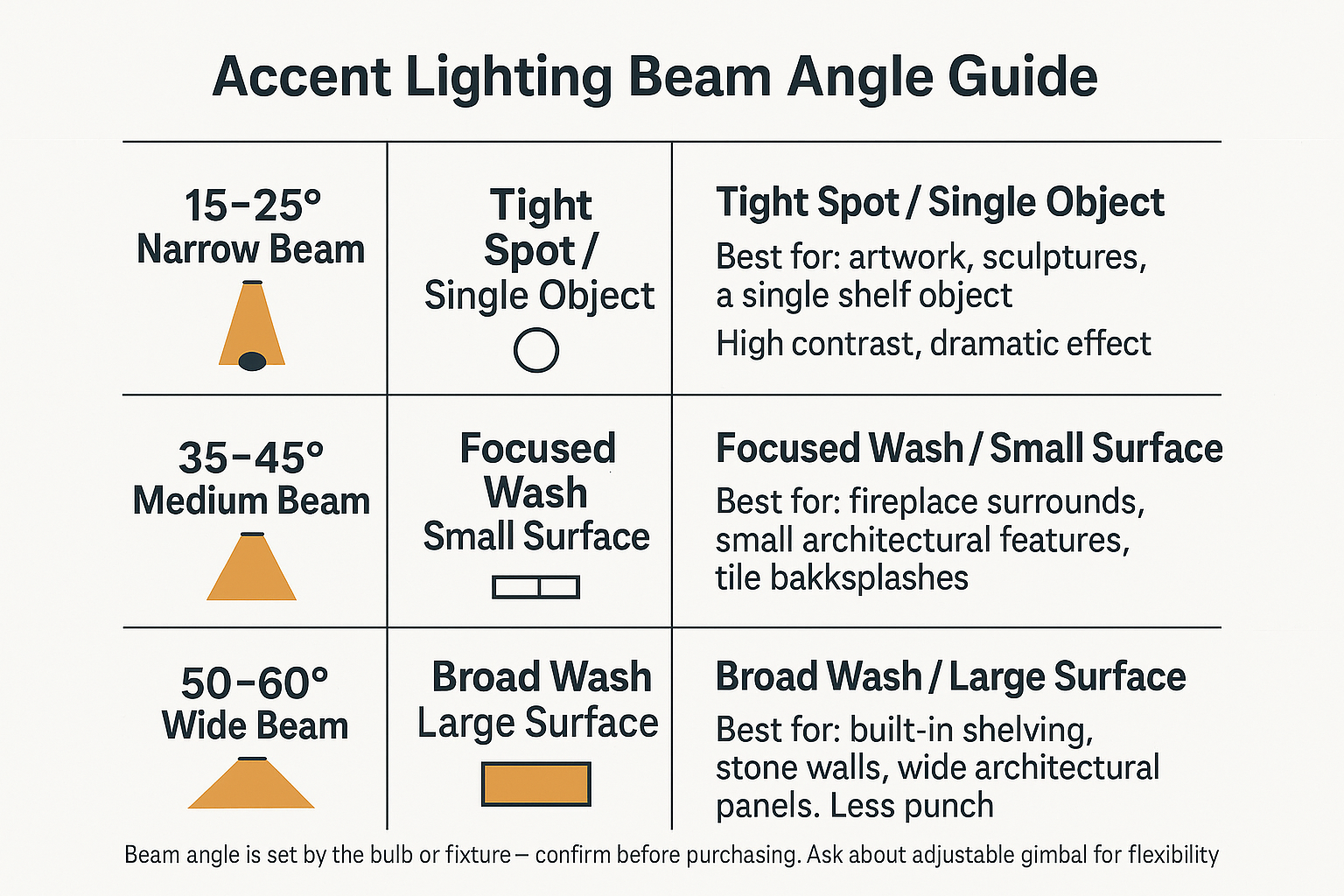
A narrow beam of 15–25 degrees creates a tight, focused spot on a single object. Think of the pool of light on a sculpture or a framed painting. A wider beam of 40–60 degrees washes a broader surface but loses that punch — better for washing a section of shelving than for making one piece of art stand out.
The fixtures used most often for accent lighting include:
- Recessed adjustable (gimbal) fixtures — these can be aimed after installation, which matters
- Track heads — movable along a rail, useful when the focal points of a room may change
- Picture lights — mounted directly above a frame, designed specifically for artwork
- Wall-mounted adjustable sconces — useful for grazing textured surfaces
Here is where a very common mistake happens: a recessed downlight aimed straight at the floor will illuminate the floor, not the painting on the wall below it. Adjustability is not optional for accent fixtures — it is the whole point. A standard non-adjustable recessed can is an ambient fixture. Only an adjustable gimbal or eyeball fixture belongs in the accent role.
This is also why placement decisions need to be made before the electrician runs wire. Moving a recessed fixture even 12 inches after the fact means cutting drywall again.
Beam Angle at a Glance
This reference shows how beam angle affects accent lighting coverage — from a tight spot on a single object to a broad wash across a surface.
Why CRI Matters More for Accent Lighting Than Almost Anything Else
CRI stands for Color Rendering Index — it measures how accurately a light source shows the true colors of what it’s illuminating, on a scale of 0 to 100.
For general ambient lighting, a CRI of 80 or above is usually acceptable. But for accent lighting, where the whole point is to draw attention to something specific, CRI becomes much more important. A fixture with a CRI below 80 can make warm wood tones look gray and vibrant artwork look washed out.
For the kinds of interiors common in Carmel-by-the-Sea and Pebble Beach — homes with original paintings, rich ceramic tile, exposed stone, or handcrafted woodwork — a CRI of 90 or higher is worth specifying. The difference is visible in person even if it doesn’t show up in product photos online.
This is one of the reasons why buying accent fixtures in person rather than off a website catalog makes a real difference. Why buying lighting locally still matters gets into this in more detail — but the short version is that you cannot evaluate CRI from a screen.
Color temperature also interacts with CRI in ways that are worth understanding. A fixture can have a high CRI but still cast light that feels wrong if the color temperature (measured in Kelvin) doesn’t suit the surface it’s hitting. For most residential accent applications, 2700K–3000K is the right range — warm enough to feel inviting, accurate enough to show materials well. The article on the difference between dim and warm explains how these two settings interact.
Accent Lighting Quick Reference
This table summarizes the key specs that matter when selecting accent fixtures — the decisions that determine whether the light actually does its job.
| Spec | What It Controls | Recommended Range for Accent Use |
|---|---|---|
| Beam Angle | How wide the light spreads | 15–25° for single objects; 35–45° for surfaces |
| CRI | Color accuracy of the light | 90+ for artwork and rich materials; 80+ minimum |
| Color Temperature | Warm vs. cool appearance of light | 2700K–3000K for most residential interiors |
| Fixture Type | Adjustability and placement flexibility | Adjustable gimbal, track head, or picture light |
| Lumen Output | Brightness of the beam | Depends on surface distance and ambient light level; confirm per fixture |
Exterior Accent Lighting on the Monterey Peninsula — Where Compliance Comes In
Accent lighting is not just an interior technique. Uplighting a mature oak, grazing a garden wall, or washing a stone facade are all forms of accent lighting — they work by the same contrast principle outdoors that they do inside.
But in Carmel-by-the-Sea, exterior lighting decisions carry regulatory weight that most homeowners don’t expect. The city’s exterior lighting ordinance caps residential exterior fixtures at 3000K and restricts lumen output. Getting beam angle, fixture placement, and color temperature right isn’t just an aesthetic choice there — it matters for compliance.
Anyone planning exterior accent lighting in Carmel should verify current requirements with local authorities or a licensed contractor before purchasing fixtures. The rules can be updated, and the consequences of a non-compliant install are easier to avoid than to correct after the fact.
For a deeper look at how these ordinances affect fixture selection on the peninsula, does your landscape lighting meet Carmel’s exterior rules covers the specifics in plain language.
Frequently Asked Questions About Accent Lighting
How far away from the wall should a recessed accent fixture be placed?
A general starting point for accent lighting on artwork or architectural features is to place the fixture roughly one-third of the ceiling height out from the wall. For a standard 9-foot ceiling, that’s about 3 feet from the wall surface. But this changes based on beam angle, the height of what you’re lighting, and whether you want a tight spot or a broader wash. This is exactly the kind of decision worth talking through before your electrician marks the ceiling.
Can I add accent lighting to an existing room without major work?
Sometimes. Track lighting is the most flexible option because it runs off a single electrical connection and the heads can be positioned and aimed without additional wiring. Picture lights are another low-disruption choice — many are hardwired, but plug-in versions exist for artwork. Recessed adjustable fixtures are the most effective option but do require an electrician and some ceiling work. What’s possible depends on what’s already in your ceiling and walls.
What’s the difference between an accent fixture and a regular recessed light?
A standard recessed downlight is an ambient fixture — it points straight down and spreads light across the floor and lower walls. An adjustable recessed fixture (gimbal or eyeball style) can be angled after installation to direct the beam toward a wall, a painting, or a feature surface. The trim type is what makes the difference. You can often retrofit an adjustable trim into an existing recessed housing — ask about compatibility before assuming you need to replace the whole fixture.
Does accent lighting work in low-ceiling rooms?
Yes, but the fixture type matters more. Recessed adjustable fixtures need enough ceiling depth to work and may be limited in shorter spaces. Track lighting is a good alternative because it sits closer to the ceiling surface and the heads still tilt. Wall-mounted adjustable sconces and picture lights work entirely independently of ceiling height, which makes them useful when overhead options are limited.
How do I know if my accent lighting is actually aimed correctly?
Turn off all other lights in the room and look at what the accent fixture is illuminating. If it’s hitting the floor or the lower part of the wall instead of the object or surface you intended, the fixture needs to be adjusted or repositioned. Aim before your electrician closes up the ceiling — adjustable fixtures are meant to be fine-tuned, but that conversation needs to happen during or right after installation, not months later.
Want to See What Accent Lighting Does in Person?
The showroom at The Home Lighter — 2034 Sunset Drive in Pacific Grove — carries adjustable recessed fixtures, track heads, and picture lights, and Greg and Tammy can walk you through beam angle and CRI options with fixtures you can actually see lit up side by side. Walk-ins are always welcome, and if you’re mid-remodel or working with a contractor, appointments are available for more involved projects. Give them a call at (831) 655-5500 to talk through what you’re working with.