
Direct Answer: Pick 2700K to 3000K for outdoor fixtures on the Monterey Peninsula. Carmel-by-the-Sea caps residential exterior lighting at 3000K, and warmer light cuts through coastal fog with far less glare.
If your home is in Carmel-by-the-Sea, the color of your outdoor light is not just a style choice. The city sets a hard ceiling of 3000K on residential exterior fixtures, and a light that goes up above that number can get flagged after it is already mounted and wired.
Here is the practical position: nearly every home on the Monterey Peninsula should land between 2700K and 3000K outside, and should use the same number everywhere on the property. The common advice to buy a brighter, cooler light for safety backfires here, because cool light and marine fog make a glare wall instead of a lit path.
This guide covers what the Carmel rule actually says, how warm and cool light behave in our fog, and how to keep a patched-together exterior from looking patched together at night.
Carmel caps outdoor lighting color temperature at 3000K
Kelvin, written as K, measures the color of light, not the brightness. Lower numbers look warm and amber. Higher numbers look white, then blue.
Local research compiled for Peninsula homeowners points to a few things Carmel property owners should know before ordering anything:
- A 3000K maximum on residential exterior fixtures
- A lumen cap of roughly 400 lumens per fixture for certain residential exterior uses
- Municipal Code Chapter 17.39 calls for a lighting plan submitted to the Department of Community Planning and Building at the same time as the related permit application
- Floodlights and spotlights routed to the Planning Commission for review
Most people hear “cap” and assume they are losing something. In practice, 3000K is already the warmest practical ceiling that design-minded shoppers aim for. The rule mostly rules out the 4000K and 5000K fixtures stacked in big box aisles, not the look you actually wanted.
One homeowner reached out about replacing outdoor lighting on a small cottage in Carmel, which is exactly the project where this matters. A swap that seems simple can still touch permit and review requirements, especially with anything aimed or shielded in a particular way.
Rules change, and they vary by address and project type. Confirm current requirements with the City or your licensed contractor before anything is ordered or installed, and read up on what fully shielded means for a Carmel porch light while you are at it.
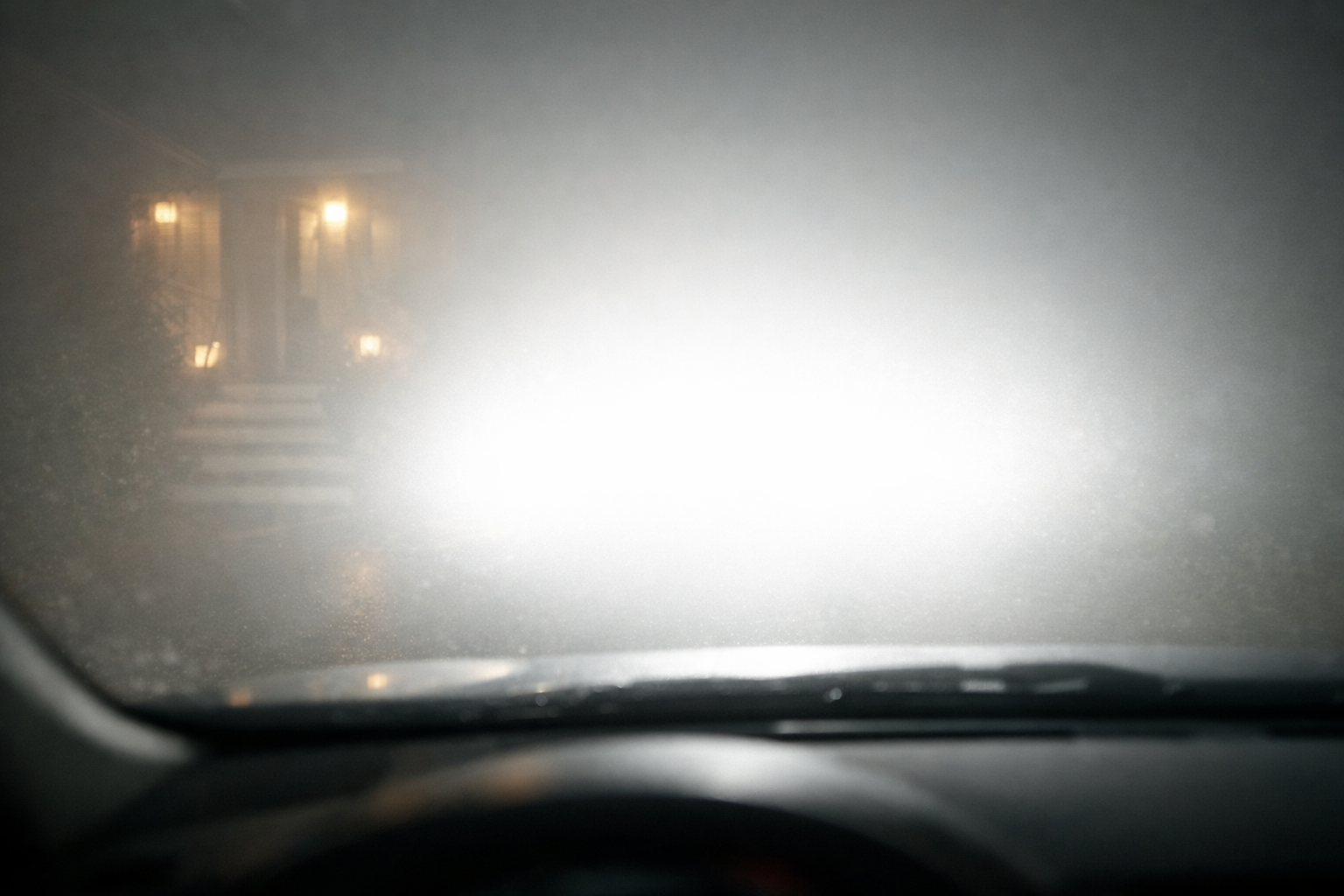
Why cool light disappears in Monterey fog
You already know this feeling. You pull into the driveway on a thick night, flip on the high beams, and see less than you did before.
That happens because blue-heavy light scatters harder off the water droplets hanging in the air. The beam lights the fog instead of the ground. Warmer light has less of that short-wavelength content, so it pushes through with less veiling haze and puts light where you wanted it.
An exterior fixture does the same thing your headlights do. A cool 5000K wall pack on a foggy night turns into a bright smear that hides the steps underneath it.
This is not a once-a-year problem on the Peninsula. Monterey’s wet season runs November through March, and December is the darkest and wettest stretch of it:
- About 9 hours and 42 minutes of daylight
- Sunset around 4:51 pm on December 1
- Roughly 2.4 inches of rain spread across about 9.9 rain days
That means your exterior lighting is doing real work for a long evening, in damp air, for months at a time. Going warmer and lower almost always reads as safer light, not dimmer light, because your eyes are not fighting glare to find the edge of a step.
Moisture also drives the fixture itself. If you are choosing something for a covered entry versus an open walkway, the difference between wet rated and damp rated fixtures matters as much as the Kelvin number.
How each Kelvin range reads outside on the Peninsula
A quick reference for what each color temperature looks like after dark in coastal conditions.
| Color temperature | How it reads at night in fog | Where it tends to fit |
|---|---|---|
| 2200K to 2400K | Deep amber, very soft, almost candlelight. Minimal scatter. | Low path lighting, accent glow, older lanterns with filament-look lamps |
| 2700K | Warm and inviting, flatters wood and stone, cuts haze well | Front entries, cedar shingle and shake homes, garden walls |
| 3000K | Clean warm white, still legal in Carmel, keeps white stucco from going yellow | Stucco exteriors, black metal fixtures, driveways, modern architecture |
| 3500K and up | Starts looking clinical, scatters more in marine layer | Not permitted for Carmel residential exteriors, and generally a poor fit Peninsula-wide |
Pick one number for the whole property, then write it down
Most Peninsula exteriors were lit in pieces over many years. One 3000K lantern at the door, a 4000K motion light someone added at the side gate, and a set of path lights ordered online at 5000K will never look like one plan.
That mismatch is what makes a house look stitched together after dark. It reads as neglect even when every single fixture is new and clean.
The fix is boring and it works:
- Decide on one Kelvin number for every exterior light on the property before you buy anything else
- Write it in your phone notes along with the finish name and the brand
- Match every future purchase to it, including replacement bulbs in older lanterns
- Check the garage and side yard lights too, since those are usually the oldest and coolest
One buying detail deserves real weight. Integrated LED fixtures lock their color temperature in permanently, because there is no bulb to change. A socketed fixture can be corrected later with the right lamp.
If you are adding to an existing scheme rather than starting fresh, socketed fixtures give you a way out of a mistake. If you are doing the whole exterior at once and you are confident in the number, integrated LEDs are fine and often cleaner looking.
This is also where the walkway choices get decided, since path lights, bollards, and post lights each throw light differently even at the identical color temperature.
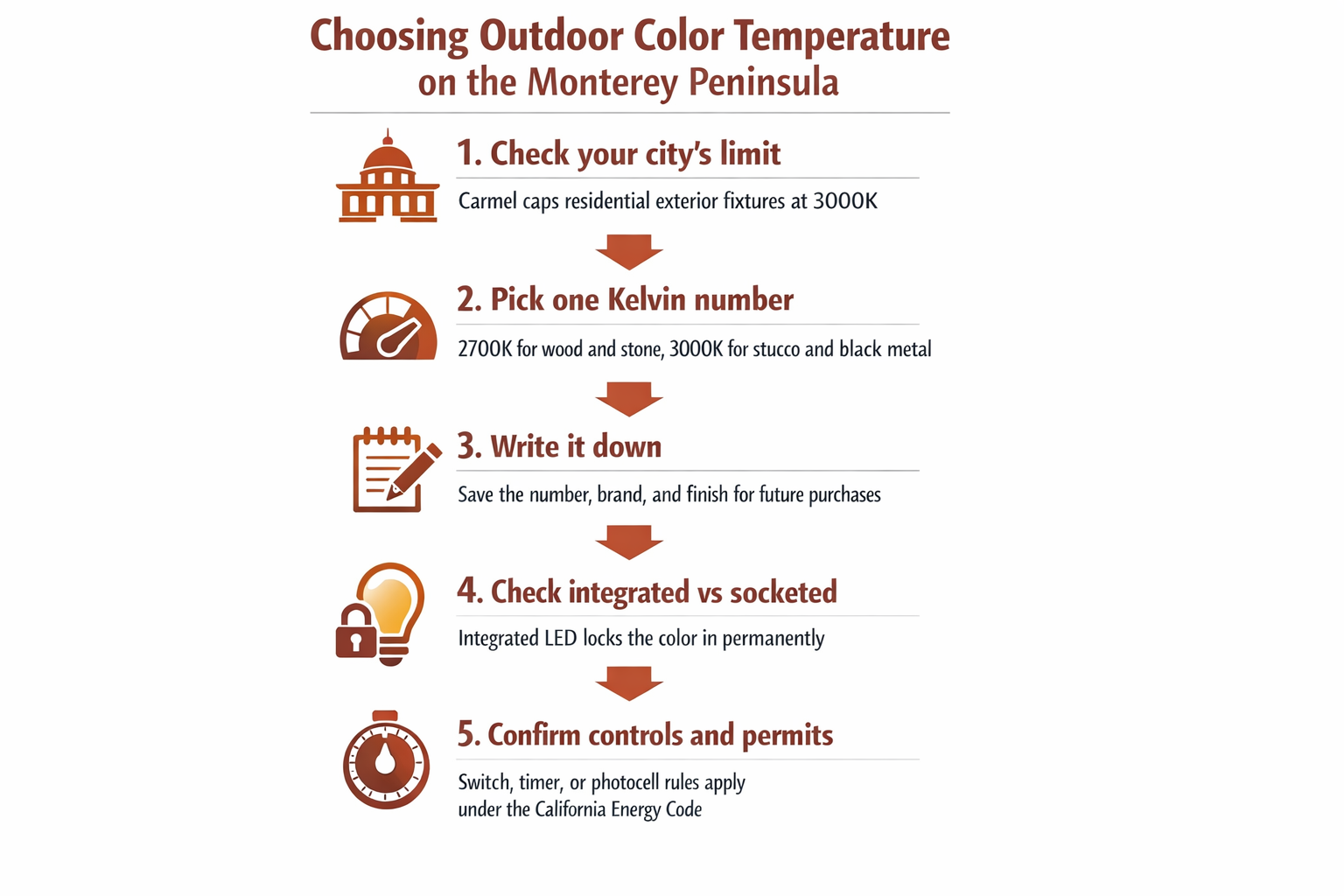
The order to make these decisions in
A simple sequence that keeps a Peninsula exterior project from drifting out of compliance or out of match.
The same 3000K looks different on shingle than on stucco
Color temperature does not exist on its own. It lands on a material, and that material changes what you see.
Warmer light flatters cedar shingle, Carmel stone, copper, and bronze. It brings out the grain and the patina. Slightly cooler light, still inside the legal range, keeps white stucco and black metal from going butter-yellow after dark.
There is a second number on the spec sheet that almost nobody looks at. Correlated color temperature and color rendering are different measurements. Color rendering, often listed as CRI, describes how accurately a light shows the true color of what it hits.
That second number is why two 3000K fixtures can make the same hedge look entirely different. Low rendering turns green plantings gray and makes a bronze finish look flat and brown.
Design professionals ask about this more often than homeowners do. One inquiry from a design pro involved how many downlights a Carmel area community needed and whether path lights or bollards suited a mid century modern look, which is exactly the kind of question where rendering decides the answer.
One practical test beats all of it. Hold a sample against your own siding at dusk and look at it with your own eyes, because a screen will never show you how a finish reads on your wall at 5 pm in December.
Controls are part of the same decision
Color temperature is the first question. Controls are the next one, and they arrive faster than people expect.
California’s 2025 Building Energy Efficiency Standards, Title 24 Part 6, took effect January 1, 2026 and govern lighting controls on remodels and new construction statewide. You can read the standards directly from the California Energy Commission. Carmel also requires residential outdoor lighting to be controlled per the California Energy Code, so the switch, timer, or photocell behind the fixture is part of the purchase, not an afterthought.
The calendar sharpens this every fall. Daylight saving time ends November 1, 2026, and every exterior fixture on the Peninsula starts running an extra hour each evening the next day. A property manager in the area asked about putting exterior lighting on a programmable timer or automated control system for exactly this reason.
Be clear on one thing before you start. Picking a fixture and installing a fixture are two separate jobs.
Wiring, mounting, and control work belongs with your own licensed electrician or contractor. Permit and code questions are worth confirming with the City before the order goes in. If you are weighing how the lights should switch on, timers, photocells, and app control each behave differently through a foggy Peninsula winter.
The spec sheet answers the Carmel questions before you buy
Every one of these answers lives on a product spec sheet: the color temperature, the lumen output per fixture, the shielding, and the rendering number. Someone just has to read it and know which line matters for your address.
That is the gap between a showroom and an anonymous online listing. A catalog page and a big box aisle label will not tell a Carmel homeowner whether a fixture fits what their jurisdiction allows.
Greg at The Home Lighter can pull those numbers on a given fixture and walk through what they mean for a specific property. The Pacific Grove showroom has been a fixture resource on the Peninsula since 1969 and carries lines across a wide range of price points, so the work is narrowing a curated collection rather than scrolling endless inventory.
Frequently Asked Questions About Outdoor Lighting Color Temperature
Is 2700K or 3000K better for a Carmel porch light?
Both are allowed, since 3000K is the ceiling, not the requirement. Choose 2700K if your house is cedar shingle, wood, or warm stone, because it flatters those materials. Choose 3000K if you have white stucco or black metal, where a warmer light can read yellow.
Will warmer outdoor lighting make my entry feel too dim?
Usually the opposite on a foggy night. Warm light scatters less off suspended water droplets, so more of it reaches the steps instead of lighting the air in front of them. If a space still feels dark, the fix is almost always better placement and shielding rather than a cooler, brighter fixture.
Can I install 4000K outdoor lights in Pacific Grove or Monterey?
Those cities do not have the same exterior cap that Carmel-by-the-Sea does, so a cooler fixture may be permitted. It is still a poor fit for coastal conditions, and Title 24 controls requirements apply statewide. Check with your own city before ordering, since requirements shift.
Can solar path lights handle uplighting a large tree away from an outlet?
This question comes up often, and the honest answer is that solar is unpredictable for that job. Output drops through our foggy months, run times shorten in December, and many solar fixtures do not publish a color temperature at all, which makes matching the rest of the property nearly impossible. Low-voltage wiring, installed by your electrician, gives consistent output and a known Kelvin number.
What do exterior fixtures typically cost on the Monterey Peninsula?
Pricing varies a lot and depends on material, finish, size, and brand. Many Monterey County homeowners see quality exterior lanterns land anywhere from the low hundreds to well over a thousand dollars per fixture, with solid brass and marine-grade finishes at the higher end because they hold up to salt air. A showroom can give you an exact quote on a specific fixture.
Sorting out color temperature for a Peninsula exterior project?
Reading a spec sheet next to the actual fixture, in person, settles most of these questions in a few minutes. The showroom at 2034 Sunset Drive in Pacific Grove is open to walk-ins, and appointments are available for more involved exterior projects around Monterey County, CA. The number there is (831) 655-5500.
