
Direct Answer: Path lights light the walking surface itself. Bollards cover wider entry walks and driveway edges. Post lights cover the most ground with the fewest fixtures, but carry the highest glare and trespass risk.
A designer working on a residential community near Carmel walked into the showroom with a question that had nothing to do with style. She wanted to know whether path lights might work as a stand-in for pole lights in some spots, or whether bollards would be the better call, while she was still trying to settle how many downlights the property needed.
That is the real question most homeowners on the Monterey Peninsula are asking too. Not whether the walkway needs light, but which of the three fixture families actually belongs there.
This guide compares those three head to head. It covers what each one does well, the local rules that quietly rule out some options, and what to measure if you already have posts in the ground.
Path Lights vs Bollards vs Post Lights: What Each One Is Built to Do
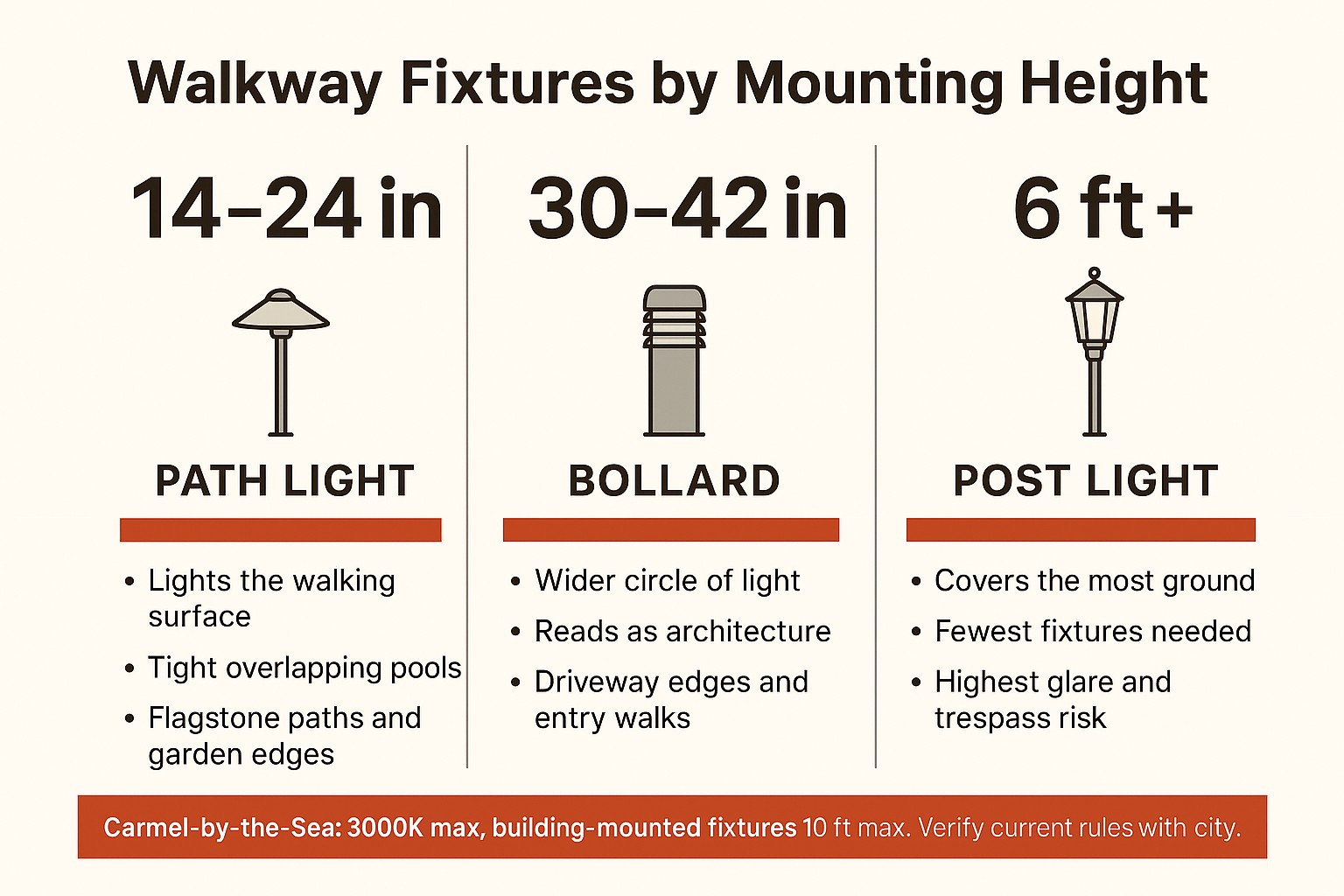
The difference between these three comes down to one thing: mounting height. How high the light source sits decides how far the light spreads, how much glare hits your eyes, and how much of it drifts onto your neighbor’s property.
- Path lights sit low, usually 14 to 24 inches off the ground. They drop overlapping pools of light directly on the walking surface. That makes them right for flagstone paths, garden edges, and narrow walks where you want to see your footing and not much else.
- Bollards stand roughly waist high, often 30 to 42 inches, with a shielded or 360 degree head. They throw a wider circle and read as architecture rather than as a garden accessory. Driveway edges, wider entry walks, and shared paths between units are where they earn their keep.
- Post and pole lights mount highest and cover the most ground with the fewest fixtures. That efficiency is the appeal. It also means the most glare and the most light trespass, which is exactly why they get restricted around here.
One fixture family is not better than the others. A short flagstone walk to a Pacific Grove front door and a 200 foot shared drive in Carmel Valley are different problems, and they call for different heights.
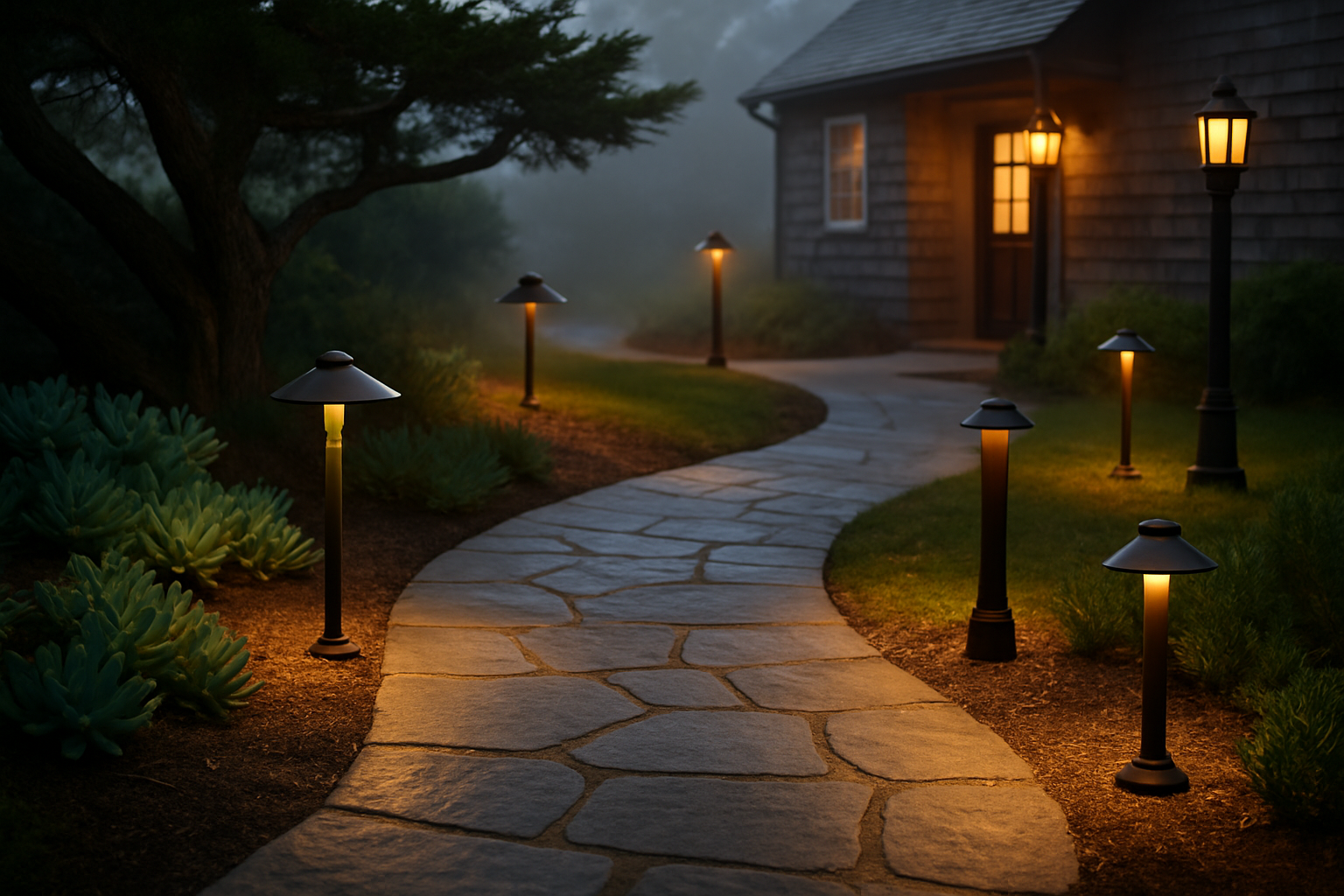
Why This Choice Is Heavier on the Monterey Peninsula
In most towns, a walkway fixture is one small light among many. Here it is often doing all the work.
Carmel-by-the-Sea has historically avoided public street lighting on residential streets, and the city treats its dark nighttime character as something worth protecting. Take away the street light and your path fixture is not supplementing anything. It is the only source out there.
The city’s exterior lighting rules put real limits on what you can buy:
- Exterior fixtures are capped at 3000K correlated color temperature, so warm light only
- Lighting attached to a building is limited to no more than 10 feet above the ground, a deck, or a balcony
- A per fixture output cap applies, commonly cited around 400 lumens
- Light trespass onto neighboring property and into the night sky is restricted
You can read the city’s own exterior lighting requirements document before you shop. Confirm the current numbers with the city or your licensed electrician before ordering anything, because rules get amended and a fixture that is perfectly legal in Monterey or Pacific Grove may not fly five minutes away in Carmel.
If you want the longer version of how these rules shape a whole property, see does your landscape lighting meet Carmel’s exterior rules.
Quick Comparison: Path Light, Bollard, Post Light
Here is how the three stack up on the things that actually decide the purchase.
| Fixture type | Typical mount height | Best fit | Main drawback |
|---|---|---|---|
| Path light | 14 to 24 inches | Flagstone paths, garden borders, narrow front walks | Needs several fixtures to cover distance; easy to overdo |
| Bollard | 30 to 42 inches | Driveway edges, wide entry walks, shared paths, courtyards | Larger visual presence; wrong style reads commercial |
| Post or pole light | 6 feet and up | Long drives, property entries, large open areas | Highest glare and light trespass risk; most likely to be restricted |
Mounting Height Decides Everything
This breakdown shows how each fixture family behaves once it is in the ground.
The Mistake Almost Everyone Makes With Path Lights
Too many path lights, evenly spaced, marching all the way down the walk. It looks like an airport runway, and it flattens the yard instead of shaping it.
Even spacing feels safe when you are ordering online. But a walkway does not need continuous light. It needs enough light at the points where footing changes and enough at the destination.
A better approach:
- Light fewer points well. Grade changes, a step, a turn in the path, the front door. Skip the straight middle stretch.
- Use a shielded fixture that hides the lamp from eye level. If you can see the source standing up, you will see it from the sidewalk too.
- Let downlight do the broad work. A fixture mounted in a tree or under an eave washes a wide area softly, so the ground fixtures can run at low output.
- Vary the spacing. Uneven placement follows the landscape instead of fighting it.
Coastal fog changes the math here. Airborne moisture scatters light, so a fixture that looks reasonable on a clear night in Salinas turns into a headlight glowing through the marine layer in Pacific Grove.
That is a strong argument for more fixtures at lower output rather than fewer at high output. The same thinking shows up in how low-voltage landscape lighting actually gets designed.
What to Do When You Already Have Posts in the Ground
Plenty of Peninsula properties already have poles set in concrete with conduit run to them. The infrastructure is fine. The heads are dated, or the pole diameter does not match anything sold today.
The designer mentioned earlier ran into exactly this. Her existing poles measured 2.5 inches across, and she was trying to figure out whether adapters would let her use a modern head.
Before you shop, measure and write down:
- Outside diameter of the pole at the top, to the nearest sixteenth of an inch
- Inside diameter, if the pole is hollow and the fixture slips over or into it
- Overall height from finished grade to the top of the pole
- Mounting style already in place: post top, pier mount on a flat base, or side arm
- Voltage: line voltage 120V or low voltage 12V
With those numbers, one of three fixes usually applies. A post top fixture sized to your pole diameter. A pier mount fixture if the pole has a flat capped top with bolt holes. Or an adapter collar that steps a nonstandard pole up or down to a common size.
Replacing only the head is often the smarter move. Cost varies quite a bit by brand, finish, and whether the fixture is a stock line or a special order, so ask for a quote against your actual measurements rather than working from a catalog price. Setting new poles means trenching, concrete, and permits, which pushes a project into a different budget entirely.
All installation and electrical work should go to your licensed electrician or landscape contractor. Bring them the measurements too, since they may spot a conduit or grounding issue before you order.
What You Cannot Judge From a Product Photo
Shielding, beam spread, and how a lens handles glare are close to impossible to read from an online listing. Two bollards that look identical on screen can behave nothing alike once they are lit.
Lines like Hinkley, Arroyo Craftsman, and Hubbardton Forge each handle the light source differently, and you see that in about four seconds standing in front of them. Greg can show what a 2700K to 3000K head does to Carmel stone or weathered shingle compared with a cool white big box fixture on the same wall.
That side-by-side is also the fastest way to understand the difference between dim and warm, which trips up a lot of exterior projects. Walk-ins are welcome at the Pacific Grove showroom, and appointments are available for more involved projects.
Frequently Asked Questions About Walkway Lighting Fixtures
Can path lights replace pole lights along a driveway?
Sometimes, but you will need more of them. Path lights cover a much smaller circle, so a run that took four pole lights might take a dozen path lights. On a long drive, bollards are usually the better middle ground: taller than a path light, far less glare than a pole.
What color temperature is allowed for exterior fixtures in Carmel-by-the-Sea?
The city’s exterior lighting chapter caps correlated color temperature at 3000K, and warmer options like 2700K are common on the Peninsula. Building-attached fixtures are also limited to about 10 feet above the ground, deck, or balcony, with a per fixture output cap. Verify the current numbers with the city or your licensed electrician before ordering.
My existing poles are 2.5 inches wide. Will a new fixture fit?
Often yes, with an adapter collar. Measure both the outside and inside diameter at the top of the pole and note whether the top is open or capped. Bring those numbers in, and a post top, pier mount, or adapter fix can usually be matched to what is already in the ground.
How far apart should path lights be spaced?
There is no single number, and even spacing is usually the problem rather than the solution. Light the points that matter: steps, grade changes, turns, and the entry. Leave the flat straight stretches alone and let downlight from a tree or eave fill in.
Do bollards hold up in coastal salt air?
The better ones do, but finish matters more here than almost anywhere. Marine grade finishes and solid brass or copper bodies age far better within a mile of the water than powder-coated aluminum. Ask specifically about the finish warranty in coastal exposure.
Still Deciding Between a Path Light, a Bollard, and a Post?
Seeing the three lit side by side settles the question faster than any spec sheet, especially once you factor in Monterey County’s fog and Carmel’s color temperature limits. Greg and Tammy at The Home Lighter keep a curated selection of exterior fixtures on display at 2034 Sunset Drive in Pacific Grove, and walk-ins are welcome. Bring your pole measurements or a photo of the walkway, or call (831) 655-5500 if you would rather talk it through first.
