
Direct Answer: A good local lighting supplier brings product knowledge, design guidance, and familiarity with local codes — not just a showroom floor full of fixtures to browse on your own.
Most homeowners on the Monterey Peninsula start a lighting project the same way — they open a browser tab, scroll through hundreds of fixtures, and quickly feel lost. The options are endless, the descriptions are vague, and nothing is easy to compare side by side.
A local lighting supplier should solve that problem. But not every showroom does. There’s a real difference between a place that stocks product and a place that actually helps you make good decisions — and that difference matters a lot when you’re mid-remodel in Carmel-by-the-Sea or finishing a kitchen in Pacific Grove.
This guide breaks down what to look for when choosing a lighting resource locally — specifically the things that never show up in an online product listing but matter the most when you’re standing in your kitchen wondering why nothing feels right.
Design Guidance That Goes Beyond Pointing at a Catalog
Inventory is the easy part. Any retailer, online or off, can put fixtures in front of you. What separates a genuinely useful local supplier is the ability to help you understand why one fixture works in your space and another won’t.
That kind of guidance touches things like:
- Ceiling height and fixture scale — a chandelier that looks balanced at 10 feet reads completely wrong at 8
- Layered lighting — knowing when a room needs ambient, task, and accent sources working together, not just a single overhead fixture
- Color temperature — the difference between a 2700K warm glow and a 4000K bright white can change the entire mood of a space
- Finish coordination — matching fixture metal finishes to hardware, plumbing, and cabinetry across rooms
These aren’t decisions a product page can walk you through. As covered in Beyond the Bulb: How the Right Fixture Changes Everything in a Room, the fixture itself is only part of the equation — placement, scale, and layering do the actual work.
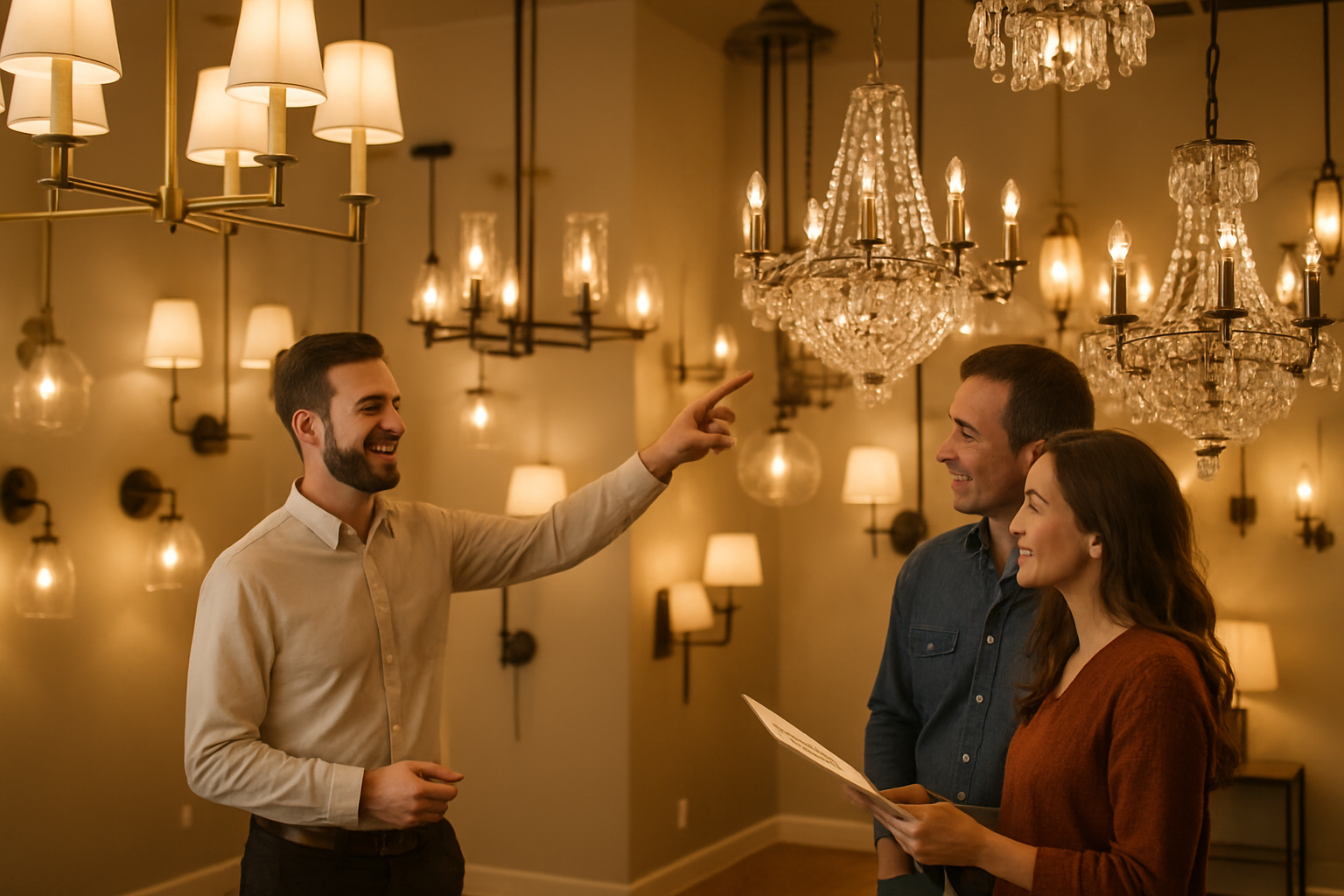
A supplier worth trusting will ask questions about your space before recommending anything. If a showroom skips that step, you’re just browsing.
Local Code Knowledge Is Worth More Than You Might Think
This is the piece most homeowners don’t think about until it’s too late. Lighting isn’t just a design decision — in many parts of Monterey County, it’s also a compliance decision.
Carmel-by-the-Sea has some of the most specific exterior lighting rules in the state. Residential exterior fixtures are capped at 3000K color temperature, and lumen output is restricted to protect the area’s dark-sky character. If you buy exterior fixtures online without knowing this, you may find yourself swapping them out after a conversation with the city. The full breakdown of Carmel’s exterior lighting rules is worth reading before you purchase anything for the outside of your home.
Beyond Carmel, California Title 24 governs lighting controls and efficiency requirements for any permitted remodel or new construction statewide. The updated rules taking effect January 1, 2026 affect which fixtures qualify, how dimming controls must be wired, and what documentation you may need for a permit.
A local supplier who knows these requirements can steer you toward compliant fixtures from the start — rather than leaving you to figure it out mid-project. Always confirm current specifics with your licensed contractor or the local building department, since code details can shift. But walking into a showroom where the staff already knows the landscape is a very different experience than ordering from an anonymous ecommerce site.
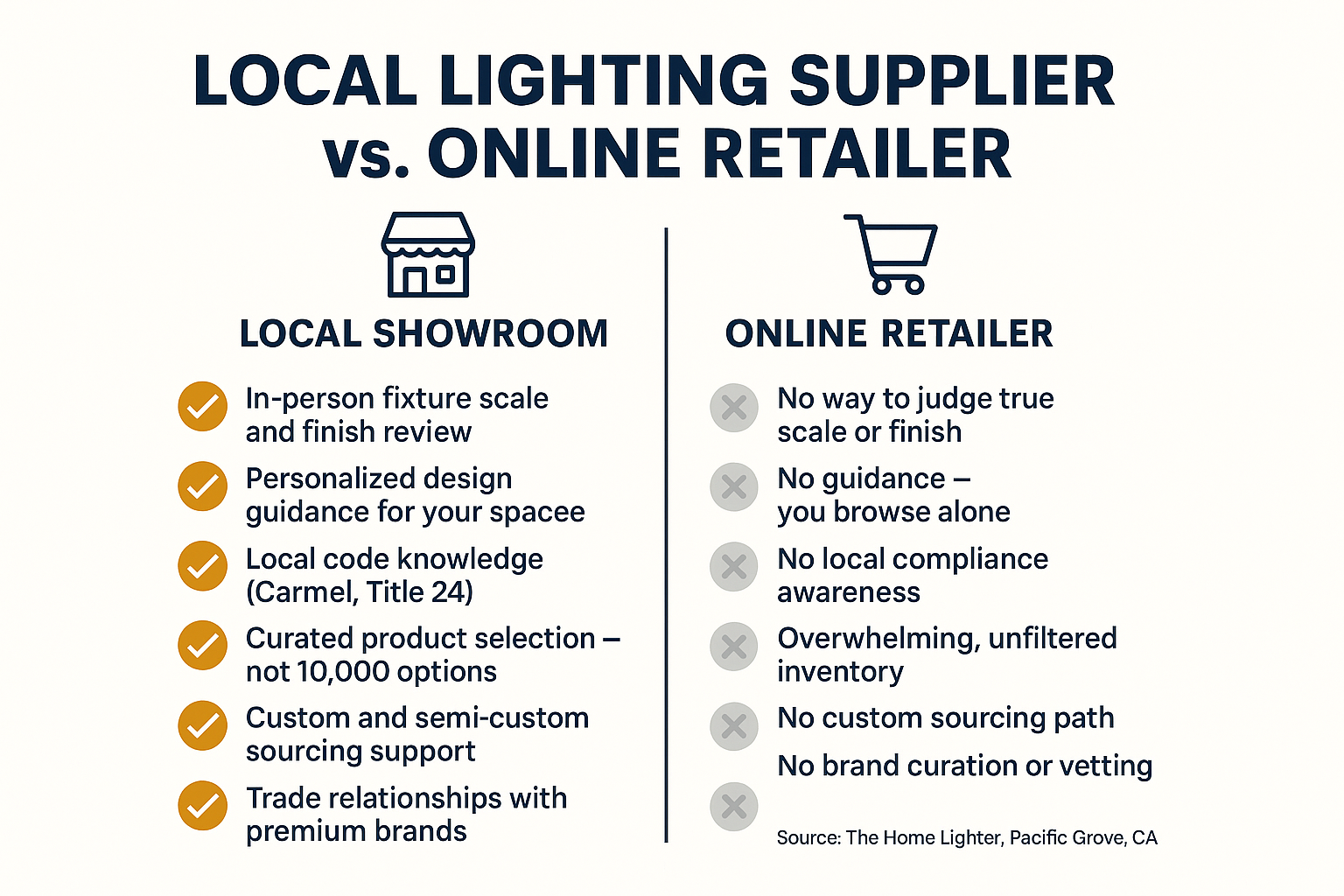
How a Local Lighting Supplier Compares to Online-Only Options
Here’s a side-by-side look at what you actually get — and don’t get — from each source when planning a real lighting project.
What to Actually Ask When You Walk Into a Showroom
Not every showroom with nice fixtures has staff who can actually help you. A few questions will tell you quickly whether you’re in the right place.
Ask about project experience: Has this supplier worked with clients on kitchen remodels, bathroom renovations, or whole-home refreshes? Can they walk you through a layered lighting plan — not just hand you a brochure?
Ask about brand relationships: A showroom with direct access to brands like Hinkley or Minka Group can often source fixtures that aren’t sitting on a shelf anywhere. That matters when you’re looking for something specific. For a deeper look at what that sourcing relationship means in practice, see how to find a reliable Hinkley Lighting supplier near you.
Ask about the process for a larger project: If you’re doing a full kitchen remodel or building new in Pebble Beach, you want to know whether the showroom can handle a multi-room fixture package — not just sell you one pendant at a time.
And pay attention to how the staff responds. Do they ask about your space, your finishes, your electrician’s timeline? Or do they just point you toward the floor samples and step back? The difference is obvious within about five minutes.
Quick Reference: What a Local Supplier Should Offer
Use this as a checklist when evaluating any local lighting resource — whether you’re in Monterey, Carmel, or anywhere on the Central Coast.
| What to Look For | Why It Matters | Red Flag If Missing |
|---|---|---|
| In-person fixture viewing | Scale, finish, and light quality are hard to judge online | Staff can’t show you fixture proportions in context |
| Design consultation ability | Layered lighting plans require expertise, not just product knowledge | Showroom only sells — doesn’t advise |
| Local code familiarity | Carmel and Title 24 rules affect fixture selection directly | No awareness of 3000K exterior limits or 2026 Title 24 updates |
| Custom/semi-custom sourcing | Off-shelf options don’t always fit unique or high-end spaces | No access to special order or trade-only lines |
| Established vendor relationships | Brand access affects availability, lead times, and pricing tiers | Limited to what’s already on the floor |
| Clear installation boundaries | A good supplier knows where their role ends — at the fixture, not the wire | Any implication they install creates liability confusion |
Why the Coastal Context Matters Here Specifically
The Monterey Peninsula isn’t a generic market, and lighting decisions here come with specific environmental and regulatory realities that suppliers in Sacramento or San Jose simply don’t deal with daily.
The salt air and fog along the coast — from Pebble Beach’s shoreline to the waterfront neighborhoods of Pacific Grove — means wet-rated and damp-rated fixture requirements come up constantly, even for covered outdoor areas. A fixture that would last ten years in Fresno might corrode in two years on a Pacific Grove patio without the right rating.
Carmel’s exterior lighting ordinance is detailed enough that it warrants its own reading — why outdoor lighting on the Monterey Peninsula needs a different approach covers the environmental and regulatory landscape in full.
And for interior work, homes here often carry significant architectural character — craftsman bungalows in Pacific Grove, mid-century properties in Carmel Valley, contemporary builds in Pebble Beach estates. Generic big-box inventory rarely has the range to serve that variety well. That’s where a curated, locally rooted showroom earns its place.
Frequently Asked Questions About Choosing a Local Lighting Supplier
Can’t I just buy everything online and save money?
You can, and for simple replacements it sometimes works fine. But for any project that involves multiple rooms, a renovation, or exterior fixtures in a regulated area like Carmel, the cost of getting it wrong often exceeds whatever you saved upfront. Returning fixtures is slow, restocking fees are common, and by the time you’ve ordered, waited, returned, and reordered twice, you’ve lost more than money — you’ve lost time on a project that’s probably holding up other trades.
Does a local showroom cost more than buying online?
Sometimes yes, sometimes no. Premium fixture lines that are available through local trade-affiliated showrooms are often priced comparably to what you’d find online — and in some cases, the showroom has access to pricing tiers that aren’t available to the general public. More importantly, the guidance you get is part of what you’re paying for. One well-chosen fixture you don’t have to replace is worth more than two cheaper ones you do.
What if I already have a design or fixture list from my interior designer?
A good local supplier works well alongside designers — that’s actually a common relationship. If your designer has specified certain fixtures, a showroom with strong vendor relationships may be able to source exactly those pieces, or suggest comparable alternatives if lead times are long. Many interior designers on the Peninsula already work with local showrooms as a trade resource specifically because of that sourcing depth.
How do I know if my outdoor fixtures need to comply with Carmel’s lighting rules?
If your property is within Carmel-by-the-Sea city limits, any exterior residential lighting is subject to the ordinance — including landscape lighting, porch fixtures, and decorative garden lights. The key limits are 3000K maximum color temperature and restricted lumen output. The details are specific enough that it’s worth reviewing them carefully before purchasing anything for the outside of your home. Always confirm current requirements with the City of Carmel or your licensed contractor before finalizing fixture selections.
Do I need an appointment to visit a local lighting showroom?
At The Home Lighter in Pacific Grove, walk-ins are always welcome. For larger projects — a full kitchen remodel, a whole-home fixture package, or a new construction spec list — scheduling time in advance means the staff can give your project proper attention from the start.
What should I bring when I visit a lighting showroom for a remodel project?
The more context you bring, the faster the conversation goes. Useful things to have: room dimensions and ceiling heights, photos of the existing space, samples or photos of your finishes (cabinet color, countertop material, floor), your electrician’s contact or any electrical plans if you have them, and a rough sense of your fixture budget. You don’t need all of it — but even a few photos on your phone make the selection conversation much more productive.
Ready to Talk Through Your Lighting Project in Person?
Greg and Tammy at The Home Lighter have been helping Monterey Peninsula homeowners, designers, and contractors make confident fixture decisions since 1969 — from single-room refreshes to full-home remodels. Walk-ins are welcome at the showroom at 2034 Sunset Drive in Pacific Grove, or give them a call at (831) 655-5500 to talk through what your project needs before you stop by.