
Direct Answer: Chandeliers work best in dining rooms, entryways, and primary bedrooms — spaces where ceiling height, sight lines, and the need for a focal point all align.
A lot of homeowners fall in love with a chandelier online, buy it, and then realize it looks wrong in the room — too big, too small, hanging too low, or just out of place. It happens constantly on the Monterey Peninsula, where remodels in Carmel-by-the-Sea and Pacific Grove often mix older Spanish Colonial bones with newer interior design choices.
The truth is, a chandelier isn’t something you drop into any room and call it done. There are maybe three or four spaces in a typical home where a chandelier genuinely earns its place — where the ceiling height, the room’s function, and the sight lines all work together.
This article breaks down which rooms those are, why they work, and what you actually need to think about before you commit to a fixture.
The Dining Room: Where a Chandelier Has Always Belonged
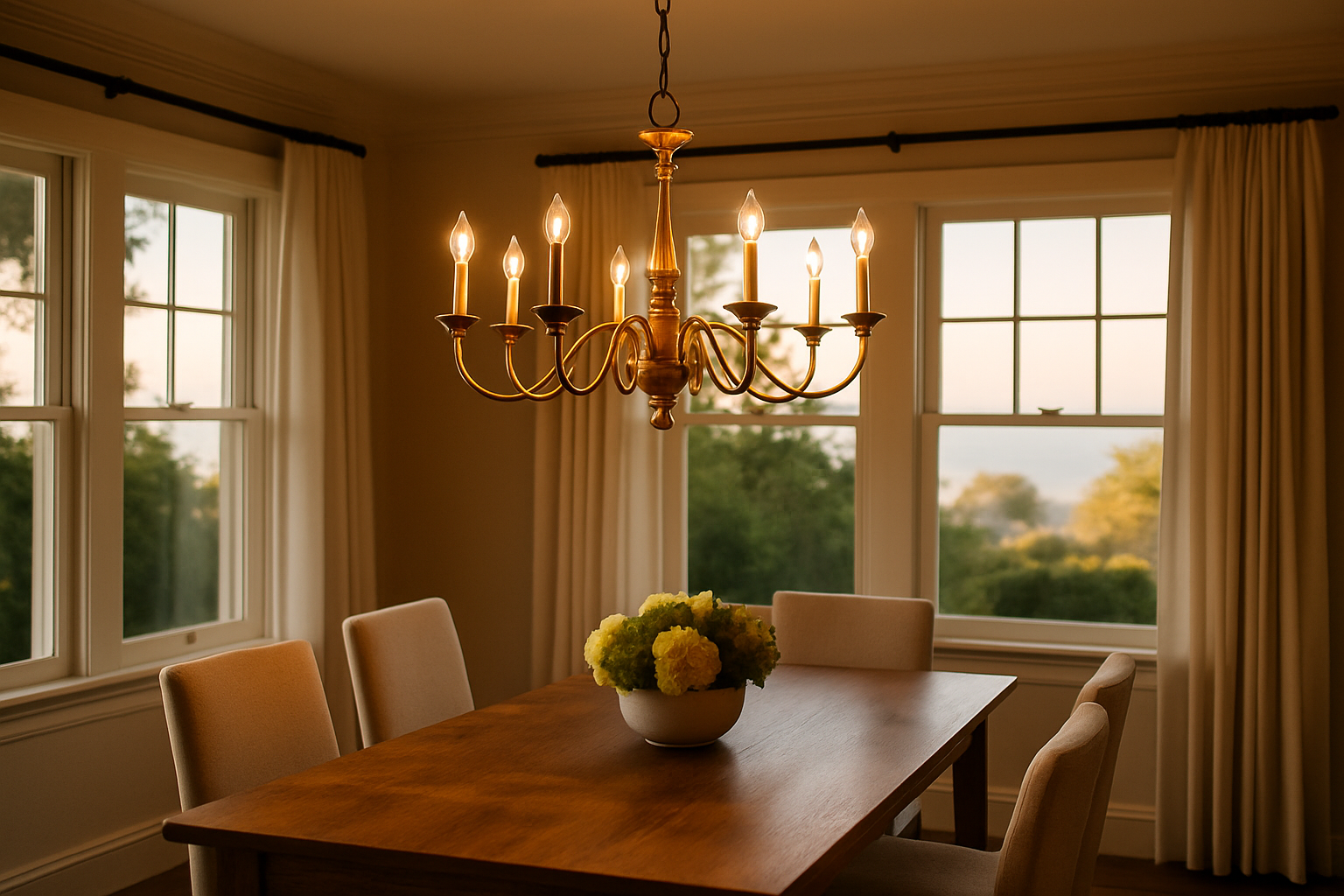
The dining room is the one space where almost nobody argues about whether a chandelier belongs. The table creates a natural anchor point directly below the fixture, the ceiling height in most homes supports a hanging light, and people are seated — so the fixture lands right in their sight line without being in their way.
The sizing question is where most people get it wrong. A chandelier that hangs over a dining table should generally be 12 to 36 inches narrower than the table itself, depending on the room’s width. Over a standard 36-inch by 72-inch dining table, a fixture somewhere between 24 and 34 inches in diameter tends to look proportional.
Height matters just as much. The bottom of the fixture should hang approximately 30 to 34 inches above the tabletop in a room with standard 8-foot ceilings. Add 3 inches of clearance for every additional foot of ceiling height above 8 feet — so a 10-foot ceiling pushes that clearance to 36 to 40 inches.
If you want to go deeper on sizing math before you shop, the chandelier size calculator guide at The Home Lighter walks through the formulas room by room.
One other detail that gets overlooked in dining rooms: dimming. A chandelier over a dinner table should almost always be on a dimmer. A 3000K or 2700K warm white light source at 60 to 80 percent intensity is what makes food look good and conversation feel easy — the same principle restaurants rely on to create atmosphere.
Entryways and Foyers: The First Impression Room
The entryway is the second room where a chandelier genuinely makes sense — and here, it’s less about function and more about what the space communicates. A foyer with a well-chosen chandelier tells guests something about the home before they’ve gone any further.
But entryways also have the most variation in ceiling height of any room in a house. A two-story foyer in Pebble Beach with 18-foot ceilings calls for a very different fixture than a Pacific Grove cottage with a 9-foot entry ceiling. The scale has to match, or the effect falls apart.
For single-story entries with ceilings at 8 to 9 feet, a semi-flush chandelier or a fixture with a short canopy drop often works better than a traditional pendant-style chandelier. For anything with 12 feet or more of vertical clearance, a statement chandelier with visible drop and visual weight can anchor the entire entry.
A few things to confirm before buying for an entryway:
- Ceiling height — measure from floor to ceiling, not floor to the junction box
- Door clearance — the fixture should never swing into line-of-sight when the front door opens
- Traffic flow — anyone over 6 feet tall should be able to walk under the fixture with at least 7 feet of clearance below it
- Electrical box location — if it’s not centered over the entry, the fixture will look off no matter what you choose
The entryway is also one of the rooms where finish selection really matters. A fixture in antique brass or matte black can set a design tone that carries through the rest of the house. If you’re curious how finish choices play out in practice, the antique brass ceiling lights buyer’s guide covers the material-specific decisions worth thinking through.
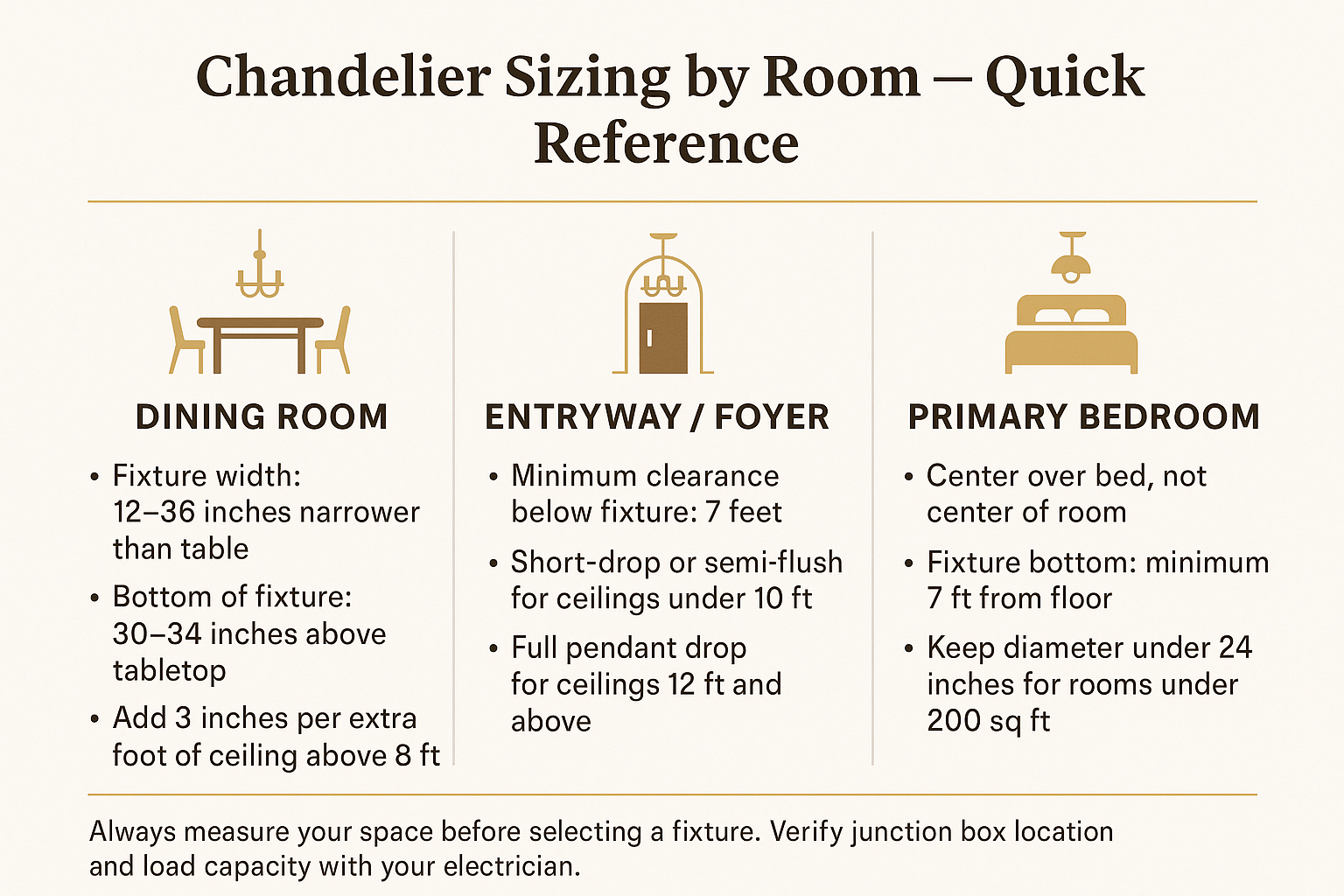
Quick-Reference: Chandelier Sizing by Room
This reference covers the three rooms where chandeliers make the most sense, with the key measurements you need before you buy.
The Primary Bedroom: Where Most People Get It Wrong
Chandeliers in bedrooms are increasingly popular — and they can absolutely work. But this is the room where homeowners most often miscalculate, because bedrooms don’t have the same natural anchor point that a dining table or entryway provides.
The key is centering the fixture over the bed, not over the geometric center of the room. In most bedrooms, the bed is the functional focal point, so the light should relate to it — not float awkwardly over an empty floor somewhere between the dresser and the closet.
Scale is critical here too. A 20 to 24-inch diameter fixture works well in most primary bedrooms under 200 square feet. Go larger and it starts to feel like the chandelier is competing with the room rather than completing it.
One more thing: bedroom chandeliers have to clear the bed. If your mattress and frame sit 24 to 26 inches off the floor, and you want to sit up comfortably in bed without the fixture looming directly overhead, you want the bottom of the fixture at least 6.5 to 7 feet from the floor. In a room with standard 8-foot ceilings, that’s tight — which is why a flush or semi-flush chandelier-style fixture often makes more practical sense than a full pendant drop.
For rooms with 10-foot or higher ceilings — common in newer construction in Carmel Valley and some of the larger Pebble Beach estates — a proper hanging chandelier has the breathing room it needs and can become a genuine design feature.
Chandelier Fit at a Glance: Room-by-Room Summary
Use this as a starting checklist before you visit a showroom or make any final fixture decisions.
| Room | Does a Chandelier Fit? | Key Watch-Out |
|---|---|---|
| Dining Room | Yes — almost always | Size relative to table; dimmer required |
| Entryway / Foyer | Yes — with ceiling height check | 7 ft minimum clearance below fixture |
| Primary Bedroom | Yes — with caveats | Center over bed, not room; ceiling height often limits drop |
| Living Room | Sometimes — depends on layout | No natural anchor; needs vaulted ceiling or strong focal point |
| Kitchen | Rarely over work areas | Pendant clusters usually outperform a single chandelier here |
| Bathroom | Occasionally over soaking tub | Wet-rated or damp-rated fixture required; verify with electrician |
| Home Office | No | Task lighting matters more; chandelier adds glare, not function |
The Rooms That Are More Complicated
Living rooms, kitchens, and bathrooms come up constantly in these conversations — and the honest answer is that chandeliers sometimes work in those spaces, but they’re not the default right choice.
Living rooms are the hardest call. Unlike a dining room, there’s no single furniture anchor the light can relate to. A chandelier over a coffee table can work if the room has vaulted ceilings and a strong central seating arrangement, but in most standard-height living rooms it ends up feeling random. A layered lighting approach with recessed ambient light plus a statement floor lamp or sconces tends to serve living rooms better.
Kitchens are primarily work spaces, which means task lighting — over counters, islands, and prep areas — should drive the fixture plan. A chandelier above a kitchen island is a look some homeowners want, but pendant lighting over a kitchen island almost always delivers better focused light for cooking and prep. If a statement fixture matters to you in the kitchen, consider a decorative semi-flush over the table area if you have one — not over the island.
Bathrooms are the one space where a chandelier can work beautifully but requires the most caution. A fixture above a soaking tub can be stunning, but California building code requires any fixture within 3 feet horizontally and 8 feet vertically of a water source to be rated for wet or damp locations. That limits your fixture options significantly, and your licensed electrician needs to confirm placement before anything is ordered.
Frequently Asked Questions About Choosing a Chandelier
Can I put a chandelier in a room with 8-foot ceilings?
Yes, but your fixture options narrow considerably. With 8-foot ceilings, you need the bottom of the fixture to sit at least 7 feet from the floor — which only leaves 12 inches of drop from the junction box. That rules out most traditional pendant-style chandeliers. A semi-flush or flush chandelier-style fixture usually makes more sense, and there are genuinely beautiful options in that category that don’t look like compromise choices.
How do I know if my ceiling box can support a chandelier?
Standard ceiling boxes are typically rated for fixtures up to 35 pounds. Heavier chandeliers — anything over that — require a fan-rated box or a dedicated structural brace, which your electrician installs before the fixture goes up. Always check the fixture weight on the spec sheet before you purchase, and confirm your box rating with your electrician before anything is ordered.
What’s the right chandelier size for a small dining room?
For a small dining room — say, a table around 36 by 48 inches — a fixture in the 18 to 24-inch diameter range usually looks right. Going bigger makes the fixture feel like it’s eating the room. The chandelier size calculator guide has the math broken down if you want a more exact starting point.
Do chandeliers have to go on a dimmer?
They don’t have to, but they almost always should. A chandelier at full brightness in a dining room or bedroom tends to feel harsh. Dimming gives you flexibility — bright when you need it, warm and low when you want atmosphere. Just confirm that the bulbs in the fixture are compatible with the dimmer you’re installing; not all LED drivers dim the same way, and a mismatch causes flickering.
Is there a specific style of chandelier that works better in coastal homes?
The Monterey Peninsula has a lot of mixed architecture — Spanish Colonial, Craftsman, mid-century, and newer construction all exist within a few miles of each other. Fixture style should follow the bones of the house more than any regional trend. That said, materials like natural iron, aged brass, rattan, and textured glass tend to hold up well visually in coastal interiors and pair naturally with the organic textures common in homes near the water.
Not Sure If Your Room Is Right for a Chandelier?
Greg and Tammy at The Home Lighter have been working through exactly these questions with homeowners across the Monterey Peninsula since 1969. Stop by the showroom at 2034 Sunset Drive in Pacific Grove — walk-ins are always welcome — or call at (831) 655-5500 to talk through your space before you commit to anything.