
Direct Answer: A lighting consultation starts with a talk about your rooms and scope, moves to a showroom walkthrough with fixtures lit, and ends with a short list of realistic fixture choices.
Most people who reach out about a lighting consultation already know they want to come in. What they do not know is what they are supposed to bring, how long it takes, and whether they will be put on the spot to buy something.
That uncertainty shows up constantly in messages from Monterey Peninsula homeowners. One asked about coming in the same day for a house being built in the area. Another wanted to stop by that week with a photo of an existing fixture she was trying to match.
So here is the honest walkthrough. What happens, in what order, what to bring, and the difference between a walk-in visit and a scheduled consultation.
Lighting Consultation: What to Expect Once You Walk In
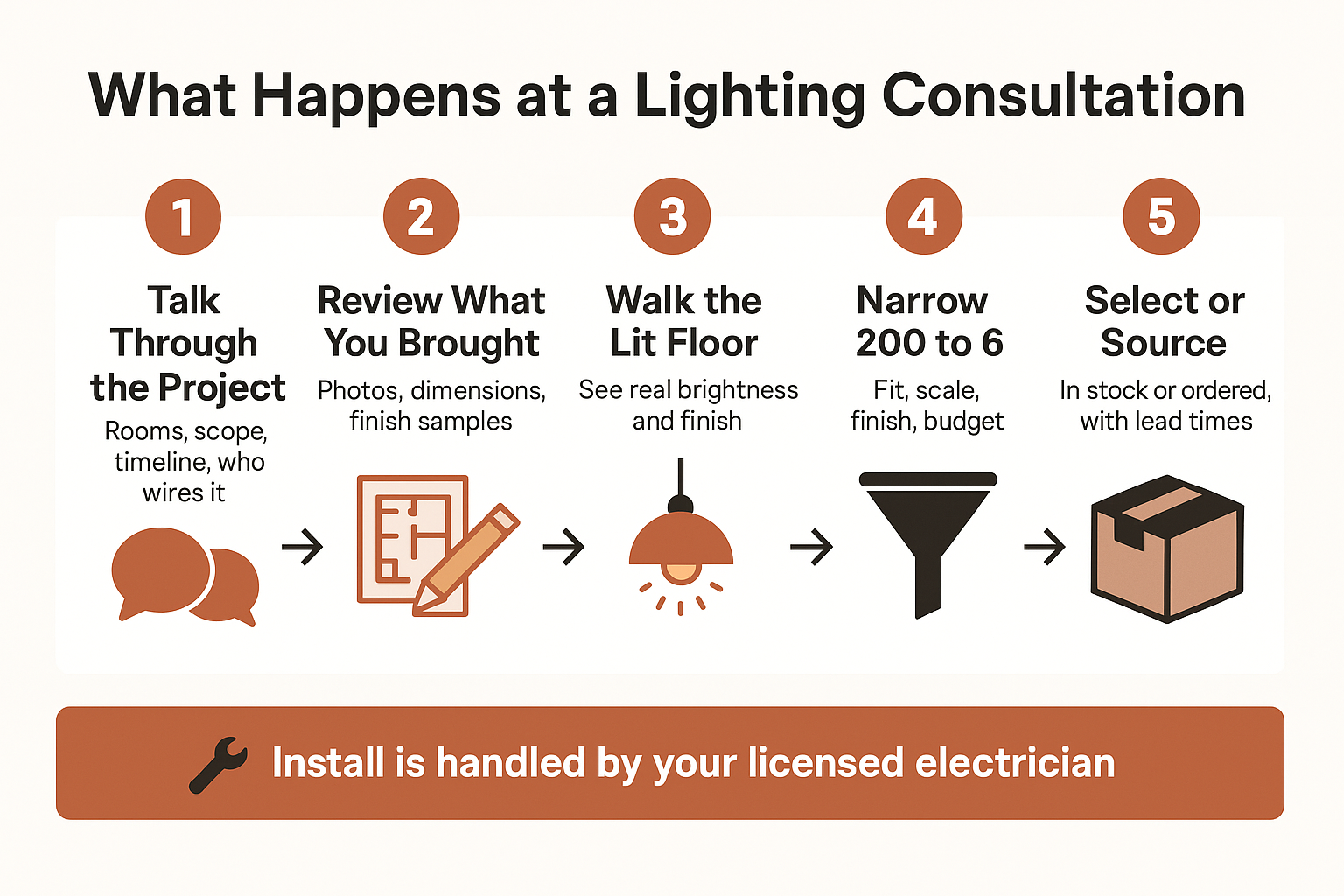
The first part is a conversation, not a sales pitch. A consultant asks what the project is, which rooms matter most, where you are in the schedule, and who is doing the electrical work.
That last question matters more than people expect. Fixture choices are limited by what is already in the ceiling, so the answer shapes everything that follows. A showroom sells and specifies fixtures; your licensed electrician or contractor handles the install.
From there, the visit usually moves in this order:
- Review of your photos, dimensions, and finish direction
- A walkthrough of the showroom floor with fixtures actually illuminated
- Side by side comparison of finishes under the same light source
- Narrowing a category down to a handful of workable options
- Talking through bulb type, color temperature, and dimming
- Checking lead times, then selecting from stock or sourcing from a manufacturer line
A single fixture question can be answered in 15 to 20 minutes. Whole-home selection for a remodel or new build usually runs closer to an hour or more, sometimes across two visits, because kitchen and bath decisions tend to loop back on each other.
If you are still at the stage of figuring out what a room even needs, how to read a room before you pick a light fixture is a useful place to start before you go anywhere.
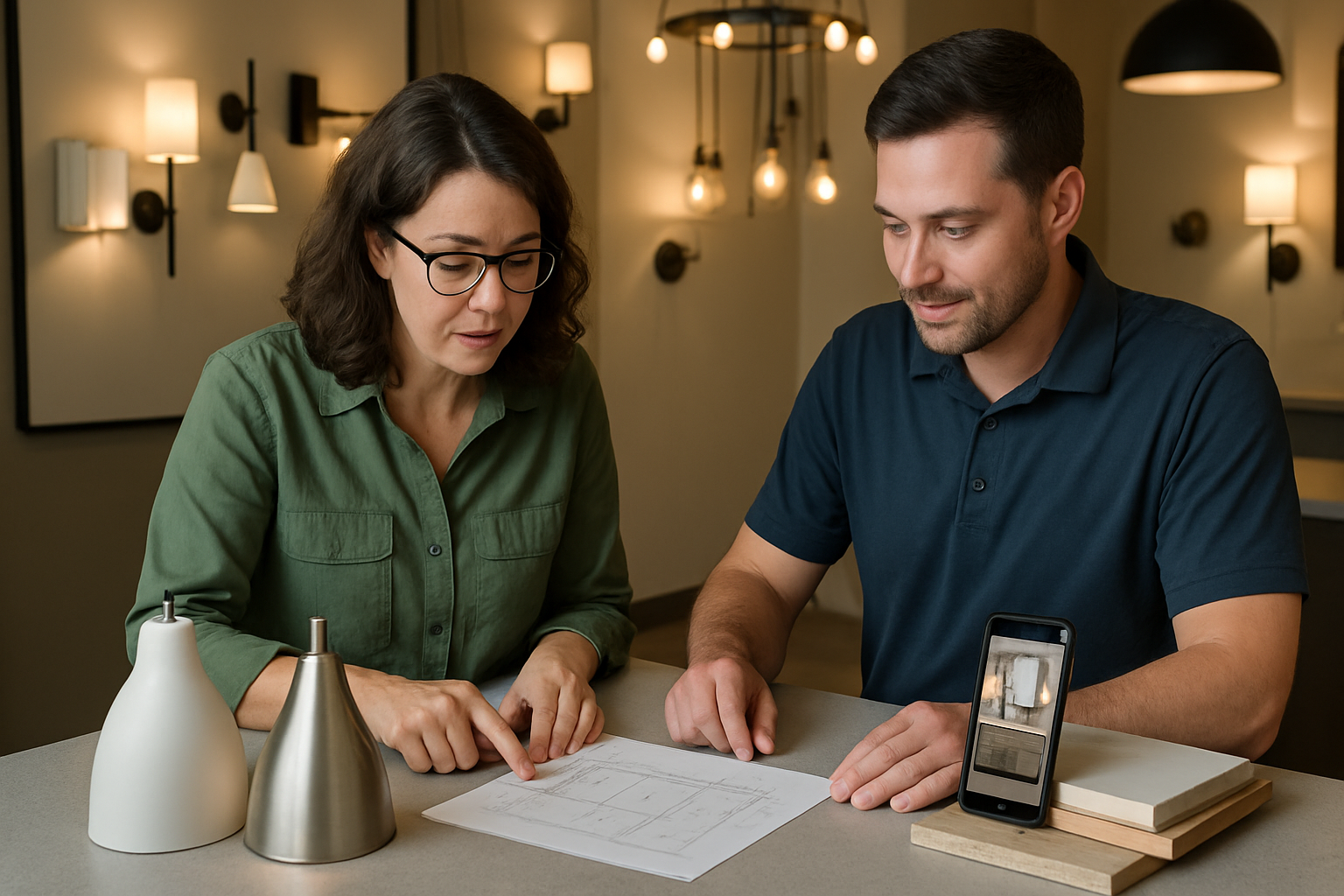
What to Bring (A Phone Photo and a Rough Sketch Is Plenty)
A consultant can read a space, but cannot guess your dimensions or the tile you already ordered. The more specific your input, the more specific the guidance you get back.
Nothing here needs to be formal. Bring what you have:
- Room dimensions, including ceiling height, which drives pendant and chandelier sizing
- A floor plan or hand sketch, even a rough one on notebook paper
- Phone photos of the space as it is now, plus the room from the doorway
- Finish direction already committed: cabinet color, flooring, countertop, tile, wall tone
- Physical samples if you have them, since photos shift color badly
- Which rooms are the priority and which can wait
- Notes from your electrician about existing junction boxes, switch locations, and dimmers
- Your rough install timeline
Homeowners who bring cabinet doors and tile chips get further in one visit than those working from memory. Finish matching is the single most common reason a fixture gets returned.
If you are replacing something you love rather than starting fresh, bring the old part. People do this all the time with shades, and finding a replacement lamp shade that actually fits explains why the measurements matter so much.
Walk-In Visit or Scheduled Consultation?
Walk-ins are welcome, and plenty of people finish a decision the same day. Appointments are available for more involved projects. Here is how to tell which fits your situation.
| Your Situation | Better Fit | Why |
|---|---|---|
| Replacing one dated fixture | Walk-in | Often decided in one visit with a photo and measurements |
| Shade, bulb, or dimmer question | Walk-in | Quick match against what you bring in |
| Single bathroom remodel | Either | Depends on how many decisions are still open |
| Kitchen remodel with island pendants | Scheduled | Layout, spacing, and finish coordination take focused time |
| Whole-home or new construction | Scheduled | Multiple rooms reviewed together without interruption |
| Designer or contractor spec support | Scheduled | Sourcing and lead times need dedicated review |
Why a Fixture Looks Different Lit Than It Does on a Screen
This is the part a website cannot do. On a monitor, every fixture is photographed in a styled room at the same flattering brightness. In person, you see actual output, actual finish, and actual glare.
Two fixtures that look identical online can read completely differently once they are on. One throws light down in a tight pool. The other spreads it and washes the ceiling. Same photo, different room.
The other thing a showroom does is subtract. A single manufacturer line can carry dozens of vanity fixtures, and across many lines the number gets unmanageable fast. Someone who knows the product range narrows 200 possibilities down to about six that fit your ceiling height, finish, and budget.
That is what breaks the return cycle so many homeowners describe: order online, unbox it, realize the scale is wrong or the brass is too yellow, ship it back, start over. Two or three rounds of that costs more in weeks than in dollars.
Color temperature is the other thing worth seeing in person. Warm and dim are not the same effect, which the difference between dim and warm covers in detail, and it is far easier to understand standing in front of two lit fixtures than reading a spec sheet.
The Consultation, Step by Step
A quick view of how a showroom visit moves from a vague idea to a short list of real fixtures.
Local Rules That Come Up in Almost Every Coastal Project
On the Monterey Peninsula, a consultation is not purely about looks. Two compliance topics come up constantly, and both affect which fixtures are even on the table.
Carmel-by-the-Sea exterior lighting. The city caps residential exterior fixture color temperature at 3000K and limits lumen output. That rules out a lot of otherwise attractive outdoor fixtures, so exterior selection for a Carmel property starts with the ordinance, not the catalog. Always verify current requirements with the city or your contractor before ordering. Whether your landscape lighting meets Carmel’s exterior rules goes deeper on this.
California Title 24. The updated standards took effect January 1, 2026 and govern lighting controls and efficiency in remodels and new construction statewide. The practical result is that dimmers, switches, and bulb type belong in the fixture conversation from the start. You can read the standards directly through the California Energy Commission.
Salt air is the third local factor. Homes in Pebble Beach, Pacific Grove, and along the Carmel coast go through exterior finishes faster than inland properties, so finish and material selection is a durability decision as much as a style one.
How Budget Gets Discussed Without the Awkwardness
Budget comes up early because it is a useful filter, not because anyone is sizing you up. Saying “I would rather stay under a certain number for this dining fixture” saves everyone twenty minutes.
Costs vary widely and depend on real factors, so treat any number you see online as loose context. What actually moves the price:
- Manufacturer line and whether the fixture is American made
- Materials and finish, since hand-applied finishes cost more than plated ones
- Size and number of light sources
- Integrated LED versus standard sockets
- Custom or semi-custom work, which carries longer lead times
In practice, many Monterey County homeowners find that a designer dining chandelier sits well above a big-box equivalent and well below a bespoke commission. Exact pricing depends on the fixture, so the showroom is the place to get a real number for what you are considering.
Frequently Asked Questions About Lighting Consultations
Do I need an appointment, or can I just stop by?
Walk-ins are welcome. Many people browse and decide the same day, especially for a single fixture or a shade. Appointments are available for more involved projects, and a scheduled session is worth it for a full remodel or new construction so the whole scope can be reviewed without interruption.
How long does a consultation take?
A single fixture question is often 15 to 20 minutes. Whole-home selection usually runs an hour or more and sometimes takes two visits, because kitchen, bath, and hallway decisions influence each other.
Do I have to buy anything at the consultation?
No. Plenty of people come in to understand their options, take notes, then come back once their cabinets or tile are locked in. That is a normal sequence, not a wasted visit.
Can the showroom install the fixtures I pick?
No. Installation is handled by your own licensed electrician or contractor. What a showroom does is help select and source the right fixtures, then give you the specs your electrician needs, including box requirements and dimming compatibility.
I am a designer working on a Monterey Peninsula project. Is this useful for trade work?
Yes. Designers, contractors, and remodelers use local showrooms for spec support, finish coordination, and sourcing fixtures that are not stocked. For multi-room specs, a scheduled visit makes lead time review a lot easier.
What if I want something I cannot find in any catalog?
That is what custom and semi-custom guidance is for. It starts with a conversation about the space, then moves to sketches and sourcing. Expect longer lead times than a stock fixture, so bring it up early in your project timeline.
Thinking About Coming In?
Greg and Tammy at The Home Lighter have been guiding Monterey County, CA homeowners, designers, and contractors through fixture selection from the showroom at 2034 Sunset Drive in Pacific Grove since 1969. Walk-ins are welcome, and appointments are available for larger remodels and new construction. The number is (831) 655-5500 if you would rather ask a question first.