
Direct Answer: Small app-controlled glow lamps add warm mood light at table height, but they cannot light a room. Warm-dimming bulbs in shaded table lamps or sconces do the same job with more usable light.
It is 6 pm in December. The overhead light is on, the room feels flat and a little harsh, and you are scrolling past the fourth ad this week for a small app-controlled glow lamp that fades to warm amber after sunset.
The ad looks exactly like the feeling you want. So the real question is whether a set of those lamps is the answer, or whether the lighting already in the room could do the same thing better.
Here on the Monterey Peninsula that question comes up constantly from November through February, when evenings run entirely on fixtures. This is an honest look at what these lamps get right, where they stop, and what an oasis lighting alternative built from permanent fixtures actually looks like.
What the Glow Lamps Actually Get Right
Give them credit for two real things, because both are correct lighting instincts.
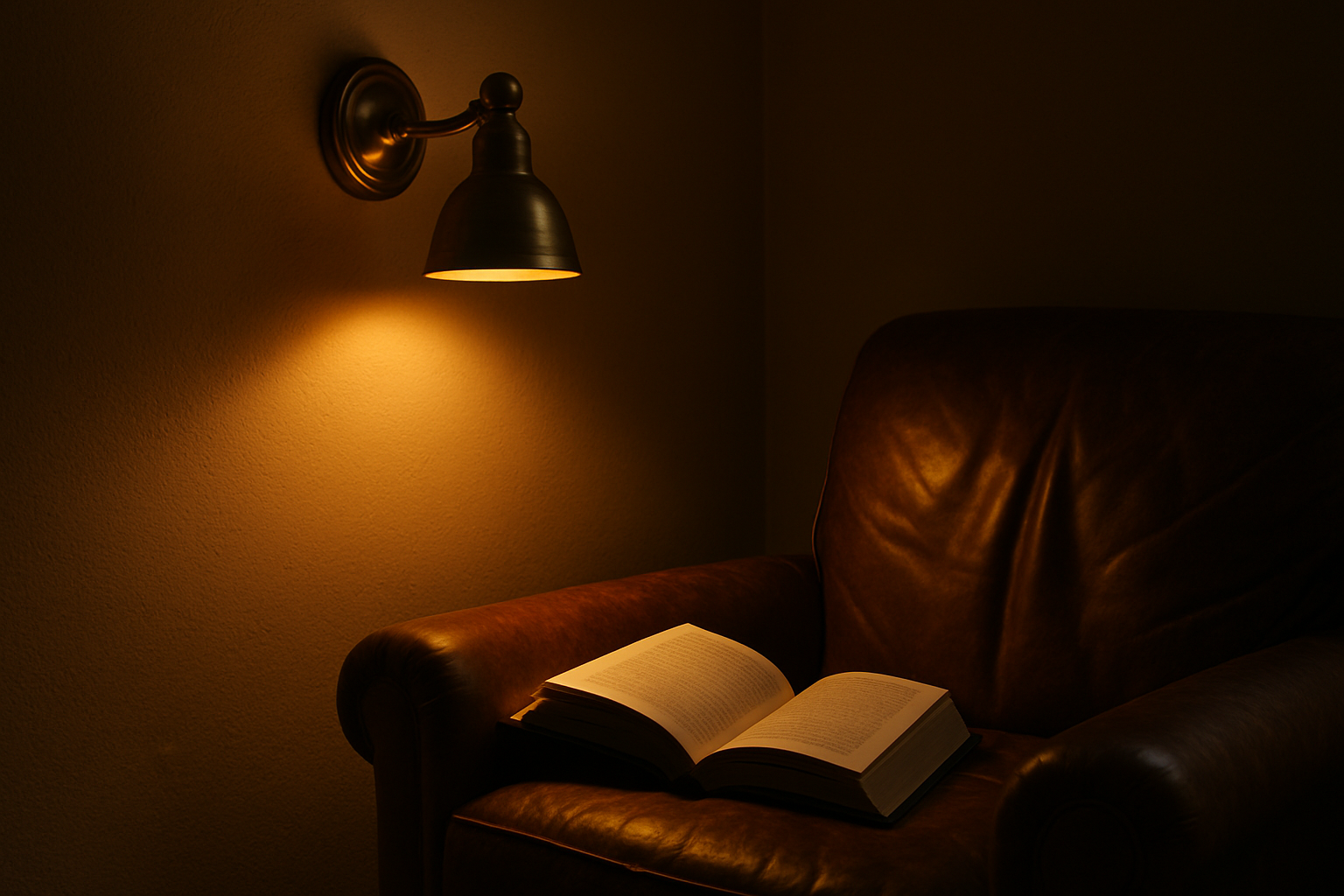
First, they put light at table height, below eye level. Most harsh rooms are harsh because the only light source is a ceiling fixture firing straight down. Light that sits low and spreads sideways reads as calm to the human eye.
Second, they shift warm in the evening. Cool white light at 6 pm fights what your body expects after dark. A warm amber tone at night feels right because it matches firelight and low sun.
That matters more here than in most of the country:
- Daylight saving time ends November 1, 2026, pushing sunset back an hour overnight
- December 1 sunset on the Peninsula lands around 4:51 pm
- December averages roughly 9 hours 42 minutes of daylight and about 6 hours of sunshine per day, the lowest of the year
- Coastal fog and marine layer cut usable daylight further, even at midday
So from early November through late February, the light in a Pacific Grove or Carmel Valley living room at dinnertime is whatever you chose to put there. The quality of that light is a daily experience, not a decorating detail.
Where These Lamps Stop Working
They are accessories. They are not room lighting, and the ads never say that part out loud.
A glow lamp will not fix:
- A kitchen counter where you are chopping in your own shadow
- A bathroom mirror that makes everyone look slightly ill
- A hallway or stairwell with no fixture at all
- A room that simply does not have enough light in it to read comfortably
Notice they are sold in packs of two, four, and eight. That is because one does very little. Covering a single living room takes several, and published per-lamp and per-bulb prices on direct-to-consumer sites climb quickly once you do that math.
Prices on these products shift constantly, so treat any figure you see as a moving target. The more useful exercise is comparing the total for a multi-lamp set against what a good shaded table lamp or a pair of sconces would cost from a showroom, where you can see the thing lit before you buy.
Then there is the stuff nobody photographs. Every lamp needs an outlet, a cord, and a spot on a surface you were already using for something else. Four of them in one room means four cords and four surfaces committed.
What Each Option Actually Covers
A quick side-by-side of what these three approaches really deliver in an average Monterey County living room.
| Option | What it does well | What it will not do |
|---|---|---|
| Plug-in glow lamp set | Soft amber accent light on tabletops, app scheduling, no wiring | Light a room, support reading or tasks, stay cord-free |
| Table lamps with fabric shades and warm-dim bulbs | Wide warm pool at seated height, real reading light, dims through the evening | Light a kitchen counter or vanity on its own |
| Wall sconces on a dimmer | Frees up table surfaces, excellent in reading corners, no visible cords | Get installed without a licensed electrician |
Getting the Same Evening Glow From Permanent Lighting
This is the part worth your attention, because the effect in those ads is not hard to reproduce. It just comes from fixtures instead of gadgets.
The recipe is simple:
- A pair of table lamps with fabric shades, not one. Two light sources in a room kill shadows that one cannot.
- Shades set so the bottom edge sits near seated eye level, roughly 58 to 64 inches from the floor for a lamp on an end table.
- Warm-dimming or low-Kelvin sources inside them, so the color drops toward candlelight as you dim instead of staying cool and gray. That difference is covered in detail in Warm Dimming LEDs: What They Do That a Standard LED Cannot.
- A dimmer matched to the load. Mismatched dimmers are the single most common reason a nice fixture flickers or hums, explained in Why Your LED Fixtures Flicker or Buzz on a Dimmer.
No app. No account. No cords crossing the floor.
Wall sconces do it even better in a reading corner, since they free up the table entirely and throw light where a chair actually is. Sconce questions spike around here every January, right after people spend a dark December staring at their ceiling fixture. And if the room has no overhead box at all, there are plug-in and portable paths worth knowing, laid out in When a Room Has No Ceiling Light.
Mood Light Is Only One of Three Layers
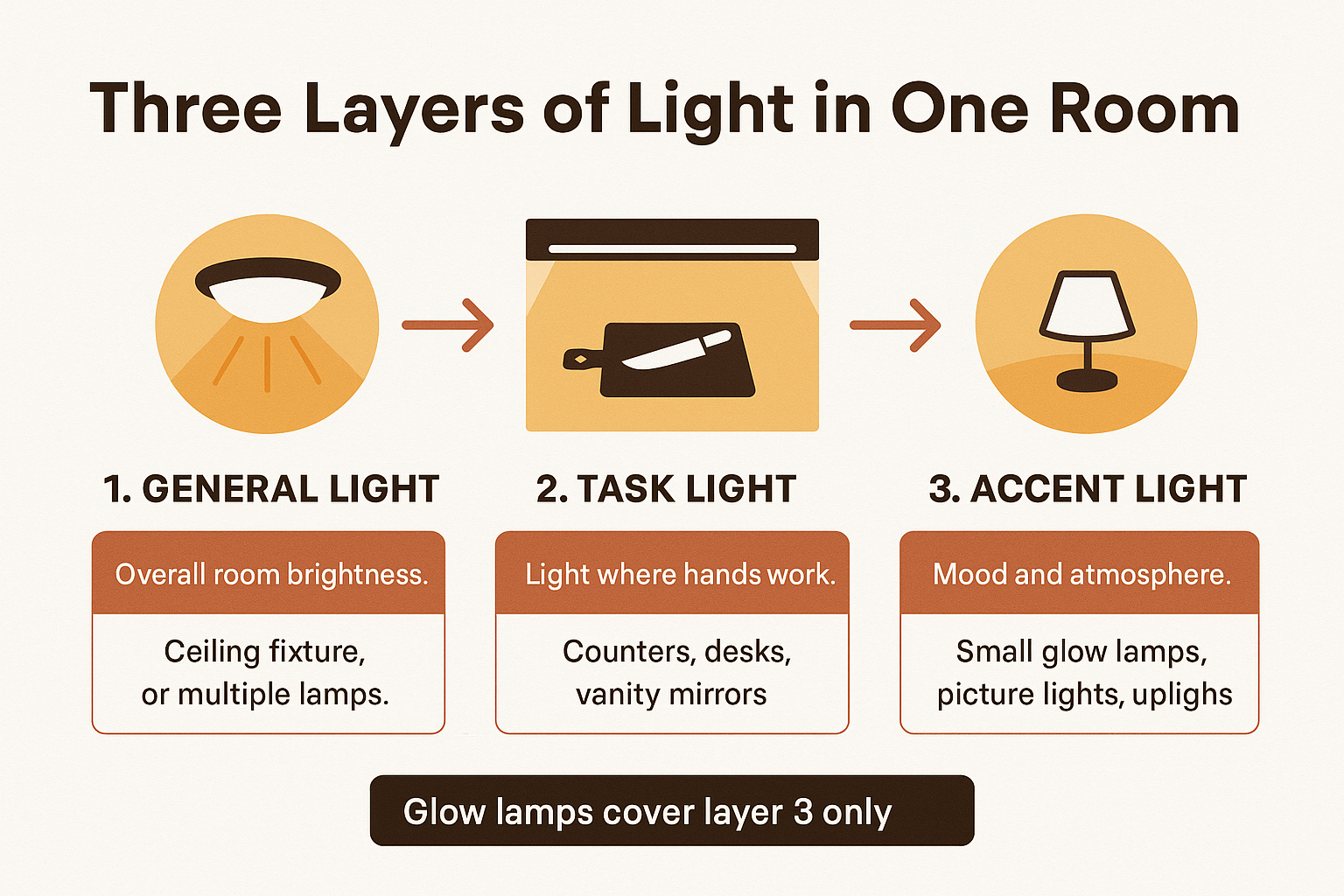
Glow lamps handle the third layer and none of the first two. Here is how the three layers divide the work in a single room.
The Question Nobody Asks Until Year Seven
There is a difference between buying a fixture and buying a device, and it shows up long after the purchase.
Homeowners on the Peninsula come back to a showroom five, ten, even fifteen years later looking for a replacement shade, a transformer, or a remote. One customer wrote in with exactly that problem: the remote for a ceiling fan was lost and nobody could remember the brand. In cases like that, the original sales record can often be pulled and the part tracked down through the manufacturer.
A lamp that runs on a phone app, a company account, and periodic firmware updates is a different kind of bet. It works beautifully until the app changes, the account system moves, or the company stops supporting that model.
None of that makes these lamps a bad purchase. It just means they belong in the category of things you replace, not things you keep and service. Price them accordingly.
Mood Light and Usable Light Are Two Different Problems
One local homeowner described the goal in a way that sums up most of these calls. They wanted to update the lighting in their home, needed more light, and wanted suggestions for doing it in an energy-efficient way.
Glow lamps answer the mood half of that and none of the brightness half. Which is why it helps to separate the two before buying anything:
- General light carries the room. This is what makes a space usable when you walk in.
- Task light goes where hands work: counters, desks, mirrors, reading chairs.
- Accent light is atmosphere. Glow lamps, picture lights, a lamp on a sideboard.
Most rooms that feel harsh are actually missing layers two and three while overworking layer one. Adding a glow lamp without fixing the overhead source leaves you with a pretty amber puddle in an otherwise unchanged room.
Energy use is the easy part now. LED sources use a fraction of the power of older bulbs while lasting far longer, so more light no longer means a bigger bill.
One boundary worth stating plainly: anything hardwired, including sconces, recessed cans, and new switch legs, belongs to a licensed electrician or contractor. Fixture selection and wiring are two separate jobs.
Frequently Asked Questions About Glow Lamps and Warm Evening Light
Can I just put a warm bulb in my existing lamps and get the same effect?
Often yes, and it is the cheapest thing to try first. Look for a warm-dimming bulb that shifts toward amber as it dims, rather than a standard LED that stays the same color at every level. Pair it with a shade that is fabric or linen rather than clear glass, since the shade is doing half the softening.
How many glow lamps would it take to light a living room?
More than you want to buy, and it still would not be room lighting. These produce a small amount of accent light each. Even six or eight of them scattered around a room leaves you without real general or task light, plus you now have six or eight cords and six or eight occupied surfaces.
Do the color temperature rules in Carmel apply to lamps like these?
Carmel-by-the-Sea’s exterior lighting ordinance caps residential outdoor fixture color temperature at 3000K and limits lumen output, but those rules govern exterior lighting, not a plug-in lamp on your living room table. California’s Title 24 requirements taking effect January 1, 2026 cover controls and efficiency in remodels and new construction. Verify current requirements with the city or your licensed contractor before any exterior or remodel work.
Are sconces worth it if I already have table lamps?
In a reading corner, usually yes. Sconces put light exactly where you need it without eating table space, and they hold a steadier position than a lamp that gets bumped. The tradeoff is that they need an electrician and a wall you are willing to open up.
Why does my room feel dark even with a bright overhead light?
Because brightness and comfort are not the same thing. A single downward source creates hard shadows and glare, which the eye reads as unpleasant rather than bright. Two or three softer sources at different heights almost always feel brighter than one strong one.
Seeing Warm Light in Person Before You Buy It
Ad photos and product pages cannot show you what a warm-dim source actually looks like at 7 pm in a Monterey County living room. The showroom at 2034 Sunset Drive in Pacific Grove has been at this since 1969 and carries curated lines from more than 60 manufacturers, so Greg and Tammy can put warm-dim sources and shaded lamps side by side, lit, and let you compare them with your own eyes. Walk-ins are welcome, appointments are available for more involved projects, and the phone is (831) 655-5500.
