
Direct Answer: A sculptural lighting fixture works as a room’s focal point when it’s chosen first, scaled correctly to the space, and considered alongside any existing pieces it needs to coexist with.
Most homeowners shop for lighting last. The furniture is in, the paint is on the walls, and the fixture becomes whatever fills the empty box in the ceiling. But something has shifted in the way designers and remodeling clients are thinking about that choice, and it changes where lighting belongs in a project timeline.
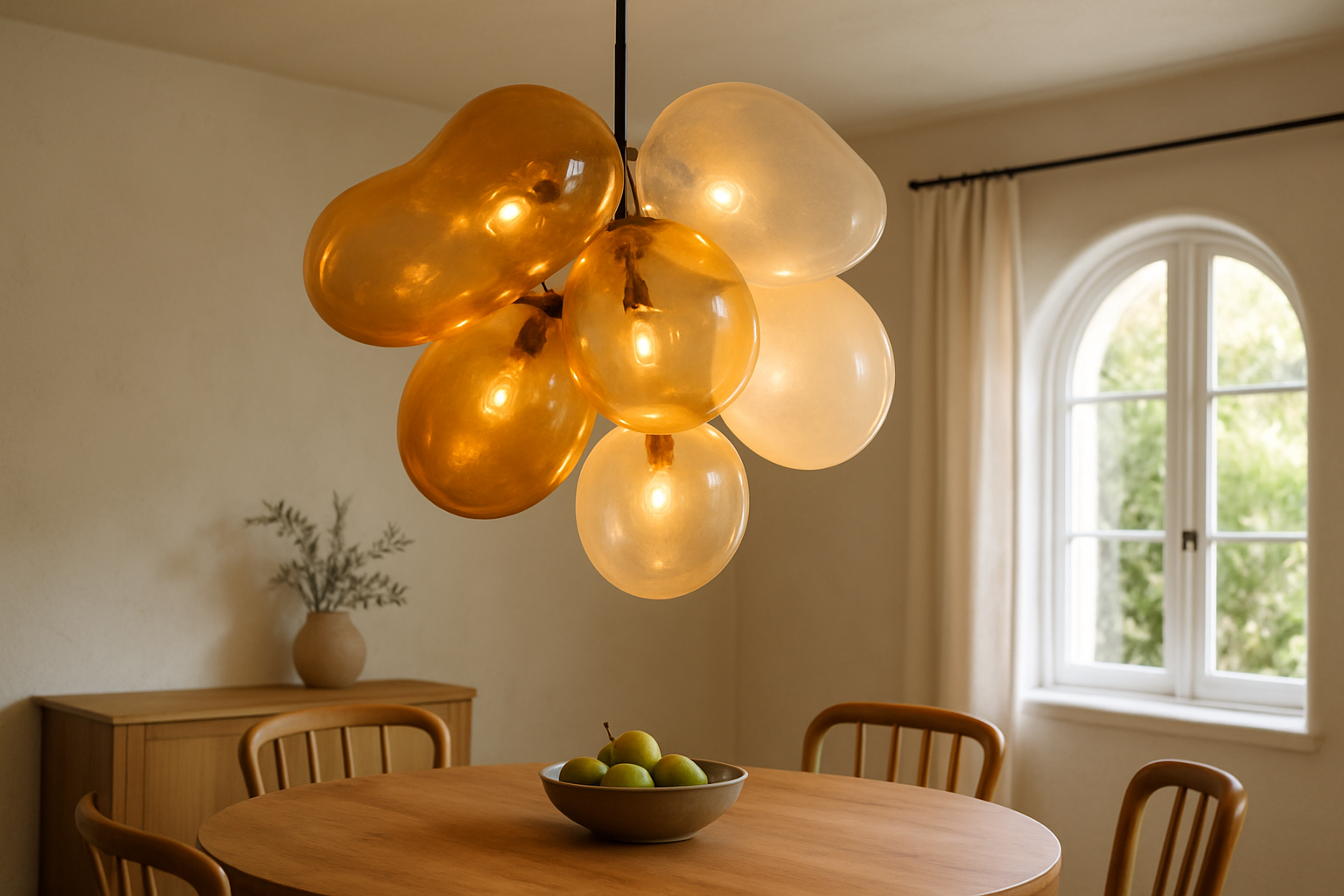
Sculptural lighting fixtures are no longer a niche choice for high-design showhouses. Organic curves, asymmetrical silhouettes, blown glass, and handcrafted mixed materials have moved into the mainstream of the premium fixture market. Homeowners on the Monterey Peninsula, from Carmel-by-the-Sea to Pebble Beach, are increasingly walking into showrooms with a fixture in mind before they have finishes selected.
That shift matters practically. When a statement fixture becomes the visual anchor of a dining room, entryway, or primary bedroom, it stops being a finish decision and starts being a design decision. Getting the order of operations right, and understanding the real constraints involved, is what separates a room that feels pulled together from one that almost works.
Choosing the Fixture First (Or Working With What’s Already There)
The ideal scenario is a clean slate: you pick your statement fixture early, then build the room’s finishes and secondary pieces around it. That is genuinely how designers approach spaces anchored by a sculptural pendant or chandelier. The fixture sets the tone for metal finishes, material warmth, and proportion throughout the room.
But that clean-slate situation is not most people’s reality. A common scenario at showrooms like The Home Lighter is a homeowner looking for a pendant to replace an outdated fixture while trying to coordinate with a floor lamp or accent piece already committed to the space. One form submission described exactly this: shopping for a hallway pendant while working around a bronze-finished floor lamp with a mosaic shell top already in the room. That kind of layered, accumulative design challenge is the rule, not the exception.
When an existing anchor piece is already in the room, the goal shifts. You are not matching it, matching creates a costume, not a room. Instead, look for shared language:
- Metal finish family, warm metals (bronze, unlacquered brass, aged gold) tend to coexist; cool metals (chrome, brushed nickel) form a different camp
- Material warmth, a lamp with shell or organic texture reads well alongside blown glass or woven fixtures; it fights with machined metal forms
- Scale relationship, a pendant hung in a hallway should feel proportionate to the floor lamp visible from the same sightline
For more on how finish coordination works across fixture types in non-kitchen spaces, Picking a Pendant for a Room That Isn’t Your Kitchen breaks down the decision clearly.
The Scale Problem Nobody Warns You About
Scale is where most sculptural fixture purchases go wrong, in both directions.
A fixture that reads as dramatic and appropriately bold on a manufacturer’s product page is often photographed in a loft with 14-foot ceilings and an open floor plan. That same piece hung in a Carmel cottage with 8-foot ceilings and a compact dining area can feel overwrought, visually crowded in a way that makes the room feel smaller and the fixture feel like an intrusion rather than an anchor.
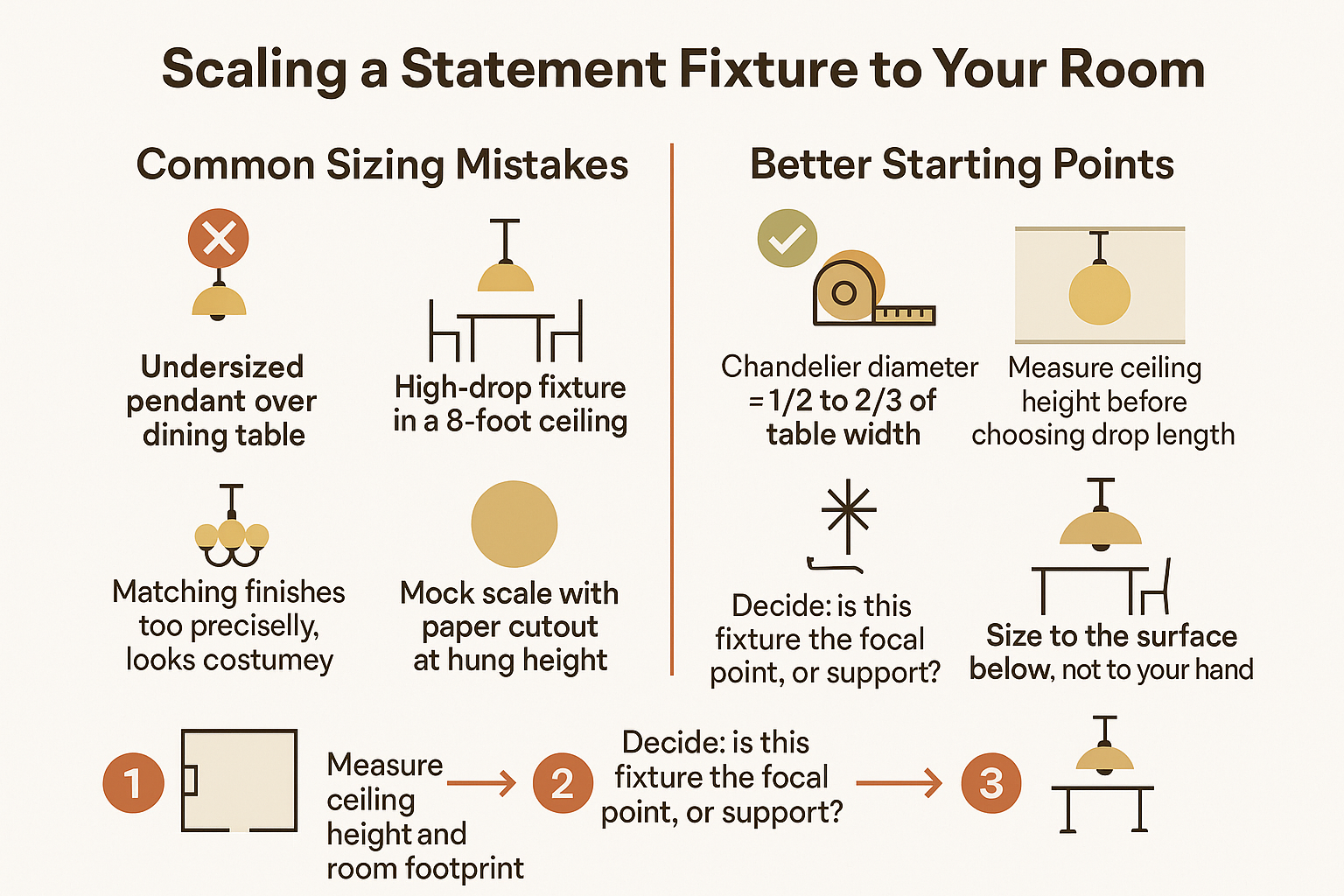
The opposite problem is more common, especially over dining tables and kitchen islands. Homeowners consistently undersize pendants and chandeliers over horizontal surfaces because the diameter that looks correct when you are holding it in your hands reads as timid once it is hung at height and viewed from across the room. A general rule used by lighting designers: the diameter of a chandelier over a dining table should be roughly half to two-thirds the width of the table itself. A 36-inch round table does not want a 12-inch fixture above it.
For coastal homes with the lower ceilings common in older Pacific Grove and Carmel properties, a few practical guidelines help:
- Measure the ceiling height first, fixtures with significant vertical drop require more clearance than the spec sheet always makes obvious
- Mock the scale before ordering, cut a circle of kraft paper to the fixture’s diameter and hold it at hung height; this is a low-tech trick that prevents expensive mistakes
- Consider visual weight, not just physical size, an open wire or skeletal form reads as lighter than a solid drum or opaque blown glass piece of the same dimensions
Some of this is genuinely hard to assess from a product grid. The Energy Star Lighting Resources site touches on fixture sizing in relation to room dimensions, and it is a useful reference, but scale judgment in a specific room with specific proportions is something that benefits from seeing fixtures in a real environment.
How to Scale a Statement Fixture to Your Room
This reference covers the core sizing relationships that determine whether a sculptural fixture works in a space, or overwhelms it.
Why Blown Glass and Handcrafted Materials Reward Seeing In Person
The fixture categories driving the most design interest right now, blown glass, mixed organic materials, handcrafted ceramic and rattan forms, also happen to be the categories where online shopping produces the most buyer’s remorse.
There are a few reasons for this. Blown glass in particular varies in color, opacity, and texture from piece to piece. A manufacturer’s photo is shot under controlled studio lighting; the way that amber or smoke glass reads under warm incandescent-equivalent LED in your actual dining room can be meaningfully different. The variation is not a defect, it is part of what makes the piece worth owning, but it is something you can only evaluate by seeing a comparable piece in a lit environment.
Mixed-material fixtures, especially pieces that combine metal armatures with natural or handcrafted elements, also have a tactile quality that a product grid cannot communicate. The weight, the joinery, the way light actually passes through or bounces off the material, these things matter for a piece that is supposed to be the focal point of a room.
This is one of the real differences between what is available through a curated showroom and what scrolls past on a big-box retailer’s website. The showroom carries lines from makers like Visual Comfort, Hubbardton Forge, Currey and Co., and Hudson Valley Group, manufacturers whose handcrafted and artisan-finished fixtures are available through specialty retailers, not warehouse stores. Seeing those pieces lit and hung at scale is a different experience than reading a spec sheet.
For context on how layered lighting decisions interact with a statement piece, How to Read a Room Before You Pick a Light Fixture walks through the spatial assessment that should come before any fixture selection.
Statement Fixture by Room: What Changes and What Stays the Same
The core question, is this fixture the focal point, or does it support something else?, plays out differently depending on the room. This table outlines the key considerations by space.
| Room | Typical Fixture Role | Key Sizing or Placement Factor |
|---|---|---|
| Dining room | Primary focal point, chosen before table or chairs if possible | Diameter 1/2 to 2/3 of table width; bottom of fixture 30-36 inches above table surface |
| Entryway or foyer | First impression, sets material and finish tone for adjacent spaces | Vertical scale matters most; measure from floor to ceiling, not just ceiling height |
| Primary bedroom | Focal point above bed or ambient anchor, depends on ceiling height | Avoid heavy visual weight directly over sleeping area; consider off-center placement |
| Kitchen island | Task-forward but still visible, often undersized | Two pendants over a standard island; diameter 1/3 of island width per pendant |
| Hallway | Supporting role, coordinates with anchor pieces in adjacent rooms | Scale down; a hallway pendant should complement, not compete with nearby statement pieces |
The Question to Ask Before You Order
Before committing to a sculptural fixture, especially one at a price point where returns are expensive and complicated, one question cuts through most of the uncertainty:
Is this fixture the room’s focal point, or does it need to support something else that is?
If it is the focal point, it can be bold, asymmetrical, and material-forward. Scale it to dominate its surface, not fill it modestly. Let it lead.
If it is supporting another element, a piece of art, an architectural feature, a furniture anchor that already owns the room, then it needs to read as considered without competing. That is a different fixture, chosen for a different reason.
Getting that hierarchy clear before ordering saves real money and frustration. A sculptural piece purchased for a supporting role and hung in a tight hallway alongside a strong existing anchor will fight the room rather than complete it. And returning a handcrafted fixture is rarely simple.
For rooms where layered lighting is part of the plan, Why Your Living Room Feels Flat (And How Accent Lights Fix It) and What Makes Each Fixture Type the Right One for a Room are both worth reading before the decision is final.
Frequently Asked Questions About Sculptural Lighting Fixtures
How do I know if a sculptural fixture will look right in my ceiling height?
Measure your ceiling height before looking at fixtures, not after. For rooms with 8-foot ceilings, common in older Carmel and Pacific Grove homes, you want a fixture with limited vertical drop and lighter visual weight. Open wire forms, smaller blown glass clusters, and slimmer profiles all read less heavy at lower heights. Anything with a significant chain or rod drop needs at least 9 feet to hang without feeling oppressive.
I already have a floor lamp I love. Do I have to choose a pendant that matches it exactly?
No, and you should not try to match exactly. The goal is shared language, not duplication. Look for finish family (warm metals together, cool metals together), similar material warmth, and compatible visual weight. A bronze lamp with organic texture can coexist with a blown glass pendant that has a warm amber tone, they do not need to be from the same manufacturer or finish line.
Why does the fixture look so much bigger in the showroom than it did online?
Because product photography almost always shoots against neutral backgrounds in large spaces. A fixture hung at 11 or 14 feet in a photo studio reads smaller than the same piece hung at 8 feet in your dining room. Seeing it in a showroom environment, lit, hung at real height, next to other scaled objects, gives you an accurate read that a screen cannot.
Is there a rule for how low a chandelier should hang over a dining table?
The widely used guideline is 30 to 36 inches between the bottom of the fixture and the surface of the table. Lower than 30 inches and people are ducking and losing sightlines across the table. Higher than 36 inches and the fixture starts to lose its connection to the table visually, it reads as floating rather than anchoring.
What if my remodel is subject to California Title 24 requirements? Does that affect which fixtures I can choose?
It can. California’s Title 24 energy code governs lighting controls and efficiency requirements for remodels and new construction, with updated requirements taking effect January 1, 2026. Some decorative fixtures need to be paired with compliant controls or meet efficacy thresholds depending on how the circuit is treated. This is a conversation to have with your licensed electrician before you finalize fixture selections. For a plain-language overview, What California’s 2026 Lighting Code Means for Your Remodel covers the basics.
Ready to Find the Fixture That Actually Anchors the Room?
Greg and Tammy at The Home Lighter have been helping Monterey Peninsula homeowners work through exactly these decisions since 1969, from scale questions in tight Pacific Grove cottages to finish coordination around existing pieces in Carmel Valley remodels. Walk-ins are welcome at the showroom at 2034 Sunset Drive in Pacific Grove, and appointments are available for more involved projects. You can also reach the showroom directly at (831) 655-5500.