
Choosing the right pendant light is about more than style. It is about getting the size just right. The size of your light fixture is the most important factor in creating a balanced, professional look. This guide turns complex design rules into simple, easy steps.
Why Pendant Size Is the Secret to Great Lighting
A perfectly sized pendant light can make a room look amazing. Think of it as jewelry for your home. It highlights your home’s best features while providing great light. But if the size is wrong, even a beautiful space can feel awkward.
We have all seen common lighting mistakes. A tiny pendant gets lost in a big entryway. A huge fixture overwhelms a cozy breakfast nook. These mistakes throw off a room's harmony. Our goal is to help you avoid these problems with a simple, foolproof guide.
Tailored for Monterey Peninsula Homes
Here on the Central Coast, our homes are very diverse. We have historic adobes in Monterey and modern coastal homes in Carmel. Each style has its own unique room sizes. This guide keeps those local features in mind. Our tips work for the high ceilings of a Santa Cruz mountain home and the smaller spaces of a Pacific Grove cottage.
Lighting that fits the room's scale not only looks better but also works better. It spreads light evenly, creating a space that is both welcoming and useful. This mix of beauty and function is a big focus in home design today.
The decorative lighting market was valued at about USD 35.98 billion in 2024. It is expected to reach USD 51.65 billion by 2033. This shows how much homeowners value good lighting. You can learn more about these trends at Straits Research.
By the end of this guide, you will have the confidence to pick the perfect pendant for any room. You will learn our in-house formulas, expert shortcuts, and room-specific rules. Let's start lighting your home with style and precision.
The Simple Formula for Perfect Pendant Sizing
Forget the guesswork and complex design rules. We will share a simple formula we use here on the Monterey Peninsula. It helps find the perfect pendant diameter for any open room. It's a simple calculation that works.
Here is the secret: add the length and width of your room together in feet. That number, in inches, is your ideal pendant diameter. This is the basic rule for a balanced look.
The Home Lighter Formula: Room Length (ft) + Room Width (ft) = Ideal Pendant Diameter (in)
Let’s try it with a 12' x 14' living room. You just add 12 + 14 to get 26. This means a pendant with a 26-inch diameter is a great starting point. It is like choosing the right size frame for a piece of art. It has to be the right proportion.
From Formula to Fixture
This simple math gives you a good starting point for general room lighting. It makes sure the fixture is big enough to anchor the space without being too much. This is very helpful in open-concept homes where you need to define different areas with lighting.
Once you have this main measurement, you can adjust your choice. Think about the style of the fixture. A light, airy design might allow you to go a little larger. A heavy, solid piece might look best if you stick closer to your calculated size.
A Quick Look at Common Room Sizes
This chart shows how room width changes the recommended pendant diameter.
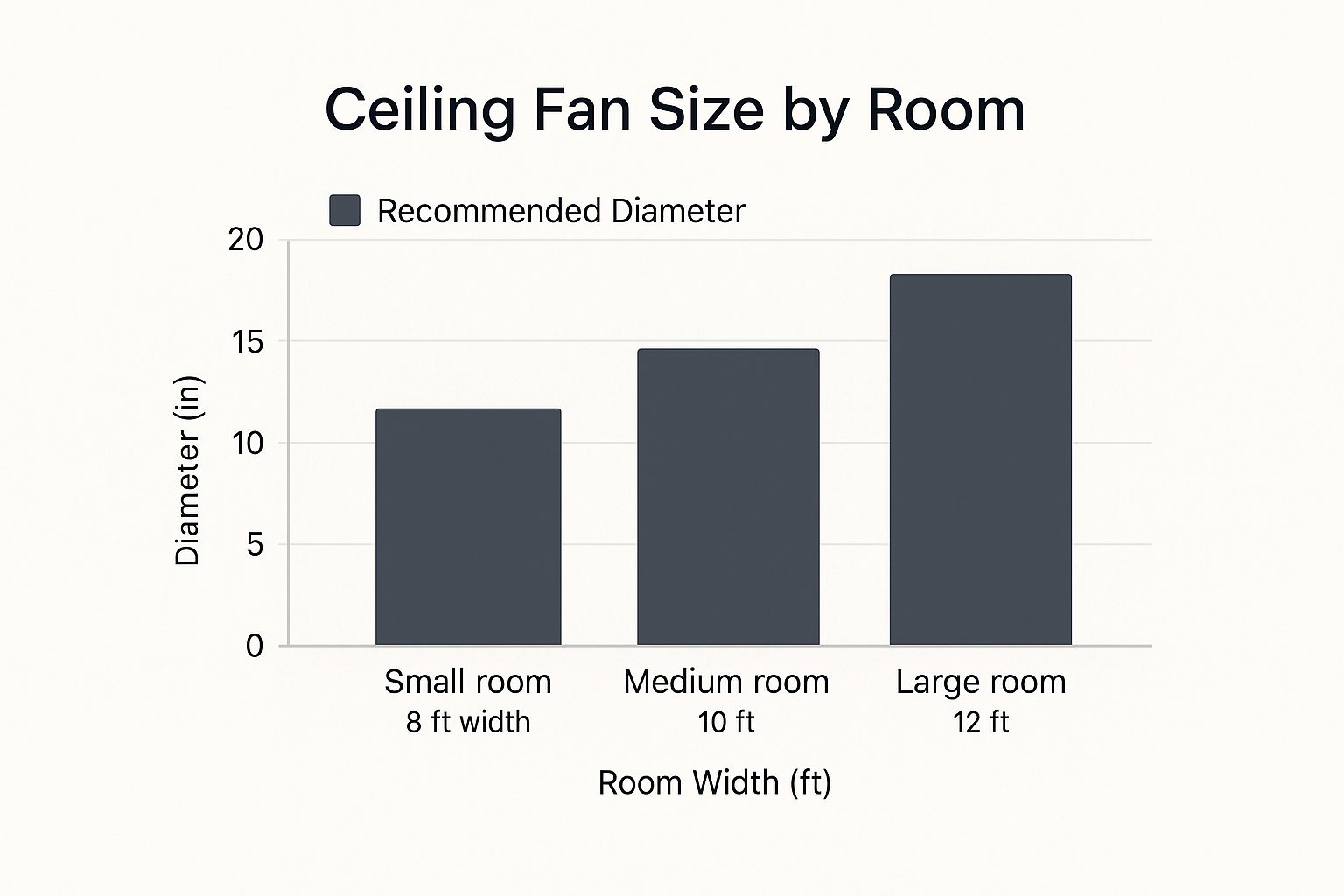
As you can see, even a few feet in room width can change the ideal size of your light fixture.
To help you find the right fixture faster, here is a quick table based on our formula for common room sizes.
Quick Pendant Diameter Guide Based on Room Size
Use this table to quickly find a recommended pendant light diameter. Add your room's length and width in feet to find the right diameter in inches.
| Room Dimensions (Length + Width in Feet) | Recommended Pendant Diameter (Inches) | Ideal For |
|---|---|---|
| Up to 20 ft (e.g., 10' x 10' room) | 18" – 22" | Cozy dens, home offices, smaller bedrooms. |
| 21 ft – 28 ft (e.g., 12' x 14' room) | 24" – 30" | Standard living rooms, master bedrooms, dining areas. |
| 29 ft – 36 ft (e.g., 15' x 18' room) | 32" – 38" | Large great rooms, open-concept living spaces. |
| 37 ft & Above (e.g., 20' x 20' room) | 40"+ | Grand entryways, vaulted living rooms, expansive spaces. |
This table is a great starting point. Always remember to think about your room's unique features, like ceiling height and furniture layout.
Adjusting for Ceiling Height
Ceiling height is the next important factor. Our formula works well for standard 8 to 9-foot ceilings. These are common in many Salinas and Monterey homes. But if you have taller ceilings, you have more vertical space.
- For 10-foot ceilings: Add an extra 2-3 inches to your calculated diameter.
- For ceilings 11 feet or higher: You can definitely go bigger. The vaulted ceilings in many Carmel Highlands homes are perfect for large, statement pendants.
Higher ceilings need larger fixtures to feel balanced. A pendant that looks perfect with an 8-foot ceiling can seem tiny when hanging from 12 feet up. Adjusting the size ensures your lighting makes the right impact. The fixture's size also affects its light output, so it's important to learn how to choose the right light bulb.
Lighting Kitchen Islands and Dining Tables
Kitchen islands and dining tables are the heart of many homes on the Monterey Peninsula. These are important areas where pendant light size is key. When you get it right, you create a warm, useful focal point. But get it wrong, and the whole room feels off.
Here, general room formulas are less important than specific rules. Let's break down the foolproof methods for lighting these spaces. We will make sure they are beautiful and perfectly lit for every meal and conversation.
Sizing Pendants for Your Kitchen Island
Your kitchen island is a busy spot, so its lighting must be just right. The first rule is clearance. You need to hang your pendants so the bottom of the fixture is 30 to 36 inches above the countertop. This height gives you light for tasks without blocking your view.
Another key measurement is the island's edge. Hang your pendants at least 6 inches in from each end of the island. This simple trick keeps the fixtures from looking like they are about to fall off. It also centers the light over your workspace.
So, how many pendants should you use? Two larger fixtures or three smaller ones? Here is a simple way to decide:
- For two pendants: Imagine your island is divided into three equal sections. Place one pendant at the one-third mark and the second at the two-thirds mark.
- For three pendants: Divide the island into four equal sections. Place one pendant in the center, with the other two at the one-quarter and three-quarter marks.
Expert Shortcut: Want perfect spacing? Measure the length of your island and divide it by the number of pendants plus one. For a 6-foot (72-inch) island with two pendants, divide 72 by 3. That gives you 24 inches. Place each pendant 24 inches from the ends and 24 inches from each other.
Choosing between individual pendants and a large linear fixture is a matter of style. For more inspiration, check out our kitchen island lighting ideas.
Finding the Perfect Pendant for Your Dining Table
Lighting a dining table is all about creating atmosphere. The pendant should feel connected to the table, not just floating in the room. That is why we size the fixture based on the table's dimensions.
A simple rule is to choose a pendant with a diameter that is one-half to three-quarters the width of your table. So, if your table is 42 inches wide, look for a pendant between 21 and 31.5 inches in diameter.
This proportion makes sure the light is big enough to make a statement without being too much. It also casts light evenly across the table, avoiding harsh shadows for your guests.
For hanging height, the rules are similar to kitchen islands.
- The bottom of the pendant should hang 30 to 36 inches above the tabletop for a standard 8-foot ceiling.
- For each extra foot of ceiling height, add about 3 inches to that hanging height.
This keeps the light intimate and centered over the table. Following these rules is a key part of our foolproof pendant light size guide. It guarantees a result that is both useful and stylish.
A Room-by-Room Guide to Pendant Placement
While kitchens and dining rooms get a lot of attention, pendants can be used in almost any space. They add style and function to any room. This guide breaks down our rules for sizing and placement, making sure every light fits perfectly.
Pendant lighting has become a favorite for designers and homeowners. Their popularity has grown, making them a key piece in modern home design. This is a global trend, not just a local one.
Bedroom Pendants for Style and Space
Using pendants instead of bedside lamps is a stylish and practical choice. This is especially true in Monterey Peninsula homes where space can be limited. Hanging a small pendant on each side of the bed frees up nightstand space. It creates a clean, modern look like a boutique hotel.
For sizing, choose smaller pendants, about 8 to 12 inches in diameter. This keeps them in proportion with your nightstands. Hang them so the bottom of the fixture is about 20-24 inches above the nightstand. This gives you light for reading without glare.
Bathroom Pendants for Flattering Light
In the bathroom, pendants are a great alternative to standard vanity bar lights. Placing a slender pendant on each side of a mirror provides even, flattering light. It gets rid of harsh shadows, which is perfect for your morning routine. This simple change can make a bathroom feel more like a spa.
Here are a few placement rules for bathroom pendants:
- Height: The center of the light source should be at eye level, which is 60-66 inches from the floor.
- Spacing: Place the pendants a few inches out from the sides of the mirror and about 30-36 inches apart.
- Size: Look for damp-rated fixtures with a diameter of 6-10 inches. This ensures they complement the mirror.
Entryway and Foyer Pendants for a Grand Welcome
Your entryway makes the first impression of your home. For the two-story foyers in Santa Cruz mountain homes or the grand entries of Carmel estates, a statement pendant is essential. The focus here is on vertical size and choosing a fixture that feels grand without being too much.
The number one rule for entryways is clearance. The bottom of the pendant must hang at least 7 feet above the floor. If your foyer has a second-story window, centering the fixture in the window creates a beautiful view from inside and out.
Expert Tip: For a two-story foyer, hang the bottom of the fixture level with the second floor. This helps the pendant feel connected to the home's architecture.
These same ideas apply to other areas, like living rooms. You can find more ideas in our guide to pendant lighting ideas for your living room. It's a great resource to help every room in your home shine.
Common Sizing Mistakes and How to Avoid Them
Even with the right formulas, it is easy to make a sizing mistake. This can throw off the feel of a room. Think of this as your guide to the most common mistakes we see in homes around the Monterey Peninsula. From Pacific Grove cottages to Salinas ranch houses, these simple errors can happen to anyone.
We have seen it all. Once you know what to look for, you can avoid these mistakes. This will help you make sure your lighting plan is perfect.
Mistake 1: The Tiny Dot
This happens when a pendant is too small for a large room. It looks more like a period than a statement piece. This often occurs in rooms with high ceilings, where a standard-sized fixture looks tiny. The light feels small and does not anchor the space.
The Fix: Always consider ceiling height. For ceilings taller than nine feet, add 2-3 inches to your pendant diameter for every extra foot of height. This simple adjustment ensures the fixture has enough presence.
Mistake 2: The Light Hog
This is the opposite of the "Tiny Dot." A "Light Hog" is a pendant so large it dominates the room. It can make a standard space feel cramped and heavy. This is a common problem over dining tables, where an oversized fixture can feel like it is joining you for dinner.
The Fix: Stick to the rules for specific areas. Over a dining table, a pendant that is 1/2 to 3/4 the width of the table is best. This guideline keeps the fixture in harmony with the furniture.
Expert Tip: Visualize Before You Buy
Before you buy, make a template of the pendant using cardboard. You can also use painter's tape on the ceiling. This simple trick lets you see the fixture's true size in your room. Live with it for a day or two to make sure it feels right.
Mistake 3: The Head Bumper
This is a frustrating and avoidable mistake. "The Head Bumper" is any pendant hung too low over a walkway. It forces people to duck. It is not just a design flaw; it is a safety hazard.
The Fix: Keep proper clearance. In any area with foot traffic, the bottom of your pendant must hang at least 7 feet (84 inches) from the floor. This is a firm rule that ensures your lighting is both beautiful and functional.
Learning how to avoid these problems is important. You can learn more in our article about common home lighting mistakes.
Getting Your Lighting Plan Just Right
Our foolproof pendant size guide gives you a strong foundation. But every home is unique. From the sloped ceilings in Santa Cruz to the open-concept layouts in Salinas, a single approach does not always work. A professional eye can make the difference between a good lighting plan and a great one.
This is where our team at The Home Lighter excels. We understand the architectural styles of the Monterey Peninsula. We can help you adjust the final details for a perfect result. We think about how a new pendant will work with your existing lights. We create a unified look throughout your home, which you can learn more about in our recessed lighting layout guide.
Your Local Lighting Partner
For a truly custom plan, visit our Pacific Grove showroom. Or, you can schedule a chat with our team. We will help you with the final details, making sure your new lighting reflects your home and your style. We are your local partner in creating a beautifully lit space.
Once you have picked the perfect pendants, the next step is installation. We suggest using professional lighting installation services to ensure everything is handled safely. An expert can manage the technical details, so your new fixtures are installed correctly.
Let us help you bring your vision to life with lighting that inspires and transforms.
Frequently Asked Questions About Pendant Sizing
Even with the best formulas, every home is different. You might run into a unique situation. Here are some of the most common questions we hear from homeowners on the Monterey Peninsula to help you handle tricky scenarios.
Think of this as a final check to make sure your pendant lighting looks just right.
How do I choose a pendant for a sloped ceiling?
For a sloped ceiling, the biggest challenge is making sure the pendant hangs straight. The solution is a fixture with a swiveling canopy or a sloped-ceiling adapter. Many modern pendants include this feature, but you should always check the product details. For size, our formula (Room Length + Room Width) is still a great starting point.
Can I use multiple pendants in a living room?
Yes! A cluster of smaller pendants can create a beautiful focal point. It can add more texture and interest than a single large fixture. When sizing a cluster, think of the group as one unit. The total width of the cluster should be about the same as the diameter you would choose for one large pendant. Make sure the lowest-hanging pendant provides at least 7 feet of floor clearance.
What is the best pendant for a long, narrow hallway?
In a long hallway, a single round pendant can look awkward. A better choice is to hang a series of smaller pendants evenly down the hall. Or, you can use a single linear pendant. This helps spread the light and works with the room's shape. As a rule, the fixture's width should be no more than one-third of the hallway's width.
How does an open-concept layout affect pendant sizing?
In an open-concept home, use lighting to create defined "zones." Instead of sizing a light for the whole open space, think about each area's function. Apply our sizing rules to each zone. For example, size the pendant over your dining table based on the table's dimensions. To tie it all together, choose pendants with a similar style or finish.
How high should a pendant light be over a kitchen island?
The bottom of the pendant fixture should hang 30 to 36 inches above the kitchen island countertop. This provides enough light for tasks like food prep without blocking your view across the room. It also prevents the light from being a "head bumper" for taller family members.
Ready to find the perfect pendant light with personalized, expert guidance? Visit The Home Lighter Inc. showroom in Pacific Grove or schedule a consultation with our design team today.