
Picking the right light bulb is straightforward once you understand what to look for. It truly boils down to three key elements: brightness (lumens) for function, color temperature (Kelvin) for mood, and CRI for true-to-life color. Once you get a handle on these, you can completely transform any room in your home.
This small choice makes a significant difference in your daily life. It’s a design tool that helps your Monterey Peninsula home feel more welcoming, functional, and beautiful.
Why Your Light Bulb Choice Matters More Than Ever
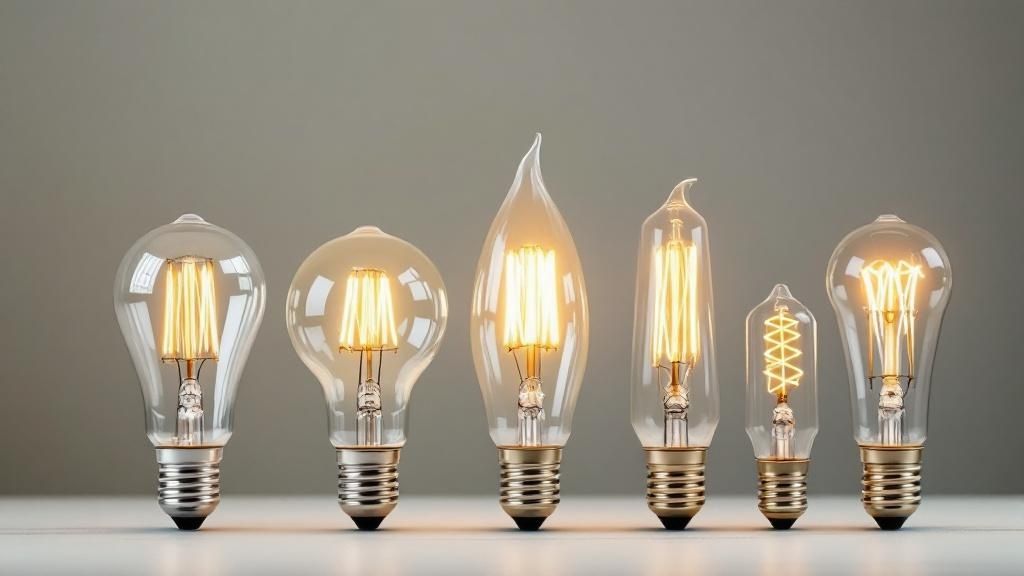
Gone are the days of grabbing any bulb off the shelf. Today, a light bulb is a powerful design tool that can dramatically shift the feel of a space, making it cozy and inviting or bright and productive. It’s no longer just about wattage; it’s about carefully crafting an environment that fits your life.
For homeowners across the Monterey Peninsula—from modern builds in Santa Cruz to classic Spanish-style homes in Salinas—the right bulb brings out architectural details and improves daily living. A warm, soft glow can turn a living room into a sanctuary, while a crisp, clean light makes a kitchen feel more functional and efficient.
The Shift to Smarter, More Efficient Lighting
The world of lighting has changed significantly due to new technology and updated energy standards. This evolution has placed a major spotlight on energy efficiency, longevity, and overall performance, making your choice more impactful than ever.
Today's LED bulbs use up to 75% less energy and last an incredible 25 times longer than the old incandescent bulbs they’ve replaced. This makes them a genuinely smart investment for any homeowner.
While the initial cost of an LED might be slightly higher, the long-term savings are substantial. You'll notice the difference in your energy bills and appreciate not having to change bulbs constantly. For a deeper dive, check out this detailed industry report on the lighting market.
Choosing a light bulb is an opportunity to fine-tune your home's atmosphere. At The Home Lighter, we help our clients navigate these choices daily, ensuring their lighting is both beautiful and practical.
Decoding Brightness to Find the Perfect Lumens
When selecting a light bulb, the most important factor is no longer wattage. For years, we associated watts with brightness, but that thinking is outdated.
The real number you need to pay attention to is lumens (lm). This is the modern, accurate way to measure a bulb's actual brightness, telling you how much light it produces.
Watts simply measure how much energy a bulb consumes. Thanks to modern technology like LEDs, you can get the same bright light as an old 60-watt incandescent while using just a fraction of the power.
Matching Lumens to Your Room and Needs
So, how many lumens do you really need? There's no single magic number; it depends on the room's function, size, and your personal taste. Over years of consulting with clients here on the Monterey Peninsula, we've developed some solid rules of thumb.
Here's a quick breakdown:
-
Task Lighting (1,100 – 1,600+ lumens): You need bright, direct light where details matter. Think chopping vegetables on a kitchen island, applying makeup at a bathroom vanity, or working in a home office. Our guide on the best lighting for a kitchen island has great ideas for this.
-
Ambient Lighting (450 – 800 lumens): This is your everyday, general lighting. It’s perfect for creating a comfortable, inviting vibe in living rooms, bedrooms, and hallways.
-
Accent Lighting (150 – 450 lumens): To make artwork pop or highlight an architectural feature, use a lower, more focused lumen output. It’s about drawing the eye without flooding the area with light.
Factors That Influence Your Lumen Choice
Choosing the right brightness isn't just about the bulb—the room's environment is a massive factor. For example, a home in Salinas with dark-painted walls will absorb light, meaning you’ll likely need higher-lumen bulbs to feel well-lit.
Expert Tip: Don't forget to consider room size and ceiling height. A large great room with soaring vaulted ceilings requires far more lumens to feel bright and welcoming than a small, cozy den with standard eight-foot ceilings.
The efficiency of modern LEDs is a huge advantage. They not only give you more lumens per watt but also have astonishingly long lifespans of 25,000 to 50,000 hours, compared to just 1,000 for an old incandescent. You can see how much the market has shifted by looking at the latest research on LED lighting.
Creating the Right Mood with Color Temperature
Once you’ve figured out brightness, the next critical piece is color temperature. This has nothing to do with physical heat—it’s about the color of the light the bulb emits. Measured on the Kelvin (K) scale, color temperature is what truly sets the mood for an entire room.
Think of how sunlight changes throughout the day. Morning light is crisp and cool, while sunset casts a warm, golden glow. Your choice here can make a space feel energizing and alert or, conversely, calm and intimate.
Warm vs. Cool: What Kelvin Is Right for You?
For most homes, the Kelvin scale ranges from 2000K to 6500K. A lower number on the scale means the light is warmer and more yellow, while a higher number means you're getting a cooler, bluer light.
This chart gives you a great visual guide to the Kelvin scale, showing how different values produce very different kinds of light.
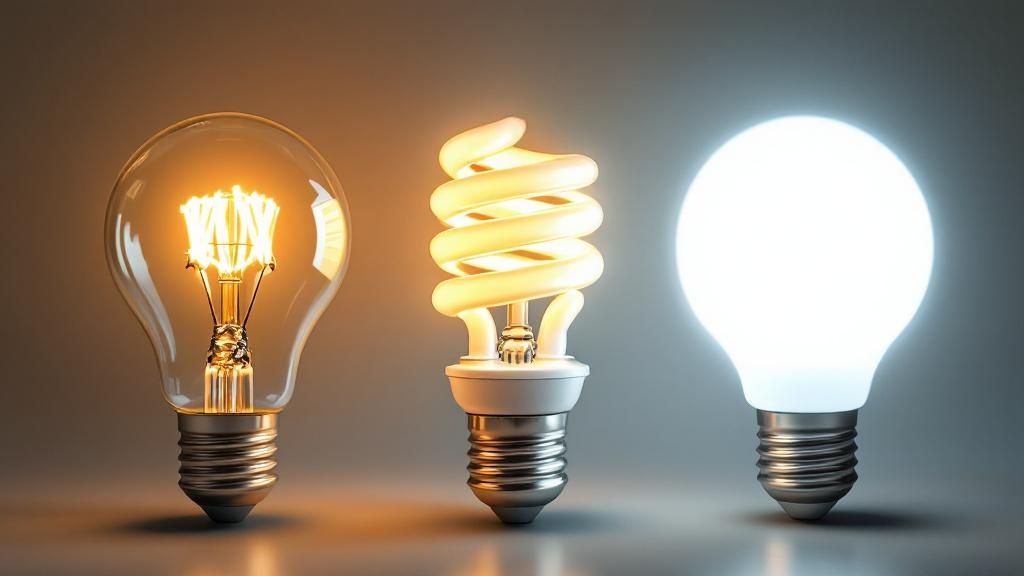
As you can see, the lower Kelvin values create that familiar, candle-like glow, whereas the higher values produce a sharp light that feels much more like natural daylight.
Picking the right Kelvin value is about matching the light to the room's function. Here are the practical recommendations we give our clients on the Monterey Peninsula:
-
Warm White (2700K – 3000K): This is your best bet for a cozy, inviting atmosphere. Its soft, yellowish glow is perfect for living rooms, dining rooms, and bedrooms, enhancing warm materials in a classic Carmel home.
-
Neutral or Cool White (3500K – 4100K): This range gives a cleaner, more vibrant light that feels balanced. It’s an excellent choice for kitchens, bathrooms, and home offices where clarity is key.
-
Daylight (5000K – 6500K): Mimicking natural daylight, this bright, bluish-white light is built for task-heavy areas like workshops, garages, or laundry rooms. Use it carefully in living spaces, as it can feel sterile.
A common mistake we see is mixing different color temperatures in the same room. This creates a jarring, inconsistent look. For a cohesive and professional feel, stick with one Kelvin temperature for all the bulbs in a single space.
Making the Switch from Older Bulbs
Many homeowners are still transitioning from older bulb technologies. If you're replacing incandescents, you're likely used to their color temperature, which was typically around 2700K.
If you enjoyed that classic warm glow, just look for an LED with a similar Kelvin rating. Modern LEDs can perfectly replicate that warmth—a huge improvement from early CFLs. To see just how different these older bulbs are, check out our comparison of CFL vs. incandescent bulbs.
Why Color Rendering Index Is Your Secret Design Weapon
Beyond brightness and warmth, there's another layer to lighting that professional designers swear by: the Color Rendering Index (CRI). It’s a scale from 0 to 100 that tells you how accurately a light source reveals the true colors of objects, using natural sunlight as the benchmark.
Have you ever picked the perfect paint color, only to find it looks muddy or green at night? A low CRI is almost always the culprit. Bulbs with poor color rendering can wash out colors, making a vibrant red look dull or a rich navy blue appear flat.
Why High CRI Is Non-Negotiable
For certain rooms, a high CRI is a must-have. Think about your kitchen, where you want fresh food to look appetizing, or your bathroom, where you need true-to-life skin tones for makeup application.
We always steer our clients toward bulbs with a CRI of 90 or higher for these critical spaces. It guarantees that the colors you so carefully chose for your home look exactly as intended.
- Kitchens: See the true, vibrant colors of your food, cabinets, and countertops.
- Bathrooms: Get accurate makeup application and natural-looking skin tones.
- Art & Photography Displays: Showcase your collection without distorting the artist’s original palette.
- Walk-in Closets: Finally tell the difference between your black and navy blue clothes.
Real-World Impact in Monterey Peninsula Homes
For our clients along the Central Coast, from Monterey to Santa Cruz, getting the CRI right makes their design details sing. Imagine a stunning slab of natural stone in a Carmel kitchen—a low-CRI bulb would rob it of its natural character and depth.
Choosing a high-CRI bulb is like switching your home from standard definition to HD. Suddenly, everything just looks sharper, richer, and more authentic. It’s a subtle change that makes a huge difference.
Most of our clients are amazed by the dramatic difference a high-CRI bulb can make. Paint colors have more depth, wood grains look warmer, and textiles feel more luxurious. You can explore some of the best energy-efficient light bulbs that also deliver fantastic color rendering right here in our showroom.
Matching Bulb Shapes to Your Fixtures and Rooms
You've mastered brightness, warmth, and color accuracy—now for the final piece. Choosing the right bulb is also about ensuring it physically fits your fixture and suits the room's purpose. It's about so much more than just whether it screws in.
Bulb shapes have their own lingo, like A19 or G25. The letter denotes the shape (A for Arbitrary, G for Globe), and the number gives the diameter in eighths of an inch. Knowing the basics will save you from frustration.
Common Bulb Shapes and Base Types
Most homes rely on two main socket sizes. You have the standard E26 base for most lamps and overhead fixtures, and the smaller E12 candelabra base, found in chandeliers and decorative sconces. Always double-check your fixture's needs before buying.
Here are a few popular shapes we see people using:
- A-Series (A19, A21): This is the classic, pear-shaped bulb. It’s a workhorse for table lamps, floor lamps, and most ceiling lights.
- Globe (G25, G40): These large, round bulbs are made to be seen. They look fantastic in bathroom vanities and open pendant lights.
- Candelabra (B10, C7): With their torpedo or flame tip, these smaller bulbs bring elegance to chandeliers and wall sconces.
Common Bulb Shapes and Their Best Uses
| Bulb Shape (e.g., A19, G25) | Common Name | Best For These Fixtures | Expert Design Tip |
|---|---|---|---|
| A19 | Standard | Table lamps, floor lamps, enclosed ceiling fixtures | An all-purpose bulb. Opt for a frosted version to soften light and reduce glare in lamps with fabric shades. |
| G25/G40 | Globe | Bathroom vanities, exposed pendants, sputnik chandeliers | Designed to be seen. Use clear or vintage-style filament globes to create a strong decorative statement. |
| B10/C7 | Candelabra / Flame Tip | Chandeliers, wall sconces, decorative accent lights | Mimics a candle flame. Choose a bent-tip (C-style) for a more traditional, classic look in chandeliers. |
| PAR20/PAR30 | Parabolic Aluminized Reflector | Track lighting, recessed cans, spotlights | Excellent for directing focused light. Use them to highlight artwork, architectural details, or kitchen workspaces. |
| ST19 | Edison / Vintage | Exposed-bulb pendants, industrial-style fixtures | Purely for aesthetics. The warm, gentle glow is perfect for creating ambiance, not for primary task lighting. |
By paying attention to the bulb's shape, you ensure that your lighting not only functions well but also enhances the overall beauty and style of your space.
Special Features for Performance and Safety
Beyond the basic shape and size, other features are essential for performance and safety. Ignoring these can lead to flickering, buzzing, or even a fire hazard.
Expert Insight: A common mistake is putting a standard LED bulb into a fully enclosed fixture. These fixtures trap heat, causing the bulb to overheat and burn out quickly. Always look for bulbs specifically rated for enclosed fixtures to ensure longevity and safety.
Dimmable bulbs are another must-have for creating a flexible atmosphere. They allow you to go from bright task lighting to a soft, ambient glow for relaxing. Just be sure to pair them with a compatible dimmer switch to avoid issues.
This visual guide shows how lumens, color temperature, and energy efficiency come together.
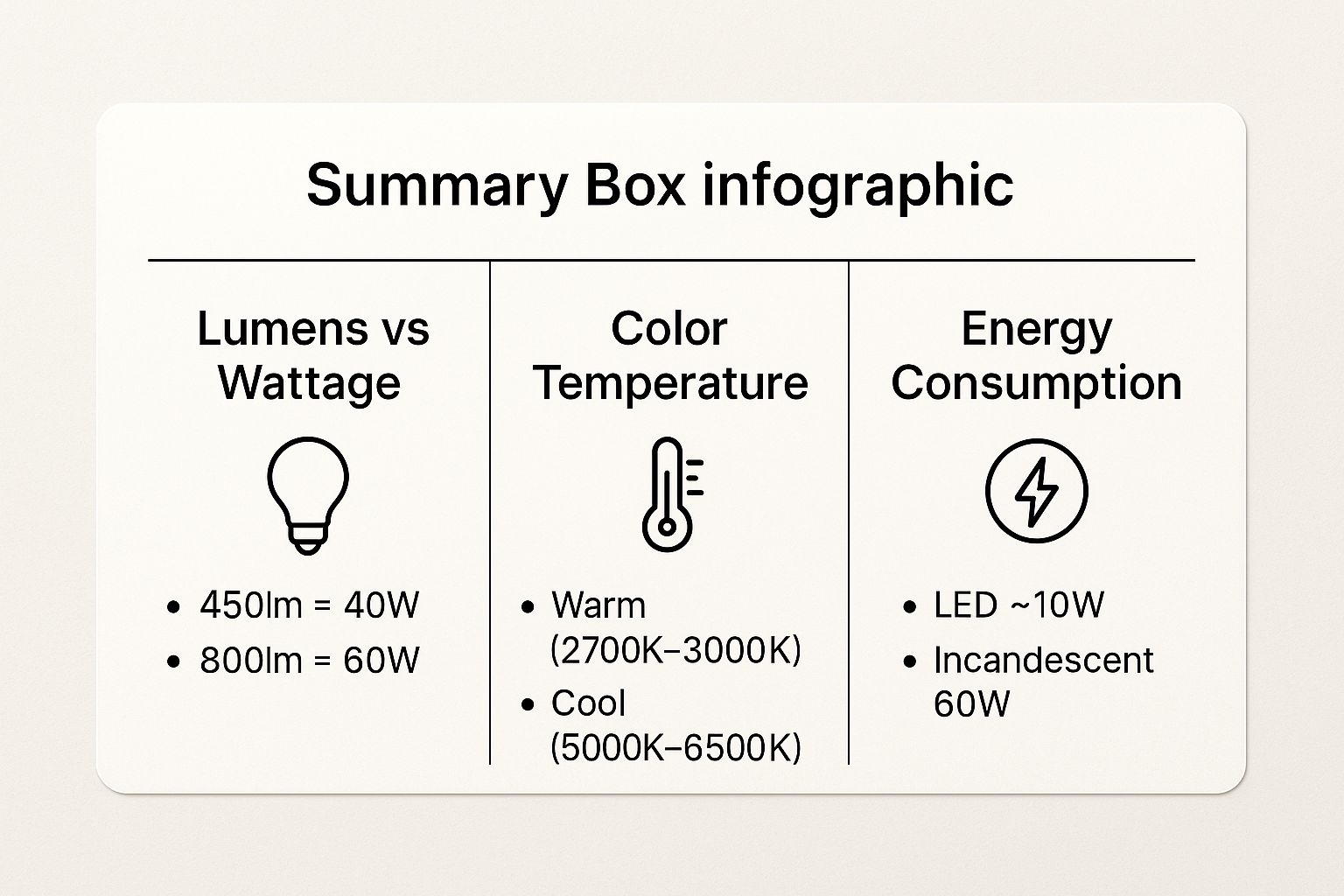
It highlights the magic of modern LEDs—you get the same brightness as an old incandescent bulb but use a fraction of the energy, with the freedom to choose any light color from warm to cool.
Bulbs for Specific Environments
For homes in the Monterey Bay area, the coastal air requires smart choices for outdoor and bathroom lighting. A damp-rated bulb is fine for a covered porch, but you absolutely need wet-rated bulbs for any area directly exposed to rain. For more tips tailored to our local climate, see our guide on the best types of bathroom lighting fixtures.
Your light bulbs are a key part of your home's design. You can find incredible inspiration by exploring contemporary lighting collections to see how light can be woven into your decor.
FAQs: How to Choose the Right Light Bulb

Even with all the specs, a few practical questions always pop up. As lighting consultants, we’ve heard it all. We’ve pulled together the most common questions from homeowners to give you clear, straightforward answers.
What is the real difference between LED, CFL, and incandescent bulbs?
Each bulb type has its own trade-offs. LEDs are the modern champion—highly efficient, long-lasting, and cool to the touch. CFLs (the spiral bulbs) were an early energy-saver but contain mercury and can take time to warm up. Incandescents are the old-fashioned, inefficient bulbs that are now being phased out.
Can I use a dimmable bulb in a regular, non-dimming fixture?
Yes, you absolutely can. A dimmable bulb in a non-dimming socket will simply function at 100% brightness without any issues. However, you should never use a non-dimmable bulb with a dimmer switch, as this can cause flickering and damage both the bulb and the switch.
What is the most important thing to look for on the "Lighting Facts" label?
Think of the "Lighting Facts" label as the nutrition facts for your bulb. The two most critical numbers for homeowners are Lumens (Brightness), which tells you how much light it produces, and Light Appearance (Kelvin), which tells you the color of the light. These two factors have the biggest impact on how a room looks and feels.
How do I choose the right bulb for the climate in Monterey or Santa Cruz?
Our coastal climate with its salt air and fog demands durable lighting choices. For any outdoor fixture, look for its location rating. Use "damp-rated" bulbs for covered porches and "wet-rated" bulbs for any fixture directly exposed to rain to ensure safety and longevity.
Do LED bulbs really save money?
Yes, the savings are substantial. According to ENERGY STAR, a single certified LED bulb can save you more than $80 in electricity costs over its lifetime compared to an old incandescent bulb. When you factor in that an LED lasts at least 15 times longer, you also save on the cost and hassle of frequent replacements.
At The Home Lighter, Inc., we believe the right light bulb is the finishing touch that makes a house feel like home. If you have more questions or want to see these options in person, visit our showroom on the Monterey Peninsula. We’re here to help you light your space beautifully.