
Direct Answer: Restaurant lighting works because it layers warm, low-level light from multiple sources instead of flooding a room with one overhead fixture. You can do the same at home with the right fixtures, dimmer switches, and color temperature.
You’ve sat down at a restaurant in Carmel-by-the-Sea, looked around, and thought: why does this feel so good? The food isn’t even on the table yet and the room already feels warm, calm, and a little special. Then you go home and flip on your dining room light and the moment is gone.
That gap isn’t accidental. Restaurant designers spend real money engineering a specific feeling through lighting — and most of it comes down to fixture placement, color temperature, and layering. None of those things require a commercial budget.
This article breaks down the two things that actually make restaurant lighting work, and how to apply both of them in a home on the Monterey Peninsula without starting from scratch.
What Restaurants Actually Do With Light (That Most Homes Don’t)
The single biggest difference between a restaurant and a typical living room or dining room is where the light comes from. Most homes rely on one overhead source — a flush mount, a recessed can, or a ceiling fan with a light kit — and call it done. Restaurants almost never do that.
Instead, they build light from multiple levels at once:
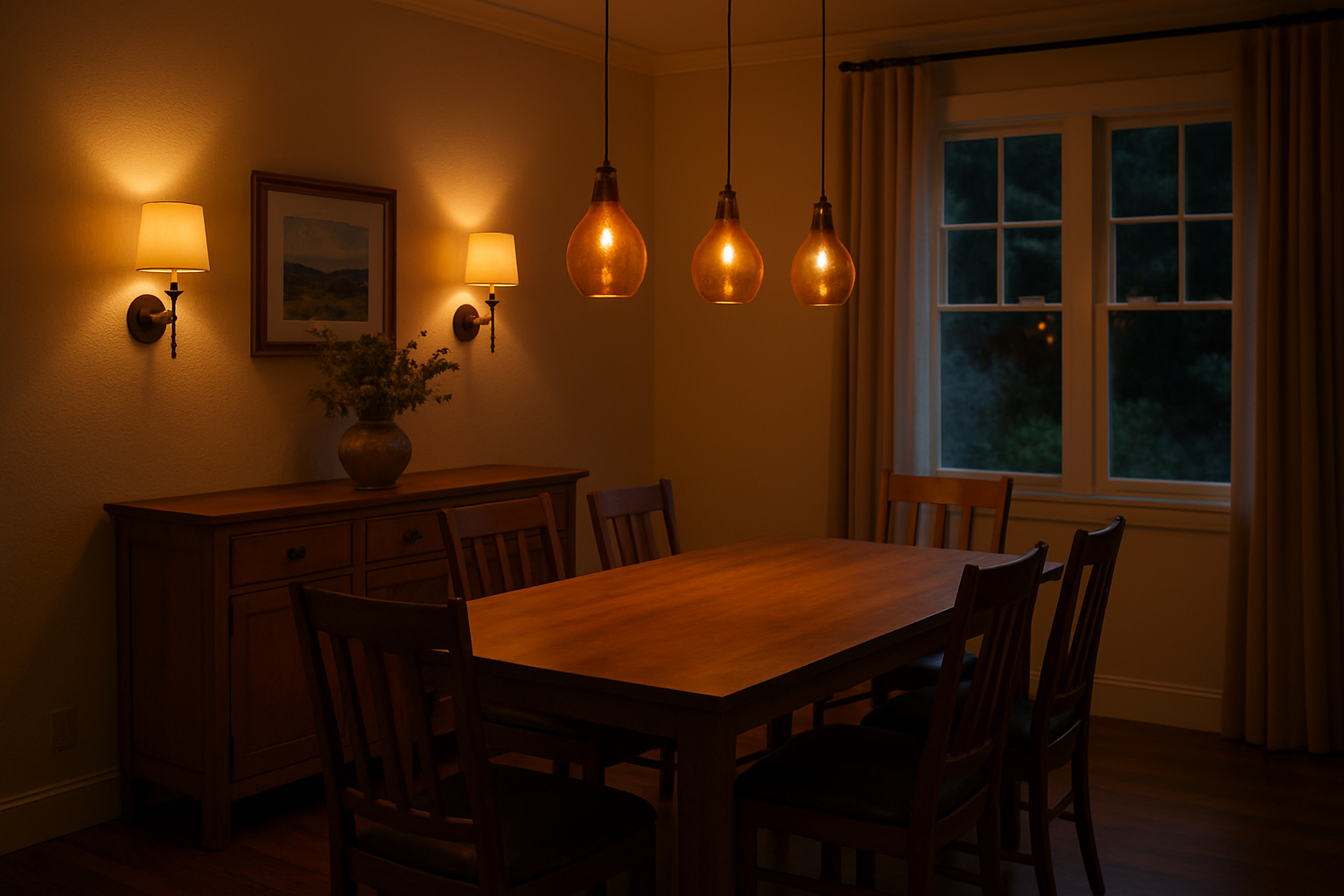
- Pendants or chandeliers hung close to the table to create an intimate pool of light
- Wall sconces at eye level to soften shadows and eliminate the flat, washed-out look of ceiling-only lighting
- Candles or small table lamps at surface level for warmth and visual depth
- Accent lighting on architectural features, artwork, or shelving to create visual interest around the room
This approach is called layered lighting, and it’s the foundation of why restaurant rooms feel the way they do. No single fixture is doing all the work, so no single fixture creates that harsh, over-lit feel.
At home, the fix is usually not replacing one fixture with a better one. It’s adding sources. A dining room with a chandelier and two wall sconces will feel dramatically different than the same room with just the chandelier — even if the chandelier itself doesn’t change.
Color Temperature Is Doing More Work Than You Think
Restaurants almost universally use light in the 2700K to 3000K range — that’s the warm amber end of the spectrum. Some go as low as 2200K, which is the candlelight zone. What they almost never use is anything above 3000K, which starts to feel clinical and cool.
Most homes are lit somewhere between 3000K and 4000K, especially if the bulbs were swapped for whatever was on sale at the hardware store. That extra 500 to 1000 degrees Kelvin makes a real difference in how a room feels at dinner.
Warm light does two things that matter for the restaurant effect:
- It makes skin tones look flattering — everyone at the table looks better
- It makes wood, stone, and warm-toned finishes glow instead of looking flat
If you want to understand how color temperature affects what you actually see in a room, the concept of Color Rendering Index is worth a few minutes of reading. CRI measures how accurately a light source shows the true color of objects — and restaurant designers care about it a lot.
The practical fix: if your dining room bulbs are 4000K, swap them for 2700K versions in the same base and wattage. That change alone, before you touch a single fixture, will shift the feel of the room. It’s a $15 to $40 change that most people never make because they don’t know color temperature matters.
Restaurant vs. Typical Home Lighting: What’s Actually Different
This breakdown shows the key differences between how restaurants approach lighting versus how most homes are currently set up — and what the home version of each choice looks like.
| What Restaurants Do | What Most Homes Do | The Home Fix |
|---|---|---|
| Multiple light sources at different heights | One ceiling fixture per room | Add wall sconces or table lamps alongside existing overhead fixture |
| Color temperature 2700K–3000K | 3500K–4000K bulbs from the hardware store | Swap bulbs to 2700K — same base, same wattage |
| Pendants hung 30–36″ above table surface | Chandelier hung too high, near the ceiling | Lower the canopy or use a longer chain/rod |
| All fixtures on dimmers | On/off switches only | Replace switches with dimmers compatible with LED bulbs |
| Fixtures with shades or diffusers that hide the bulb | Exposed bulb or open globe fixtures | Switch to fixtures with fabric shades or frosted glass |
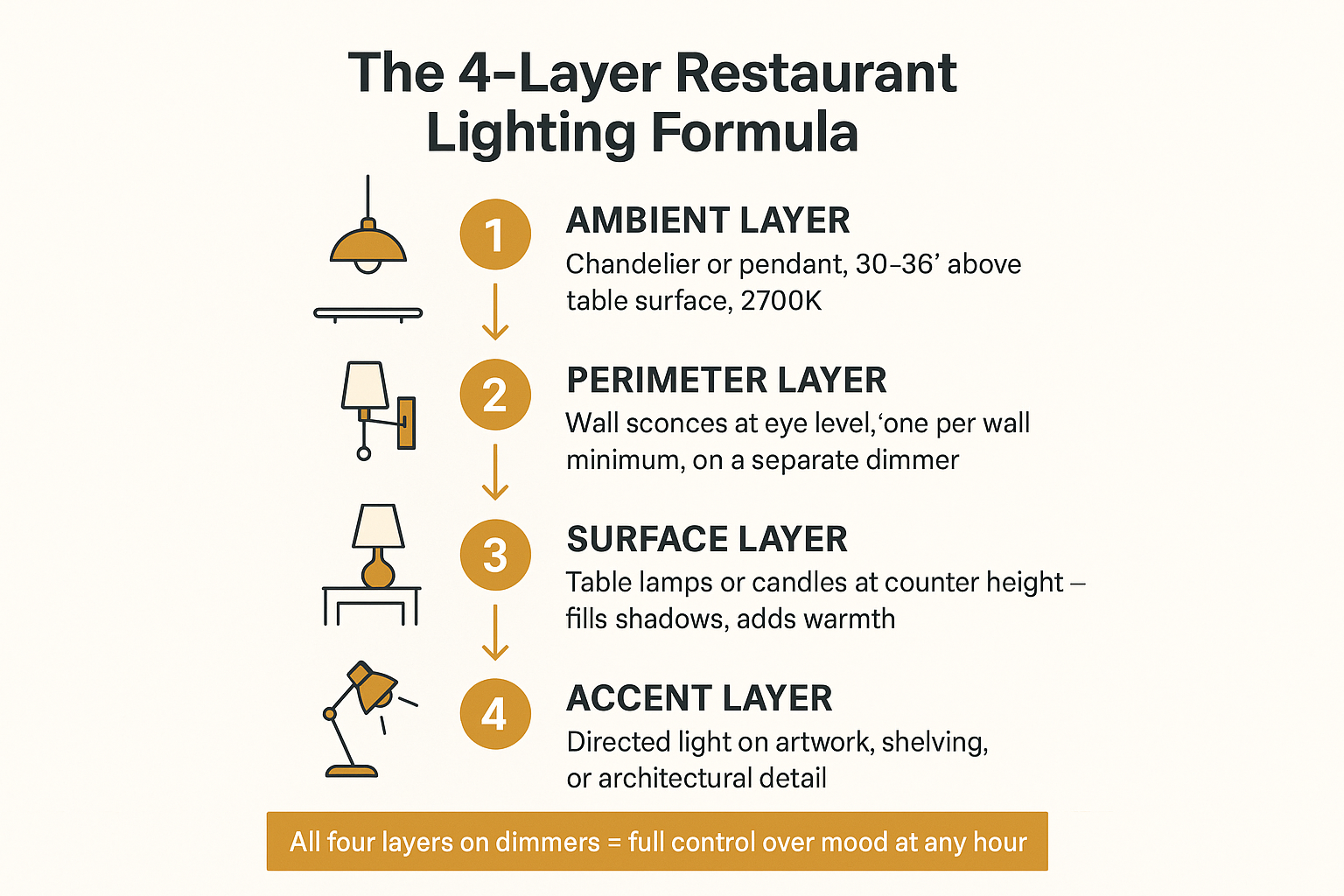
The 4-Layer Restaurant Lighting Formula
This infographic maps the four light sources that restaurant designers layer together — and how each one translates to a home dining room or living space.
The Dimmer Switch: The Cheapest Part With the Biggest Payoff
Restaurants don’t run their lights at full power during dinner service. Almost every fixture in the room is dimmed — sometimes to 20 or 30 percent of its maximum output. That’s a big part of why the light feels so different.
Most homes have a dimmer switch in exactly one room, if any. And if the home has been updated with LED bulbs but the dimmers weren’t replaced at the same time, there’s a good chance the dimmers are buzzing, flickering, or simply not working well.
LED dimmers are not interchangeable with older incandescent dimmers. If you’re getting flicker at low settings, the dimmer itself is almost certainly the problem — not the bulb. Replacing an older dimmer with one rated for LED loads is usually a $25 to $60 part, and it makes a night-and-day difference in how well the light responds.
For a dining room specifically, having the chandelier or pendant and the wall sconces on separate dimmer circuits is what gives you real control. You can bring the overhead down and leave the sconces a bit brighter, or vice versa. That flexibility is exactly what restaurant lighting designers build into a room from the start.
If you want to understand more about how ambient lighting works at home, that’s a good place to dig in before making any fixture decisions.
Fixture Height and Shade Type: The Two Details Most People Miss
Even with the right color temperature and a dimmer switch, a chandelier hung too close to the ceiling won’t feel like a restaurant fixture. Pendant and chandelier height matters more than most homeowners realize.
Over a dining table, the standard guideline is 30 to 36 inches between the bottom of the fixture and the table surface. Most electricians default to hanging fixtures too high because it feels safer. But a fixture hung at 48 or 54 inches above the table loses all its intimacy — it’s no longer creating a pool of light that brings people together, it’s just a ceiling fixture that happens to be decorative.
The other detail is shade material. Restaurant fixtures almost always diffuse the light rather than expose the bulb directly. A fabric shade, a frosted glass globe, or an opaque metal shade all accomplish the same thing: they hide the light source and create a soft glow instead of a harsh point of brightness.
If your current fixture has clear glass or an exposed Edison bulb and the brightness feels uncomfortable at dinner, the shade is probably why. The right fixture shade can change the entire character of a room without replacing the base fixture at all.
For homes on the Monterey Peninsula — especially in Carmel or Pacific Grove where older bungalows often have lower ceilings — fixture height becomes even more important to get right. A ceiling at 8 feet leaves less room for error than one at 9 or 10 feet, and the fixture selection needs to account for that from the start.
Frequently Asked Questions About Recreating Restaurant Lighting at Home
Do I need to replace all my fixtures to get the restaurant lighting effect?
Not necessarily. Start with bulb color temperature and dimmer switches before spending anything on fixtures. Swapping to 2700K bulbs and adding a proper LED dimmer can shift the feel of a room dramatically. If it still doesn’t feel right after those changes, then look at fixture selection and placement.
What color temperature do restaurants actually use?
Most use 2700K to 3000K. Some high-end restaurants go as low as 2200K for a near-candlelight warmth. Anything above 3000K starts to feel more like an office than a dining room.
How many light sources does a room actually need?
For a dining room, three is a good minimum: an overhead pendant or chandelier, at least one set of wall sconces, and either a table lamp or candles on a sideboard. The goal is that no single source carries all the weight. Four sources is even better if the room has the wall space.
My dimmer switch buzzes with my LED bulbs. Is that fixable?
Yes. The buzz almost always means the dimmer is an older model rated for incandescent loads, not LEDs. Replace it with a dimmer specifically rated for LED bulbs — brands like Lutron make models in the $25 to $45 range that work well. Your licensed electrician can swap one out in under an hour.
How low should a pendant hang over a dining table?
30 to 36 inches between the bottom of the fixture and the table surface is the standard range. On lower ceilings — 8 feet is common in older Carmel and Pacific Grove homes — stay closer to 30 inches and choose a fixture with a lower profile.
Can I do this in a living room, or does it only work in dining rooms?
It works in any room where you want to control mood. Living rooms actually benefit even more because they’re used at multiple times of day. The same layering approach — overhead on a dimmer, sconces at eye level, table lamps at surface level — applies directly. Accent lighting on shelving or artwork adds the final layer that makes a living room feel designed rather than just furnished.
Ready to See What These Fixtures Actually Look Like in Person?
Reading about color temperature and fixture height only goes so far — the real test is seeing how fixtures look when they’re lit. Greg and Tammy at The Home Lighter have been helping Monterey Peninsula homeowners make exactly these kinds of decisions since 1969, with a curated showroom at 2034 Sunset Drive in Pacific Grove where you can see fixtures burning at the right color temperatures before you commit to anything. Walk-ins are always welcome, and if you’re working through a larger dining room or whole-home project, appointments are available for a more in-depth conversation. Call the showroom at (831) 655-5500 with questions.