
Direct Answer: Measure the room and ceiling height, mock up the fixture’s listed diameter in cardboard at hanging height, then read the spec sheet for overall height, canopy size, and damp rating.
You have fourteen browser tabs open. One of them has a pendant you genuinely like, and you have no idea if it is the right size for the room, the right finish for everything else, or the right amount of light for what happens in that space.
This is the single most common thing homeowners on the Monterey Peninsula bring into a showroom. A Carmel cottage with 8 foot ceilings and a Carmel Valley great room with vaulted beams need very different fixtures, and a product photo on a white background tells you nothing about either one.
Here is a sequence you can run this afternoon with a tape measure, a roll of painter’s tape, a piece of cardboard, and the fixture’s own spec sheet. Five steps, in order, before you click buy.
Step 1: Do the Measurement Pass Before You Look at Another Fixture
Stop shopping for ten minutes and write down numbers. Almost every bad fixture decision traces back to a measurement nobody took.
Walk the room with a tape measure and record:
- Room length and width in feet
- Ceiling height at the spot where the fixture hangs, including any slope or vault
- Table or island width and length if the fixture hangs over one
- Mirror width for a bathroom vanity, plus the space between mirrors
- Height of anything nearby the fixture could collide with: a door swing, upper cabinets, a window header, a stair rail
A rough starting point for a hanging fixture: add the room’s length and width in feet, and that number in inches is a reasonable diameter. A 12 by 14 foot dining room lands around 26 inches. It is a starting point, not a rule.
Older Pacific Grove and Monterey homes often run 8 foot ceilings, which changes everything about what will clear a head at the table. If you want a deeper walkthrough of sizing a space, this guide on how to read a room before you pick a light fixture covers it well.

Step 2: Mock Up the Footprint in Cardboard and Live With It
This is the step that saves people the most money, and it takes about fifteen minutes.
Cut a circle or rectangle of cardboard at the fixture’s listed diameter and width. Tape it to the ceiling, or have someone hold it at the exact height you plan to hang the fixture. Then leave it there for an hour and walk past it.
What you are checking:
- Does it feel large enough to matter, or does it shrink into the ceiling?
- Does it crowd a cabinet run, a window, or the walkway around a table?
- Can a tall guest stand up from the table without ducking?
- Does it still look right at night with the lamps on?
Most fixtures that fail in a room fail on scale, and scale is exactly what a photo hides best. A 30 inch drum looks modest on a screen and enormous over a 36 inch round table.
For fixtures over an island, hang height matters as much as diameter. The usual target is 30 to 36 inches from the countertop to the bottom of the pendant, and how many pendants over a kitchen island, and how high to hang them walks through the spacing math.
Step 3: Read the Listing for Everything the Photo Does Not Show
Product photos sell the look. The spec sheet tells you whether the thing will actually work in your room.
Pull the PDF spec sheet, not just the retail listing, and find:
- Overall height including chain or downrod, which is often double the fixture body height
- Canopy diameter, the plate at the ceiling, since a small canopy will not cover an old box or patched paint
- Glass or shade dimensions, separate from overall width
- Socket type and count, plus whether bulbs are included (often they are not)
- Dimmable or not, and which dimmer family it needs
- Damp or wet rating if it goes in a bathroom, a covered porch, or anywhere near coastal air
That last one matters more here than inland. Salt air off the bay in Pacific Grove and Pebble Beach is hard on untreated metal, and an indoor-rated fixture on a covered entry will not hold up.
Dimming is where online buys go sideways. An LED fixture paired with the wrong dimmer buzzes or flickers, and the U.S. Department of Energy’s guidance on LED lighting is a good plain-language primer on why. There is also a local breakdown of why LED fixtures flicker or buzz on a dimmer.
One more line item nobody reads: the return policy. Large fixtures ship freight, and return freight on a heavy chandelier can cost enough to erase whatever savings made the online purchase appealing in the first place. Costs vary by carrier and fixture weight, so confirm before you order.
Spec Sheet Terms and What Goes Wrong When You Skip Them
These are the five spec lines that cause the most returns. Here is what each one actually means in your room.
| Spec line | What it tells you | What goes wrong if you skip it |
|---|---|---|
| Overall height | Fixture body plus full chain or downrod | Fixture hangs into the walkway or sits too high to read |
| Canopy diameter | Size of the plate against the ceiling | Old electrical box or patched paint shows around the edge |
| Diameter or width | Widest point of the shade or arms | Fixture looks undersized or crowds cabinets and chairs |
| Damp or wet rating | Where the fixture is approved to be installed | Corrosion in a bathroom or on a covered coastal entry |
| Dimmer compatibility | Which control the driver is tested with | Buzzing, flicker, or a dead bottom end on the dimmer |
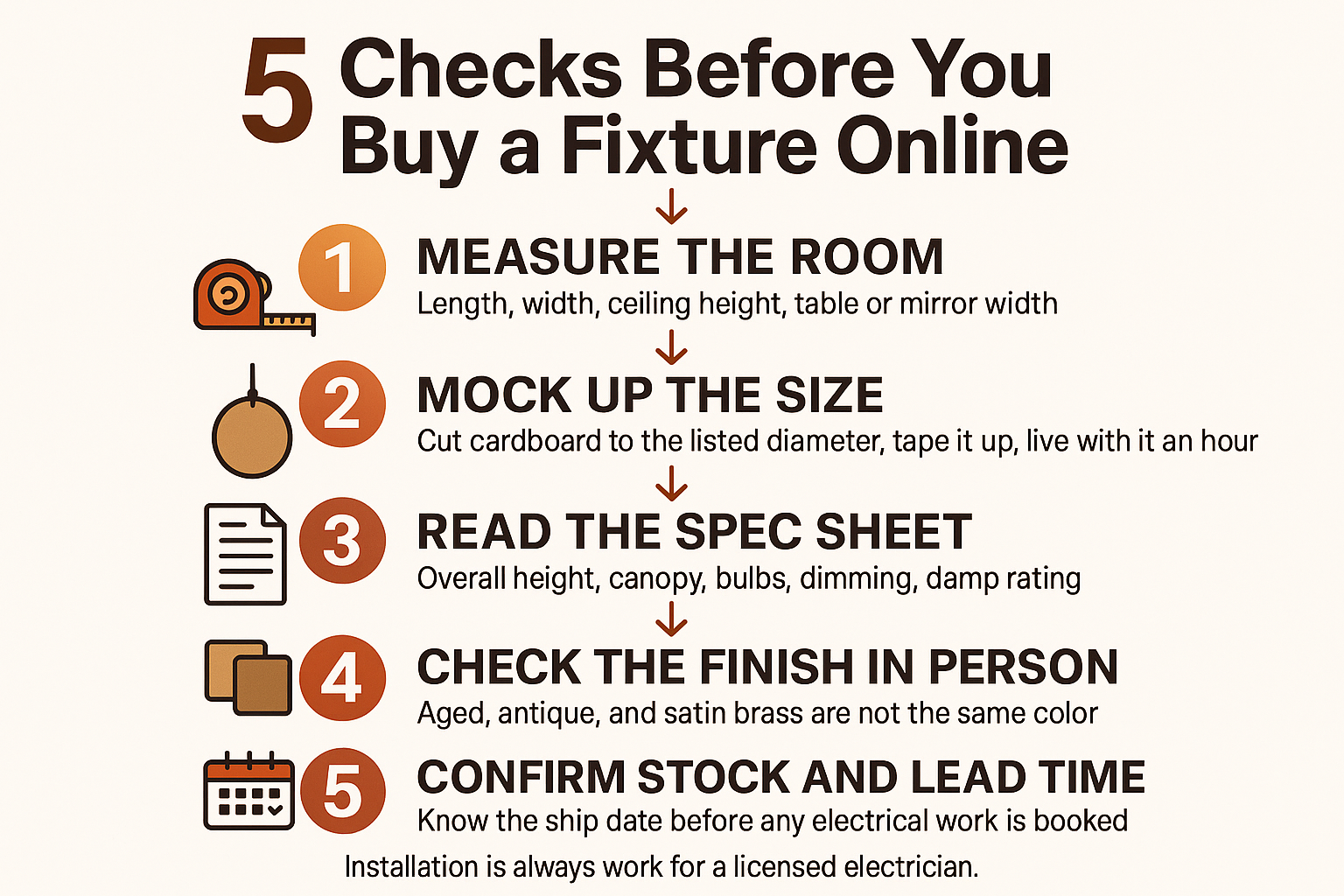
The Five-Step Fit Check at a Glance
Run these five checks in order. Each one rules out a different kind of expensive mistake.
Step 4: Treat Finish as Its Own Decision, Not a Detail
Finish is the step people skip, and it is the one they regret.
Manufacturers use different names for similar tones. Aged brass, antique brass, and satin brass can look nothing alike sitting next to each other, and one brand’s bronze reads warm while another’s reads nearly black.
Then screen calibration piles on. The same fixture photo looks gold on a phone and brown on a laptop, and neither one matches what lands on your porch.
The realistic fix is comparison under one light source. One homeowner came in shopping a pendant for a bedroom hallway and wanted it to tie into a bronze-finished floor lamp with a mosaic shell shade she already owned. Bringing a photo of that lamp made the conversation take ten minutes instead of three visits.
So bring something to compare against:
- A clear photo of the fixture or hardware you are matching
- The actual piece, if you can carry it
- A cabinet door, drawer pull, or faucet sample from the remodel
- A paint chip for the wall and ceiling color
For the broader question of which finishes can share a room, there is a full piece on how to keep fixture finishes from fighting each other.
Step 5: Confirm Stock and Lead Time Before Anyone Books Electrical Work
A fixture that fits perfectly is worthless if it shows up after the drywall is closed and the painter is gone.
Shoppers routinely arrive with exact model numbers in hand, asking whether a specific sconce and its matching three-light vanity are both available. That is a fair question to ask before you build a bathroom’s whole design around one piece, because a sconce can be in stock while its matching vanity bar is six weeks out.
A few things worth confirming:
- Current lead time, not the listing’s generic shipping estimate
- Whether every piece in a matching family is available at the same time
- Whether the finish you want is a standard run or a special order
- Whether the item ships parcel or freight, which changes delivery scheduling
Two local rules can also shape what you are allowed to buy. California Title 24 requirements that take effect January 1, 2026 govern lighting controls and efficiency on remodels and new construction statewide. And Carmel-by-the-Sea caps residential exterior fixture color temperature at 3000K with limits on lumen output, so exterior picks there need a closer look. Verify current requirements with the local building department or your licensed contractor before ordering.
The timing side is covered in more detail in lighting lead times and when to pick fixtures so your remodel doesn’t stall.
What an In-Person Look Adds That a Screenshot Can’t
People searching for a lighting showroom near me affordable enough to work with a real remodel budget are usually trying to avoid one specific thing: paying twice for the same fixture.
Standing in front of a lit fixture answers questions a product page cannot. You can see how much glare it throws at eye level, whether the shade hides the bulb from a seated position, and how two brass finishes compare under the same light instead of on two different screens.
Greg at The Home Lighter keeps a curated floor in Pacific Grove rather than a warehouse aisle, which means fewer options but a faster decision. Walk-ins are welcome, and appointments are available for more involved projects like a whole-home refresh or a new build.
Bring your measurements, photos of the space, and anything you are matching. And whatever you choose, the fixture still needs a licensed electrician to hang it. If budget is the main constraint, lighting one room at a time is a practical way to sequence it.
Frequently Asked Questions About Fitting an Online Fixture to Your Room
How big should a chandelier be over my dining table?
A common starting point is a fixture one half to two thirds the width of the table, and never wider than the table itself. On a 42 inch round table, that puts you around 21 to 28 inches. Mock it up in cardboard before you commit.
The listing says ‘overall height 48 inches.’ Is that the fixture or the chain?
Usually both. Overall height on most hanging fixtures includes the full supplied chain or downrod, which can be shortened at install. The number you actually care about is the fixture body height plus the drop you want, so check the spec sheet for both figures separately.
Can I bring a model number in and ask if you have it?
Yes, and people do it constantly. Having the manufacturer and model number makes the availability question fast to answer, and it is a reasonable thing to check before you plan a room around one piece.
Why do the same brass finishes look different in person?
Two reasons. Manufacturers name finishes differently, so aged brass from one brand may be noticeably warmer or darker than aged brass from another. On top of that, no two screens render metal the same way.
Does a bathroom fixture really need a damp rating?
For most vanity locations, a standard interior fixture is fine, but anything in or near a shower or tub zone needs the right damp or wet rating. Coastal humidity on the Peninsula also makes rated hardware a smart call on covered entries and porches. Your electrician can confirm what the location requires.
Still Not Sure If That Fixture Works in Your Room?
If you have a model number, a few photos, and a set of measurements, an in-person look usually settles it faster than another evening of browser tabs. The Home Lighter showroom sits at 2034 Sunset Drive in Pacific Grove, serving homeowners, designers, and contractors across Monterey County, CA. Walk-ins are welcome, appointments are available for larger projects, and the phone is (831) 655-5500.
