
Upgrading your home's lighting is more than a simple improvement project. It's a strategic investment that transforms your home's atmosphere, lowers your monthly bills, and reduces your environmental footprint.
Modern energy-efficient lighting upgrades are not just about swapping a few bulbs. They involve embracing superior technology, like LEDs and smart controls, for a home that is brighter, smarter, and more cost-effective.
Why Smart Lighting Upgrades Are a Bright Idea
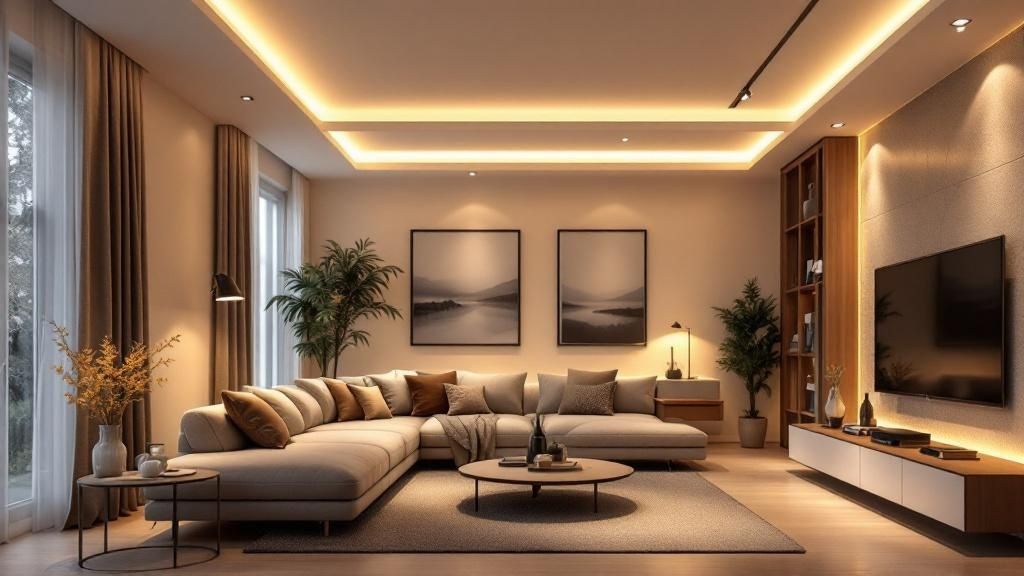
Moving on from old-school incandescent or halogen bulbs is one of the most impactful changes a homeowner can make. It’s a chance to rethink how light works in your daily life, transforming a harsh kitchen into a welcoming workspace or a dim living room into a cozy retreat.
For homeowners on the Central Coast, from Monterey to Santa Cruz, great lighting is essential. It complements our unique architectural styles and enhances our beloved indoor-outdoor lifestyle, especially when coastal fog rolls in.
At the heart of any modern lighting plan is the switch to Light Emitting Diodes (LEDs). This isn't just a minor tweak; it's a fundamental shift in how we light our homes, with immediate benefits for your utility bills and your home's overall vibe.
The Power of LEDs and Modern Controls
LED technology has advanced significantly, offering incredible light quality, impressive longevity, and a massive drop in energy use. This shift brings tangible advantages every homeowner can appreciate.
- Serious Cost Savings: LEDs use a fraction of the electricity, which you'll see reflected in lower energy bills every single month.
- A Better Home Atmosphere: With a wide range of color temperatures and high color rendering, you can create the perfect mood for any room.
- Set-It-and-Forget-It Longevity: Many LED bulbs are rated for 25,000 hours or more, meaning far less time on a ladder and less money on replacements.
When you make the switch, you're not just improving your home—you're contributing to a larger positive impact. The U.S. Department of Energy states that residential LEDs use at least 75% less energy and last up to 25 times longer than incandescent lighting.
Before we go further, here's a quick look at the major advantages you can expect from a modern lighting upgrade.
Quick Look at Lighting Upgrade Benefits
| Benefit Area | Impact of Upgrading |
|---|---|
| Energy Bills | Drastically lower monthly electricity costs due to higher efficiency. |
| Home Ambiance | Customizable light quality to create the perfect mood for any space. |
| Maintenance | Significantly longer bulb lifespan means fewer replacements and less hassle. |
| Property Value | Modern, efficient lighting is an attractive feature for potential buyers. |
| Smart Control | Gain precise control over your environment with dimmers, timers, and automation. |
As you can see, the benefits are clear, covering everything from your wallet to your well-being. A well-lit home feels more spacious, inviting, and valuable.
A Worthwhile Investment in Your Home
When you pair new fixtures with smart controls like dimmers and timers, you gain total command over your environment while maximizing efficiency. The effects of these upgrades go far beyond just saving money.
Ultimately, this transition is about making a smart, forward-thinking choice for your property. Widespread LED adoption makes a global impact, helping reduce energy consumption and environmental strain.
How to Audit Your Current Home Lighting
Before you buy a single new bulb for an energy efficient lighting upgrade, you need to know what you’re working with. A home lighting audit provides a clear baseline, helping you find the biggest energy hogs and spots where the light feels off.
This isn’t an overly technical process. It’s a simple, room-by-room inventory that helps you build a smart, actionable plan for your upgrades.
Creating Your Room-by-Room Inventory
Grab a notepad and walk through your home, one room at a time. The mission is to document every single light source, from the grand chandelier to the tiny nightstand lamp.
For each light, jot down these key details:
- Location and Purpose: Is this the main overhead light in the kitchen? A task light over a desk? An accent light on artwork? Its job is the first clue for choosing the right replacement.
- Fixture Type: Note the fixture type—recessed can, pendant, track lighting, table lamp, or an outdoor sconce common in Carmel or Pebble Beach homes.
- Bulb Type: Identify if the bulb is an old-school incandescent, a halogen, a CFL (compact fluorescent), or an early-generation LED. Outdated bulbs are your top replacement priority.
- Wattage: Look for the wattage printed on the bulb (e.g., 60W, 75W). This number is a direct measure of its energy consumption.
Going through this process turns a vague goal like "improve my lighting" into a concrete, manageable list.
Expert Tip: Pay extra attention to high-traffic areas like kitchens and living rooms. The lights you use most offer the biggest and fastest potential for energy savings when switched to efficient alternatives.
Evaluating Light Quality and Functionality
Once you've cataloged the hardware, it’s time to assess the quality of the light itself. This part of the audit is about how each space feels and functions.
As you walk through your home again, ask yourself some simple questions. Is the light in your primary workspaces bright and clear enough? Or is the lighting in your living room harsh and cold instead of warm and inviting?
This visual shows just how quickly a simple LED upgrade can translate into real annual savings and a smaller carbon footprint.
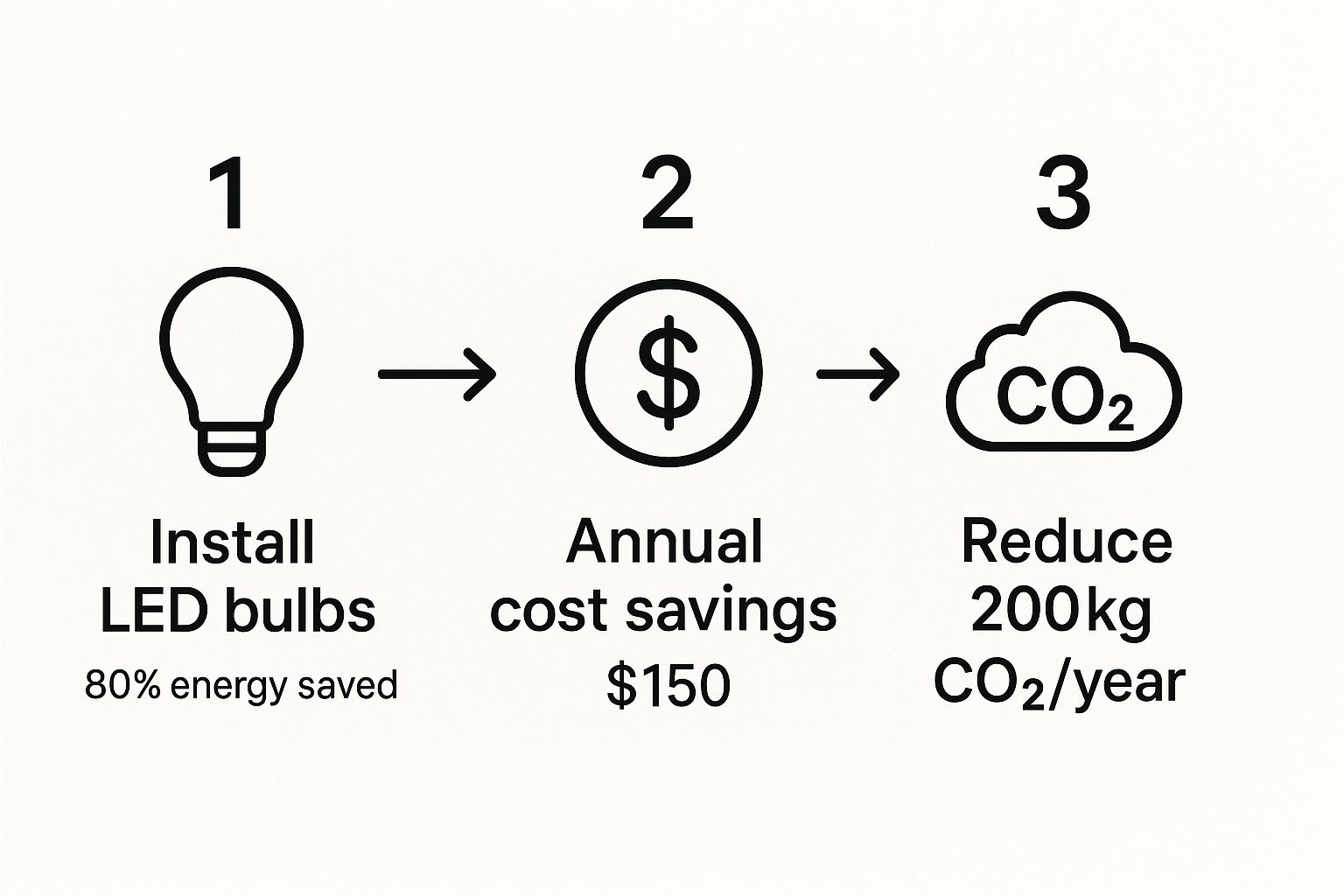
As the data shows, even small changes add up to significant financial and environmental benefits, year after year.
Identifying Your Upgrade Priorities
With your inventory and qualitative assessment in hand, you can build a prioritized action plan. Group your fixtures into logical categories to make the project feel less overwhelming.
Your priority list might look something like this:
- Immediate Replacements: Target all incandescent and halogen bulbs, especially those you use daily. These are your low-hanging fruit and will deliver the fastest return.
- Poor Light Quality Areas: Pinpoint rooms where the lighting is just not working—too dim for tasks or too harsh for relaxing. These are prime candidates for new fixtures or different LED bulbs.
- Future Smart Upgrades: Note areas where smart controls like dimmers or sensors would make life easier, even if you plan to tackle that later.
By completing this audit, you've created a personalized roadmap for your energy efficient lighting upgrades, ensuring every dollar builds a brighter, more efficient, and more beautiful home.
Selecting the Best Energy Efficient Lighting Products
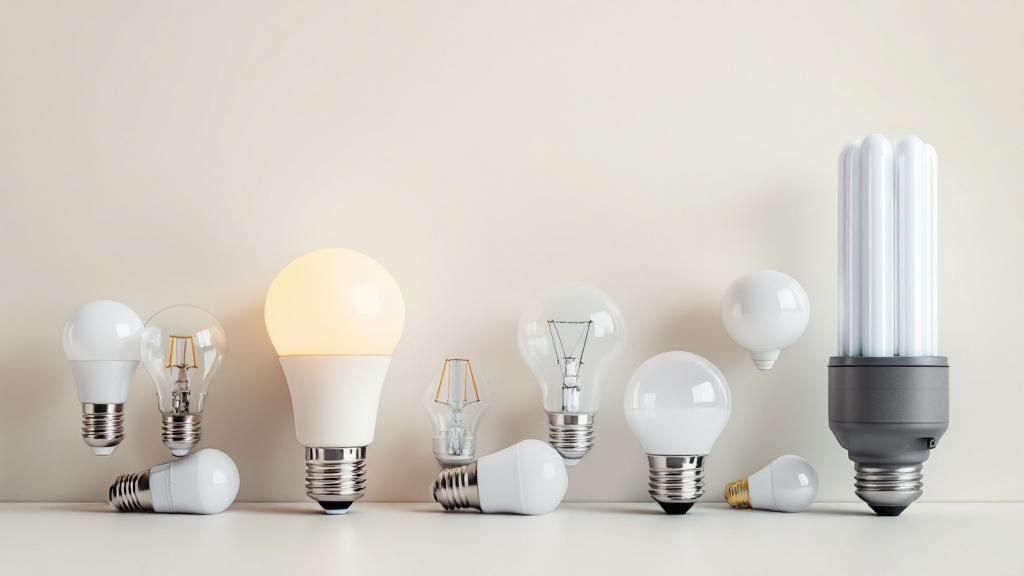
Alright, you've audited your home's lighting. Now for the fun part: choosing the right products for your energy efficient lighting upgrades. It’s easy to get lost in options, but a few key details are all you need to make smart choices.
This is about more than just swapping a bulb; it's about crafting the perfect atmosphere. The goal is to match the light to how you live in each space, whether it's a warm living room or a bright, functional kitchen.
Beyond the Bulb: Understanding Key Specs
To get your lighting right, look past wattage and focus on three crucial numbers: lumens, Kelvin, and the Color Rendering Index (CRI).
- Lumens (lm): This is all about brightness. Forget what you know about watts; lumens tell you how much light a bulb actually puts out. Higher lumens mean a brighter light.
- Kelvin (K): This tells you the color temperature of the light. Lower Kelvin numbers (like 2700K) give a warm, yellowish glow, while higher numbers (4000K or 5000K) produce a crisp, blueish-white light.
- Color Rendering Index (CRI): Rated on a scale of 0 to 100, CRI measures how accurately a light source shows the true colors of objects. For colors to look natural, you want a high CRI.
Nailing these three specs is the secret to a professional-feeling lighting design.
LED Bulb Specification Guide for Homeowners
| Specification | What It Means | Recommended Range for Living Areas | Recommended Range for Kitchens/Baths |
|---|---|---|---|
| Lumens (lm) | The bulb's total brightness output. | 800-1100 lm (equivalent to 60-75W) | 1100-1600 lm (equivalent to 75-100W) |
| Kelvin (K) | The color temperature, from warm to cool light. | 2700K – 3000K (Warm, cozy white) | 3000K – 4000K (Neutral to cool white) |
| CRI | How accurately the light reveals true colors. | 90+ (Essential for vibrant decor) | 90+ (Crucial for tasks like cooking/makeup) |
Choosing a bulb with a CRI of 90+ is a non-negotiable for our team—it makes everything from your wall paint to your food look its absolute best.
Matching Light to Your Lifestyle
A one-size-fits-all approach doesn't work. Your living room has completely different lighting needs than your bathroom vanity.
For instance, a living room on the Central Coast would feel best with bulbs around 2700K, giving off a warm, inviting glow. But in the kitchen, a brighter, cooler light around 4000K with a high CRI will make the space feel clean and functional.
Your lighting choice directly influences the mood and usability of a space. A warm, dimmable light can make a room feel intimate, while a bright, cool light promotes focus.
Integrated Fixtures vs. Retrofit Bulbs
When upgrading, you have two main options: replace the bulb or the whole fixture.
An integrated LED fixture has the technology built right in. These are often sleek, modern, and designed for peak performance. A retrofit bulb screws into your existing fixtures, offering a fast, budget-friendly way to get energy savings.
Thinking about outdoor options? A product like a large solar floodlight with remote control is a great example of an integrated fixture. For more recommendations, see our guide to the best energy-efficient light bulbs.
Why Certifications Like ENERGY STAR and Title 24 Matter
Here in California, certifications are a seal of approval that guarantees quality, safety, and compliance.
- ENERGY STAR: This federal stamp from the EPA means products meet strict energy efficiency standards, translating to real savings.
- Title 24: These are California’s own energy efficiency standards. If you're doing a major remodel or new construction, your lighting must comply, usually by using high-efficacy fixtures and controls.
Choosing certified products ensures your energy efficient lighting upgrades meet local codes—a must for any project on the Monterey Peninsula.
Integrating Smart Controls to Maximize Savings

A truly efficient lighting upgrade is about more than just swapping a bulb. It's about taking command of how and when your lights are used. Integrating smart controls is the key to unlocking the biggest savings and convenience.
This is where the magic happens. Imagine lights that automatically adjust to the time of day or hallways that illuminate only when someone is present. This level of control is now accessible to everyone.
The Building Blocks of Smart Lighting Control
Smart control doesn't have to be complicated. It often starts with a few simple, powerful components.
- Dimmers: Dimmers do more than set the mood. By reducing light output, they also reduce energy consumption and can extend the life of your LED bulbs.
- Motion and Vacancy Sensors: These are game-changers for hallways, bathrooms, and laundry rooms. They ensure you never waste power on an empty room.
- Timers and Schedules: Perfect for outdoor lighting or creating a "lived-in" look while you're away, timers let you automate when lights turn on and off.
These devices are the foundation of an intelligent lighting system, giving you precise control that translates directly into lower energy bills.
The real power of smart lighting is its ability to adapt to your life. The system remembers to turn off lights for you, ensuring you only use energy when and where it’s needed.
Standalone Solutions vs. Fully Integrated Systems
When adding smart controls, you have two main paths: standalone devices or a fully integrated smart home system.
A standalone solution could be a smart dimmer or plugging a lamp into a smart plug. These are fantastic, low-cost entry points. General-purpose smart plugs can be a flexible way to automate traditional lamps.
A fully integrated system connects all smart devices through a central hub like Google Home, Apple HomeKit, or Amazon Alexa. This allows you to create complex "scenes"—like a "Movie Night" setting. For a comprehensive setup, a professional smart home lighting installation ensures everything works together seamlessly.
The Future is Bright and Connected
The industry is moving quickly toward connected lighting. According to Statista, the global smart lighting market is projected to grow to over $44 billion by 2028.
This trend signals a future where lighting doesn't just save energy but also blends seamlessly into our digital lives. By adopting smart controls now, you're future-proofing your home and stepping into the next generation of home design.
Calculating Costs, Rebates, and Long-Term ROI
It’s easy to get excited about an energy-efficient lighting upgrade, but let's discuss what matters for most homeowners: the numbers. Figuring out upfront costs, incentives, and long-term savings turns a good idea into a smart financial decision.
This isn’t just another home expense; it's an investment in your property's value and your monthly budget. The initial investment varies, but both simple and complex projects can lead to significant returns.
Breaking Down the Upfront Investment
Your initial cost depends on the project's scale. Are you just replacing a dozen bulbs, or redesigning the entire lighting scheme for your Carmel home?
Here’s a look at typical cost factors:
- LED Bulbs: A quality LED bulb can run from $5 to $20, depending on features like dimmability or smart compatibility.
- Fixtures: New fixtures, from recessed cans to pendants, can range from $50 to several hundred dollars or more for designer pieces.
- Smart Controls: A basic smart dimmer might cost $30 to $70, while a comprehensive system costs more.
- Labor: If your project involves new wiring, you'll need to factor in an electrician's hourly rate.
My advice? Approach this in phases if the budget is tight. Start by replacing bulbs in high-traffic areas to see immediate savings.
Finding and Using Rebates and Tax Credits
One of the best ways to soften the initial cost is by using rebates and tax credits. Many utility companies and government programs offer incentives for energy efficiency.
Homeowners can often claim the Energy Efficient Home Improvement Credit, which offers credits for qualifying upgrades. Always check with a tax professional for the most current guidance.
To find local incentives, start with your utility provider, like PG&E. Websites like the Database of State Incentives for Renewables & Efficiency (DSIRE) are also fantastic resources. These programs can significantly reduce your project's cost.
Calculating Your Long-Term Return on Investment
Return on Investment (ROI) is where energy-efficient lighting upgrades truly shine. It’s the measure of how quickly your investment pays for itself through savings.
1. Energy Savings: This is your biggest return. An LED bulb uses significantly less energy than its incandescent cousin, directly lowering your monthly electricity bill.
2. Maintenance Savings: Modern LED bulbs can last up to 25,000 hours or more, compared to the 1,000 hours of a typical incandescent. This means far less money and time spent on replacements.
For a clearer picture, check out our guide on LED lighting energy savings. A well-planned upgrade doesn't just improve your home; it becomes a financial asset.
Frequently Asked Questions (FAQs)
How much can I realistically save by switching to LEDs?
The savings are substantial, depending on your daily lighting habits and electricity rates. On average, a single LED bulb uses up to 75% less energy than an incandescent bulb, which can add up to over a hundred dollars a year for a typical family. Don't forget that LEDs last up to 25 times longer, saving you money on replacement bulbs too.
Are all LED bulbs dimmable?
No, not all LED bulbs are dimmable. Trying to dim a non-dimmable LED will likely cause flickering, buzzing, or poor performance. Always check the product packaging for a "dimmable" label and pair it with a modern, compatible dimmer switch for the best results.
What is the difference between a retrofit and an integrated fixture?
A retrofit LED bulb is a quick-and-easy solution designed to screw into your existing light fixtures. An integrated LED fixture is an all-in-one unit where the LED light source is built directly into the fixture, often allowing for sleeker designs and optimal performance.
Do I need an electrician to install smart lighting?
It depends. If you’re just screwing in smart bulbs or using plug-in smart switches, you generally don't need an electrician. However, if your project involves installing new hardwired smart switches or in-wall dimmers, it's always safest to hire a licensed electrician to ensure the job is done correctly and meets local codes like Title 24.
What’s the best color temperature (Kelvin) for my home?
For living rooms and bedrooms where you want a warm, cozy feel, we recommend 2700K to 3000K. For kitchens, bathrooms, and home offices where you need bright, clear light for tasks, a cooler 3000K to 4000K is often a better choice.
How The Home Lighter Can Help
While simple energy-efficient lighting upgrades are perfect for a weekend DIY project, some situations call for a professional touch. Knowing when to bring in an expert can save you from costly mistakes and deliver a superior result.
A lighting professional does for your home what a curator does for a gallery, ensuring every fixture works together to create a cohesive, beautiful, and functional environment. This is especially true when navigating complex wiring or California's strict Title 24 energy standards during a remodel.
Partnering with a local expert from The Home Lighter means you get personalized advice tailored to our region’s specific architectural styles and climate. We can help you explore options, like in our guide on track lighting vs. recessed lighting, and avoid common pitfalls.
Ready to start your lighting upgrade with confidence? The experts at The Home Lighter, Inc. are here to provide personalized guidance and help you select the perfect fixtures for your home. Visit our Pacific Grove showroom or explore our services online at https://homelighterinc.com.