
Direct Answer: A ceiling fixture isn’t just functional — it’s the first thing people see in a room. The right one defines the scale, warmth, and personality of the entire space.
Most homeowners pick a ceiling fixture last. It’s treated like a detail — something to check off after the countertops, cabinets, and furniture are settled. But walk into almost any room and the first thing your eye finds is what’s hanging overhead.
On the Monterey Peninsula, where homes range from 1940s Pacific Grove cottages to multi-million-dollar Pebble Beach estates, ceiling fixtures carry a lot of visual weight. They set the scale, establish the mood, and often tell you more about the design intent of a room than the paint color or the rug underneath.
This article is about that decision — not the mechanics of wattage or wire gauge, but the part that actually matters to how a room feels when someone walks into it.
Why the Ceiling Is the Design Decision You Keep Skipping
There’s a reason so many remodels end up with a generic flush mount in the middle of an otherwise carefully designed room. Ceiling lighting feels complicated, the options are endless online, and by the time someone gets to it, decision fatigue has already set in.
But the ceiling fixture is doing something the sofa and the throw pillows aren’t. It’s defining the vertical plane of the room. When a fixture is too small for the space, the ceiling feels forgotten. When it’s too large, it dominates in a way that feels accidental rather than intentional.
There’s also the question of light quality. A builder-grade fixture in the center of a dining room throws flat, even light that flattens faces and makes food look washed out. A well-chosen pendant or chandelier — hung at the right height with the right bulb temperature — does something different entirely. It creates atmosphere. That’s not a subjective preference; it’s what happens when you control contrast and warmth together.
For more on how ambient light shapes the feeling of a room, The Difference Between Dim and Done Right: Ambient Lighting at Home is worth reading before you start shopping.
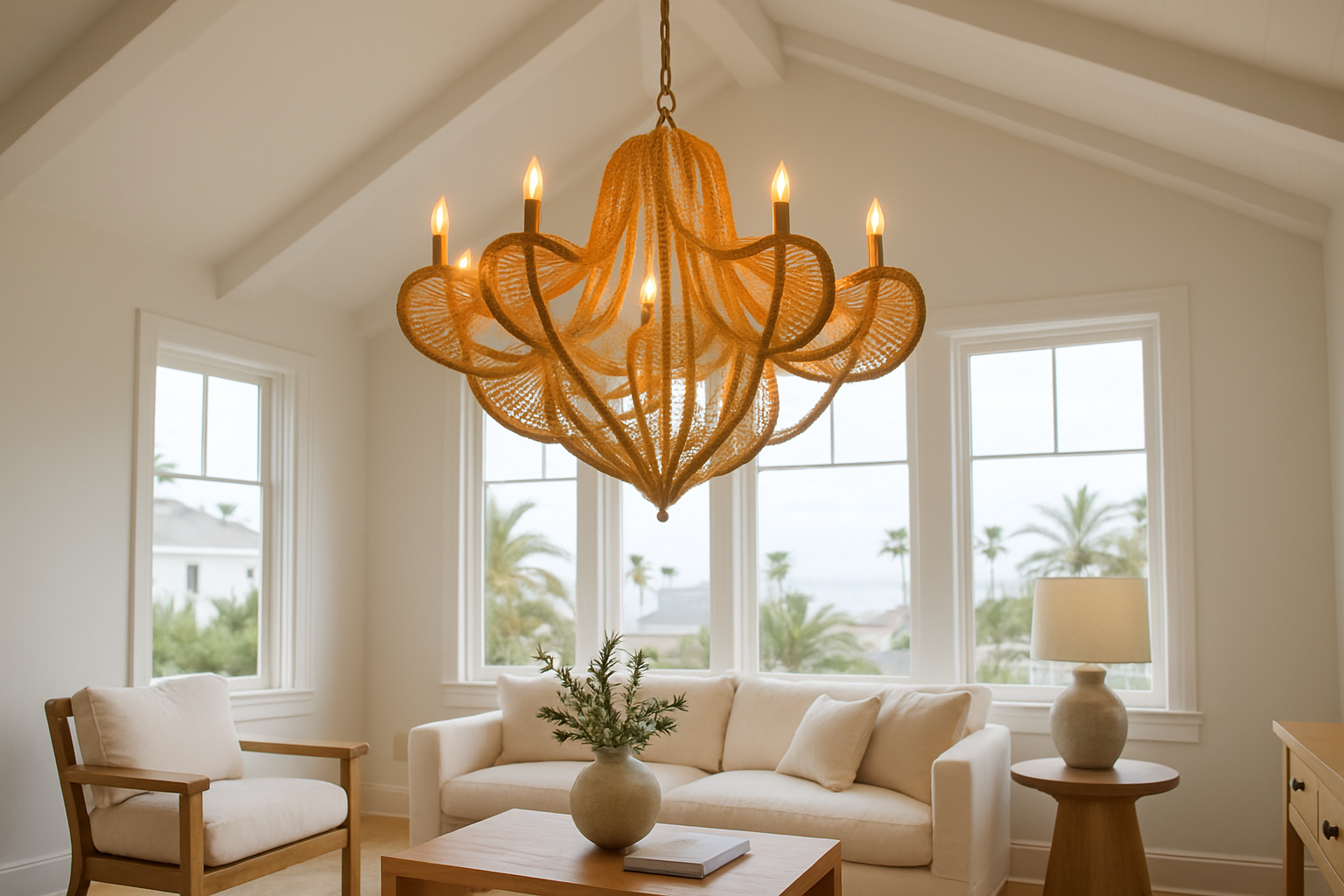
Scale Is the First Problem to Solve — and Most People Get It Wrong
The most common mistake in ceiling fixture selection isn’t the style. It’s the size.
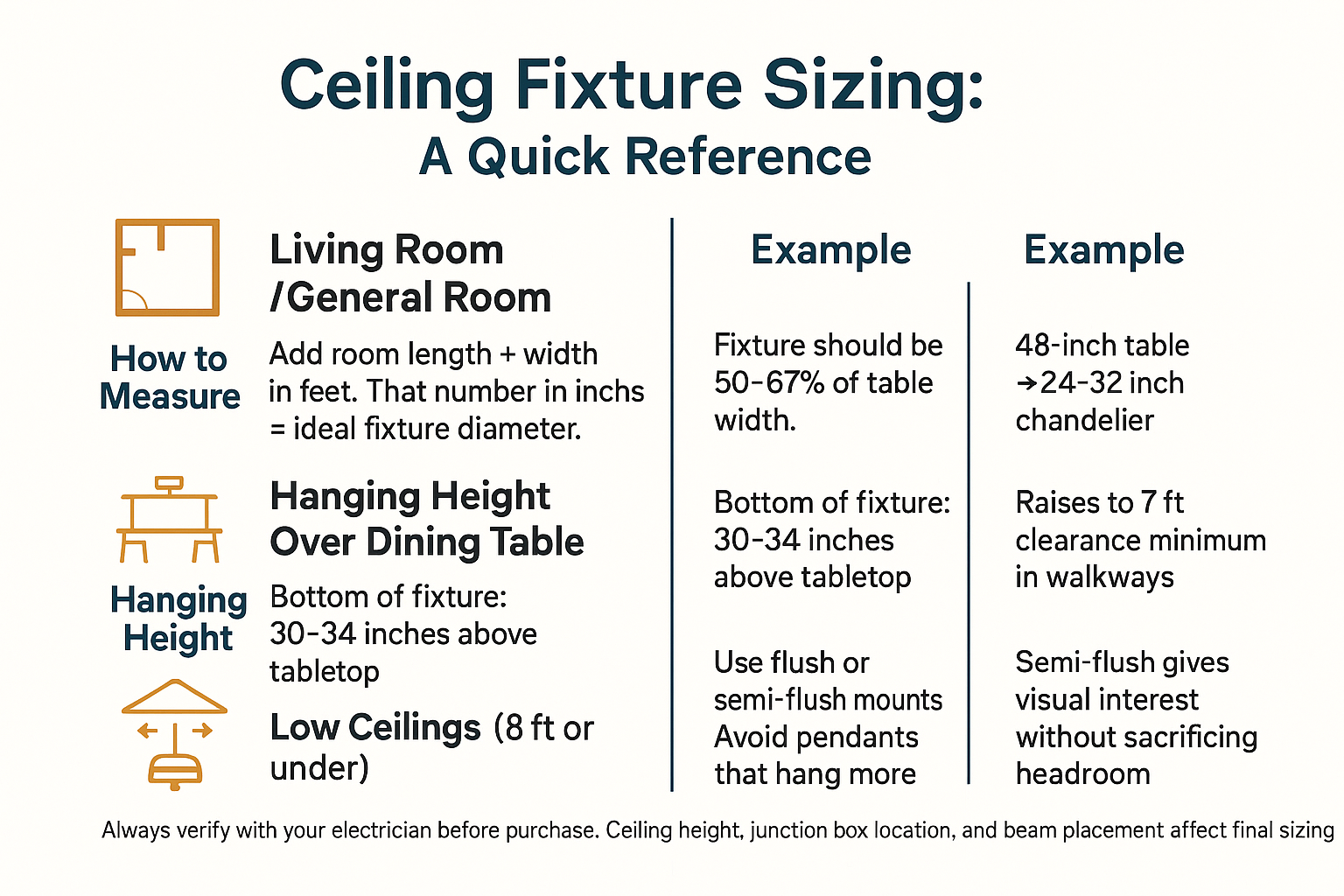
A rough rule that works in most rooms: add the room’s length and width in feet, then use that number in inches as your fixture’s diameter. A 12-by-14-foot living room calls for a fixture roughly 26 inches across. Most homeowners who shop online end up with something 12 to 16 inches — which looks like a button on the ceiling in a real room.
For dining rooms, scale is calculated differently. The fixture should be about half to two-thirds the width of the table. A 48-inch round table wants a chandelier in the 24-to-32-inch range. And the bottom of the fixture should hang roughly 30 to 34 inches above the tabletop — low enough to feel intimate, high enough that no one at dinner is ducking.
These aren’t design opinions. They’re proportional relationships that have been true in residential design for decades. Getting them right before you select a fixture saves the cost and frustration of a return — or worse, living with something that never quite looks right.
A detailed breakdown of how to approach this math for specific room types is available in this chandelier size calculator guide.
Ceiling Fixture Sizing at a Glance
These proportional guidelines apply to most residential rooms on the Monterey Peninsula — from a Carmel bungalow to a Pebble Beach great room.
What Ceiling Fixtures Are Actually Communicating About a Room
A fixture isn’t neutral. Every choice — the finish, the shape, the material, the light color — is saying something about the room.
Antique brass says warmth and history. Matte black reads as modern and grounded. Polished nickel reflects light and feels crisp. None of these is inherently right or wrong, but they each establish a tone that every other element in the room either supports or fights against.
On the Monterey Peninsula, the design context is specific. Coastal homes tend toward natural materials — weathered wood, stone, rattan, linen. Fixtures with organic shapes and warm metal finishes tend to land better here than anything that reads as cold or industrial. But Carmel-by-the-Sea has also seen a real shift toward contemporary interiors in recently renovated homes, where a sculptural matte-black pendant or a simple drum shade in white fabric makes exactly the right statement.
The finish also determines maintenance. Salt air accelerates oxidation on exposed metal. For any fixture near an open window, deck door, or covered porch, this matters — and it’s one of the reasons the finish selection should come before the style decision, not after.
For homeowners working through a bathroom remodel, this same principle applies to vanity fixtures. The brushed nickel vanity light guide covers finish selection in that specific context.
Light color also matters more than most people expect. A 2700K bulb produces a warm, candlelight-adjacent glow that works well in living spaces and dining rooms. A 3000K bulb is slightly crisper — better for kitchens and bathrooms where you want clarity without harshness. Going above 3500K in a residential interior almost always feels clinical. These are real, measurable differences — not just specifications on a box.
Fixture Type by Room: What Actually Works
Different rooms call for different ceiling fixture types — not because of style preference, but because of how each space is actually used.
| Room | Best Fixture Type(s) | Key Consideration |
|---|---|---|
| Dining Room | Chandelier, Linear Pendant | Scale to table width; hang 30–34″ above tabletop |
| Kitchen (Island) | Pendants, Linear Suspension | Space pendants 24–30″ apart; hang 30–36″ above counter |
| Living Room | Chandelier, Semi-Flush, Statement Pendant | Scale to room dimensions; layer with floor and table lamps |
| Bedroom | Semi-Flush, Flush Mount, Small Chandelier | Avoid bright direct downlight over the bed |
| Bathroom | Semi-Flush, Flush Mount | Use vanity side-lighting as primary; ceiling as fill light |
| Entryway / Foyer | Chandelier, Pendant, Statement Flush | First impression of the home — scale up, not down |
| Hallway | Flush Mount, Recessed | Clearance is priority; flush keeps sightlines clean |
The Layering Problem — and Why One Fixture Is Almost Never Enough
There’s a reason restaurants feel so different from most homes at night. It’s not the furniture or the plants. It’s the lighting — and specifically, it’s the fact that restaurants almost never rely on a single ceiling source.
A well-lit dining room at a good restaurant in Carmel has ambient ceiling light set low on a dimmer, pendant fixtures over specific tables, candles on surfaces, and perhaps some accent light hitting art or architectural detail. The result is warmth, depth, and contrast. Replicating even a fraction of that layering in a home changes everything about how the room feels after dark.
In residential design, the ceiling fixture is the ambient base — it fills the room with general light. But layered kitchen lighting and living room design rely on wall sconces, table lamps, and accent fixtures to create the depth that makes a room feel finished rather than lit.
For anyone curious about how restaurants achieve that inviting warmth, the answer applies directly to residential design — and it starts with understanding that the ceiling fixture is the foundation, not the whole building.
Dimmers are non-negotiable in this conversation. A ceiling fixture without dimming capability locks you into one light level for every use case — reading, entertaining, watching television, and falling asleep all at the same setting. That’s a waste of an otherwise good fixture. Most quality residential fixtures are compatible with standard dimmer switches, but it’s worth verifying compatibility before installation, especially with LED drivers.
Frequently Asked Questions About Ceiling Lighting
How do I know if my ceiling fixture is the right size for my room?
Add the room’s length and width in feet. That combined number, converted to inches, gives you a good target diameter for a chandelier or pendant in most rooms. So a 10×12 room would call for a fixture around 22 inches across. For dining rooms, size the fixture to roughly half the table width.
What light bulb color temperature should I use in a living room or dining room?
2700K is the standard for living and dining spaces — it’s warm and flattering without looking dim. Go to 3000K if you want something slightly crisper, which works well in kitchens. Anything above 3500K tends to feel like an office, not a home.
My ceiling is only 8 feet high. What fixture type works?
Flush mounts and semi-flush mounts are designed exactly for this situation. Semi-flush fixtures drop 6 to 12 inches below the ceiling, which adds visual interest without creating a headroom problem. Avoid pendants that hang more than 12 inches in rooms with standard 8-foot ceilings.
Can I put a chandelier in a bedroom?
Yes — and it works well when done right. The key is avoiding a fixture that aims bright light directly downward over the bed. A chandelier with upward-facing cups, frosted glass, or shaded arms distributes light more softly. Keep it on a dimmer and it becomes one of the better bedroom upgrades you can make.
Do ceiling fixtures near coastal salt air need special treatment?
Salt air accelerates oxidation on exposed metal finishes, especially anything polished or chrome-adjacent. For fixtures near open windows, screened porches, or coastal-facing rooms, look for finishes like matte black, antique bronze, or powder-coated metals that hold up better over time. This matters most within a few blocks of the water in Pacific Grove and Carmel.
Does California Title 24 affect what ceiling fixtures I can use in a remodel?
It can. California Title 24 governs lighting efficiency and controls in remodels and new construction, and the January 2026 updates tightened those requirements. In practice, this mostly affects whether fixtures must be LED-ready and whether dimmer controls are required in certain rooms. A licensed electrician or contractor can tell you exactly what applies to your specific project — and a good lighting showroom can point you toward compliant fixtures from the start. This interior lighting and Title 24 guide goes deeper on what homeowners need to know.
Ready to Stop Treating the Ceiling as an Afterthought?
Greg and Tammy at The Home Lighter have been helping Monterey Peninsula homeowners make sense of these decisions since 1969 — from right-sizing a chandelier for a Carmel dining room to finding a flush mount that actually fits an 8-foot cottage ceiling in Pacific Grove. Walk-ins are always welcome at the showroom at 2034 Sunset Drive in Pacific Grove, and appointments are available for more involved projects. Give them a call at (831) 655-5500 if you want to talk through what you’re working on before you come in.