
Direct Answer: Choosing a pendant for a hallway or dining room comes down to three decisions: the right scale for the space, a shade material that works with your light needs, and a finish that reads as intentional next to what’s already in the room.
Search for pendant lighting advice and you will find page after page written around a single scenario: three fixtures hanging over a kitchen island. That is useful content if you are remodeling a kitchen. But it leaves out a large part of what people are actually shopping for.
Form submissions and phone calls to lighting showrooms on the Monterey Peninsula regularly turn up situations like this: a homeowner in Pacific Grove wants a pendant for a bedroom hallway and is trying to tie it visually to an existing bronze Quoizel floor lamp with a mosaic shell top. Another customer is shopping for a hanging fixture over a dining table. These are two distinct decisions that involve a completely different set of trade-offs than kitchen pendants, and almost no one has written about them in a useful way.
This article covers the two most common non-kitchen pendant scenarios, the finish coordination challenge that trips people up in both, and the scale and shade questions you should answer before you buy anything.
The Finish Coordination Problem Nobody Warns You About
When a customer walks into a showroom with a photo of an existing fixture, the first question is almost never “what style do you like?” It’s “what undertone does that finish have?”
Finish coordination is the part of pendant shopping that surprises people most. The instinct is to match exactly: if the floor lamp is bronze, find a bronze pendant. But that approach usually produces a room that looks like it came from a catalog, not a home someone actually lives in. The better move is to stay within the same finish family while varying the form.
Think of finishes in two broad groups:
- Warm metals: brass, bronze, gold, champagne, antique gold, aged brass
- Cool metals: chrome, polished nickel, satin nickel, matte black, iron
Within each group, the undertones read as related even if the specific finish names are different. A hammered antique brass pendant placed in the same hallway as an aged bronze floor lamp reads as collected and deliberate. A polished chrome pendant in that same space would feel like a mismatch even though both are technically metal fixtures.
The key question to ask about any existing fixture is: is this finish warm or cool, and is it bright or aged? A bright polished brass and a deeply aged bronze are both warm metals, but they sit at opposite ends of that spectrum. Staying within the same quadrant of the warm-cool and bright-aged grid is how you get a room that feels intentional without looking matchy.
For homeowners working with existing coastal California interiors, the warm metal category is particularly forgiving. The wood tones, natural stone, and warm neutral walls common in Carmel Valley, Pebble Beach, and Pacific Grove tend to make warm-finish fixtures feel at home in nearly any room. And the broader 2026 trend toward champagne bronze, brushed brass, and distressed finishes with gold showing through means a warm-metal pendant you buy today is not a trend piece. These finishes are landing across major fixture lines right now because they work with the way a lot of coastal homes are already furnished.
Scale in a Hallway versus Scale over a Dining Table
Scale decisions are completely different depending on which room you are shopping for. Most pendant guides give you one set of rules. There are actually two separate conversations here.
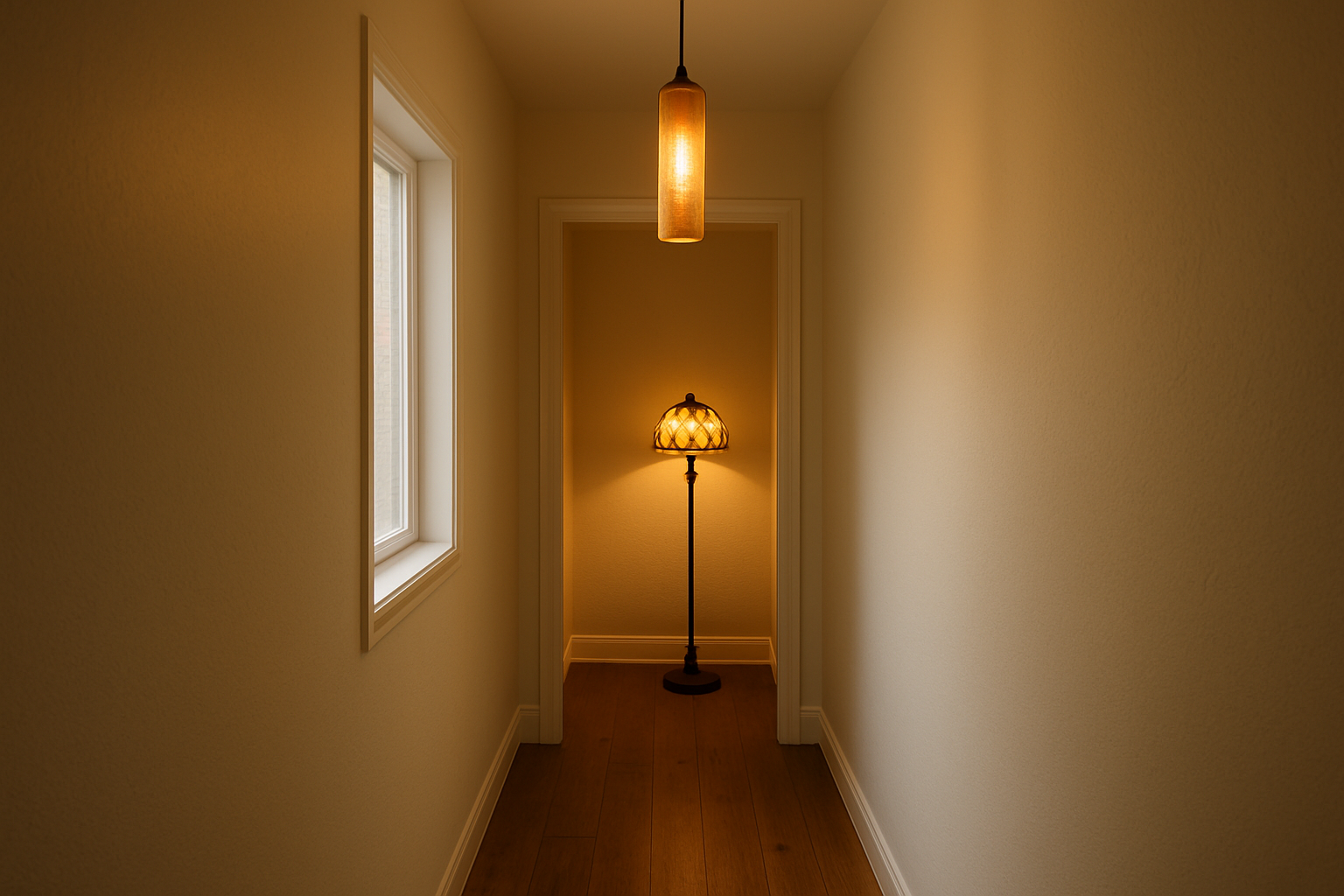
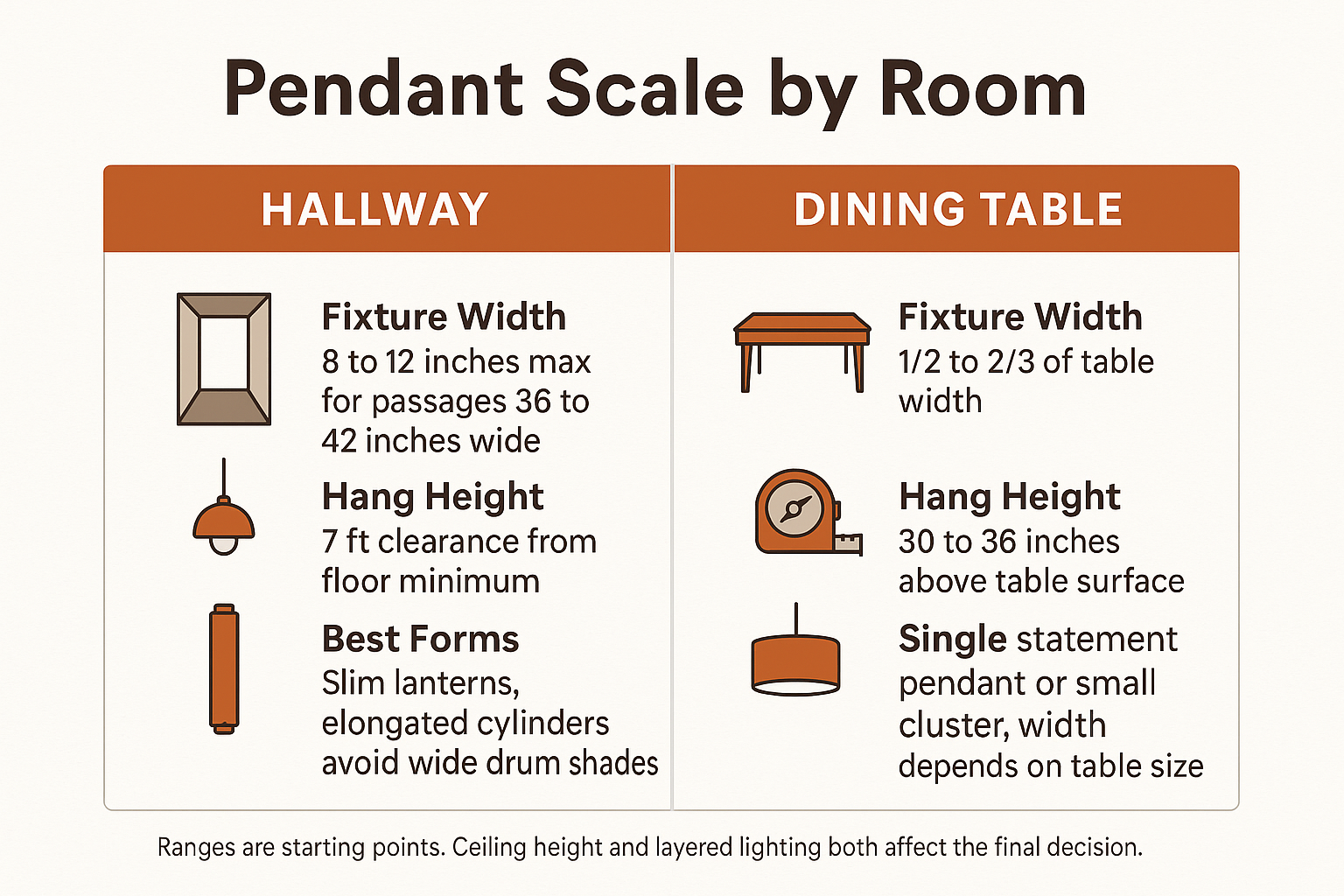
In a hallway or transitional space, the horizontal footprint of the fixture matters as much as hang height. A wide drum shade in a narrow passage creates visual congestion. Your eye hits the fixture and stops. A slim lantern form or an elongated cylinder pendant moves the eye through the space instead of blocking it. If your hallway is 36 to 42 inches wide, a pendant with a diameter of 8 to 12 inches typically works. Anything wider starts to feel like you are squeezing past it.
Hang height in a hallway should allow at least 7 feet of clearance from the floor to the bottom of the fixture. That is the minimum for comfortable passage. If the ceiling is low, a close-to-ceiling lantern or a very slim profile pendant is usually a better choice than a fixture with a long cord or chain.
Over a dining table, the conversation shifts. Here the fixture’s width should relate to the table width. A common starting range is one-half to two-thirds of the table’s width. So a 60-inch rectangular table would typically work well with a pendant or cluster in the 30-40 inch diameter range. This is a starting point, not a rule, and ceiling height matters: a room with a 10-foot ceiling can handle more visual weight than one at 8 feet.
Hang height over a dining table is generally 30 to 36 inches above the table surface. The lower end of that range creates a more intimate, restaurant-style feel. The higher end works better if the room is open to adjacent spaces and the pendant needs to be visible from across the room. If your room has layered lighting from sconces or recessed sources, you have more flexibility because the pendant is not doing all the work.
Quick Reference: Hallway vs. Dining Table Pendant Sizing
These ranges give you a starting point for each space. Ceiling height, table size, and existing light sources all affect where you land within each range.
Shade Material Changes the Whole Character of the Light
This is the decision most people make last, and it probably deserves to come first.
The shade material determines whether the pendant throws a focused pool of light or fills the room with warmth. Those are two very different outcomes, and neither is wrong. They just suit different rooms and different situations.
Opaque shades, solid metal, dark fabric, painted glass, direct light mostly downward. Over a dining table, that creates drama and focus on the surface. It works well when the room has other sources handling ambient light. But if the pendant is the only fixture in the room, an opaque shade will leave the walls dim and the ceiling dark. That may feel cozy to some homeowners and cave-like to others.
Translucent and semi-translucent shades, linen, frosted glass, alabaster, seeded glass, scatter light in all directions. The fixture glows rather than spotlights. In a hallway, this creates a welcoming warmth rather than a harsh downward beam. In a dining room, it produces general softness rather than theatrical focus.
The question to answer before you choose a shade is: what else is this room going to have for light? If the pendant is working alongside sconces or accent sources, an opaque shade can be beautiful. If it is the primary source, a translucent shade usually gives better results across the whole room. You can read more about how fixture type affects a room’s overall feel in a related guide.
One more practical note: California’s Title 24 energy code requires certain lighting controls in remodels and new construction, and that applies to pendant fixtures too. If your project involves a permit, it is worth checking those requirements with your electrician before you finalize a fixture. The California Energy Commission publishes the current standards and is the authoritative source.
Shade Material at a Glance
A quick comparison of the three most common shade types and where each tends to work best.
| Shade Type | Light Effect | Works Best When |
|---|---|---|
| Opaque (metal, dark fabric) | Directed downward pool | Room has sconces or other ambient sources |
| Translucent (linen, frosted glass) | Diffused in all directions | Pendant is the primary or only source |
| Semi-translucent (seeded glass, alabaster) | Soft glow with some directionality | Either scenario, most forgiving choice |
Putting It Together When You Already Have Existing Fixtures
The hardest version of this project is when you are not starting from scratch. One customer’s situation captures it well: shopping for a bedroom hallway pendant with a bronze-finish floor lamp already in the space, wanting the two fixtures to feel related without being identical.
The approach that works in situations like this is to build around the undertone of the existing piece, not its exact finish name. The floor lamp in that scenario has an aged, warm undertone. Brass finishes with an antique or hammered quality share that undertone. So does champagne bronze. So does distressed gold. Any of those reads as belonging in the same space. What would not work is a bright polished nickel or satin chrome pendant, even if both are technically silver-toned metals. The cool undertone would read as out of place.
The form of the new fixture should differ from the existing one to avoid repetition. If the lamp has an ornate mosaic shade, a pendant with a cleaner, simpler silhouette provides contrast that feels curated. The combination of a related finish family and contrasting form is what separates a room that looks designed from one that looks like a collection of things that were bought separately.
If you are reading a room before choosing a fixture and want a framework for thinking through all the layers, that article walks through the process in more detail.
Frequently Asked Questions About Non-Kitchen Pendant Lighting
Can I use a single pendant over a round dining table, or does it need to be a chandelier?
A single pendant works well over a round table. The fixture width should stay within roughly one-half to two-thirds of the table’s diameter. A 48-inch round table pairs naturally with a pendant in the 24-30 inch range. The choice between a pendant and a chandelier is mostly about the visual weight you want, pendants tend to feel lighter and more contemporary, chandeliers more formal. Neither is wrong for a dining room.
My hallway ceiling is only 8 feet. Is a pendant even practical?
It can be, but the fixture form matters a lot at that height. You need at least 7 feet of clearance from the floor to the bottom of the fixture, which leaves only 12 inches of fixture height before you’re crowding the space. A flush or semi-flush lantern style, or a very compact cylinder pendant on a short cord, tends to work better than a fixture with a long drop. A slim profile keeps the eye moving down the hall rather than getting snagged on the fixture.
How do I know if a warm metal finish will look dated in a few years?
The short answer is that warm metals, brass, bronze, champagne, aged gold, have been in residential interiors in one form or another for decades. The current wave of champagne bronze and brushed brass is a variation on a long-running theme, not a novelty finish. Finishes that tend to date quickly are ones tied to a single moment (the nickel boom of the early 2000s, for example). Warm metals in aged or matte forms have broader staying power, particularly in coastal California interiors built around wood tones and natural stone.
Do I need to match the finish on my pendant to every other fixture in the room?
No. Exact matching is not the goal, and in practice it often looks forced. Staying within the same finish family (warm metals together, cool metals together) while mixing specific finishes gives a room a layered, collected quality. The main thing to avoid is crossing from warm to cool in the same room without a deliberate reason, that’s usually what reads as a mismatch.
What if I want to use a pendant in a dining room that has no other light source?
That’s a common starting point in older homes. If the pendant will carry the room on its own, prioritize a translucent or semi-translucent shade so light distributes across the ceiling and walls rather than concentrating on the table surface. You can always add sconces or a floor lamp later. If you want to plan for layered light from the start, this overview of how accent lighting works is a good place to read before you finalize the room layout.
Ready to Find the Right Pendant for Your Space?
If you have an existing fixture you are trying to work around, or a space where the scale and shade questions feel unsettled, bring a photo and Greg or Tammy at The Home Lighter can walk you through the options in person. The showroom at 2034 Sunset Drive in Pacific Grove carries a curated selection across a wide range of finish families and pendant forms, and walk-ins are welcome. For more involved projects, appointments are available, just call (831) 655-5500 to set one up.