
Direct Answer: A house feels dark in winter because one overhead fixture per room cannot replace daylight. Adding a second and third lower-output source, like a lamp plus task lighting, fixes it better than a brighter bulb.
Daylight saving time ends Sunday, November 1, 2026, and the Peninsula loses an hour of evening light overnight. By December 1, sunset lands at 4:51 pm.
December here averages 9 hours and 42 minutes of daylight and roughly 6 hours of sunshine a day, the lowest stretch of the year. From early November through late February, a house is lit by its fixtures far more than by its windows.
So the lighting that felt fine in July is being asked to do a completely different job in December. This guide covers which rooms give out first, how to test them honestly, and why the answer is almost never a brighter ceiling bulb.
Why your house feels dark in winter, even though nothing changed
Nothing in the house broke. The sun just stopped doing half the work.
In summer, a north-facing room borrows light from long evenings and bright skies. In December, with the marine layer sitting over Monterey Bay and sunset before five, that borrowed light is gone by the time anyone is actually home.
What’s left is whatever is screwed into the ceiling. In most Peninsula homes built before the 1990s, that means one fixture per room, often centered, often the only switched source.
One fixture can cover a room. It cannot shape one. That gap is what people are feeling when they say the house suddenly feels gloomy, flat, or cave-like after Halloween.
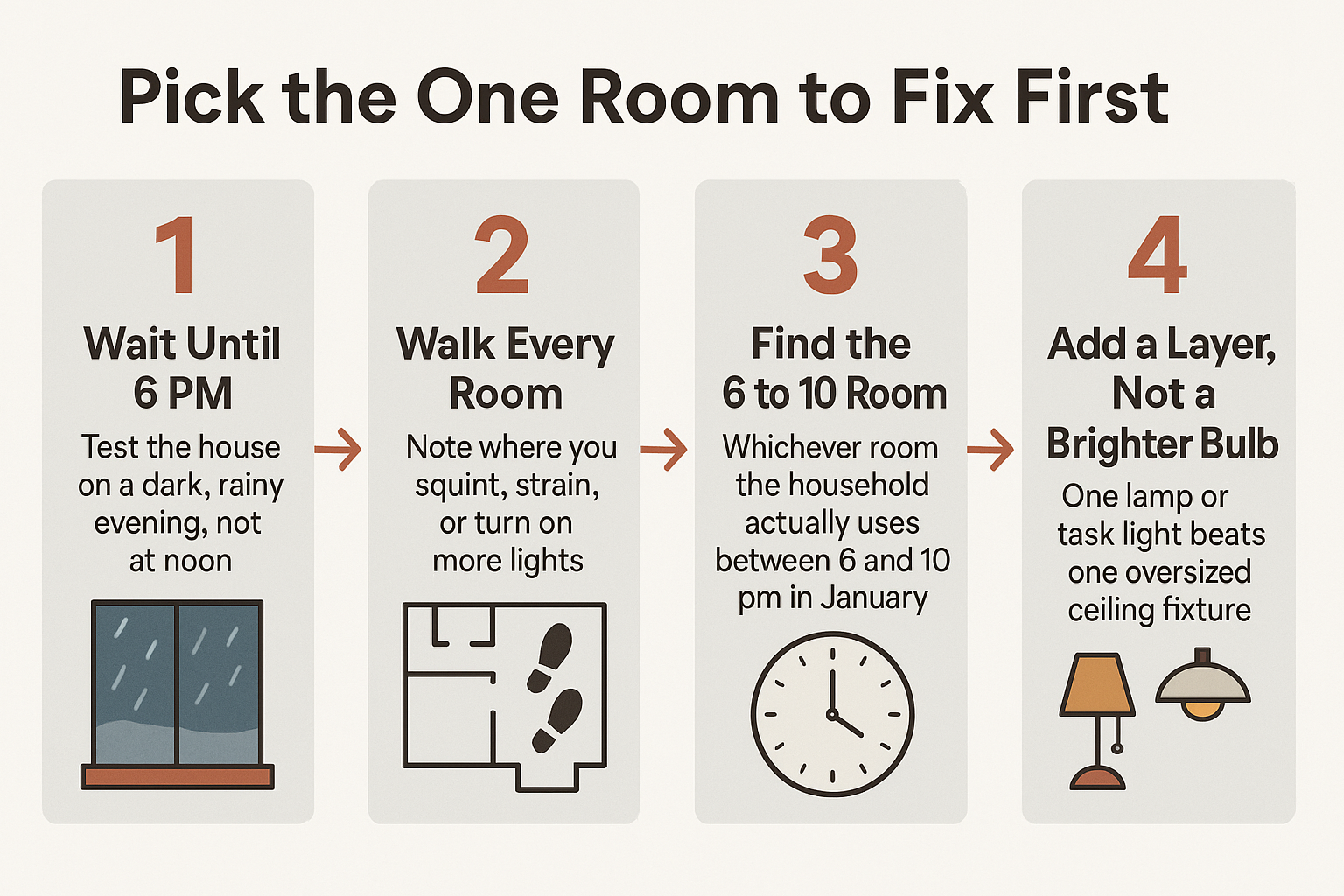
The honest test is simple: walk the house at 6 pm on a rainy evening, not at noon on a clear Saturday. At noon every room passes. At 6 pm in January you find out which rooms were running on daylight the whole time.
The rooms that give out first
They fail in a predictable order, and it has less to do with square footage than with how many light sources the room actually has.
- North-facing rooms. They never got direct sun to begin with. In winter they go dim by mid-afternoon.
- Any room with a single overhead fixture. Spare bedrooms, offices, dining rooms. One source, one flat wash, no depth.
- Hallways and stair landings. Usually lit by one small flush mount, often the oldest fixture in the house, and the one place where dim light is a trip hazard.
- The corner chair someone reads in after dinner. Light from a ceiling fixture twelve feet away lands on the top of a head, not on a page.
- The kitchen counter. This one has a specific, fixable cause.
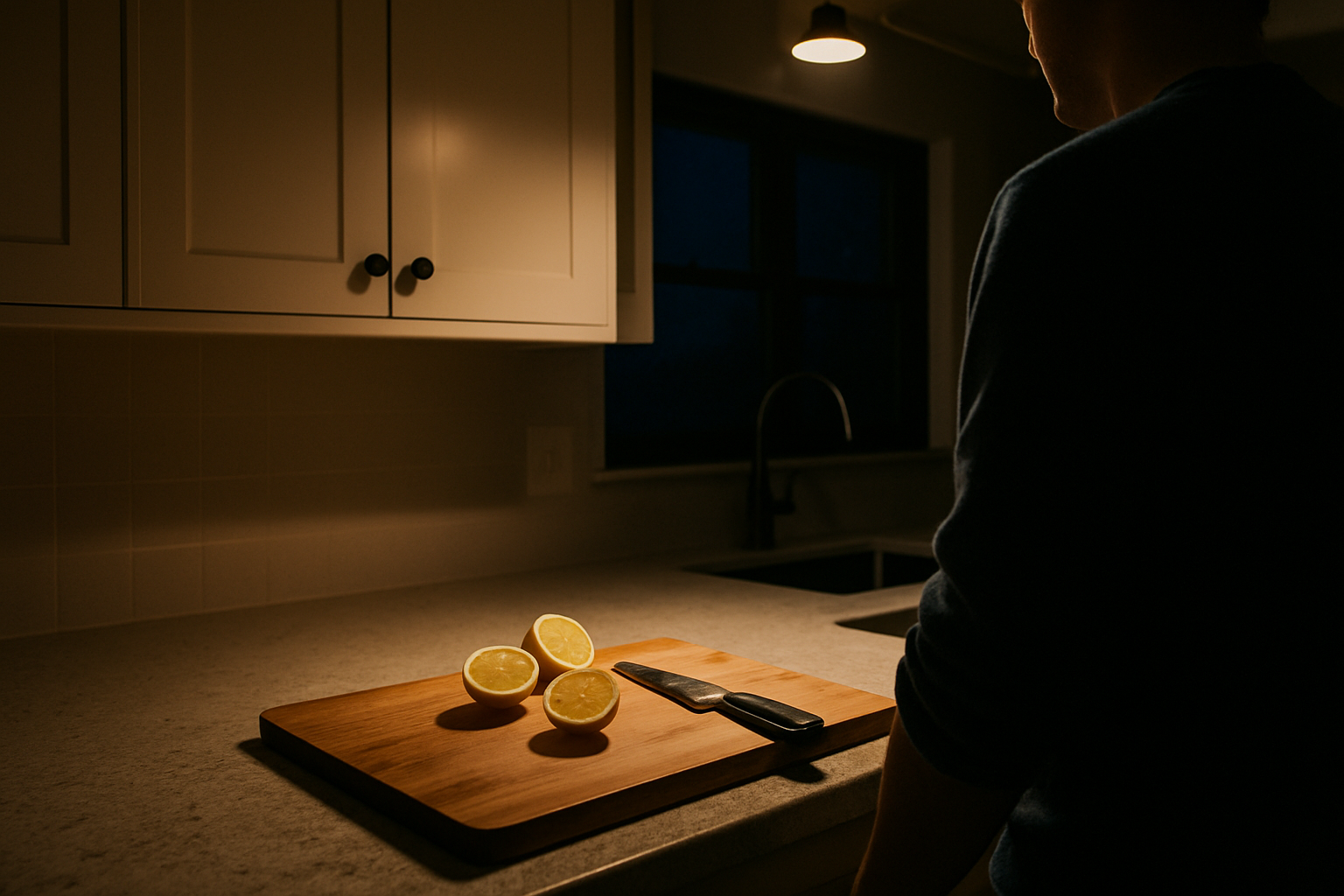
In kitchens the failure is the shadow line. A single ceiling fixture sits behind you while you work, so your own body shades the countertop.
The counter goes dark exactly where the knife is. People turn on every light in the room and the cutting board is still in shadow, because the problem was never output. It was position.
The fix is almost never a brighter ceiling bulb
The instinct is to swap in a higher output bulb. It rarely works, and it often makes the room less comfortable.
A brighter single source gives you more glare, harder shadows, and a room that feels interrogated rather than lit. The ceiling gets bright and the edges of the room stay dark, which is the exact contrast your eyes are already struggling with.
What works is a second and third source at lower output:
- A table lamp on a side table or console, at seated eye level
- A floor lamp beside the reading chair, aimed at the task, not the ceiling
- A task layer under a cabinet or over a work surface, in front of where you stand
- Wall sconces in hallways and on stair landings, which light the walls and make the space read as wider
Three modest sources beat one big one every time you turn them on. This is also why a living room can feel flat even with plenty of light in it, and why brighter bulbs tend to backfire.
Layers also let a room change character. At 4 pm it needs to be bright enough for homework at the table. At 8 pm the same room should be able to drop to a lamp and a dimmed overhead. One ceiling fixture can never do both.
Which layer each room is missing
A quick reference for the rooms that most often come up after the clocks change. Find the room, find the layer it does not have yet.
| Room | What fails at 6 pm in December | Layer it’s missing |
|---|---|---|
| Kitchen | Your body shades the counter under a single ceiling fixture | Task light in front of you, under cabinets or over the island |
| Living room | Bright in the middle, dark at the walls and corners | Two lamps at seated height, plus accent light on a wall or art |
| Reading chair | Light lands on your head, not the page | Floor lamp beside and slightly behind the shoulder |
| Hallway | One small flush mount, long dim stretches | Wall sconces spaced along the run |
| Stair landing | Shadowed treads, uneven footing | A dedicated fixture at the landing, on a dimmer |
| Home office | Screen glare and a dark desk surface | Desk or task lamp, plus a softer ambient source behind the screen |
| Bathroom vanity | Overhead-only light casts shadows under eyes and chin | Sconces or vertical light at face height on both sides |
How to pick the one room to fix first
Most people do not need a whole-house plan. They need one room handled well, and this is a simple way to find it.
More light without a bigger power bill
People raise the energy question in the same breath as wanting more light. One Peninsula homeowner put it plainly in a message to the showroom: “Looking to update lighting in our home. Needs more light and want suggestions as to best obtain this in an energy efficient manner.”
The answer is less of a tradeoff than it sounds. Several efficient fixtures on dimmers usually draw less than one oversized fixture running at full output all evening, because you almost never need every layer on at once.
A few things that matter more than wattage:
- Warmer color temperatures read better after dark. Cooler, bluer light that looks crisp at noon tends to feel clinical at 7 pm.
- Dimmers are both a comfort decision and an energy one. Running three sources at half output is a different room than one source at full blast, and it costs less.
- Controls are regulated now. California’s Title 24 energy standards govern lighting controls and efficiency for remodels and new construction, so if your project pulls a permit, your electrician will be working to those rules.
If a room has no ceiling box at all, that is not a dead end either. There are ways to light a room without rewiring it.
One room, not a whole-house project
National remodeling forecasts have cooled for three straight quarters, with projected growth in owner-occupied improvement and repair spending slowing toward roughly half a percent by mid-2027. Locally that shows up as homeowners finally dealing with the one dark room that has bothered them for years, instead of gutting the house.
Pacific Grove’s median age sits near 50.3, and median home values run somewhere around $1.13 million. Those are owners who have lived with the same fixtures for a long time and want one decision made well, not ten made fast.
So pick by use, not by ambition. Fix whichever room the household actually occupies between 6 and 10 pm in January. If that is the den and not the formal dining room, light the den.
Cost varies widely depending on the fixture, the finish, and whether anything needs rewiring, so it pays to talk through a range before you commit. Doing it one room at a time is a legitimate plan, not a compromise.
Four months of arriving home in the dark and the wet
December is also the wettest month on the Peninsula, around 2.4 inches of rain across roughly 9.9 rain days. For four months, most people are walking from a car to a front door in the dark with their hands full.
Entry lighting is a safety layer before it is a style choice, and it sets the tone for every room behind the door.
If the house is in Carmel-by-the-Sea, exterior fixtures are held to the city’s own standards. Those include fully shielded fixtures, a 3000K color temperature cap, and a lighting plan submitted along with the permit application. Carmel’s municipal code on exterior lighting lays out the shielding requirements and the goal of limiting glare and light trespass.
Rules change, so confirm current requirements with the City or your licensed contractor before ordering anything. And any wiring, mounting, or new circuits belong to your own licensed electrician.
Frequently Asked Questions About Winter Lighting on the Monterey Peninsula
Why does my house feel dark in winter when the bulbs are the same as they were in summer?
Because in summer the windows were doing most of the work. With sunset at 4:51 pm on December 1 and only about six hours of sunshine a day, your fixtures carry the whole evening instead of topping off daylight.
Will a higher wattage bulb fix a dark room?
Usually not. A brighter single source creates more glare and harder shadows while the corners of the room stay dark. Adding a second and third source at lower output gives you a room that feels lit rather than one that feels harsh.
What time of day should I evaluate my lighting?
Around 6 pm on a rainy evening. Every room passes at noon. Only a dark, wet January evening shows you which rooms were coasting on daylight.
Does adding more fixtures mean a higher power bill?
Not necessarily. Several efficient fixtures on dimmers often draw less than one oversized fixture running wide open all night, because you rarely need all layers on at once. Warmer color temperatures also tend to feel brighter and more comfortable after dark at lower output.
Can I just buy a fixture online and have my electrician hang it?
You can, and plenty of people do. The common regret is scale and light quality, since product photos do not show how a fixture actually throws light or renders color in a real room. It helps to see a fixture lit before committing, and to check the dimensions against your room first.
Do Carmel’s exterior lighting rules apply to a simple porch light swap?
They can, depending on the scope of the work. Carmel-by-the-Sea limits exterior fixtures to 3000K and requires full shielding, with a lighting plan filed alongside the permit application. Verify the current requirements with the City or your licensed contractor before you order.
Seeing a fixture lit before you commit
The practical value of a showroom in winter is standing in front of lit displays and watching how a fixture actually throws light and renders color in the room, which no product photo shows. The Home Lighter has been at 2034 Sunset Drive in Pacific Grove since 1969, and Greg and Tammy can talk through a single dark room as readily as a full plan for a Monterey County home. Walk-ins are welcome, appointments are available for more involved projects, and the phone is (831) 655-5500.
