
Direct Answer: Restaurants create their warm, inviting atmosphere with three things: color temperatures in the 2700K-3000K range, multiple light sources at different heights, and dimmers on every circuit.
Homeowners describe it constantly: they walk into a great restaurant, feel immediately at ease, and think, “I want my dining room to feel exactly like this.” Then they get home, flip on the ceiling light, and wonder why the magic never quite arrives. The problem is almost never the furniture or the paint color.
The difference is almost always the lighting. And the good news is that what restaurant designers do is not complicated, it just requires understanding a few principles that most home lighting setups ignore entirely.
For homeowners on the Monterey Peninsula, the stakes are real. These are coastal homes that often do double duty as entertaining spaces, with indoor-outdoor flows that demand a consistent, warm atmosphere from the dining table to the covered patio. Getting ambient lighting for home entertaining right pays off every time guests come through the door.
The Three Things Every Well-Lit Restaurant Gets Right
Walk into any restaurant that feels genuinely comfortable and look past the decor. The lighting is almost always doing three specific things that most home dining rooms are not.
First: color temperature is warm. Restaurant designers consistently work in the 2700K-3000K range. That is the zone where light reads as amber and golden rather than white or bluish. Fixtures outside that range, anything above 3000K, tend to produce a cooler, clinical quality that kills the mood, no matter how beautiful the room is.
Second: light comes from multiple heights. A chandelier or pendant over the table provides a focal point. Wall sconces or picture lights add a mid-level glow. Subtle toe-kick or cove lighting anchors the room at floor level. The result is a kind of visual depth that a single overhead fixture simply cannot produce.
Third: everything is on a dimmer. A restaurant at lunch and the same restaurant at dinner look completely different, and that shift is almost entirely about dimmer levels. Most homes are wired with a single overhead switch that offers two settings: on and off. That limitation eliminates any ability to shift the room’s mood for different uses.
If a living or dining room in Carmel or Pacific Grove is missing any one of these three elements, it will never feel quite the way a well-designed restaurant does, no matter what fixture is hanging from the ceiling. Home lighting controls explained covers dimmer selection in real detail for homeowners who want to go deeper on this.
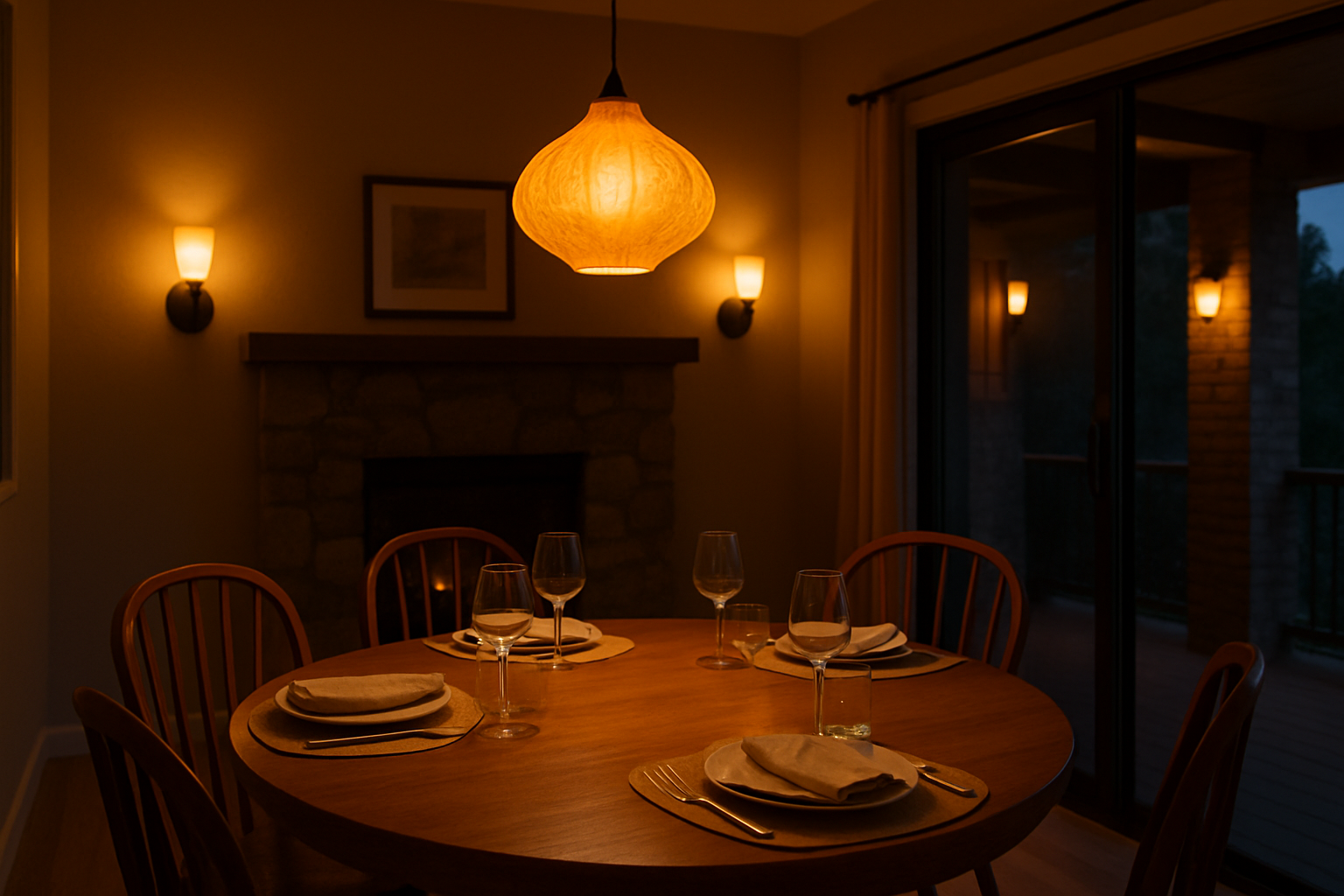
Ambient vs. Accent: The Ratio That Separates Designed Rooms from Bright Rooms
This is the distinction that trips up a lot of homeowners, and it is worth being specific about it.
Ambient light is the base layer, the general glow from a chandelier, ceiling fixture, or recessed cans that lets you move around a room safely. It is the foundation. On its own, though, ambient light produces flat, even illumination that feels institutional rather than inviting.
Accent lighting is the focused layer that does the atmospheric work. It highlights a textured wall, a piece of art, a bookcase, or architectural details. The standard guideline from lighting designers is that accent lighting typically runs at roughly three times the intensity of the ambient layer. That ratio is what creates visual depth, the sense that some surfaces are glowing warmly and others are falling softly into shadow.
A room with only ambient light looks bright. A room with both layers, at the right ratio, looks designed.
To understand what accent lighting actually does and where homeowners most often get it wrong, that piece is worth reading alongside this one.
The fixtures that do the most work in this layered system tend to be:
- A statement pendant or chandelier over the dining table, providing the ambient anchor
- Wall sconces flanking a fireplace or artwork at mid-wall height
- Cove or toe-kick lighting built into cabinetry or millwork for a low, grounded glow
- Adjustable recessed fixtures or picture lights for the accent layer
The fixtures themselves matter, but the distribution across these layers matters more. A single beautiful chandelier in an otherwise flat room is still a flat room.
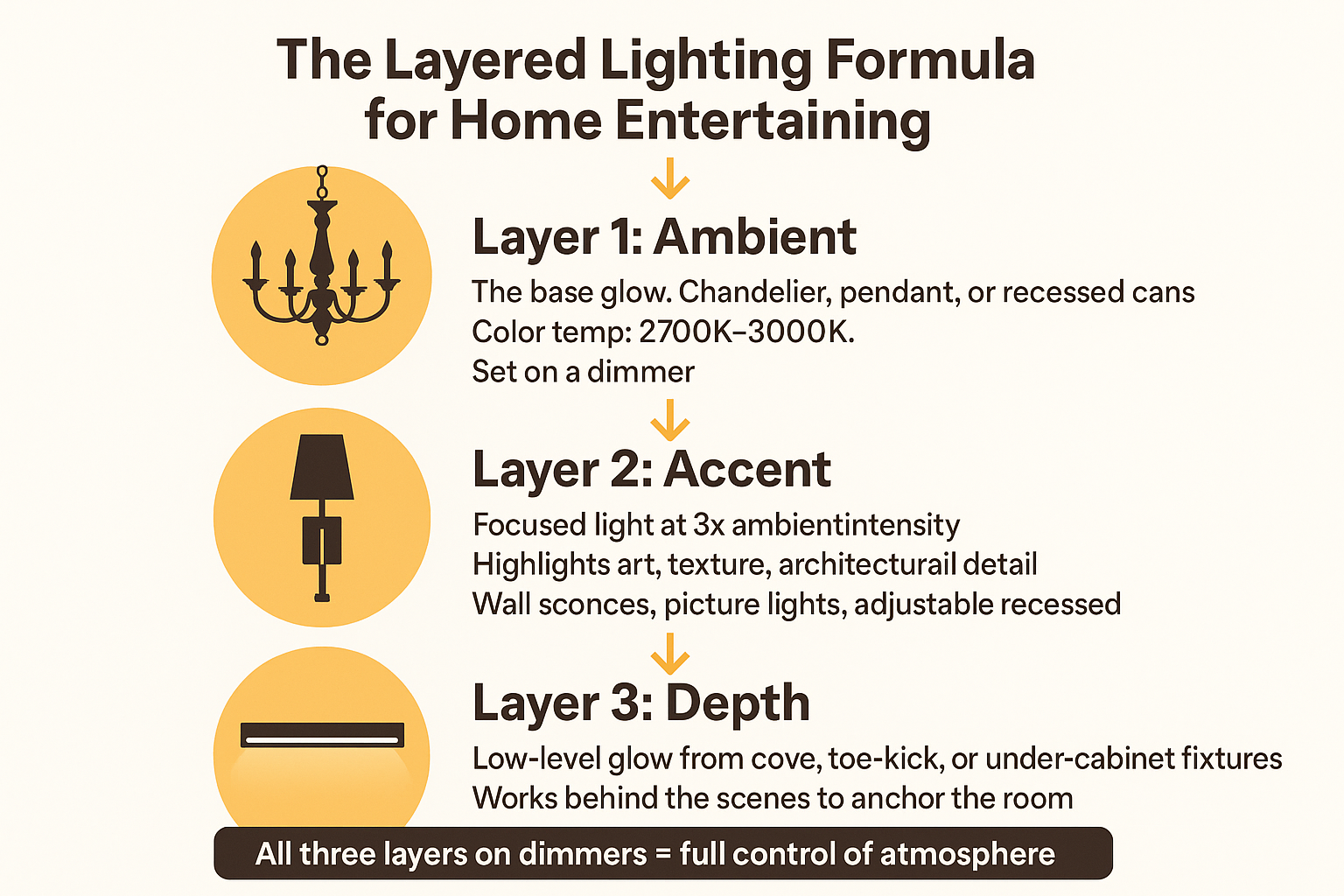
The Layered Lighting Formula for Home Entertaining
This breakdown shows how the three lighting layers work together to create the kind of atmosphere most homeowners associate with a well-designed restaurant.
The Indoor-Outdoor Challenge on the Monterey Peninsula
Summer entertaining on the Monterey Peninsula often means moving between an interior dining space and a covered patio or sunroom, sometimes within the same meal. The lighting challenge in those situations is managing two distinct environments without creating a jarring contrast at the threshold.
The most effective way to do this is to maintain a consistent color temperature across both zones. If the dining room pendant is at 2700K and the patio fixtures are at 4000K, guests stepping outside will notice a cold, unwelcoming shift even if they can’t name why. Keeping both interior and exterior fixtures in the 2700K-3000K range carries warmth through both spaces without any visual interruption.
Outdoor fixtures on the coast also need to stand up to salt air and coastal humidity. Fixtures that look beautiful in a showroom but are not rated for coastal environments can corrode quickly in Pacific Grove, Carmel, or Pebble Beach. Planning outdoor lighting for a Pebble Beach or Carmel property covers those durability and finish considerations in specific terms.
For properties in Carmel-by-the-Sea specifically, exterior lighting choices also carry regulatory weight. The City of Carmel caps residential exterior fixture color temperature at 3000K and restricts lumen output, which means that staying in the warm color temperature range is not just a design preference, it is a compliance requirement. Always verify current requirements with local authorities or a licensed contractor before selecting exterior fixtures.
Comparing Lighting Approaches: Single Overhead vs. Layered System
This comparison shows how a single overhead fixture and a layered lighting system perform across the factors that matter most for home entertaining.
| Factor | Single Overhead Fixture | Layered System (3 Sources) |
|---|---|---|
| Atmosphere | Flat, even, no depth or shadow | Warm depth, visual interest |
| Mood control | On/off only | Fully adjustable with dimmers |
| Color temperature flexibility | One fixed source | Tunable across multiple fixtures |
| Restaurant-quality feel | Rarely achievable | Closely replicable |
| Cost to upgrade | Low, one fixture | Moderate, multiple fixtures, dimmer wiring |
| Indoor-outdoor continuity | Disconnected | Manageable with consistent 2700K-3000K |
Fixed Architecture vs. Portable Fixtures: Which Way to Go
One question that comes up regularly, including from homeowners in Carmel asking about low-voltage options for living and dining rooms, is whether to invest in fixed architectural lighting or work with plug-in and portable fixtures instead.
The honest answer depends on a few practical factors that differ by household.
For a primary residence where the homeowner is staying long-term, fixed architectural lighting, hardwired dimmers, recessed cans, dedicated wall sconce circuits, generally pays off. The control is better, the result is cleaner, and the investment stays with the house.
For a second home, a rental property, or a room where renovation isn’t on the table, portable and plug-in fixtures can do real work. A well-placed torchiere or a pair of table lamps with warm-temperature bulbs can add layers to a room without touching the electrical infrastructure. A statement pendant on a plug-in canopy kit is another option that requires no new wiring.
The underlying principle stays the same either way: multiple sources, warm color temperature, and some form of dimming control. Whether those come from hardwired fixtures or portable ones is a practical decision, not a design one.
If a remodel is involved, California’s updated energy code, effective January 1, 2026, governs lighting controls and efficacy requirements for residential projects. The California Energy Commission’s building energy efficiency standards covers what applies, and what California’s 2026 lighting code means for your remodel translates those requirements into plain language for homeowners.
For most entertaining-focused rooms, the fixtures that do the heaviest lifting tend to be the statement pieces, the pendant over the table, the sconces flanking the fireplace, rather than the background elements. Getting those right, and putting them on dimmers, is where the investment makes the most visible difference. Picking a pendant for a room that isn’t your kitchen covers scale, finish coordination, and placement for dining and living spaces.
Frequently Asked Questions About Ambient Lighting for Home Entertaining
What color temperature should my dining room lights be for entertaining?
Stay in the 2700K-3000K range. That is where light reads as warm and golden rather than white or cool. Anything above 3000K will work against the atmosphere you are trying to create, no matter how good the fixture looks.
Do I really need dimmers, or is that overkill for a home dining room?
Dimmers are not optional if you want real mood control. A restaurant at full brightness during a lunch rush and the same space dimmed for dinner service look like two different rooms, that shift is almost entirely the dimmers working. At home, the same principle applies. A dining room that can only go fully on or fully off will never feel as inviting as one where you can dial things in.
How many light sources does a dining or living room actually need?
Most well-designed entertaining rooms work with at least three sources at different heights, a ceiling-level focal fixture, a mid-level source like wall sconces, and something lower like table lamps or cove lighting. Two can work in smaller rooms. One overhead fixture almost never does the job on its own.
Can I create a layered lighting effect without rewiring the whole room?
Yes, to a degree. Plug-in wall sconces, table lamps with warm-temperature bulbs, and even battery-operated picture lights can add layers without new wiring. The result won’t be as clean as a hardwired system, but it can make a meaningful difference in how a room feels. For rooms where renovation is happening anyway, it is worth wiring in the proper circuits from the start.
My outdoor patio and indoor dining room feel disconnected when I entertain. What fixes that?
The most reliable fix is matching color temperature across both spaces. If interior fixtures are at 2700K and exterior fixtures are at 4000K, that contrast will feel cold every time guests step outside. Keeping both zones in the 2700K-3000K range creates continuity. For properties in Carmel-by-the-Sea, exterior fixtures must also stay at or below 3000K per local ordinance, which makes warm color temperature both a design and compliance choice. Verify current requirements with local authorities.
What fixtures should I prioritize first if I’m working with a limited budget?
Focus on the statement piece over the dining table and add dimmers to any existing fixtures before buying anything new. A well-chosen pendant at 2700K-3000K on a dimmer circuit will do more for an entertaining room than five accessory fixtures at the wrong color temperature. Sconces and lower-level lighting are the next layer, and they can come later.
Ready to See What Layered Lighting Looks Like in Person?
The Home Lighter’s showroom at 2034 Sunset Drive in Pacific Grove has served Monterey Peninsula homeowners since 1969, and the curated collection on display is a working demonstration of how layered lighting actually feels in a room. Walk-ins are always welcome, and appointments are available for more involved projects. Greg and Tammy at The Home Lighter can be reached at (831) 655-5500, or stop by and see it for yourself.