
Planning a new build or a major remodel on the Central Coast? Understanding California's Title 24 is your first step. Think of it not as a complex set of rules, but as the state’s blueprint for a smarter, more energy-efficient home that saves you money.
At its core, Title 24 is the Building Energy Efficiency Standard. It was created to slash energy waste, lower utility bills, and champion sustainable living. For homeowners, this means your lighting plan is a key part of building a home for the future.
What Is Title 24 and Why Does It Matter for My Home?
Title 24 is California's official rulebook for energy conservation in new and altered buildings, including residential homes. Its goal is simple: ensure every home is built to be as energy-efficient as possible from the start.
For homeowners, builders, and designers in communities like Monterey, Salinas, and Santa Cruz, these regulations are the foundation of lighting design. The rules don’t stifle creativity; they guide you toward modern, high-performance technology that elevates your space while saving money and resources.
The Foundation of Modern Energy Codes
California has been a leader in sustainability for decades. The california title 24 lighting requirements first appeared in 1978 as part of the state's forward-thinking energy conservation movement.
The California Energy Commission updates Title 24 every few years to keep pace with new technologies and higher conservation goals. You can explore the code's evolution and learn more about its history in detail. This cycle of improvement means compliance today is about embracing modern solutions that make our homes better.
At its heart, Title 24 is about building smarter from the start. It ensures your lighting plan is an integral part of a high-performing, comfortable, and future-ready home.
To help you understand what this means for your project, here’s a quick breakdown of the main lighting standards.
Key Areas Covered by Title 24 Lighting Standards
| Requirement Area | What It Means for Your Home |
|---|---|
| High-Efficacy Fixtures | Most of your lights must be energy-efficient, producing more light (lumens) for less power (watts). This is why LED is the go-to choice. |
| Mandatory Controls | Dimmers and vacancy sensors (which turn lights off automatically) are required in most spaces to prevent wasted electricity. |
| Room-Specific Rules | Different rooms have different needs. Kitchens and bathrooms, for example, have some of the most detailed requirements. |
| Outdoor Lighting | Exterior lights must also be efficient and are often required to have controls like photocells or motion sensors to save energy. |
These rules work together to create a smart, cohesive lighting system. Let’s take a closer look at what each of these components involves.
The Power of High-Efficacy Lighting
A core idea behind the California Title 24 lighting requirements is the push for 'high-efficacy' lighting. Think of it like fuel efficiency in a car—you want more miles per gallon. High-efficacy lighting is the same concept: getting more light output (lumens) for every watt of energy used.
This focus on performance ensures today's homes are beautifully lit and engineered to operate with minimal energy waste. By mandating fixtures that provide brilliant illumination without guzzling power, Title 24 helps homeowners choose smarter lighting that pays back on utility bills.
Why LEDs Are the Standard for Compliance
When you need to meet high-efficacy standards, modern LED (Light-Emitting Diode) technology is the undisputed champion. Unlike old incandescent bulbs that waste most of their energy as heat, LEDs convert electricity directly into light with incredible efficiency. This makes them the automatic choice for any Title 24 compliant project.
Finding a compliant fixture is simple: look for products certified by the California Energy Commission (CEC). These fixtures are tested and approved to meet the state's tough performance standards, taking the guesswork out of your selection. At The Home Lighter, we can guide you through our collection of CEC-certified and energy-efficient lighting solutions that blend performance with stunning design.
Key Takeaway: High-efficacy lighting isn't about sacrificing brightness or style. It's about achieving the perfect ambiance with fixtures designed to do more with less, making your home both beautiful and smart.
The code uses a flexible, percentage-based system, focusing on rooms where lighting is used most. This allows for a balanced design that blends functional, efficient lighting with the special decorative pieces you love.
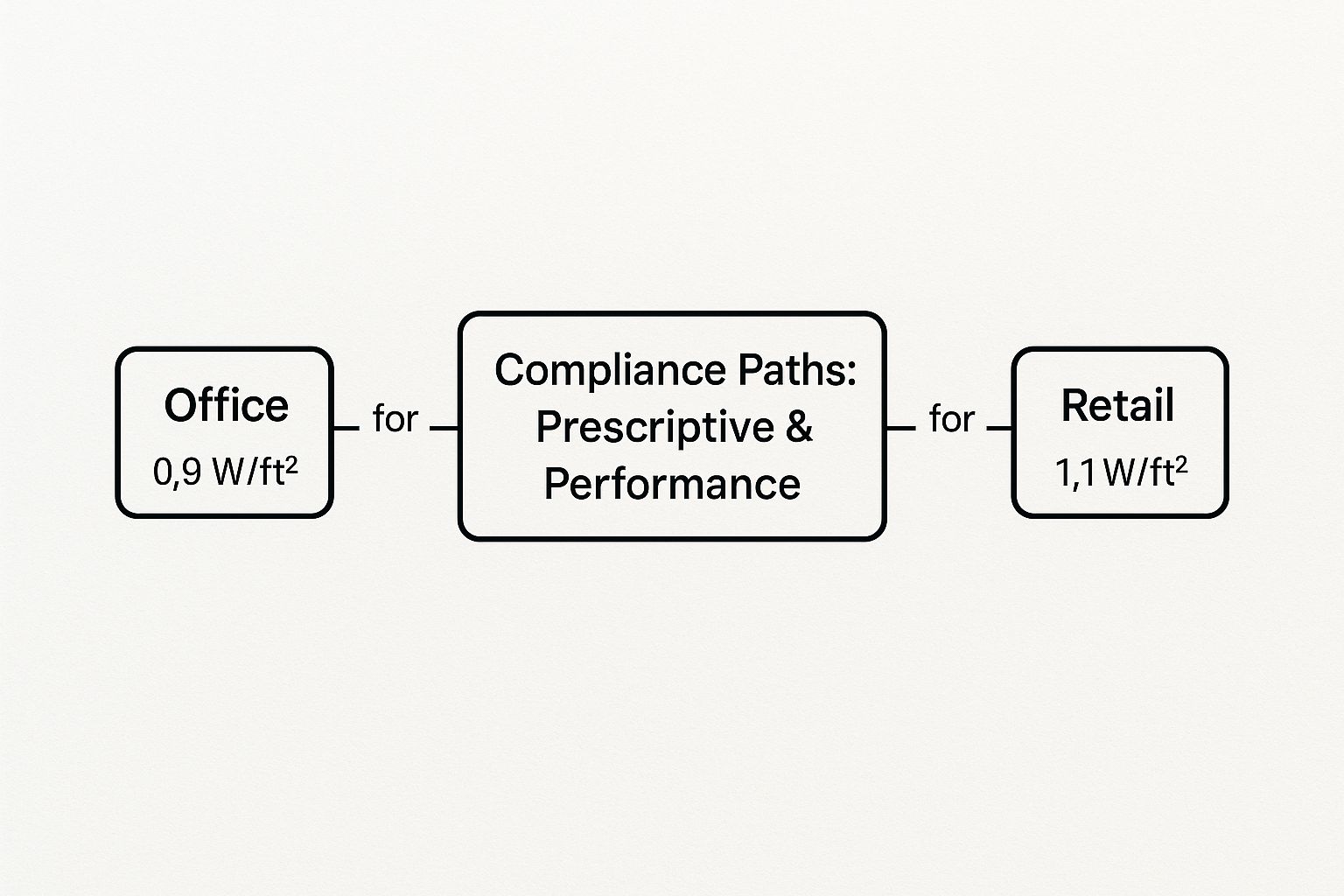
Different buildings have specific power limits, which is why efficient fixtures and clever compliance strategies are so important.
Room-by-Room High-Efficacy Rules
Nowhere are the high-efficacy rules more specific than in the busiest rooms of your home—kitchens and bathrooms. These spaces are workhorses demanding bright, functional light, so Title 24 puts special emphasis on making their lighting plans as efficient as possible.
In kitchens, at least 50% of the total rated wattage must come from high-efficacy sources. This ensures your main lights—like recessed cans or under-cabinet task lighting—are powered by energy-sipping LEDs.
Let's break it down with a real-world example from a Carmel bungalow remodel:
- The Kitchen Plan: The design includes eight recessed LED downlights for general lighting, a run of LED under-cabinet strips for tasks, and two beautiful, low-wattage decorative pendants over the island.
- The Compliance Check: The recessed lights and under-cabinet strips are high-efficacy and make up the bulk of the wattage. The decorative pendants are perfectly fine because the overall plan easily clears the 50% threshold.
This logic applies to other high-use areas like bathrooms, garages, and laundry rooms. As long as your primary light sources are efficient, you have the freedom to add your personal stylistic flair.
Mastering Your Home's Lighting Controls
Beyond efficient bulbs, the California Title 24 lighting requirements emphasize smart controls. Think of these as the brain of your lighting system, ensuring you only use energy when and where you need it. These controls are key to compliance and transform how you interact with your home.
These aren't just extra gadgets; they are the foundation of modern energy management. They turn a simple light switch into a powerful tool for savings and convenience.
The Role of Dimmers in Every Room
One of the most common controls required by Title 24 is the dimmer. The days of a simple on/off switch are over; now, nearly every permanently installed fixture needs a dimmer or similar control.
A dimmer lets you adjust a light’s brightness, which does more than set the mood. Lowering the brightness directly cuts energy use, leading to serious savings over time and extending the life of your LED bulbs.
By requiring dimmers, Title 24 makes saving energy a natural part of your daily routine. You get total control over your home's atmosphere, from bright task lighting in the kitchen to a soft, relaxing glow in the evening.
This adaptability is a game-changer for the indoor-outdoor lifestyle we love on the Central Coast. Imagine dimming your living room lights to match the soft glow of a sunset over Monterey Bay, creating a seamless transition that enhances how your home feels.
Automatic Savings with Vacancy and Occupancy Sensors
Title 24 also requires automated controls in certain areas to prevent lights from being left on by mistake. This is where vacancy and occupancy sensors shine.
- Vacancy Sensors: You manually turn lights on, but the sensor automatically shuts them off when the room is empty. This “manual-on, auto-off” function is a core requirement for bathrooms, laundry rooms, and garages.
- Occupancy Sensors: These sensors are fully automatic, turning lights on when you enter and off when you leave. They are a great convenience in closets or pantries.
The logic is simple but effective. We often use rooms like bathrooms for short periods, and it's easy to forget to flip the switch. According to the U.S. Department of Energy, using these sensors can cut lighting energy waste by 30% or more.
Integrating Controls for a Smarter Home
These controls are the perfect launchpad for a fully integrated smart home. Modern systems can tie your dimmers, sensors, and even automated shades into one seamless network.
Picture a "Good Night" scene that dims your bedroom lights, turns off all other lights, and lowers the shades with one button. Exploring a professional smart home lighting installation can reveal just how powerful these systems can be.
Inside vs. Outside: A Tale of Two Lighting Strategies
California's Title 24 lighting requirements have two distinct personalities: one for inside your home and one for the outdoors. This smart approach tackles different goals.
Inside, the focus is on energy efficiency and user control. Outdoors, the rules add another layer of responsibility: saving energy while protecting the incredible dark night skies we cherish here on the Central Coast.
Outdoor Lighting: Smart Controls for Dark Skies
Outdoor lighting must be both efficient and smart. Under Title 24, any permanently installed outdoor fixture must be high-efficacy and have automated controls to prevent it from burning all night.
Your outdoor lighting plan needs to include at least one of these control methods:
- Photocell with Motion Sensor: The photocell knows when it's dusk and dawn, while the motion sensor ensures lights are only at full brightness when there's activity. The rest of the time, lights must switch off or dim significantly.
- Astronomical Time Clock: This "GPS for your lighting" knows your location and the time of year to turn lights on at sunset and off at sunrise. It must also include a feature to lower light levels during late-night hours.
- Energy Management Control System (EMCS): For complex setups, an EMCS can tie everything together, but it must still meet the fundamental on/off and dimming requirements.
These controls are a brilliant two-for-one solution. They slash energy waste and are essential for fighting the light pollution that washes out our view of the stars.
This push to preserve dark skies reflects our local values on the Monterey Peninsula, ensuring home security lighting doesn't come at the cost of our region’s natural beauty.
Keeping Light Pointed in the Right Direction
Another key piece of the outdoor puzzle is the fixture design. The code is clear: most outdoor fixtures must be "cutoff" or "fully shielded." This means the fixture aims all its light downward, where you need it.
This rule accomplishes several things:
- Improves Safety: It lights walkways and patios without creating harsh, blinding glare.
- Stops Light Trespass: It keeps light contained on your property, not in your neighbor’s window.
- Fights Sky Glow: Directing light down is the most powerful tool for reducing light pollution.
Exceptions exist for low-wattage decorative lighting, like the ambient glow from outdoor string lights for your patio. By using shielded fixtures for essential areas and adding thoughtful decorative touches, you can create a design that is both breathtaking and fully up to code.
When Does Title 24 Apply to Your Project?
The number one question we get from homeowners is, "Do I actually need to worry about Title 24?" The California Title 24 lighting requirements extend far beyond building a new house from scratch.
The rules apply anytime a home's lighting system gets a major overhaul. This means your remodel might just trigger compliance, and it's best to know that upfront.
Common Triggers for Title 24 Compliance
The code kicks in for alterations and additions. An alteration is any change to your home's existing systems, while an addition is new conditioned space you build onto your home.
This covers many popular renovations Central Coast homeowners undertake:
- A Major Kitchen Remodel: If you are designing a completely new lighting layout, you will almost certainly need to comply.
- A Master Suite Addition: Building a new primary bedroom and bathroom adds new space that must meet today's energy standards.
- Finishing a Basement or Attic: Turning an unconditioned space into a livable room also brings it under the code's requirements.
The rule of thumb is this: if your project involves changing more than 40 light fixtures, you’re expected to follow the code's lighting standards. Even a modest-sized Carmel home getting a refresh of its old recessed lighting can easily hit that number.
Planning Ahead for a Compliant Project
Figuring out if your project falls under Title 24 is the critical first step. It helps you dodge last-minute scrambles and ensures your final design is beautiful, functional, and legal.
If your Santa Cruz kitchen remodel needs to be compliant, you'll want to plan for high-efficacy LED lights and vacancy sensors from day one. To learn more about compliant tech, check out our guide on LED lighting and energy savings. By sorting out compliance needs early, you can make smart choices you love while meeting every energy standard.
How The Home Lighter Can Help
Trying to make sense of California's Title 24 lighting requirements can feel like a maze. Having a local lighting expert in your corner can turn a complex chore into a smooth part of your design process.
You don’t need to become a Title 24 guru—that's our job. At The Home Lighter, we guide homeowners, designers, and builders on the Monterey Peninsula to meet every requirement without sacrificing style. We translate code-speak into beautiful, practical lighting solutions.
A Design-First Approach to Compliance
We start every project with a conversation about your vision, whether it's a sleek, modern kitchen in Santa Cruz or a cozy Carmel cottage. Then, we build a compliant lighting plan that brings it to life.
We believe compliance should never get in the way of great design. Our job is to handle the technical rules so you can focus on creating a home you love.
Our partnership means we’re with you at every step:
- Fixture Selection: We’ll point you toward perfect high-efficacy fixtures that fit your personal taste.
- Control Design: We thoughtfully weave in required dimmers and vacancy sensors so they feel natural to use.
- Layout Optimization: Our team designs lighting plans that create beautiful, layered light while ensuring an easy final inspection.
We Handle the Headaches (and the Paperwork)
One of the most frustrating parts of Title 24 is the paperwork. The state requires specific forms, like the CF2R-LTG-01, to be filled out perfectly.
We take that entire burden off your shoulders. By managing the specifications and double-checking every detail, we ensure your project's documentation is spot-on and ready for sign-off. Our goal is to make compliance feel seamless, so your project moves forward without a hitch.
Frequently Asked Questions About Title 24
Diving into the California Title 24 lighting requirements often brings up a few questions. Here are straightforward answers to the most common ones we hear from homeowners on the Central Coast.
What Is the Difference Between a Vacancy Sensor and an Occupancy Sensor?
A vacancy sensor is semi-automatic. You manually turn lights on, but the sensor automatically turns them off after you leave. This "manual-on, auto-off" setup is what Title 24 requires for most bathrooms and several other rooms.
An occupancy sensor is fully automated. It turns the lights on when you enter and off when you exit. This hands-free solution is perfect for closets, pantries, or laundry rooms.
Do I Have to Use Dimmers on Every Single Light?
Pretty much, yes. Under Title 24, the vast majority of permanently installed lights need to be connected to a dimmer or similar control device. This applies to your main general and task lighting.
The idea is simple: giving you the ability to lower light levels is one of the easiest ways to save energy. There are a few exceptions, but the best rule of thumb is to plan on having dimmers in every key space.
Can I Still Use My Favorite Decorative Chandelier?
Absolutely! The code is designed to make homes more efficient, not to kill your personal style. While it mandates that most lighting be high-efficacy, it includes an allowance for those special decorative pieces.
The trick is to create a balanced lighting plan. You can showcase that stunning antique chandelier as long as the room's workhorse fixtures—like recessed or under-cabinet lights—meet the high-efficacy standard. It’s all about mixing compliance with character.
Is My Small Bathroom Remodel Subject to Title 24?
It depends on the scale of your project. If you're just swapping one vanity light for another, you probably won't have to worry about the full suite of Title 24 rules.
However, the rules kick in when the project gets bigger. If your remodel involves altering a significant number of your home's fixtures, moving walls, or running new wiring, it will likely trigger full compliance. You would then need to install high-efficacy lights and a vacancy sensor to meet the code.
How Do I Know if a Light Fixture Is High-Efficacy?
The easiest way to stay compliant is to choose LED. Nearly all modern LED products are considered high-efficacy, giving you plenty of light while using very little power. For more tips, our guide on the best energy-efficient light bulbs is a great place to start.
For guaranteed compliance, look for fixtures certified by the California Energy Commission (CEC). This certification is your assurance that the product meets the state's tough energy standards, taking all the guesswork out of the equation.
Making sense of these regulations is what we do every day. The experts at The Home Lighter, Inc. are here to help you design a beautiful, fully compliant lighting plan for your Central Coast home. Reach out to us today to get started.