
Direct Answer: Wall sconce height depends on the room: 60-66 inches from the floor works for hallways, while living rooms often do better at 48-54 inches. Shade direction and scale matter just as much as height.
Not long ago, a customer came in with a very specific problem. Large decorative brass overlays were already mounted on their wall, and they needed a wall sconce that could sit in front of them without looking like an afterthought. That situation reveals something most people don’t realize when they start shopping for sconces: very few homeowners are starting with a blank wall. There’s existing trim, artwork, a mirror, a console table, or some other architectural element already in play.
Getting the sconce wrong in that context doesn’t mean picking an ugly fixture. It means picking a beautiful fixture that ends up feeling awkward because the height is off by six inches, or the shade throws light in exactly the wrong direction. These are the decisions that don’t show up in a product photo.
This guide covers living rooms, hallways, stairwells, and dining rooms, specifically the height numbers, shade direction choices, and layering logic that determine whether a sconce actually works in a real room. If you’re dealing with bathroom vanity placement specifically, that’s a separate topic covered in Bathroom Vanity Lighting: Height, Width, and Why Both Matter.
Height Is Not One Number, It Depends on the Room
The most common mistake people make is treating sconce height as a universal rule. It isn’t. The right mounting height changes based on how you use the room and whether people are mostly standing or sitting in it.
Hallways and stairwells are the most straightforward. Mounting at 60 to 66 inches from the floor to the center of the fixture puts the light at roughly eye level for a standing adult. That height feels welcoming, scales well to standard 8-foot ceilings, and creates a path of light that reads naturally as you move through the space.
Living rooms are different because most of the activity happens seated. A sconce at 60 inches in a room full of sofas and armchairs can throw light directly into a seated guest’s eye line. Dropping to 48 to 54 inches above the floor, or positioning the sconce just above sofa back height, creates a softer ambient layer that adds warmth without creating glare. If your sofa sits against the wall, a sconce mounted 10 to 12 inches above the sofa back is a reliable starting point.
Dining rooms that use wall sconces alongside a chandelier call for a different approach entirely. The sconces shouldn’t compete with the pendant for visual attention. Mounting at 60 to 66 inches and choosing a shade that washes the wall rather than draws the eye lets the chandelier stay the focal point while the sconces add depth and warmth around the perimeter.
All of these are starting points. Ceiling height, room geometry, and what’s already on the wall will nudge every number up or down. For a room with 10-foot ceilings, add a few inches. For a narrow Carmel cottage hallway, the standard range may need to come down to keep proportions from feeling top-heavy.
Wall Sconce Height by Room Type
These ranges are starting points for rooms with standard 8-foot ceilings. Adjust up for taller ceilings and down for tighter or lower spaces.
| Room | Recommended Height (floor to center) | Primary Goal |
|---|---|---|
| Hallway or stairwell | 60 to 66 inches | Eye-level path lighting, human-scaled warmth |
| Living room (seated use) | 48 to 54 inches, or above sofa back | Ambient fill without eye-level glare |
| Dining room (with chandelier) | 60 to 66 inches | Wall wash that supports, not competes with, pendant |
| Beside artwork or a mirror | Centered on the piece, typically 60 to 65 inches | Accent or framing light on the focal point |
Shade Direction: The Decision Most People Get Wrong
Shade direction is where most homeowners make the wrong call without realizing it, and it’s usually because they chose based on how the fixture looked in a product photo, not how it would actually behave on their wall.
There are three basic configurations:
- Upward-facing shade: Light bounces off the ceiling and comes back down as diffused ambient fill. Good for hallways and living rooms where you want warmth without a harsh focal point. Works especially well in rooms with lower ceilings where you want to push the eye upward.
- Downward-facing shade: Light falls onto the wall below the fixture and onto adjacent surfaces. More directional and dramatic. Good for flanking artwork, creating pools of light in a dining room, or adding a moody depth to a space with high ceilings.
- Bi-directional (open top and bottom): Does both. The most versatile option for general living spaces, and the safest choice when you’re not sure how the light will behave in the room.
The ceiling height matters here too. An upward-facing sconce in a room with a 9-foot ceiling looks great. In a room with an 8-foot ceiling, it can feel like the light is cramped and has nowhere to go. A showroom visit lets you see these effects with fixtures actually illuminated, something a website photo cannot replicate. This connects directly to how to read a room before you pick a light fixture, which walks through the broader process of evaluating a space before making any fixture decision.
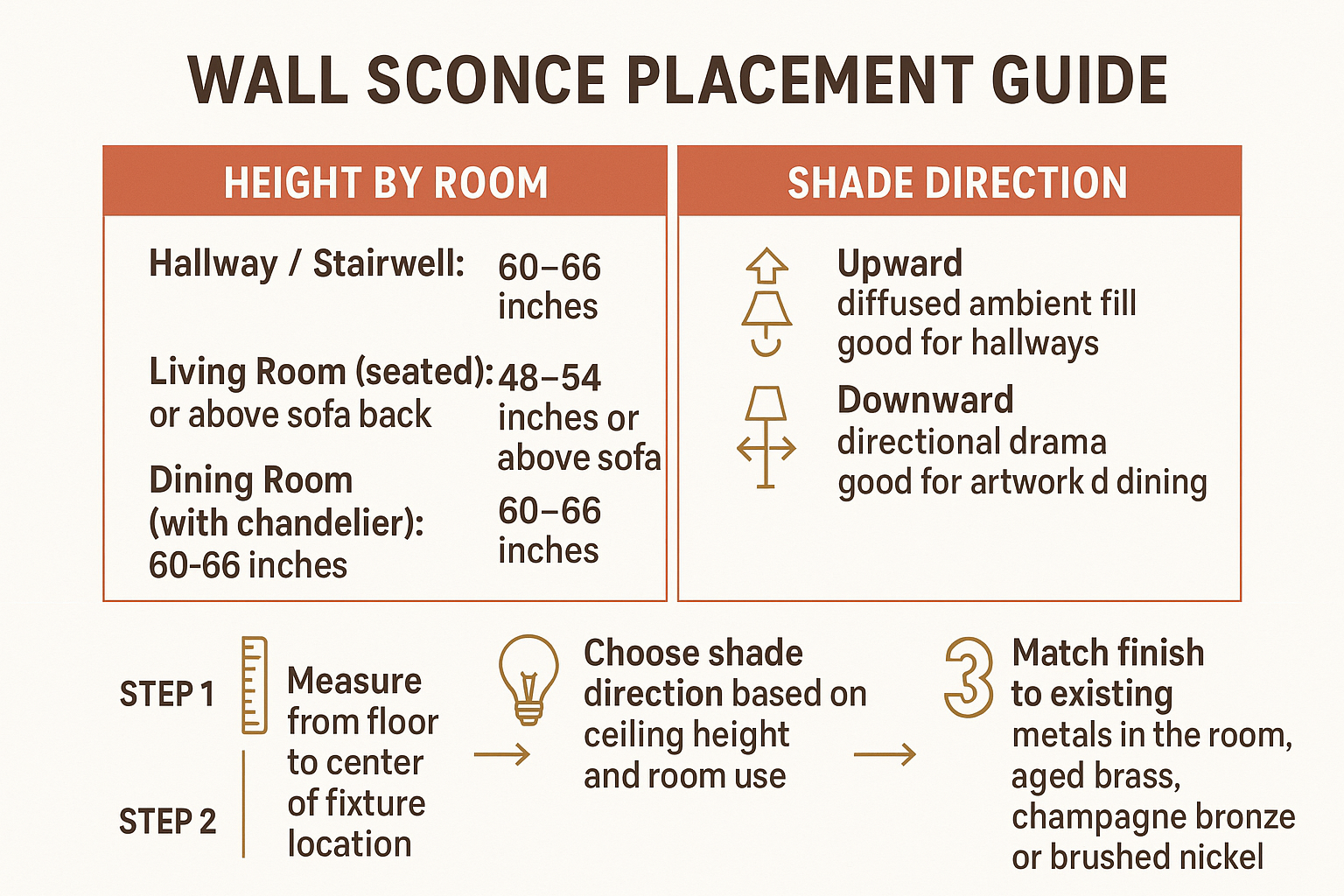
Wall Sconce Placement at a Glance
This reference graphic summarizes the three key decisions for wall sconce placement: height by room, shade direction by use case, and finish guidance for coastal California homes.
Scale, Finish, and Why the Wall Itself Is Part of the Decision
A sconce that looks right in a wide great room in Pebble Beach can look completely out of proportion in a narrow hallway in a Pacific Grove craftsman. The wall surface area around the fixture changes how big or small it reads, and most people don’t account for that when they’re browsing online.
As a starting point, a sconce backplate or shade width of 5 to 7 inches tends to read well in a standard hallway. A living room accent wall or wide dining room wall can support something larger, in the 9 to 14 inch range, without feeling oversized. When in doubt, cut a piece of cardboard to the fixture dimensions and tape it to the wall before committing.
On finish, the 2026 trend toward warm metals, aged brass, champagne bronze, and textured finishes, is directly relevant to sconces because they live at eye level, they repeat across a room, and they register as a deliberate material choice more visibly than almost any other fixture type. In a coastal California home with wood floors and natural stone, an aged brass or hammered bronze sconce is a grounded, durable choice. These aren’t finishes that will feel dated in a few years. They read as honest materials that belong in a coastal environment.
For homeowners who are already navigating finish coordination across a remodel, the pendant fixture selection guide covers the finish coordination logic in more detail and applies directly to sconce decisions as well.
Sconces Are a Lighting Layer, Not a Decoration
A living room with only recessed ceiling lights has a flat, institutional feel after dark. The light comes from one direction, there’s no variation in depth, and nothing changes the mood of the room when you dim the overheads. Adding a pair of sconces at sofa height doesn’t just make the room look better, it changes how the room feels to be in.
Wall sconces create shadow and depth by putting light sources at a lower plane, which is exactly what overhead lighting cannot do. That’s not a style preference. It’s physics. The layered lighting approach that transforms a flat room into a warm one depends on sources at multiple heights, and sconces are often the missing layer.
For dining rooms where a chandelier already anchors the space, pairing it with wall sconces that wash the perimeter walls creates a completely different atmosphere than the chandelier alone. The chandelier draws the eye; the sconces hold the room. That combination is what gives restaurant lighting its warmth, and it translates directly to a residential dining room when the fixtures are scaled and placed correctly. The guide to recreating restaurant lighting at home gets into the specific techniques if that’s the effect you’re after.
The key takeaway: sconces work best as part of a plan. Adding one as an afterthought often leaves it feeling disconnected. When the placement, height, shade direction, and finish all work together from the start, the fixture disappears into the room in the best possible way, you stop noticing the fixture and start noticing how good the room feels. The Energy Star fixture database is also a useful reference if you want to verify which sconce options carry energy efficiency ratings before you buy.
Frequently Asked Questions About Wall Sconce Placement
Can I mount wall sconces at different heights in the same room?
Within a single room, sconces should generally be mounted at a consistent height to maintain visual order. The exception is when they’re serving completely different functions, for example, a pair flanking a fireplace versus a single sconce illuminating artwork across the room. If they’re the same fixture repeated across a room, keep them at the same height.
What if I have existing architectural elements on the wall, like decorative overlays or paneling?
This is more common than most people expect. The fixture needs to work with what’s already there, in terms of projection depth, shade size, and finish. A sconce with a shallow backplate and a small shade footprint gives you more flexibility when you’re layering over existing wall details. This is exactly the kind of situation where seeing options in person, rather than ordering online, saves a lot of frustration.
How many sconces do I need for a living room or hallway?
Hallways typically space sconces 6 to 8 feet apart along the run, which creates a rhythmic path of light without over-illuminating the space. Living rooms usually use sconces in pairs, one on each side of a sofa, fireplace, or doorway. Symmetry reads as intentional; an odd number of sconces in a symmetrical space tends to feel unresolved unless the room layout itself is asymmetrical.
Do wall sconces need to be on a dimmer?
Ideally, yes. Sconces at eye level in a living room or dining room benefit significantly from dimming because their whole purpose is to set mood and warmth, both of which change depending on time of day and what you’re doing in the room. California Title 24 also has dimmer requirements for certain renovation projects. The California 2026 lighting code guide covers what those requirements mean in practical terms for a remodel.
How do I know which finish to choose if I have mixed metals in my home already?
Mixed metals are fine, the goal is to choose one dominant finish and let the others play a supporting role. If you have brushed nickel door hardware and a black-framed mirror, an aged brass sconce can still work as long as it appears more than once in the room (a pair of sconces, for example). Repetition is what makes a finish read as intentional rather than accidental.
Is there a way to test sconce placement before my electrician comes to wire them?
The cardboard template method works well. Cut a piece to the approximate dimensions of the fixture’s backplate and shade, tape it at your proposed height, and live with it for a day. Also consider how the light will hit the wall at that height by holding a flashlight at the fixture location pointing in the shade direction you’re considering. It’s a rough approximation, but it catches obvious problems before any wiring happens.
Ready to Get the Placement Right Before Anything Goes on the Wall?
Greg and Tammy at The Home Lighter have been working through exactly these kinds of decisions with Monterey Peninsula homeowners for decades, including the ones involving unusual wall conditions, mixed finishes, and rooms where the layout makes the standard rules a starting point rather than a final answer. The showroom at 2034 Sunset Drive in Pacific Grove has sconces illuminated and on display so you can actually see how different shade directions and finishes behave. Walk-ins are welcome, and appointments are available for more involved projects. Give them a call at (831) 655-5500 if you’d like to talk through what you’re working with before you come in.