
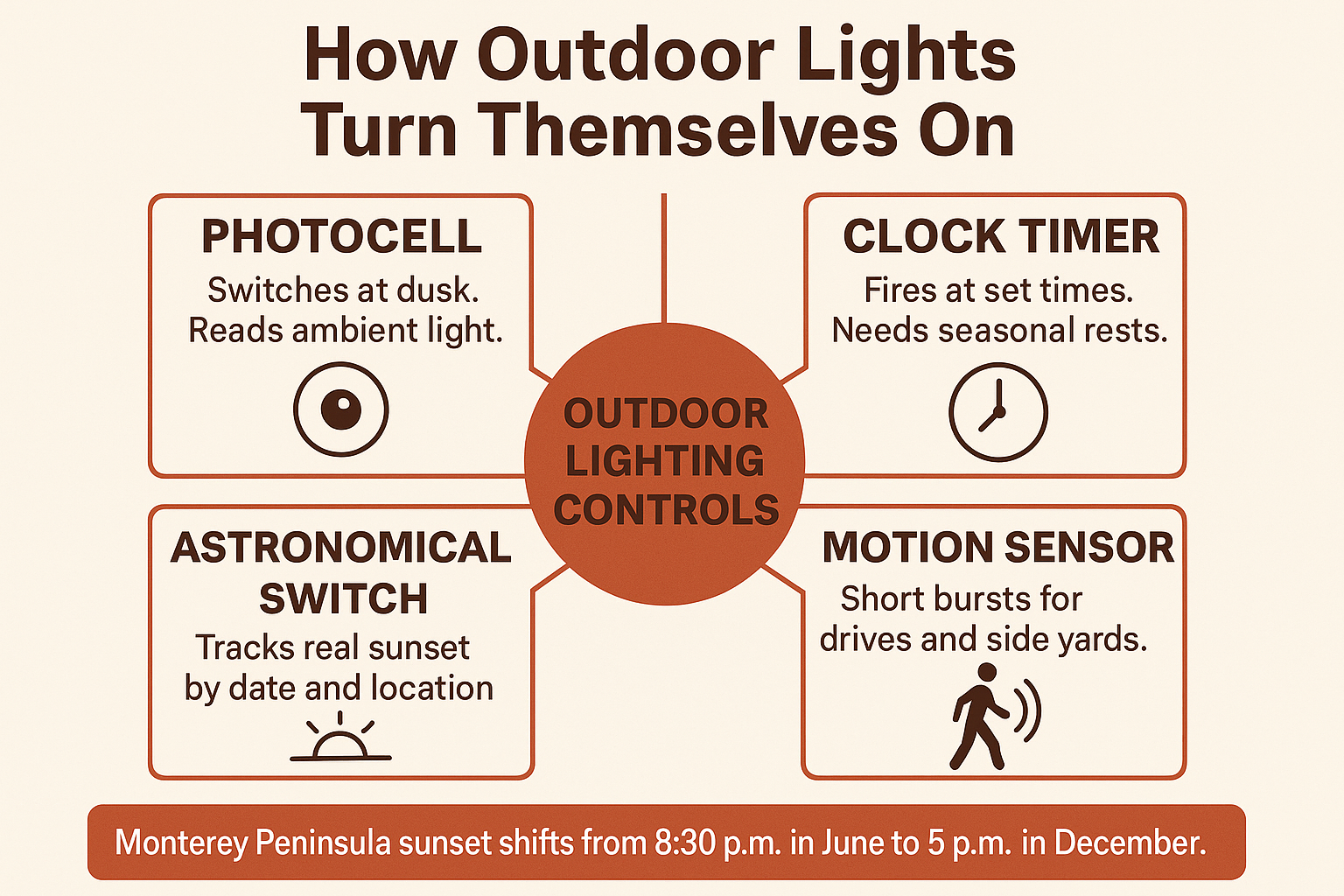
Direct Answer: Outdoor lights switch on by photocell at dusk, by clock timer, by an astronomical time switch that tracks real sunset, or by motion sensor. Most homes use a combination.
The fixtures are picked. The walkway looks good. And then somebody asks the question nobody planned for: how do these lights turn on?
That gap shows up constantly on the Monterey Peninsula. One project manager reaching out about a Peninsula property asked about putting new landscape fixtures on a programmable timer or automated control system, which is smart, except that question usually gets asked last instead of first.
Fixture selection is only half the decision. The control method decides whether the system feels effortless or whether you are out there fiddling with a dial by the second winter.
The four ways outdoor lights actually switch on
There are really only four mechanisms in common use, and each one is good at something different.
- Photocell: reads ambient light and switches the fixture on at dusk, off at dawn. No programming, no seasonal adjusting.
- Mechanical or digital timer: fires at clock times you set, like 6:00 p.m. on and 11:00 p.m. off. Predictable, but it does not know what the sky is doing.
- Astronomical time switch: tracks the real sunset and sunrise for your date and location, so it drifts along with the calendar automatically.
- Motion sensor: short bursts of light for driveways, side yards, and service doors. Good for utility, wrong for ambiance.
On the Peninsula, the astronomical option earns its keep. Sunset slides from around 8:30 p.m. in late June to just before 5 p.m. in December, a swing of more than three hours.
Set a fixed timer and you pick your poison: dark walkways in November, or fixtures burning for two hours of daylight in July. An astronomical switch handles that shift without anyone touching it.
If you are still working out which fixtures go where before you get to controls, it helps to sort out path lights, bollards, or post lights first.
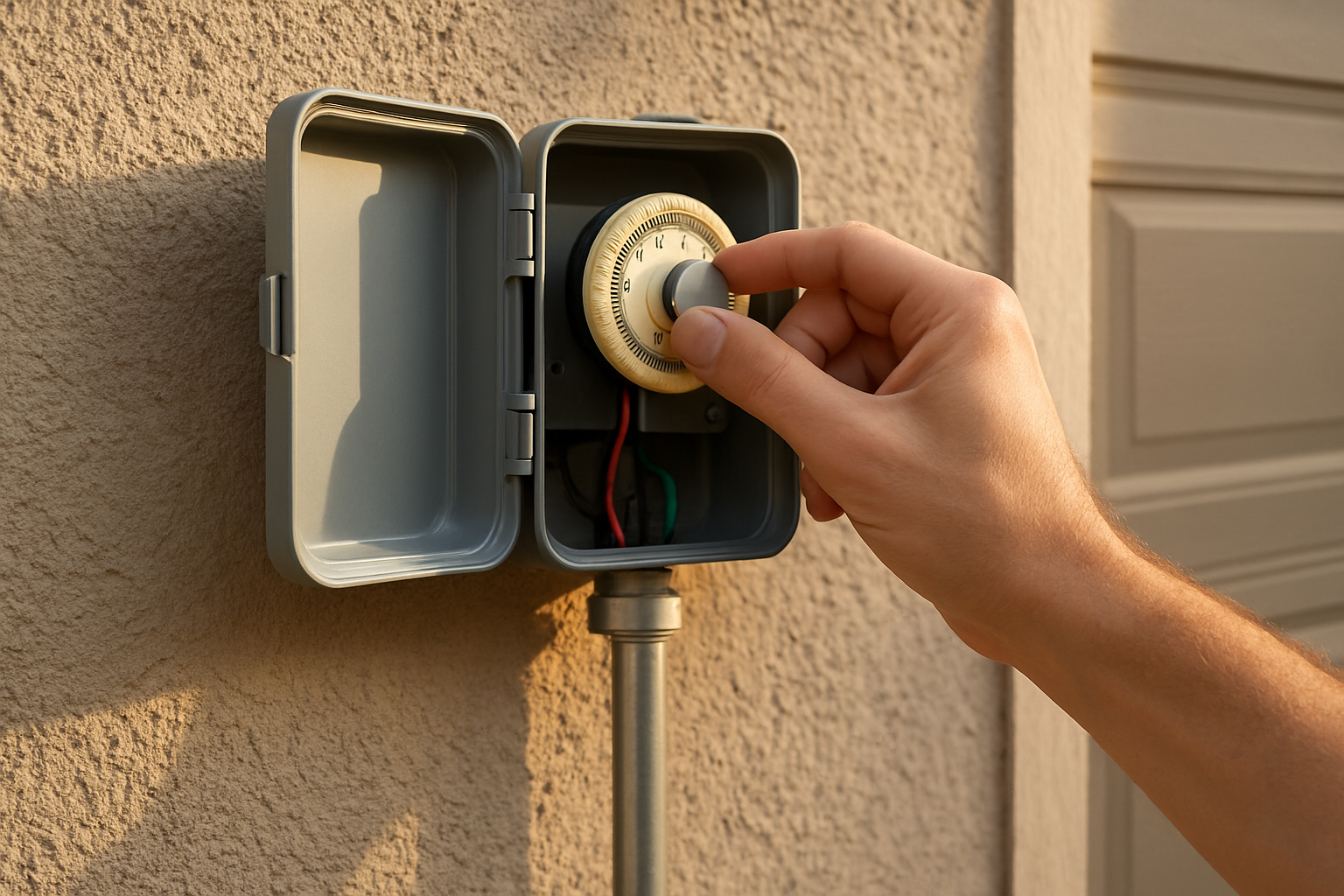
Where photocells go wrong in fog country
Photocells are the simplest control on the market, and they are also the one that generates the most callbacks. The failure mode has a name: photocell washout.
Here is what happens. Light bounces off a pale stucco wall, a glossy painted trim board, or a nearby metal railing and lands back on the sensor. The sensor decides it is daytime and shuts the fixture off, or it cycles on and off all evening while the neighbors watch.
The Peninsula adds its own wrinkle. A heavy marine layer over Pacific Grove or Pebble Beach can drop ambient light enough to trip a photocell at 2:00 p.m., so the yard is lit through a gray afternoon and the sensor is working exactly as designed.
When you are specifying fixtures or sensors, these are the things worth asking about:
- Recessed sensor heads that are shielded from the fixture’s own output
- Remote sensor leads that let the sensor sit away from the beam path, often on a north-facing surface
- Adjustable sensitivity, so the trip point can be dialed in after install
- Whether the fixture has an integrated photocell or expects a separate device on the circuit
That last one matters more than people expect. Two fixtures that look nearly identical in a showroom can have completely different control guts.
Comparing outdoor lighting timers and controls
A quick side by side of the four control types and where each one tends to break down.
| Control type | What it does well | Where it falls short |
|---|---|---|
| Photocell | Dusk to dawn with zero programming | Washout from reflected light, tripped early by marine layer |
| Clock timer | Predictable on and off times, easy late-night shutoff | Needs resetting through the year, ignores actual sunset |
| Astronomical time switch | Follows real sunset and sunrise by date and location | Costs more, usually needs setup by an electrician |
| Motion sensor | Driveways, side yards, service doors, short bursts | Wrong tool for ambiance, false triggers from deer and fog |
Matching the control to the job
Most Peninsula properties end up using two or three of these together, zoned by what each area is for.
What California code expects from exterior switching
Exterior lighting controls are not purely a preference question. California’s energy standards have specific expectations for outdoor fixtures on single family homes.
In general terms, permanently installed luminaires mounted to the building need to be high efficacy, or they need to be controlled by a motion sensor paired with a photocontrol, an astronomical time clock, or an energy management control system. Manufacturer guidance on residential requirements lays out those same pairings in Eaton’s Title 24 residential reference.
The practical takeaway is simple: a bare switch on the wall is usually not the whole answer for building-mounted exterior fixtures.
When your project pulls a permit for a remodel or new construction, current standards come into play for that work. Requirements also change over time, and the details depend on what you are doing and where.
So confirm what applies to your specific project with your local building department or your licensed electrician before you order anything. Ordering fixtures first and reading code second is how people end up returning boxes. If the broader code picture is on your mind, there is more on what California’s 2026 lighting code means for a remodel.
In Carmel, the schedule is part of the design
Carmel-by-the-Sea writes its exterior lighting code around minimizing light pollution, glare, and light trespass onto neighboring properties. That focus changes how you think about controls.
Two provisions come up over and over. The city caps exterior fixture color temperature at 3000K, and it limits building-mounted exterior lighting to no more than 10 feet above the ground, deck, or balcony.
Read those together and the control conversation shifts. Dusk-to-dawn full output across a whole yard reads very differently to a neighbor than a schedule that steps the property down late in the evening.
A common approach is entry and path lighting on a longer schedule, with facade or tree lighting dropping off or dimming down at a set hour. Requirements do get updated, so verify current city rules before finalizing a plan. There is a fuller breakdown in this guide to Carmel’s exterior lighting rules.
Retrofits: zoning matters more than the gadget
Almost nobody starts from scratch. Most Peninsula homes already have exterior circuits and existing fixtures, and the useful move is not buying a fancier controller. It is separating the zones.
One switch controlling everything is the root of most complaints. Split the property into groups that each get their own schedule:
- Path and step lighting, which people want on when they are walking outside
- Facade, wall, and tree lighting, which is where late-night dimming or shutoff belongs
- Entry and address lighting, often the one zone worth running longer
- Motion-triggered utility areas like the driveway, side yard, and service door
Adding a transformer, a new sensor, or a scheduling device to existing exterior circuits is work for your licensed electrician or contractor. That includes anything involving new wiring or a control panel.
Before that visit, though, there is a purchasing question to settle. The fixtures themselves have to be dimmable and compatible with whatever control gets chosen, and that is a spec sheet answer, not a guess.
Driver type, minimum dim level, and control protocol all live on the cut sheet. If you have ever dealt with LED fixtures that flicker or buzz on a dimmer, you already know what a mismatch feels like.
Frequently Asked Questions About Outdoor Lighting Timers and Controls
Can I just use a smart plug or an app instead of a real timer?
For a plug-in low-voltage transformer, an app-based control can work fine and many transformers now include scheduling built in. For hardwired building-mounted fixtures, the control needs to be a device on the circuit, and code expectations apply. Ask your electrician which category your setup falls into before buying anything.
Why do my outdoor lights come on in the middle of the afternoon?
Almost always a photocell reading a heavy marine layer as dusk. A gray Pacific Grove afternoon can drop light levels enough to trip the sensor hours early. Adjustable sensitivity or a remote sensor lead placed away from shadow usually solves it.
What does it cost to add a timer or sensor to existing exterior circuits?
Costs vary quite a bit, and the device itself is usually the smaller part. What drives the number is how many zones you are separating, whether new wiring or a transformer is needed, panel access, and your electrician’s labor rates. Get the scope defined first, then a quote from a licensed contractor.
Does an astronomical time switch need internet or a subscription?
No. Most units calculate sunset and sunrise from a stored location and date, so they run offline. Smart panels and app-based systems are a separate category with their own connectivity needs.
Should path lights and entry lights be on the same control?
Usually not. Entry lighting tends to run longer for safety and address visibility, while path and accent lighting is the natural place to dim down or shut off later in the evening. Separating them costs a little more up front and saves a lot of annoyance.
Thinking through how your exterior lights should switch on?
The showroom on Sunset Drive in Pacific Grove has been sourcing fixtures for Monterey County, CA homes since 1969, and Greg can walk through which lines offer integrated photocells, dimmable drivers, and lower-output lamping that plays well with a schedule. Walk-ins are welcome at The Home Lighter, and appointments are available for more involved projects. The showroom can be reached at (831) 655-5500.
