
Welcome to our guide on home lighting. Here, we answer the most common questions homeowners ask. Good lighting does more than brighten a room. It sets the mood, makes spaces work better, and shows off your home's best features. We made this guide to give you clear, simple answers to your biggest lighting problems.
Your Go-To Lighting Reference Guide
Many lighting stores sell products but don't answer real-life questions. Homeowners and designers want to know things like, "How big should this chandelier be?" or "How do I layer lights in an open floor plan?" These are the questions that can stop a project. If you're a homeowner in the Monterey, Salinas, or Santa Cruz areas, you know that getting solid answers is the first step.
This guide fills that need. At The Home Lighter, Inc., we have decades of experience. We offer expert answers with a personal touch. Think of this as your resource for the expert advice you're looking for.
How to Use This Guide
We designed this post so you can jump to the parts you need. You don't have to read it all from start to finish. Just find the section that solves your problem. It's like having a lighting expert on call.
We will cover these key areas:
- Fixture Sizing: Simple rules to help you choose the right size for chandeliers and pendants.
- Light Bulbs and Color: Explaining lumens, Kelvin, and why color temperature is so important.
- Layered Lighting: The pro method for mixing ambient, task, and accent lighting.
- Smart Home Integration: A clear look at modern lighting control systems.
- Outdoor and Landscape Lighting: How to boost curb appeal and safety with outdoor lights.
For a quick overview, the table below lists the most common questions. It includes direct links to the detailed answers. Use it to find what you need, fast.
Quick Answers to Top Lighting Questions
We know you're busy. Here is a quick table for the most frequently asked lighting questions. Find your question, get a short answer, and click the link to jump to the full explanation.
| Common Question | Quick Answer & Key Consideration | Relevant Section |
|---|---|---|
| How do I choose the right size fixture for my room? | Add the room's length and width (in feet) to find the best diameter (in inches). For pendants, think about island length and ceiling height. | Fixture Sizing |
| What's the difference between lumens and Kelvin? | Lumens measure brightness. Kelvin measures color temperature (warm vs. cool light). Both are key for setting the right mood. | Light Bulbs and Color |
| What are the three layers of lighting? | Ambient (overall), Task (focused), and Accent (highlighting). Using all three creates a balanced, useful room. | Layered Lighting |
This table is just a start. For more detailed advice and examples, read the sections below. They will help you get your project right the first time.
Choosing the Right Fixture Size
Picking the right size for a light fixture can be hard. It's a common problem for homeowners. If it's too small, it gets lost. If it's too big, it takes over the room. The good news is, you don't have to guess. Designers use simple rules to get it right every time.
These tips will help you choose fixtures that look balanced. This is true whether you have a small Carmel cottage or a large modern home in Salinas. It's all about creating a professional look.
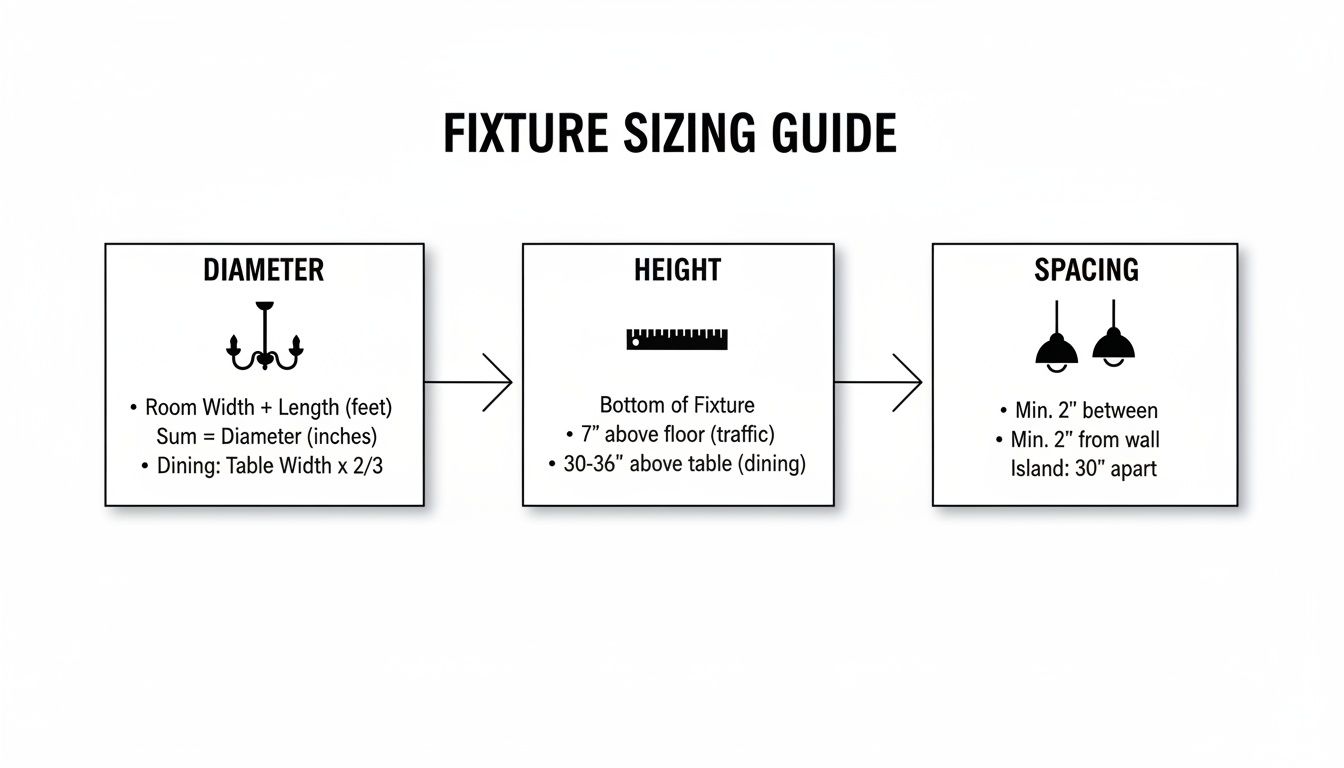
Sizing a Chandelier for Your Room
For main fixtures like chandeliers, there's an easy formula. It's based on the room's size. This makes sure the fixture fits the space.
- Measure Your Room: Use a tape measure to get the length and width of the room in feet.
- Add Them Up: Add the two numbers together. For a room that's 12 feet by 15 feet, you get 27.
- Convert to Inches: That number is the best diameter for your chandelier in inches. For our example, a chandelier about 27 inches wide is perfect.
This simple formula is a game-changer. It helps you pick a fixture that looks great without being too much.
Perfect Pendants Over a Kitchen Island
The kitchen island is often the center of the home. The lighting there needs to be just right. You need great task lighting that doesn't block the view.
- Island Length is Key: For long islands (over 6 feet), use two or three smaller pendants. For smaller islands, one larger pendant or two small ones works well.
- Spacing Matters: Leave about 30 to 36 inches of space from the countertop to the bottom of the pendant. If you hang more than one, space them about 30 inches apart (from the center of each fixture). Leave at least 6 inches of space from the edge of the island to the pendant.
- Get the Height Right: The bottom of the pendants should hang about 30 to 36 inches above the island. This is high enough to be out of the way but low enough to light your tasks.
Getting the size and placement right is key. To learn more, check out our foolproof pendant light size guide for every room.
Expert Tip: Have ceilings taller than 8 feet? Add 3 inches to the hanging height for each extra foot of ceiling. This keeps the light from looking like it's floating too high.
Understanding Light Bulbs and Color
Picking a beautiful light fixture is just the first step. The bulb you put inside is what really creates the mood. The right bulb can make a room feel warm and cozy instead of cold and harsh.
With new LEDs, there are a few terms to know. Once you learn them, you'll be able to choose the perfect bulb for any space.
Lumens and Watts: A Modern Update
For years, we chose bulbs based on watts. Watts measure how much energy a bulb uses. Today, the most important number is lumens. Lumens tell you how bright the bulb is. LEDs give you the same brightness (lumens) for much less energy (watts).
Here's how it works:
- Watts: How much energy a bulb uses.
- Lumens: How much light a bulb gives off.
A small 9-watt LED can be as bright as an old 60-watt incandescent bulb. That's how you save on energy bills.
The Kelvin Scale: Color Temperature Explained
Have you ever noticed some rooms have a cozy, yellow light, while others have a crisp, blue light? That's color temperature. We measure it on the Kelvin (K) scale. It has a big impact on a room's mood.
- Warm White (2700K – 3000K): This is a cozy glow, like old light bulbs. It's great for living rooms, bedrooms, and dining rooms.
- Neutral or Cool White (3500K – 4100K): This light is brighter and more energetic. It's good for kitchens, bathrooms, and offices where you need to see clearly.
- Daylight (5000K+): This is a very bright, blue-toned light. It's best for workshops or garages where you need to see details.
To help you see how these numbers work together, here's a helpful guide.
Knowing about lumens and Kelvin is key to choosing the right bulbs.
Why LEDs Are the Standard Today
Switching to LED lights is a smart choice for any home. LEDs use 60–75% less electricity than old incandescent bulbs. A good LED bulb can also last for 25,000 hours or more. That means you might not have to change a bulb for over 20 years.
There's one more thing to know: the Color Rendering Index (CRI). This scale (0 to 100) measures how well a light shows true colors. A high CRI of 90+ is best. It makes your paint, furniture, and food look natural and vibrant.
Feeling unsure about the options? Learn more in our expert guide on how to choose the right light bulb.
Implementing a Layered Lighting Plan
 ambient lighting.” />
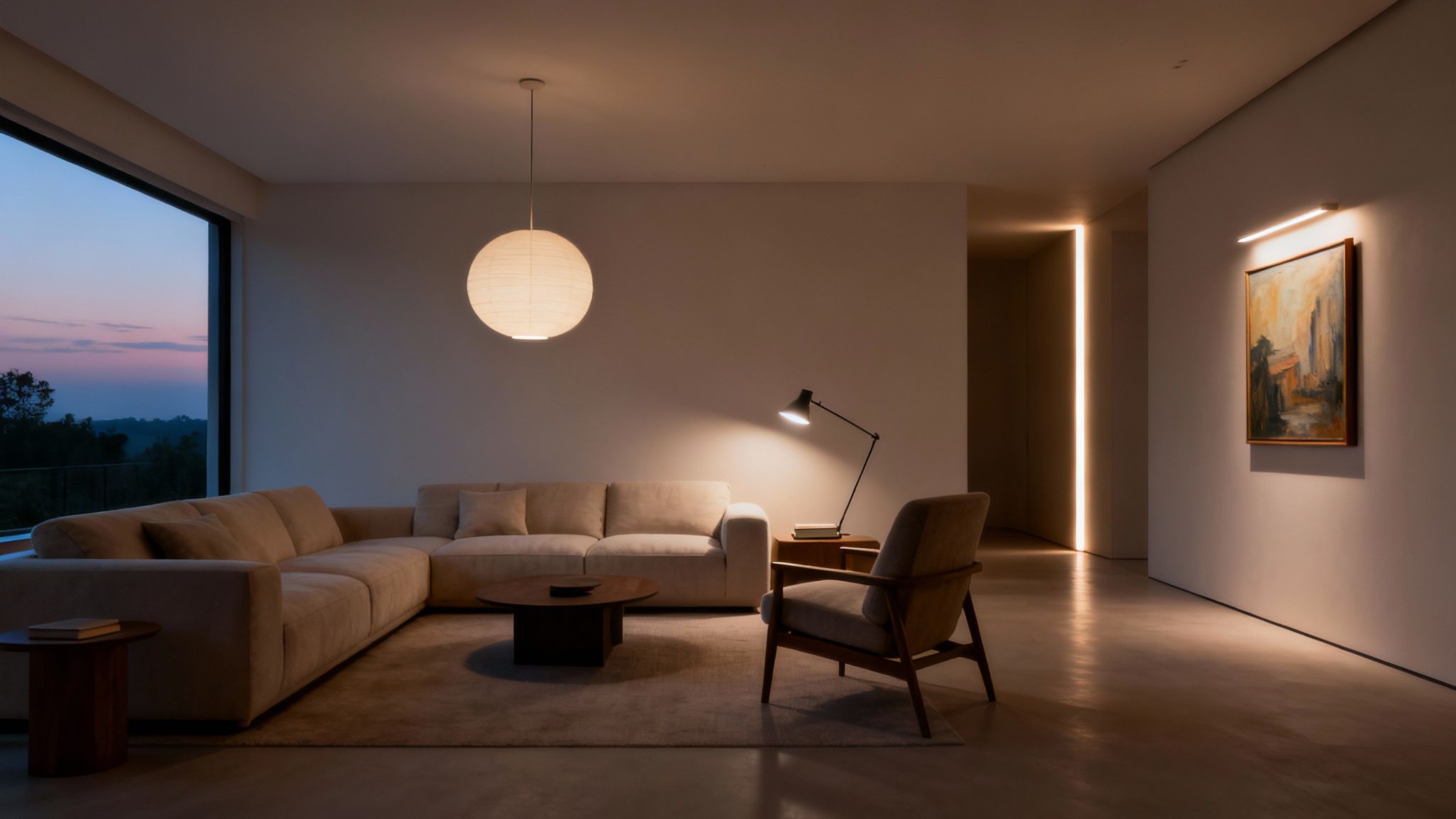
If you've ever walked into a room and felt it was perfect, it probably had great layered lighting. Professional lighting design is more than just one light in the ceiling. It's a smart plan that uses different light sources to make a space beautiful and useful.
By mixing three types of light, you can make any room feel better. This method makes sure you always have the right light for any activity.
The Three Essential Lighting Layers
Every well-lit room uses a mix of three types of light. Each one does a specific job.
-
Ambient Lighting: This is your main light source. It provides the room's general, overall light. Think of it as the soft glow that lets you move around safely. Chandeliers and recessed lights are common sources. To learn more, read our guide on how to create ambient lighting.
-
Task Lighting: This layer is for specific activities. It gives you focused, bright light for things like chopping vegetables, reading a book, or doing makeup. Examples include under-cabinet lights in a kitchen or a reading lamp by a chair.
-
Accent Lighting: This is the dramatic layer. Accent lighting highlights special features in your home. This could be a piece of art, a stone fireplace, or a unique architectural detail. Track lights and picture lights are great for creating accents.
Layering Light Room by Room
How you use these layers depends on the room. A kitchen has different needs than a bedroom. Here in the Monterey area, coastal homes with open floor plans can benefit from smart lighting that works with natural light.
In the Kitchen:
- Ambient: Recessed lights or a central fixture provide general light.
- Task: Under-cabinet lighting is a must for food prep. Pendants are perfect over an island.
- Accent: Small lights inside glass cabinets can show off your favorite dishes.
In the Living Room:
- Ambient: A chandelier or a ceiling fan with a light can set the mood.
- Task: Table lamps beside sofas and floor lamps next to chairs are great for reading.
- Accent: A picture light over a painting or an uplight behind a plant adds depth.
Why Dimmers are Non-Negotiable
The secret to a great layered lighting plan is using dimmer switches. Dimmers let you control the brightness of each light source. This allows you to change the room's mood for any occasion. They are the most important tool for creating atmosphere with light.
Integrating Smart Lighting Into Your Home
The idea of a "smart home" might sound complex. But smart lighting is actually easy to set up. It's a popular topic because it gives you amazing control over your home's mood, security, and energy use.
Smart lighting is more than just an on/off switch. You can schedule lights to turn on before you get home. You can change a room's mood with a voice command. You can even control everything from your phone, no matter where you are.
Getting Started with Smart Lighting
You don't need a huge project to get started. Smart lighting options range from single bulbs to full home systems.
Here are a few ways to start:
- Smart Bulbs: This is the easiest way. Just screw a smart bulb into a lamp. Then, you can control it with an app or a smart speaker like Alexa.
- Smart Plugs: These turn any regular lamp into a smart one. Plug the lamp into the smart plug, and you can control it from your phone.
- Smart Switches and Dimmers: For a more permanent solution, replace your wall switches. This gives you smart control over all the lights on that circuit.
These options offer different levels of control and cost. To learn about whole-home systems, explore the benefits of professional smart lighting control systems.
Benefits Beyond Convenience
Being able to turn off lights from your bed is nice. But the real benefits are even bigger. First, you'll save a lot of energy. With smart features, homeowners can cut their lighting energy use by an extra 20–40%. Combined with LEDs, your total lighting energy can drop by over 70%.
Second, advanced systems can improve your health. Human-centric lighting can match your home's light to your body's natural rhythm. Your lights can mimic a sunrise to help you wake up gently. Then, they can shift to a cooler light during the day to help you focus.
Expert Insight: Think of smart lighting as a wellness tool. By matching your lights to daylight patterns, you can sleep better and feel more focused. It's a popular feature in new homes.
Smart features can work together. For example, smart home window coverings can team up with your lights to save energy and improve comfort.
Your Guide to Outdoor and Landscape Lighting
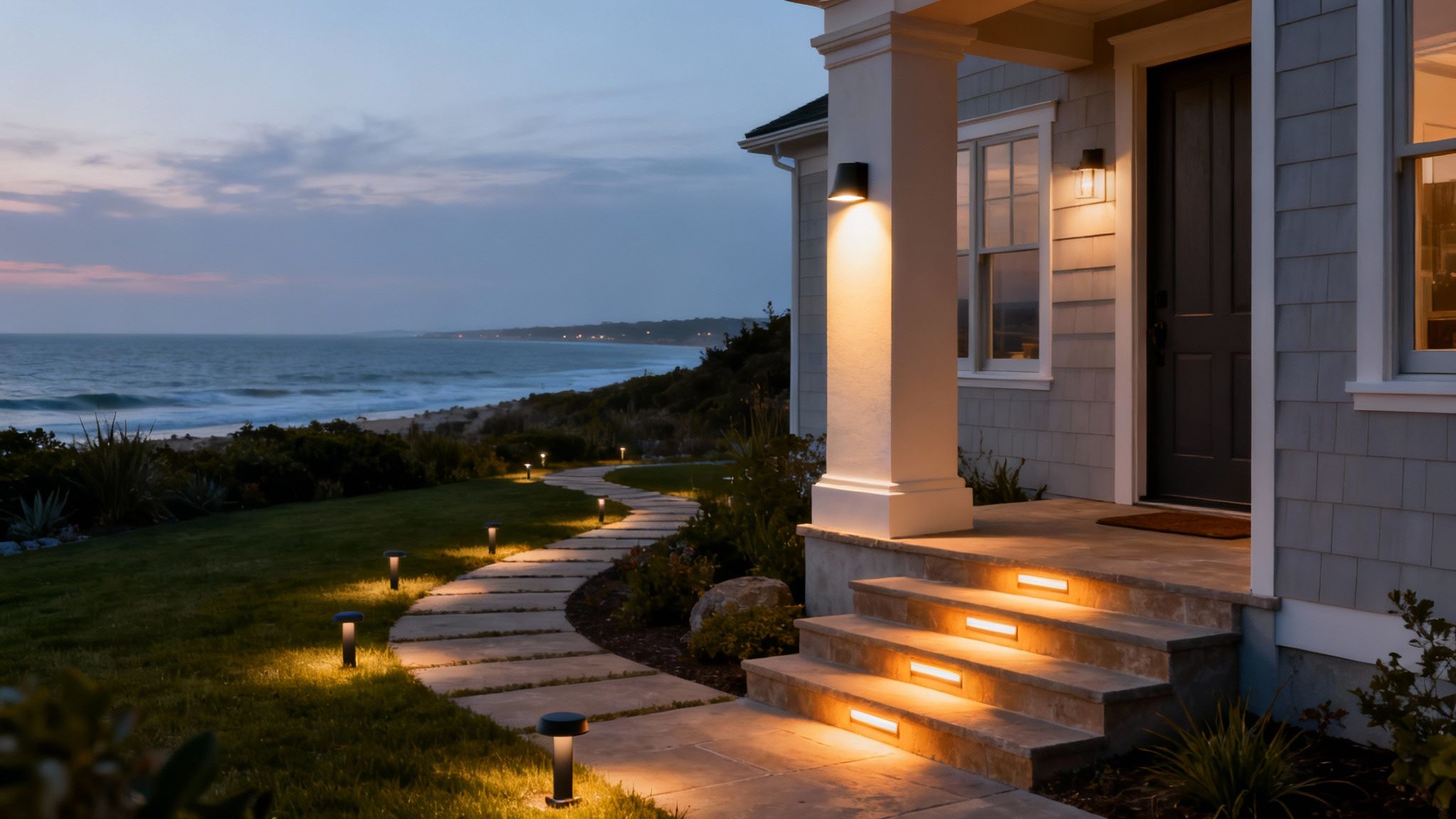
Great lighting design shouldn't stop at your front door. When you light your home's exterior, you boost curb appeal and improve safety. You can also enjoy your outdoor spaces long after sunset. For those of us on the Monterey Peninsula, a well-lit landscape adds security and highlights our area's natural beauty.
The goal is to create a space that feels safe and welcoming. Light up key areas like paths, entries, and interesting home features. A good outdoor plan makes your home look as nice at night as it does during the day.
Key Areas and The Right Fixtures for The Job
When planning your outdoor lighting, focus on a few key areas. This helps create a smart design.
- Pathways and Walkways: Use low path lights. They cast a gentle light downward, making it safe to walk without harsh glare.
- Entryways: Wall sconces on either side of a front door are a classic choice. They provide a warm welcome and help you see clearly.
- Architectural Features: Use spotlights or uplights to highlight things like stone columns or a beautiful tree. This adds character to your home.
Choosing the right fixtures is important. In our coastal climate, you need materials like brass or marine-grade aluminum that can handle salt and moisture. To get more ideas, explore our landscape lighting design ideas.
Modern Solutions for Outdoor Lighting
Today's technology offers great options for landscape lighting. Low-voltage LED systems are the standard. They are very energy-efficient and safer to install than older systems.
Also, consider "dark sky friendly" fixtures. We are lucky to live on the Central Coast. These fixtures help protect our view of the night sky. They direct light downward, which reduces light pollution. For large projects, it can be helpful to work with professional landscape lighting installation services.
Why Bring in a Lighting Specialist?
Many homeowners enjoy DIY projects. But some jobs, like lighting, can benefit from an expert. A professional lighting consultant can help you avoid costly mistakes. They ensure the final result is beautiful and works well.
An expert does more than help you pick fixtures. They create a plan that considers how you use your space. This means getting the fixture size right and finding the perfect balance between ambient, task, and accent lighting.
We Handle the Technical Stuff, So You Don’t Have To
A great lighting project has technical details. A specialist can guide you through them. This is especially true for homeowners in California who must follow specific energy codes.
For example, Title 24 is California's energy code. It has rules for new homes and big remodels. A lighting consultant makes sure your plan follows these rules. They specify high-efficiency LEDs and required controls like dimmers. This expertise saves you from headaches and helps your project pass inspection.
Local Insight: On the Monterey Peninsula, home styles vary from historic adobes to modern coastal homes. A local specialist knows how to light these unique styles. They also know how to choose materials that last in our salt air.
A Personal Approach for a Perfect Fit
At The Home Lighter, our appointment-only showroom lets us focus on you. We learn about your home's style and your family's needs. We then create a lighting plan that is practical and perfect for you.
This personal guidance helps make every choice a good one. Whether you need a statement chandelier or subtle garden lighting, we are here to help. If you have a lighting challenge, let our Monterey Peninsula specialists guide you.
Your Top Lighting Questions, Answered
Even with a good plan, questions can come up. Small details can be tricky. This section answers the most common lighting questions we hear in our showroom every day.
These are real-world problems homeowners on the Monterey Peninsula face. Getting these details right makes a big difference. Here are our answers to the top five questions.
How High Should I Hang My Dining Room Chandelier?
This is the number one question we get. The right height is very important. It ensures your table is well-lit for meals without blocking anyone's view.
As a general rule, hang your chandelier so the bottom is 30 to 36 inches above your dining table. This is the ideal range for lighting the table without getting in the way.
If you have ceilings taller than 8 feet, you'll need to adjust this. Add about 3 inches of hanging height for every extra foot of ceiling. This keeps the fixture looking balanced in a taller room.
Should I Put All My Lights On Dimmers?
You don't need a dimmer on every single light. But installing them in key areas is a powerful and affordable upgrade. Dimmers give you total control over a room's mood.
We recommend installing dimmers in these spaces:
- Living Rooms: Go from bright for a party to soft for movie night.
- Dining Rooms: Set the right mood for any meal.
- Bedrooms: Wind down with low light before bed.
Dimmers also save energy and help your LED bulbs last longer.
What Is Title 24 and Why Does It Matter for My Lighting?
If you live in California, you've likely heard of "Title 24." It's our state's energy efficiency code. It has rules for lighting in new construction and major remodels to save energy.
For your lighting project, Title 24 requires two main things: high-efficacy light sources (usually LEDs) and lighting controls. The controls often include dimmers or sensors that turn lights off in empty rooms.
The code can seem complex, but that's why we're here. A lighting specialist can guide you through the rules. This ensures your project is compliant without giving up style.
Can I Mix Different Metal Finishes for Light Fixtures?
Yes, you can! Mixing metal finishes is a great way to add interest and a designer touch to your home. The days of matching every fixture are over.
The key is to do it with a plan. Pick one main metal as your base. Then, add one or two other metals as accents. For example, in a kitchen, you could have matte black pendants over the island, polished nickel cabinet pulls, and a brass faucet. This creates a stylish, layered look.
What Is the Best Way to Light a Room With a Low Ceiling?
Low ceilings (under 8 feet) can be a challenge. The wrong lights can make a room feel smaller. The goal is to create the feeling of height with smart lighting choices.
Avoid long pendants or large chandeliers. Instead, use flush-mount or semi-flush-mount fixtures for your main light. You can also use wall sconces that shine light upward. This draws the eye up and makes the room feel taller.
Finally, remember to layer your light. Use floor lamps and table lamps to add task and accent lighting without taking up vertical space.
Have a lighting challenge that wasn't covered here? At The Home Lighter Inc., our Monterey Peninsula lighting specialists are ready to provide the expert guidance you need to illuminate your home perfectly. Schedule a consultation with us today!